Microbio Exam 3
 Call Kai
 Learn
 Practice Test
 Spaced Repetition
 Match
 Flashcards
 Knowt Play
1/240

There's no tags or description
Looks like no tags are added yet.
241 Terms
Genome
The complete genetic content of a cell or organism
Bacteria and archaea:
chromosomes
plasmids
Eukarya:
chromosomes
plasmids
organelle chromosomes (i.e. mitochondrial dna)
bacterial and archaeal genomes are usually between 1.5 and 14 Mb (usually smaller)
eukaryotic genomes range from 2 Mb to 23,562 Mb (usually larger)
Chromosomes
essential genes
copy number varies
haploid
diploid
polyploid
usually circular and usually 1 to 12 Mb
plasmids
Copy number varies (1- 100 copies)
Can have different plasmids per cell
accessory functions
antibiotic/disinfectant resistance
virulence factors
degradation of weird carbon sources
circular double-stranded DNA
can direct their own replication, but use host machinery
range in size from 2 kb to 1,000 kb
have their own origin of replication
Purine Bases
adenine
guanine
pyrimidine bases
cytosine
thymine
uracile
DNA bases
A and T
G and C
RNA bases
A and U
G and C
C and G base pair
have three hydrogen bonds
RNA
has an extra oxygen —> less stable
GC Content
%G + %C
%G = %C
%A = %T
Codon Bias
codons used for same amino acid are not used at equal frequency in all microbes
Histones
how eukaryotes organize and compact their DNA
Coiling rubber bands
bacteria don’t have histones
can’t super coil —> have enzymes that twist girates/super coiling
DNA gyrase
DNA gyrase
topoisomerase that can make double-strand breaks to introduce negative supercoiling
predominant in nature (among bacteria)
requires ATP
topoisomerase
requires ATP
universal features of DNA replication
semiconservative replication
adds nucleotides only to the 3’ end
Mediated by DNA polymerase
requires a primer (usually RNA) synthesized by primase
requires the primase enzyme
archaeal DNA rep. proteins more similar to eukaryotes than bacteria
bidirectional
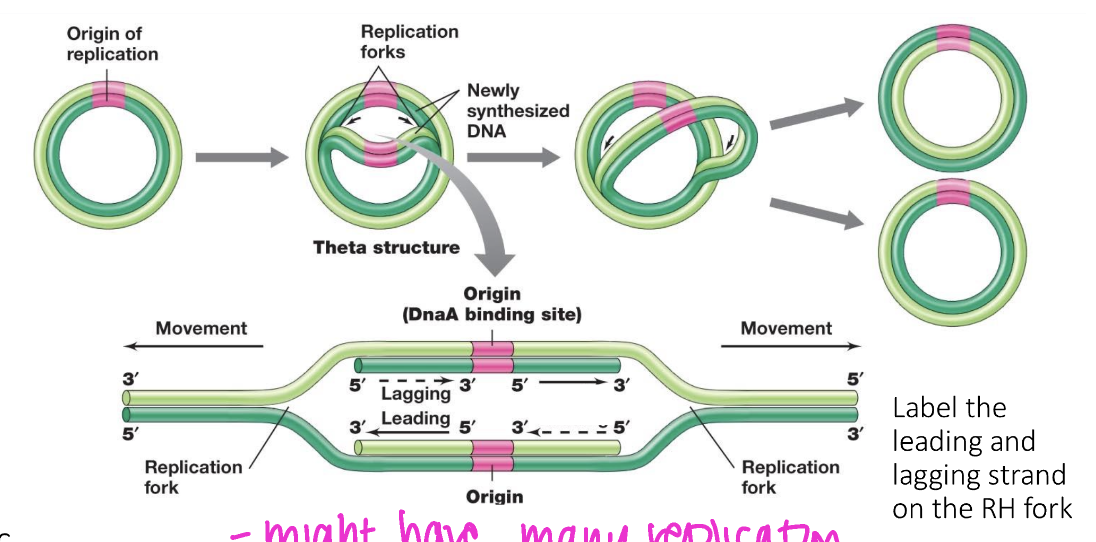
two replication forks moving away from each other
DNA polymerase
makes a chain of DNA —> needs a primer to recognize DNA
connects in. the 5’ to 3’ direction
adds nucleotides to 3’ OH
origin of replication
where DNA replication starts (ORI)
at the ORI the DNA double helix is recognized, melted open, and prepared for copying
origins are typically rich and A and T because they are only help together by two hydrogen bonds
terminus/terminator
where dna replication stops
follows stop codon and trailer
DNA replication in bacteria
usually generates two replication forks from one origin of replication
DNA ligase
glues together short fragments
ligates digested dna into cloning vector with complementary “sticky ends”
DNA primase
an enzyme that synthesizes RNA primers to kickstart DNA replication
helicase
enzyme that unpacks and separates double-sgtranded nucleic acids
Central Dogma
expression of DNA into functional products via:
transcription (RNA synthesis)
translation (protein synthesis)
gene
the functional unit of genetic information
what can be acted on by selective presure
encode functions
polypeptides
tRNA
rRNA
Transcription
RNA synthesis
mRNA synthesized in the 5’-3’ direction by RNA polymerase from the template strand
matches sense strand
only one strand transcribed at a time
no primer needed
adding to 3’
stops at transcription terminator
Translation
protein synthesis
ribosome
Operons
many genes under same transcriptional unit controled by a single “on/off” switch and transcribed together into a single molecule of mRNA
cluster of genes under the control of a single regulatory region
only in bacteria and archaea, but not eukaryotes
Polar mutations
when you make a mutation in the first gene
How many genes are in the human genome?
about 20,000 genes
template strand
almost all coding genes are on this strand
sensing strand
usually never coded
RNA polymerase
core enzyme that synthesizes an RNA strand from a DNA template during a process called transcription
sigma 70 / Sigma Factor
turns on all house keeping genes
recognizes promoter and initiation site
released when transcription begins
recruits RNAP to site for transcription
promoter
sequence of nucleotides
can be weak or strong
two ways to terminate transcription
factor-independent termination
rho-depenent termination
Factor-independent termination
rna forms secondary structure
stem-loop in RNA immediately upstream of a run of uracils leads to transcription termination
string of inverted repeats near the end of the gene, followed by a string of nucleotides that only form two hydrogen bonds, dislodges polymerase
RNAP in Eukaryotes
many types of RNAP
Capping: 5’ phosphate added to the end of the mRNA
3’ poly a tail (100-200 As) added to stabilize the mRNA must be trimmed before mRNA can be degraded
nucleus site of translation
introns spliced out to create mature mRNA
alternative splicing can result in an array of mature transcripts
RNAP in Eukarya and Archaea
Complex RNAP
TATA and BRE
No Rho
Introns spliced out of RNA
archaea RNAP looks more like eukarya RNAP
RNAP in Bacteria
Simpler RNAP (4 subunits + sigma)
TATAAT (-10) and -35
Rho termination
No introns present
Structurally different from eukaryotic and prokaryotic RNAP —> targeted by antibiotics because of this
constitutively expressed
always on, needed all the time
Transcript
the single-stranded RNA molecule synthesized by an enzyme called RNA polymerase using a segment of DNA as a blueprint
start codon
following leader
usually AUG
stop codon
UAA, UAG, UGA
followed by spacer or trailer
where the sigma factor binds / RNA polymerase recognition and binding sites
-35. -10+1
sense strand / coding strand
what the dna sequence looks like
not actually coding
Transcription in bacteria and archaea
occurs in the cytoplasm, concurrent with translation
in bacteria, transcription and translation happens at the same place and time
Rho-dependent termination of transcription
the tortoise and the hare
Rut must be accesible (fre of ribosomes) in order to be bound by Rho.
moves towards RNAP and terminates transcription if it catches RNAP
Rho is slower than RNAP… but Rho can catch RNAP if RNAP pauses at Rho-dependent pause sites
Rut
Rho-utilization site
must be accessible (free of ribosomes) in order to be bound by Rho
Rho
moves towards RNAP and terminates transcription if it catches RNAP
Ribosome
rRNA + protein
RBS (shine delgarno sequence)
Ribosome binding site
specific sequence where ribozome binds in bacteria on mRNA
recruits rRNA
Bacterial ribosomes
differently shaped than Euk.
1,000s per cell
30S + 50S = 70S
rRNA is catalytic
many non-catalytic proteins in the ribosome
16S rRNA binds RBS (shine delgarno sequence) on mRNA
23S rRNA catalyzes peptidyl transferase reaction and translocation of growing peptide
Peptidyl transferase
peptide bond formation
Eukaryotic ribosomes vs bacteria ribosomes
euk. slightly larger than prokaryotic ribosomes

fMET
in bacteria, there is a different kind of methionine called fMET
translation is initiated on mRNA with a tRNA charged with this
immune system recogniz3s as foreign
30s rRNA subunit
first amino acid in bacteria
MET
in all cellular life, every protein starts with methionine
MET = euk
fMET = bacteria
acceptor site
A site
where tRNA comes in and binds to mRNA
repressor
regulatory protein that can bind to the operating site and prevent transcription
Biochemical pathway
many enzyme catalyzed reactions in a cell are carried out in a specific sequence called this
product of one reaction becomes the substrate of the next reaction
Feedback inhibition
The end product of the pathway binds to the pathway's first enzyme at its allosteric site, changing the enzyme's shape.
allosteric site
site on an enzyme that the end product of a biochemical pathway binds to, changing the enzymes shape
P site
peptide bond formation site
E site
exit site
GTP used to:
fuel translocation of the MRNA through the ribosome
fuel the activation of the charged tRNA when it is accepted
Not required for transpeptidation
What catalyzes the peptide transfer
RNA in the large subunit of ribosome
transpeptidation
catalyzed by the 23S rRNA
an amino acid is transferred from one amino compound to another
when peptide chains are cross-linked to form a stronger structure
23S rRNA
catalyzes peptide bond formation in the growing polypeptide chain
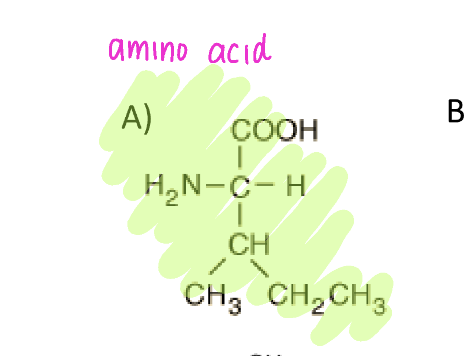
amino acid
amino group (H2N) and carboxylic acid group with one central carbon
linked in a chain by peptide bonds.
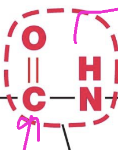
done through a dehydration reaction —> take OH from carboxylic acid and H from amino group to make water and a peptide bond
linear sequence of amino acids is the primary structure of protein.
22 amino acids in proteins
Sequence has a “C” terminus and “N” terminus
C terminus

N terminus

Peptide bond
How many codons are there?
64
Nonpolar amino acids
abundant, hydrophobic, good at folding proteins
kinds of amino acids
differ in R groups
not used at the same rate
nonpolar
polar
electrically charged
acidic
basic
Codon bias
All of life uses the same 20 different amino acids, but different codons for them
Some codons code for different things depending on the organism
i.e., CUA codes for serine in yeast, not leucine
Universal codon table
the triplet code is degenerate and not entirely universal
Organisms with High GC content
usually have bigger genomes
more types of tRNA anticodons
slower growth rate
more able to translate genes accepted from “low GC” organisms
increased adaptibility
can grow in many places
Low GC organisms
in protected environments
grow relatively more quickly
Wobble concept
the key bases in codon are the first two. Te last base pairing is in the wobble position and more flexible
tRNA = twisted 3D structure the third nucleotide doesn’t stick too well, meaning you can change the third nucleotide and have little effect
Frame shift mutation
deletion of one base changes all amino acids down frame
3 base deletion
no change depending on what protein is deleted
Leader
untranslated region of the mRNA
where the shine delegarno sequence aka RBS is
before the start codon
5’
trailer
untranslated region of mRNA
follows the stop codon
3’
Bioinformatics
computer-based analysis of sequences, is used to annotate genomes to determine how many and which types of genes are present
computer find possible start codons.
computer finds possible stop codons.
computer counts codons between start and stop.
computer finds possible RBS.
computer calculates codon bias in ORF
computer decides if ORF is likely to be genuine.
list of probable ORFs
Open Reading Frame ORF
ORF assignment
scanning a sequenced microbial genome to identify DNA stretches that have the potential to encode proteins
RBS and codon bias impact ORF assignment
not all ORFs encode proteins
non-coding RNA
not all ORFs are characterized
70% of ORFs have no informative annotation (only 30% do. soemthing)
10% of annotated genes are incorrect
aka there are a lot of knowledge gaps, but bioinformatics and sequencing an ORF is still our main way
tRNA synthetases
pair anticodon with amino acid on the tRNA
20+ unique ones
charges amino acid onto the tRNA
enzyme
can have mutations that will caused death and affect all of their proteins
Functional ORFs
encode proteins
annotation is strengthened by orthologs or if the ORF contains conserved protein functional domains
aka a predicted gene is much more likely to be real if other species have the exact same gene, or if the protein it makes has recognizable, working parts
tRNA structure
has universal code on 3’ end (CCA) where amino acids is added
20+ unique tRNA syntheses in the cell pair anticodon with correct amino acid on the tRNA
Secondary protein structure
alpha helix and beta sheet
backbone is involved in forming the shape of this structure
usually involves hydrogen bonds to form these structures
primary protein structure
sequence of amino acids
tertiary protein structure
R groups are involved and form bonds together
alpha-helix
hydrogen bonds between nearby amino acids
beta-sheet
hydrogen bonds between distant amino acids
chaperones
ATP-dependent enzyme
help properly fold proteins
hot cells have ~70% of these as proteins —> helpful in stressful environments to help them from denaturing
needed by all cells
Function to:
recognize unfolded or partially denatured proteins
prevent incorrect folding of proteins
fold newly formed proteins to their proper shape
Protein shape determines
function
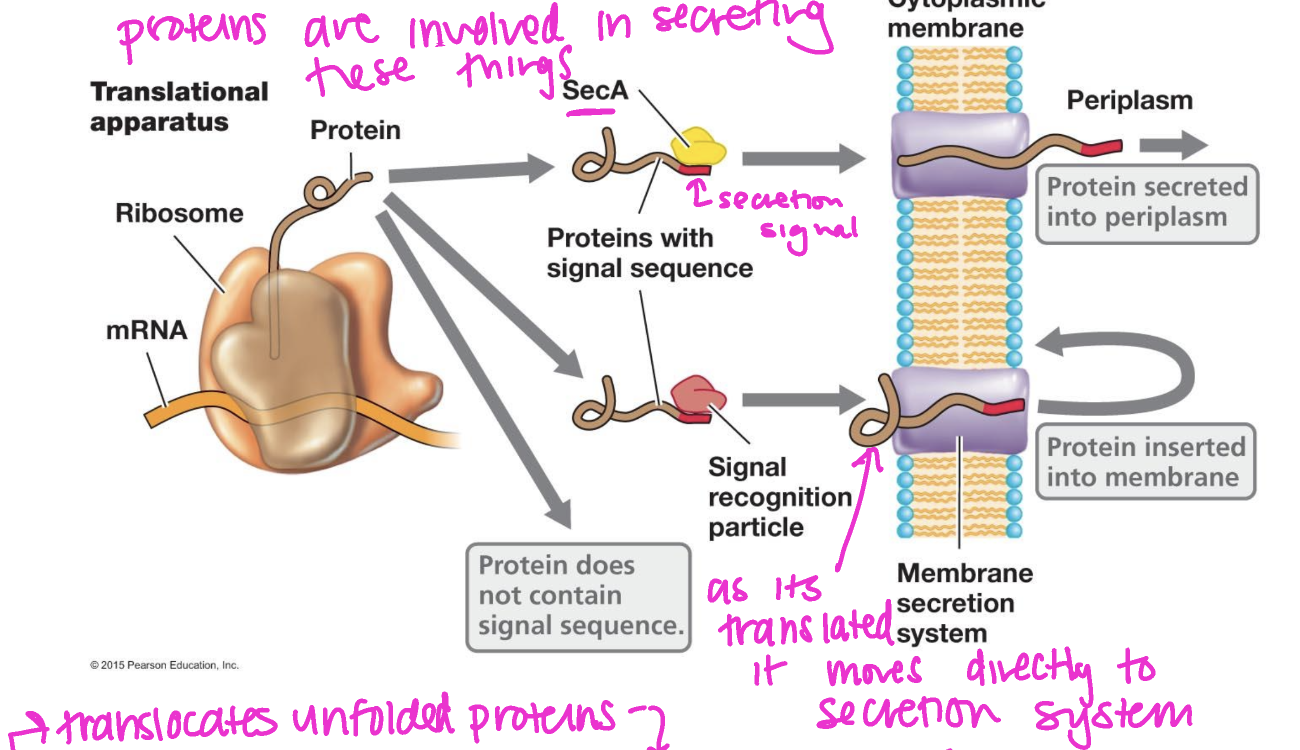
Protein location is determined by
signals for secretion
Translocation of proteins into or across the membrane can happen
post-translationally or co-translationally
gram-negative organisms needs additional translocases to get things across the outer membrane