Chapter 11 - Interactions b/w Microbes & Humans
 Call Kai
 Learn
 Practice Test
 Spaced Repetition
 Match
 Flashcards
 Knowt Play
1/39

There's no tags or description
Looks like no tags are added yet.
40 Terms
Colonization
Our resident microbiota colonize us for the long term & do not cause disease
Infection
Microbes get past host defenses, enter tissues, & multiply
Disease
Deviation from health that results when cumulative effects of infection damage or disrupt tissues & organs
Infectious disease
A pathologic state caused directly by microorganisms or their products
When colonization leads to disease
Pathogen: a microbe whose relationship w/ its host is parasitic & results in infection & disease
Pathogenicity: an organism’s potential to cause disease
True pathogens: capable of causing disease in healthy people w/ normal immune defenses
Opportunistic pathogens: cause disease when the host’s defenses are compromised or when the pathogens become established in a part of the body that is not natural to them
Virulence
Relative severity of disease caused by a particular microbe
Degree of pathogenicity
Virulence of a microbe is determined by its ability to…
Establish itself in a hot
Cause damage to host
Virulence factor: any characteristic or structure of the microbe that contributes to its ability to establish itself in the host & cause damage
Polymicrobial infections
Majority of infections a polymicrobial, w/ contributions from more than 1 microbe
Influenza infection frequently leads to pneumonia
Steps involved when a microbe causes disease in a host
Finding a portal of entry
Attaching to host cells
Surviving host defenses
Causing damage (disease)
Exiting host
**1st three steps = establishing infection**

Step 1 - Becoming Established: Portal of Entry
Portal of entry: the route that a microbe takes to enter the tissues of the body to initiate an infection
**Intact skin is NOT a portal of entry → only when skin is open/cracked**
Exogenous: organisms coming from outside the body
Endogenous: organisms coming from somewhere in the same human host
Specific or more than 1 portal of entry
The majority of pathogens have adapted to a specific portal of entry, one that provides a favorable habitat for further growth & spread
If certain pathogens enter the “wrong” portal, they will not be infectious:
Inoculation of the nasal mucosa w/ the influenza virus will result in the flu, but if the virus contacts the skin, no infections occurs
Occasionally, an infectious agent can enter by more than one portal:
Mycobacterium tuberculosis can enter through respiratory & GI tracts
Streptococcus & Staphylococcus can enter through the skin, urogenital tract, & respiratory tract
Quantity of microbes in the Inoculating Dose
Infectious dose: the minimum number of microbes necessary to cause an infection to proceed
Microorganisms w/ smaller infectious doses have greater virulence
ID for Q fever = 1 cell
ID for TB, giardiasis, & coccidioidomycosis = ~10 cells
ID for gonorrhea = 1,000 cells
ID for typhoid fever = 10,000 cells
ID for cholera = 1,000,000,000 cells
Step 2 - Becoming Established: Attaching to Host Cells
Adhesion: process by which microbes gain a more stable foothold on host tissues
Dependent on binding b/w specific molecules on both the host & pathogen
Pathogen is limited to only those cells (& organisms) to which it can bind
Firm attachment is almost always a prerequisite for causing disease, since the body has so many mechanisms for flushing microbes from tissues
Adhesion mechanisms
1. Bacterial, fungal, & protozoal pathogens attach by…
Fimbriae (pili), surface proteins, adhesive slimes/capsules
2. Viruses attach specialized receptors (spikes)
3. Parasitic worms fastened by suckers, hooks, & barbs
Step 3 - Becoming Established: Surviving Host Defenses
Phagocytes: white blood cells that engulf & destroy pathogens
Antiphagocytic factors:
1. Leukocidins: kill phagocytes outright
2. Extracellular surface layer (slime or capsule) makes it difficult for the phagocyte to engulf the pathogen
3. Some captured bacteria survive inside the phagocyte
Step 4 - Causing Disease
Three ways that microorganisms cause damage to their host:
1. Directly through the action of enzymes or toxins (both endotoxins & exotoxins)
2. Indirectly by inducing the host’s defenses to respond excessively or inappropriately
3. Epigenetic changes made to host cells by microbes (expression of genes)
Exoenzymes
Enzymes secreted by microbes that break down & inflict damage on tissues
Dissolve the host’s defense barriers to promote the spread of disease to other tissues
Examples:
1. Mucinase: digests the protective coating on mucous membranes
2. Hyaluronidase: digests the substance that cements animal cells together
3. Coagulase: cause clotting of blood or plasma
4. Kinase: dissolves fibrin clots
Bacterial toxins
Bacterial toxins: a potent source of cellular damage
Toxin: a specific chemical product of microbes that is poisonous to other organisms
Toxins are named according to their target:
Neurotoxins = act on nervous sytem
Enterotoxins = act on intestines
Hemotoxins = lyse RBCs
Nephrotoxins = damage kidneys
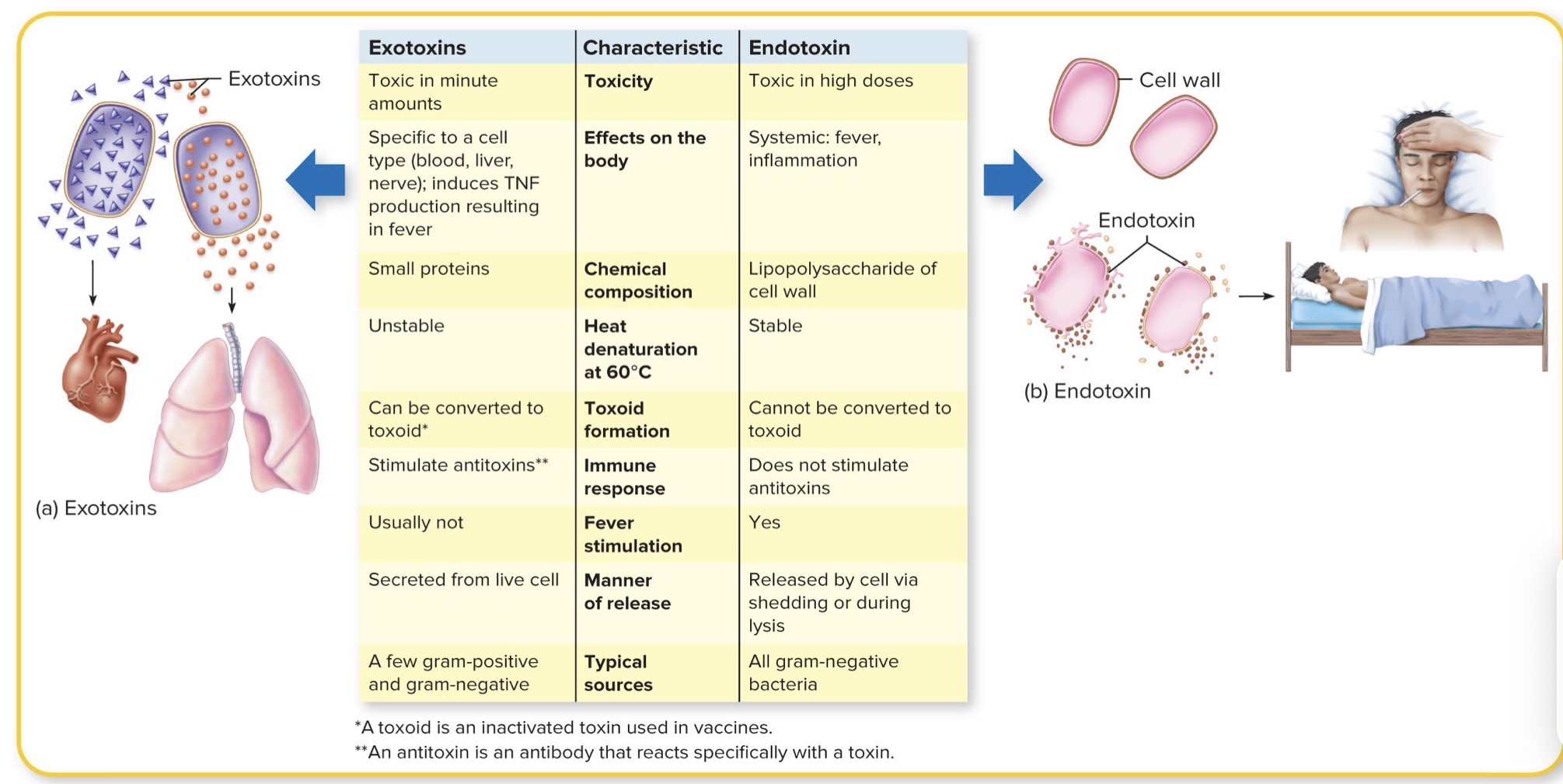
Endotoxins
Lipopolysaccharide (LPS): part of the outer membrane of gram-negative cell walls
Has a variety of systemic effects on tissues & organs
Causes fever, inflammation, hemorrhage, & diarrhea
Blood infections by Salmonella, Shigella, Neisseria meningitidis, & Escherichia coli are particularly dangerous & can lead to fatal endotoxic shock
Know entire exotoxin & endotoxin table
Definitions of infection types - table

Signs vs. Symptoms
Sign: objective evidence of disease as noted by an observer
Ex. edema, lymphadenitis, fever, redness
Symptom: subjective evidence of disease as sensed by the patient
Pain, soreness, malaise, nausea
Syndrome: a disease identified by a certain complex of signs & symptoms
Signs of infection in the blood
Leukocytosis; increase in WBC levels
Leukopenia: decrease in WBC levels
Septicemia: a general state in which microorganisms are multiplying in the blood & are present in large numbers
Bacteremia or viremia: bacteria or viruses are present in the blood but not multiplying
Infections that go unnoticed
No noticeable symptoms
Microbe is active in host tissues
Host does not seek medical attention
These infections are known as asymptomatic or subclinical (inapparent)
Stages in the course of infection & disease
Incubation (actively multiplying, but no symptoms)
Prodromal stage (vague symptoms)
Acute phase (height of infection, severe symptom/damage, large # of pathogen)
Convalescent period (sharp decline of s/s, still infectious)

Incubation period
Time from initial contact w/ infectious agent to appearance of symptoms
Agent is multiplying at portal of entry but has not caused enough damage to elicit symptoms
Varies according to host resistance, degree of virulence, & distance b/w target organ & portal of entry
Ranges from several hours → several years
Majority of infections range 2-30 days
Prodromal stage
1-2 day period when earliest notable symptoms of infection appear
Vague feeling of discomfort → head & muscle aches, fatigue, upset stomach, general malaise
Acute phase
Infectious agent multiplies at high levels, exhibits its greatest virulence, & becomes well established in its target tissue
Marked by fever & other prominent & specific signs & symptoms
Extremely variable in length of this period
Convalescent period
Patient begins to respond to the infections & symptoms decline
Patient’s strength & health gradually return due to the healing nature of the immune response
Many patients stop taking antibiotics during this period, even though pathogens are still in their system, leading to antibiotic resistance
Continuation phase
Only some infections have this phase
Either the organism lingers for months, years, or indefinitely after the patient is well OR the organism is gone but symptoms continue
Reservoirs
Where pathogens come from
Primary habitat in the natural world from which a pathogen originates
Living reservoirs:
1. Humans (ill patients or carriers)
2. Animals
Non-living reservoirs:
Soil & water (can also be plants)
Zoonosis
An infection indigenous to animals but naturally transmissible to humans
Some zoonotic infections have multi-host involvement
Some have complex life cycles in the wild
Zoonotic spread of disease is promoted by close associations b/w humans & animals
Make up full 70% of all new emerging diseases worldwide
Impossible to eradicate w/out also eradicating the entire animal reservoir
Transmission of infectious agents - communicable
A disease in which an infects host can transmit the infectious agent to another host & establish infection in that host
Contagious: a disease that is highly communicable, especially through direct contact
Influenza & measles are highly contagious
Hansen’s disease (leprosy) is only weakly communicable
Transmission of infectious agents - noncommunicable
An infectious disease that does not arise through transmission of the infectious agent from host to host
1. Compromised person is invaded by their own microbiota
2. Individual has accidental contact w/ a microbe that exists in a nonliving reservoir
3. Infected people do not become a source of disease to others
Patterns of transmission in communicable disease - Horizontal transmission
Disease is spread through a population from one infected individual to another
3 major modes:
1. Direct contact: close contact b/w people, droplets
2. Indirect transmission: an object or substance carries the agent
Fomite: inanimate object (ex. door knobs, phones, pens)
Vehicle: air, water, soil, food
3. Vector transmission: arthropods that harbor an infectious agent & transfer it to a human
Mechanical: arthropod carries microbes on outside surface of its body
Biological: microbes enter body of arthropod
Patterns of transmission in communicable disease - Vertical transmission
Disease transmitted from parent to offspring via ovum, sperm, placenta, milk
Healthcare-Associated Infections
Also called nosocomial infections
Infectious diseases are acquired or developed during a hospital or health care facility stay
0.1-20% of all admitted patients, w/ an average of 4%
750,000 cases per year, resulting in 75,000 deaths
Circumstances that make HAIs unavoidable
Compromised patients
Collection point for pathogens
Lowered defenses permit normal biota to enter the body
**Opportunistic infections**
Infections acquired directly or indirectly from fomites, medical equipment, other patients, medical personnel, visitors, air, & water
Health-care processes that make HAIs occur
Treatments using reusable instruments such as respirators & thermometers
Indwelling devices such a catheters, prosthetic heart valves, grafts, drainage tubes, & tracheostomy tubes form read portals of entry
High proportion of hospital population receives antimicrobial therapy, so drug-resistant microbes are selected at a much higher rate
Most common HAIs
Pneumonia
GI illness
UTIs
Bloodstream infections
Surgical site infections
Control of HAIs
Infection control officers: implement proper practices & procedures, tracks potential outbreaks, identifies breaches in asepsis, & trains health car workers in aseptic techniques
Training for nurses & caregivers: regularly exposed to needle-sticks, infectious secretions, blood, & physical contract w/ patients → they need to be especially aware of infection control
Most hospitals have adopted universal precautions → all secretions from all people in the clinical setting are potentially infectious & transmission can occur in either direction