Upper GI medchem
 Call Kai
 Learn
 Practice Test
 Spaced Repetition
 Match
 Flashcards
 Knowt Play
1/9

There's no tags or description
Looks like no tags are added yet.
10 Terms
Describe the SAR of 2nd generation H2 antagonists e.g., cimetidine.
- 4 Carbon chain with sulfur or oxygen in middle.
- Methyl group on planar 5-membered aromatic ring e.g., imidazole, furan.
- A bioisostere for thiourea e.g., guanidine
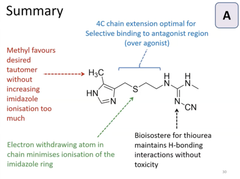
Why is the 4 Carbon chain with sulfur in middle essential for 2nd generation antagonists e.g., cimetidine?
- Provides selective binding to the antagonist region
- Electron withdrawing sulfur minimises ionisation of aromatic ring.
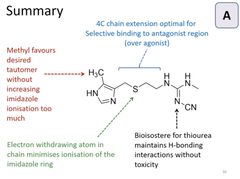
Why is the methyl group on planar 5-membered aromatic ring essential for 2nd generation antagonists e.g., cimetidine?
- Favours desired tautomer.
- Does not increase risk of ionisation of aromatic ring.

Why is the the bioisostere for thiourea essential for 2nd generation antagonists e.g., cimetidine?
Maintains H-bonding interactions without toxicity. Thiourea is a double bond from a C to another atom and the C is also attached to 2 amines.

Describe the SAR of PPIs.
- Pyridine is essential (top of image)
- Sulfoxide linker is essential
- Benzimidazole is essential.
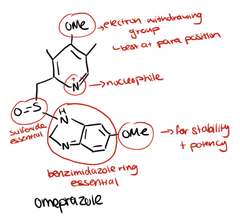
Show the mechanism for PPIs.
- Can only happen in stomach (strongly acidic)
- Covalently binds to proton pump
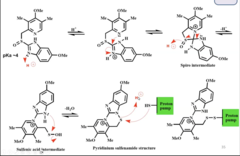
Why is the pyridine essesential on PPIs?
Nitrogen on pyridine is extremely nucleophilic which allows it to react with electrophilic carbon atom on the benzimidazole.
Why is the nitrogen on the pyridine extremely nucleophilic?
- Methyl substituents have an inductive effect which increases nucleophilicity of nitrogen.
- Methoxy substituent in the PARA position increases nucelophilicty of nitorgen.
Why is it essential that methoxy is in the para position on the pyridine on PPIs?
- Methoxy substituent in the PARA position allows resonance and therefore increases electron donating effect. This allows nitrogen to be more electron dense.
- If methoxy was in meta position resonance would not take place preventing nitrogen to act as a nucleophile.

How does structure of omeprazole increase activity of the PPI?
- Contains a methoxy group on the benzimidazole.
- Has a electron donating effect towards the imidazole ring.
- Increases electron density allowing reaction to take place faster.
