Biology Unit 2: DNA
 Call Kai
 Learn
Learn Practice Test
 Spaced Repetition
 Match
Match Flashcards
 Knowt Play
1/20

There's no tags or description
Looks like no tags are added yet.
Name | Mastery | Learn | Test | Matching | Spaced | Call with Kai | Chat |
|---|
No analytics yet
Send a link to your students to track their progress
21 Terms
DNA snythesis
Initiation – Helicase enzymes unwind the double helix at origins of replication, creating a replication fork; Primase creates short RNA primers to provide a starting point for elongation.
Elongation – DNA polymerase extends the new strand by pairing nucleotides with their complements in the template strand. If DNA polymerase incorporates a base which does not match the template, it stalls elongation until it can remove the incorrect base, after which it proceeds with synthesis (Proofreading).
Termination – DNA polymerase stops elongating and falls off of the DNA molecule; other intracellular machinery removes RNA primers and joins fragments into one continuous sequence as necessary.
mitosis
meiosis
proof-reading dna phase
DNA polymerase also has proofreading capabilities to ensure accuracy in base pairing. Incorrectly paired nucleotides are removed and replaced with the correct pair.
Ligation
After the synthesis of the new DNA strand, the fragments (Okazaki fragments in the lagging strand) are joined together by enzymes called ligases.
nucleotides
DNA is made of repeating units called nucleotides. Every DNA nucleotide has three parts:
Part | Function |
Phosphate group | Helps form the outside backbone of the DNA strand |
Deoxyribose sugar | A five-carbon sugar; connects the phosphate group and nitrogen base |
Nitrogenous base | Contains the genetic “code” through its sequence |
nitrogen base pairing in DNA
Base | Letter | Category | Pairs with |
Adenine | A | Purine | Thymine (T) |
Thymine | T | Pyrimidine | Adenine (A) |
Cytosine | C | Pyrimidine | Guanine (G) |
Guanine | G | Purine | Cytosine (C) |
*A always pairs with T using two hydrogen bonds, while C pairs with G using three hydrogen bonds. This is why regions with many C–G pairs tend to be held together more strongly.
double helix shape
DNA is shaped like a twisted ladder, called a double helix.
antiparallel strand
The two strands of DNA run in opposite directions, which is called antiparallel.
One strand runs from its 5′ end to 3′ end.
The other runs from 3′ end to 5′ end.
5’ follows 3’ : This rule causes the leading- and lagging-strand differences during replication.
5′ — A T G C C A — 3′
3′ — T A C G G T — 5′
DNA replication
the process by which a cell copies its DNA before cell division. This ensures that each daughter cell receives a complete, nearly identical set of genetic information.
Replication is semiconservative:
Each new DNA double helix contains one original (parental) strand.
Each new DNA double helix contains one newly made strand.
Original DNA:
OLD strand + OLD strand
After replication:
OLD strand + NEW strand
OLD strand + NEW strand
(called “semi-conservative” because half of each new DNA molecule—the old strand—is conserved.)
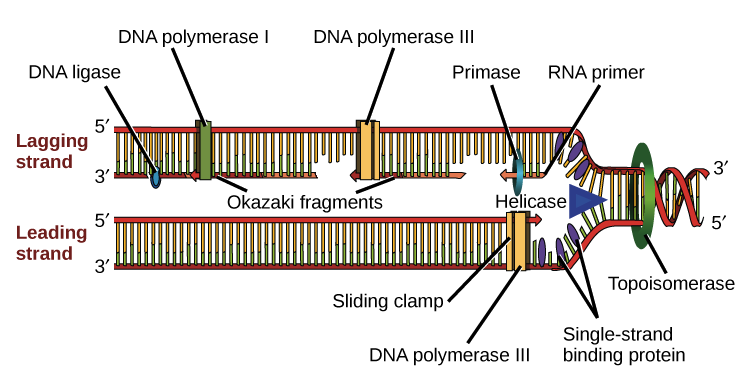
5 steps of replication
1 - initiation
2 - priming
3 - elongation
4 - leading & lagging strands
5 - finishing
initiation (repl. 1)
DNA unzips
Replication begins at a specific DNA location called the origin of replication.
Helicase breaks the hydrogen bonds between base pairs.
The two DNA strands separate.
This creates a Y-shaped region called a replication fork.
Single-strand binding proteins help keep the separated strands apart.
Topoisomerase reduces twisting strain ahead of the replication fork.
Think of helicase as unzipping a jacket: it separates the two sides without breaking the sugar-phosphate backbone.
priming (repl. 2)
a starting point is added
DNA polymerase cannot begin a new DNA strand by itself. It needs a short starting sequence called a primer.
Primase makes a short RNA primer.
The primer provides a free 3′ end.
DNA polymerase can then attach DNA nucleotides to that 3′ end.
elongation (repl. 3)
DNA polymerase adds nucleotides that are complementary to the template strand.
Example:
Template strand: 3′ — A T G C C A — 5′
New DNA strand: 5′ — T A C G G T — 3′
DNA polymerase reads the template and follows base-pairing rules:
Template A → add T
Template T → add A
Template C → add G
Template G → add C
DNA polymerase builds only in the 5′ → 3′ direction.
leading & lagging strands (repl. 4)
Because the original DNA strands are antiparallel, DNA polymerase cannot build both new strands in the same way.
Strand | How it is made | Key idea |
Leading strand | Made continuously toward the replication fork | Usually needs one RNA primer |
Lagging strand | Made in short segments away from the replication fork | Needs many RNA primers |
Okazaki fragments | Short DNA segments on the lagging strand | Later connected into one strand |
The lagging strand is built in pieces because DNA polymerase must still work 5′ → 3′ even though that strand’s orientation works against the movement of the replication fork.
finishing (repl. 5)
primers are replaced and fragments are connected
Once DNA polymerase has built the DNA:
RNA primers are removed.
The empty spaces are filled with DNA nucleotides.
DNA ligase seals the gaps between Okazaki fragments.
Ligase forms bonds in the sugar-phosphate backbone, producing a continuous DNA strand.
In a typical prokaryote-focused diagram, DNA polymerase III is the main enzyme adding nucleotides, while DNA polymerase I removes RNA primers and replaces them with DNA. Your course may focus more generally on “DNA polymerase” unless it expects the prokaryotic enzyme names.
enzymes involved in DNA replication
Enzyme/protein | Main job | Easy memory clue |
Helicase | Separates DNA strands by breaking hydrogen bonds | “Helicase = helix opener” |
Single-strand binding proteins | Keep separated strands from rejoining | “Hold strands apart” |
Topoisomerase | Relieves twisting and strain ahead of the fork | “Prevents overwinding” |
Primase | Builds short RNA primers | “Primer maker” |
DNA polymerase | Adds DNA nucleotides and helps proofread | “DNA builder” |
DNA polymerase I | Removes RNA primers and replaces them with DNA in prokaryotes | “Primer replacer” |
DNA ligase | Joins DNA fragments and seals breaks | “Ligase = glue” |
Common test mistakes
Do not say DNA polymerase “unzips” DNA. Helicase separates the strands.
Do not say A pairs with U in DNA. DNA uses thymine; RNA uses uracil.
Do not say DNA polymerase builds 3′ → 5′. It builds new DNA only 5′ → 3′.
Do not confuse hydrogen bonds and phosphodiester bonds. Hydrogen bonds connect bases across strands; phosphodiester bonds connect nucleotides along one strand.
Do not say both strands are copied continuously. The lagging strand is made as Okazaki fragments.
Do not say a daughter DNA molecule contains two completely new strands. Semiconservative replication gives each daughter molecule one old and one new strand.
quick check
What are the three parts of a DNA nucleotide?
Phosphate group, deoxyribose sugar, and nitrogenous base.Which bases pair in DNA?
A–T and C–G.Why are DNA strands called antiparallel?
They run in opposite directions: one 5′ → 3′ and the other 3′ → 5′.Which enzyme separates the two DNA strands?
Helicase.Which enzyme adds most new DNA nucleotides?
DNA polymerase.Why is the lagging strand made in pieces?
DNA polymerase can only synthesize DNA 5′ → 3′, so it must repeatedly build short segments on that template.What joins Okazaki fragments?
DNA ligase.Why is replication called semiconservative?
Each new DNA molecule has one original strand and one newly synthesized strand.
sentence summary
DNA is a double-stranded, antiparallel molecule built from complementary base pairs, and before cell division helicase separates its strands so DNA polymerase can use each old strand as a template to create a new complementary strand.