Chapter 5: Gases and the Kinetic-Molecular Theory
 Call Kai
 Learn
Learn Practice Test
 Spaced Repetition
 Match
Match Flashcards
 Knowt Play
1/27

Name | Mastery | Learn | Test | Matching | Spaced | Call with Kai | Chat |
|---|
No analytics yet
Send a link to your students to track their progress
28 Terms

Compressibility
Gas property where volume is strongly inverse to pressure
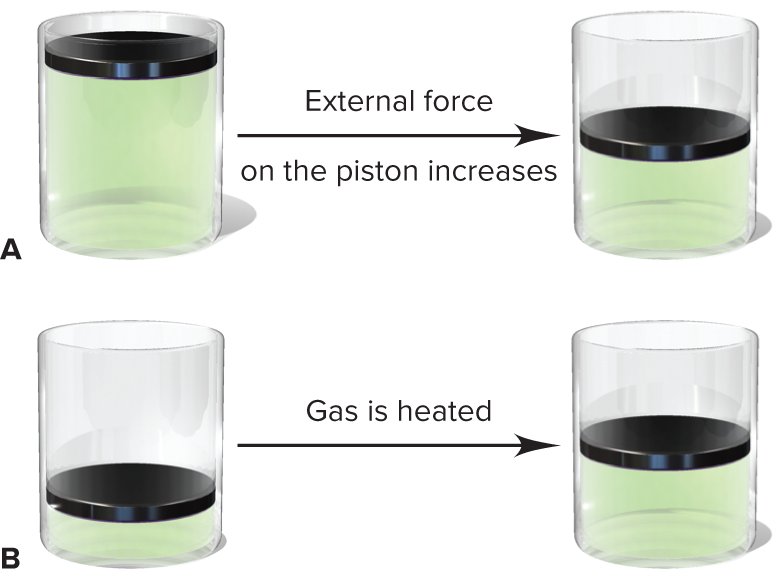
Temperature sensitivity
Gas property where volume is strongly associated with temperature, as gas particles move faster and around more
Flow
Gas property stating how gases can move freely and leak easily
Density
Gas property resulting in the measurement of g/L instead of g/mL due to extremely low levels of this
Solubility
The ability to form a solution when mixed; this is much more common in gases

Pressure
The force exerted on a surface over total area
Atmospheric pressure
The pressure of atmospheric gases at 0 degrees C and sea level
Allows for crushing of cans without air
Measured by barometers

Barometer
A device to measure atmospheric pressure by measuring the level of a liquid column (typically Hg) after outflows stop due to atmospheric pressure preventing loss
Density is inversely proportional to height, making the dense Hg convenient for use in one

Manometer
A device to measure gas pressure
Utilizes a U-tube filled with mercury to measure the level difference and thus the gas pressure (after accounting for atmospheric pressure in open-ended versions)
Ideal gas
A gas where the relationships between volume, pressure, temperature and amount are linear
0 degrees C at 1 atm
Standard temperature and pressure (STP)
Boyle’s law
Law stating that the volume of a gas is inversely related to its pressure
V = 1/P
Charles’s law
Law stating that the pressure of a gas is linearly related to its temperature
P = RT
Avogadro’s law
Law stating that the volume of a gas is linearly related to its amount at a fixed pressure and temperature
V = Rn
22.4 L
Standard molar volume; this expresses the volume of 1 mol of gas at STP
Ideal gas law
The combination of the three gas laws
PV = nRT
Universal gas constant
Denoted as R in the ideal gas law, it is the constant expressing 1 mol of gas at STP
Is equal to roughly 0.0821 atm L / mol K
Requires conversion of units when used
Density (d)
The measurement of mass per unit volume; in gases, it is inversely proportional to temperature and directly proportional to pressure
Also mainly relies on molar mass due to fixed volumes per mole
Total pressure
In a gas, this is defined as the sum of the partial pressures contributed by each gas
Mole fraction (X)
The ratio of number of moles of solute to solvent
Can be derived from the calculations of a gas’s total pressure: PA = XA(Ptotal)
If 25% of the mixture is A, 25% of the pressure comes from A as well
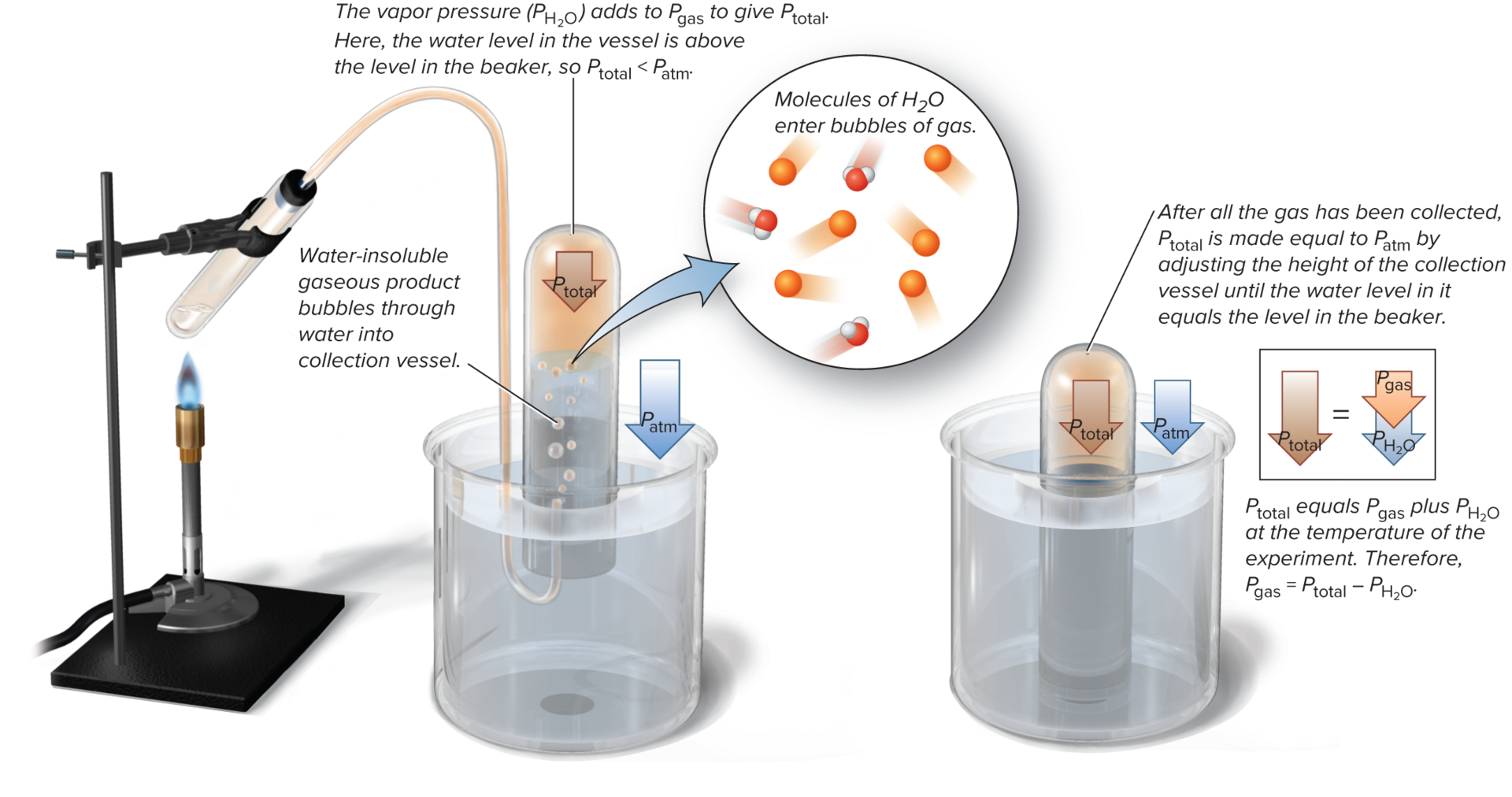
Gas collection
Performed through the heating of a reaction’s container to collect gases through a water-filled collection vessel
This leads to a volume of gas added to water vapor
Vapor pressure
The added pressure of water vapor when collecting gas through a collection vessel, adding to the total pressure
Depends on water temperature

Solve for the moles or unknown variables related to the gas, then convert to other units as normal.
How would I solve a gas stoichiometry problem?

Kinetic-molecular theory
Theory to explain the observed behaviors of gases; main points include:
Negligible individual particle volume
Random motion
Elastic collisions without friction
The same kinetic energy for a given temperature
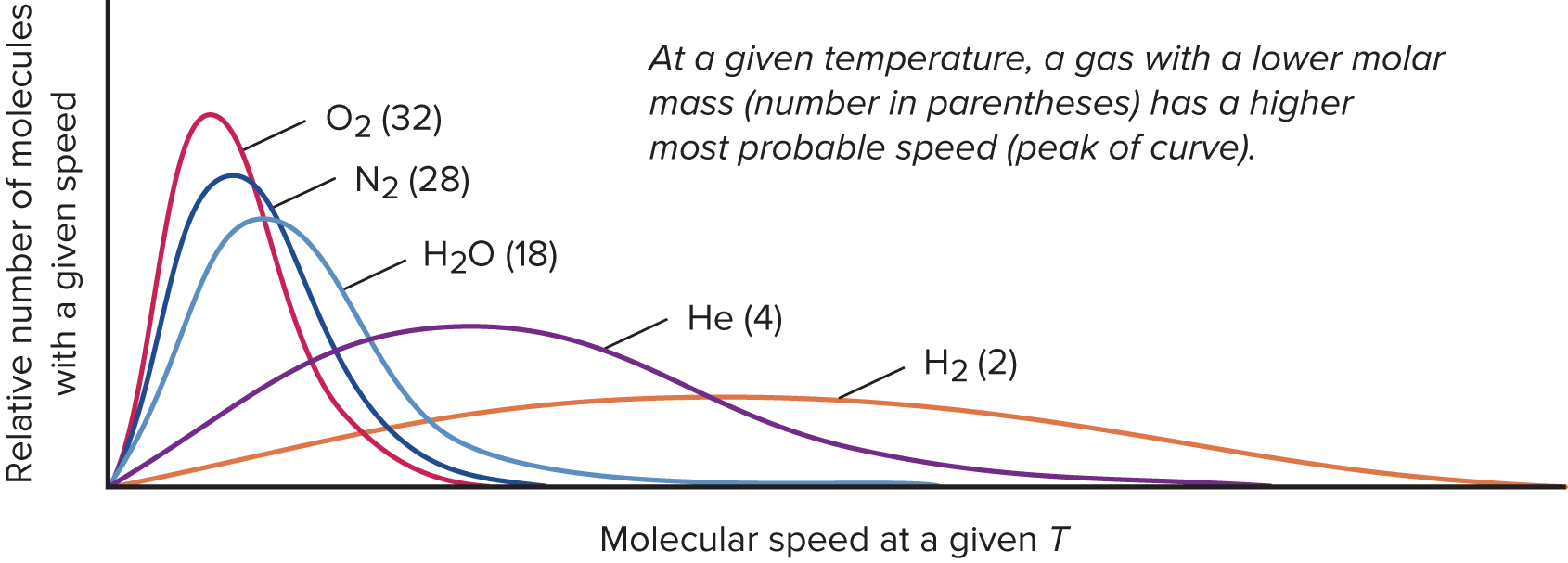
Average kinetic energy
This is the same for gases at a given temperature, as Ek = ½(mass)(speed2)
Mass being inversely proportional to speed enables a constant total energy
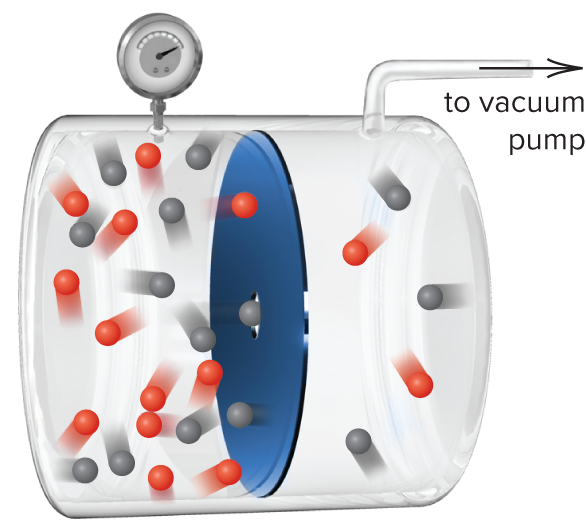
Effusion
The escape of individual gas particles through a small opening, the rate of which is governed by Graham’s Law

Diffusion
The movement of gases through another gas, governed by Graham’s Law
Much slower than effusion due to increased particle collisions
Graham’s law
The law governing effusion and diffusion, starting that
Rate of A = 1 / sqrt(MA)