Chp 9 (updated)
 Call Kai
 Learn
 Practice Test
 Spaced Repetition
 Match
 Flashcards
 Knowt Play
1/32

There's no tags or description
Looks like no tags are added yet.
33 Terms
What do heredity, genetics, genome, gene, genotype, and phenotype mean?
Heredity is passing traits from parent to offspring, and genetics is the study of how that works (how genetic material is passed on, expressed, varied, and changed). Think of DNA as a cookbook.
The genome is all the genetic material in a cell (the whole cookbook, including extra recipe cards called plasmids).
A gene is one recipe, a stretch of DNA with the instructions for one trait.
The genotype is all the genes an organism has.
The phenotype is the traits you can actually observe or measure (the dishes that get served).
Structural genes code for proteins or RNA, and regulatory genes control when genes are used.
How does a genotype create a phenotype?
Through gene expression: DNA is transcribed into RNA, and the RNA is translated into a protein (DNA to RNA to protein), and the protein is what produces the trait.
Real example: E. coli has a gene for the enzyme beta-galactosidase (genotype), so it makes that enzyme and can digest lactose (phenotype). DNA is the permanent storage, and RNA is the working copy that gets used.
What is the structure of DNA, and what does antiparallel mean?
DNA is a long chain of nucleotides, and each nucleotide has a sugar (deoxyribose), a phosphate, and a base (A, T, G, or C). Sugars and phosphates link by phosphodiester bonds into a backbone (the sides of a ladder), and the bases pair across the middle, held by hydrogen bonds (the rungs: A with T, C with G). The ladder twists into a double helix.
Antiparallel means the two strands run in opposite directions (one 5' to 3', the other 3' to 5'), like a two-lane road with traffic going opposite ways. Purines (A, G) have two rings and pyrimidines (T, C, U) have one. T is only in DNA, and U is only in RNA.
How is DNA organized and packaged inside a cell?
DNA is far longer than the cell, so it has to be coiled tightly: E. coli's DNA is about 1,000 times longer than the cell (like stuffing a 100 m rope into a 10 cm box).
Bacteria have one circular chromosome that is supercoiled (twisted like a phone cord) by the enzyme DNA gyrase.
Eukaryotes have several linear chromosomes in a nucleus, where DNA wraps around proteins called histones (thread around spools) to make nucleosomes ("beads on a string"), which coil further into chromatin. One human cell holds about 2 m of DNA.

How do you use base pairing rules to find the complementary strand of DNA?
Write each base's partner (A with T, G with C), and remember the new strand runs antiparallel to the template. '
Example: template 3'-ATG TAC TAT TTA AAC ACA AAC TTT TGG-5' gives the complementary strand 5'-TAC ATG ATA AAT TTG TGT TTG AAA ACC-3'.
Quick check: every A has a T across from it, and every G has a C.
What does it mean that DNA replication is semiconservative?
DNA replication is semiconservative, meaning each new DNA molecule consists of one original (parental) strand and one newly synthesized strand. The two parental strands serve as templates for the new strands.

What proteins are involved in DNA replication in prokaryotes, and what does each one do?
Helicase unzips the double helix by separating the strands. Single-strand binding proteins keep the strands from snapping back together.
Gyrase (a topoisomerase) relieves the twisting stress ahead of the fork, like untwisting a phone cord.
Primase builds a short RNA primer, which gives DNA polymerase a place to start.
DNA polymerase III adds new nucleotides in the 5' to 3' direction (it can only extend an existing strand) and proofreads.
DNA polymerase I removes the RNA primers, fills the gaps with DNA, and repairs mismatches.
DNA ligase seals the final gaps.
Replication is fast and accurate: E. coli copies 4.6 million base pairs in under an hour, with about 1 mistake per 10^8 to 10^9 bases, and most mistakes get fixed.

What are the steps of DNA replication in prokaryotic cells?
Initiation: replication starts at the origin of replication (E. coli has one). The origin is rich in A and T because A-T pairs have only 2 hydrogen bonds (C-G has 3), so it's the easiest spot to pull apart (Velcro vs. a stronger clasp). Helicase opens it into a replication bubble with two replication forks, replication moves in both directions, and primase lays down RNA primers.
Elongation: DNA polymerase III extends the primers and copies both strands at the same time.
Finishing: DNA polymerase I replaces the RNA primers with DNA, and ligase seals the remaining gaps.

How does replication differ on the leading strand and the lagging strand?
DNA polymerase can only build in the 5' to 3' direction.
On the leading strand that direction points toward the fork, so it's built smoothly and continuously from one primer.
On the lagging strand it points away from the fork, so the cell builds it backward in short pieces called Okazaki fragments, each with its own primer. Pol III extends each fragment until it reaches the next primer, pol I swaps the primers for DNA, and ligase joins the fragments.
Picture this: you can only write left to right, but the page keeps feeding in the wrong direction, so you write one short chunk at a time and then stitch the chunks together.
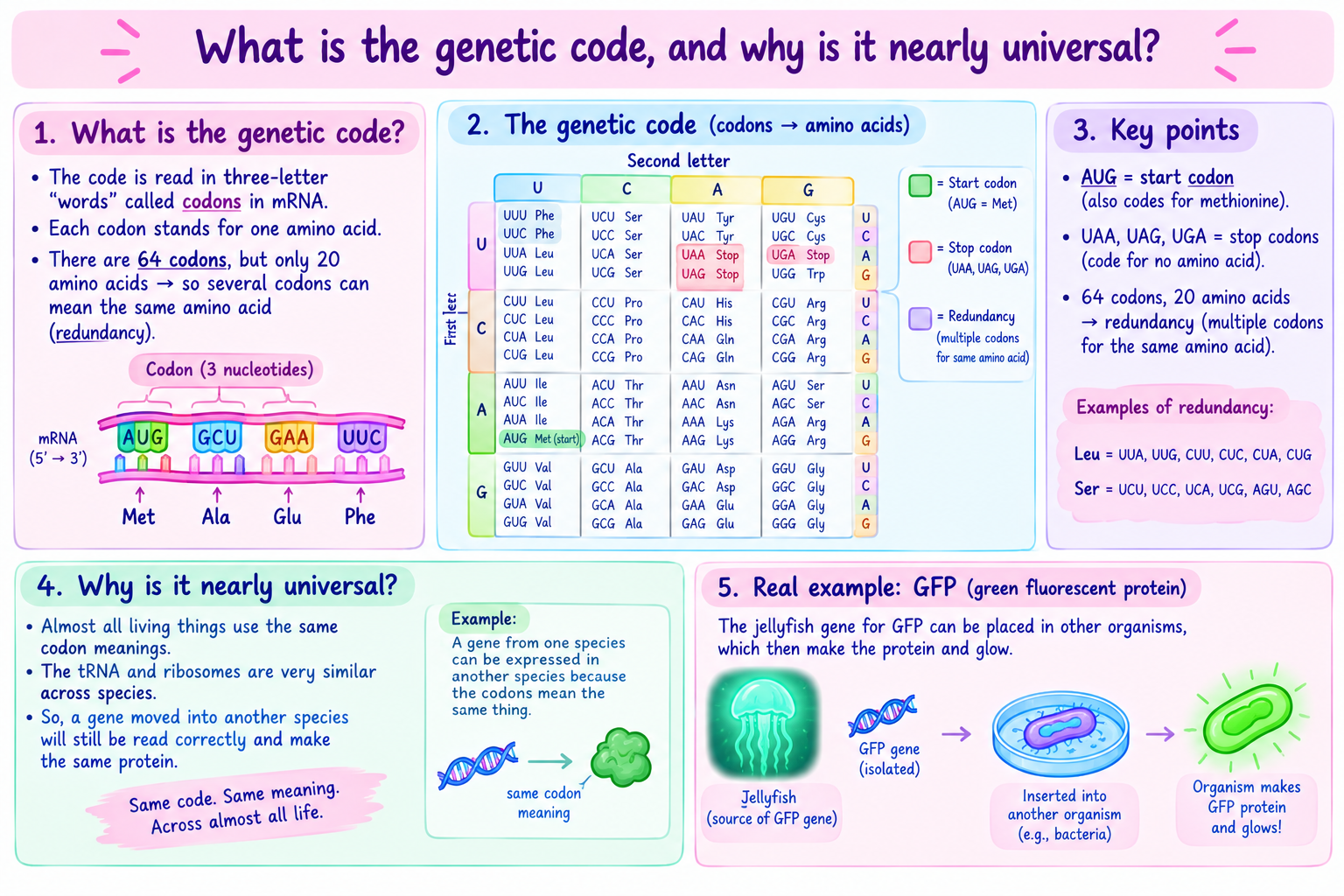
What is the genetic code, and why is it nearly universal?
The code is read in three-letter "words" called codons in mRNA, and each codon stands for one amino acid. There are 64 codons but only 20 amino acids, so several codons can mean the same amino acid (redundancy, like different spellings of one word). AUG is the start codon (it also codes for methionine), and UAA, UAG, and UGA are stop codons that code for no amino acid. It's nearly universal because almost all living things use the same codon meanings, so a gene moved into another species still gets read correctly.
Real example: the jellyfish gene for GFP (green fluorescent protein) can be placed in other organisms, which then make the protein and glow.
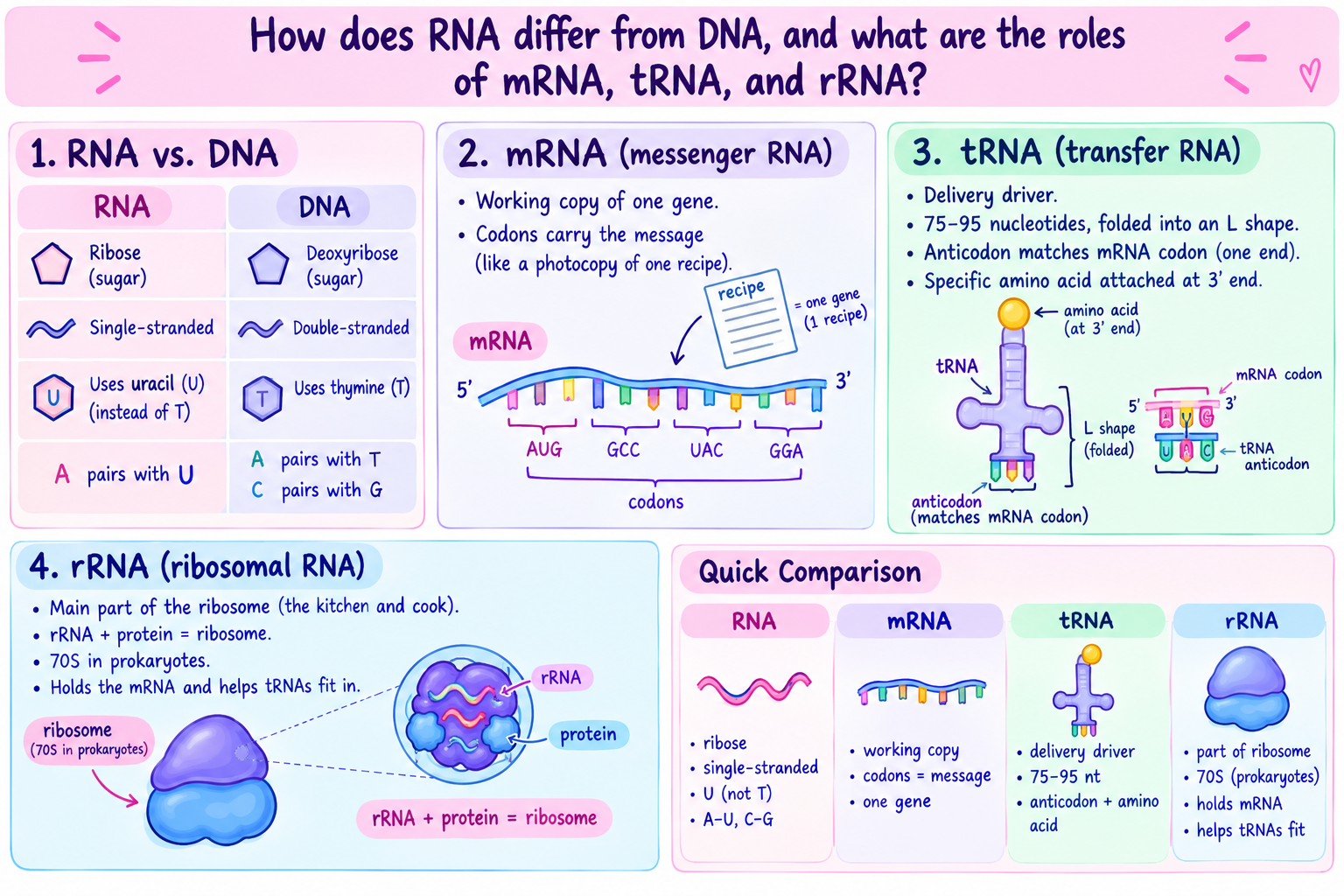
What are the types of RNA, and what does each one do?
RNA differs from DNA: it has ribose sugar, it is single-stranded, and it uses uracil (U) instead of T (U pairs with A).
mRNA (messenger RNA) is the working copy of one gene, and its codons carry the message (a photocopy of one recipe).
tRNA (transfer RNA) is the delivery driver: it is 75 to 95 nucleotides folded into an L shape, with an anticodon that matches an mRNA codon on one end and a specific amino acid attached at its 3' end.
rRNA (ribosomal RNA) is a main part of the ribosome (the kitchen and cook): rRNA plus protein make the ribosome (70S in prokaryotes), hold the mRNA, and help tRNAs fit in.

What are the major events of transcription, and what molecular components are involved?
Transcription copies one gene's DNA into RNA. RNA polymerase is the enzyme that opens the DNA and links RNA nucleotides together, and the sigma factor guides it to the promoter (the "start here" sequence just before the gene).
Initiation: RNA polymerase binds the promoter and unwinds the DNA.
Elongation: it reads the template strand 3' to 5' (only one strand is copied) and builds the mRNA 5' to 3' with complementary RNA bases (A pairs with U).
Termination: it reaches a termination site (a "stop here" sequence), lets go, and releases the new mRNA.
Practice: What RNA is made from the template 3'-ATG TAC TAT TTA AAC ACA AAC TTT TGG-5'?
Swap each base for its RNA partner (A to U, T to A, G to C, C to G): 5'-UAC AUG AUA AAU UUG UGU UUG AAA ACC-3'.
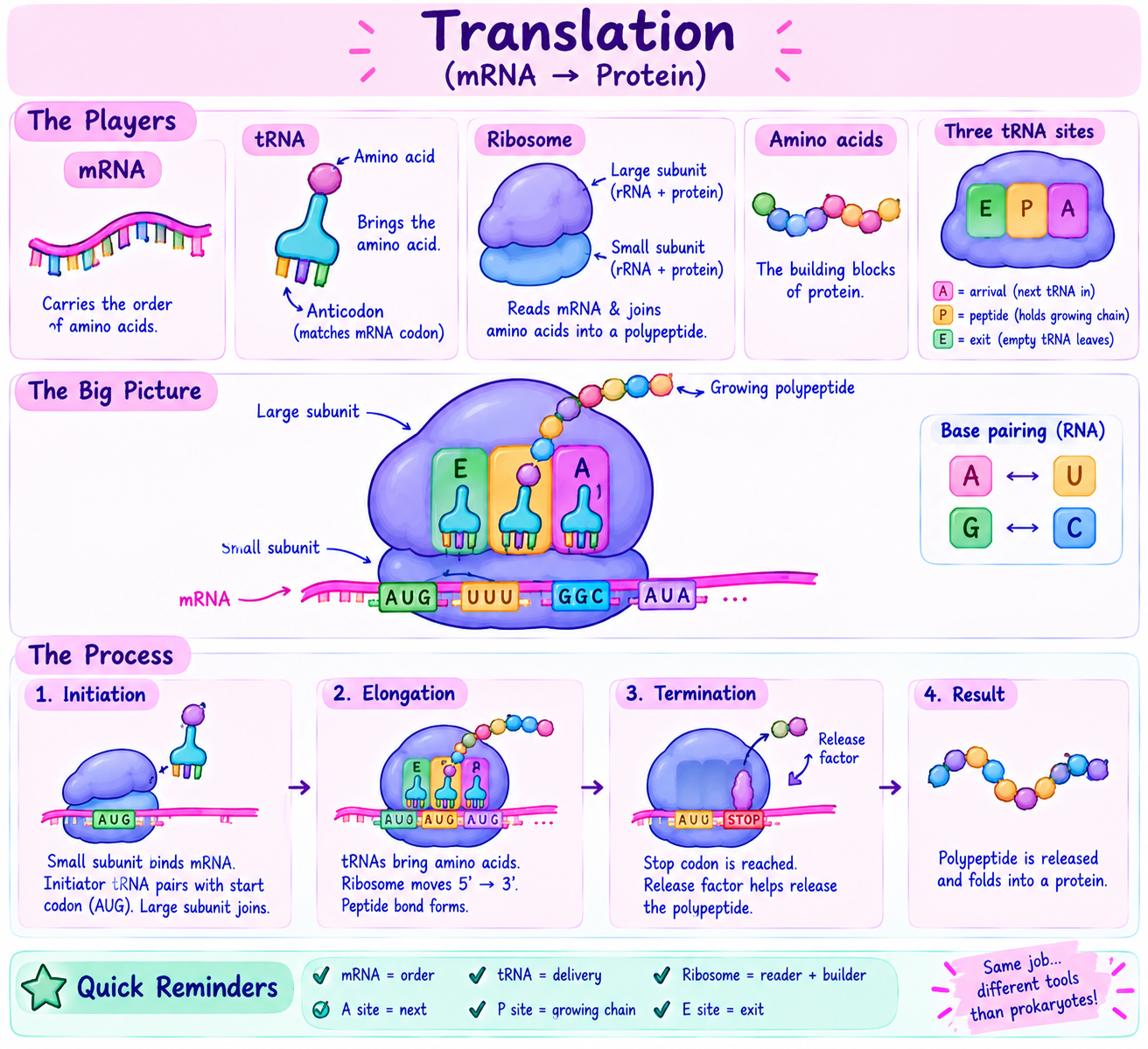
What are the molecular components of translation and what does each one do?
The mRNA carries the order of the amino acids.
The tRNAs bring the amino acids, and each tRNA's anticodon matches one mRNA codon.
The ribosome (a large and a small subunit made of rRNA and protein) reads the mRNA and joins the amino acids into a polypeptide. The ribosome has three tRNA sites: the A site (arrival, where the next tRNA comes in), the P site (peptide, holds the tRNA with the growing chain), and the E site (exit, where empty tRNAs leave).

What are the major events (stages) of translation?
Initiation: the small ribosomal subunit grabs the mRNA and a special starter tRNA carrying methionine, slides to the start codon AUG, and then the large subunit joins (initiation factors help).
Elongation repeats three steps: (1) codon recognition, where the matching tRNA drops into the A site using GTP energy; (2) peptide bond formation, where peptidyl transferase in the large subunit attaches the amino acid in the A site to the chain in the P site; (3) translocation, where the ribosome moves one codon, so the empty tRNA shifts to the E site and leaves, the tRNA from the A site moves to the P site, and the A site opens for the next tRNA.
Termination: a stop codon lands in the A site, a release factor binds, the finished polypeptide is released, and the ribosome comes apart.
Practice: What amino acids are made from the mRNA 5'-UAC AUG AUA AAU UUG UGU UUG AAA ACC-3'?
Translation starts at the first AUG, so the UAC before it is skipped. Reading codons from AUG: AUG = Met, AUA = Ile, AAU = Asn, UUG = Leu, UGU = Cys, UUG = Leu, AAA = Lys, ACC = Thr.
Answer: Met - Ile - Asn - Leu - Cys - Leu - Lys - Thr.
How do transcription and translation differ in prokaryotes and eukaryotes?
In prokaryotes there is no nucleus, so translation can start while the mRNA is still being made, and several genes are often transcribed together as one unit.
In eukaryotes, transcription and RNA processing happen in the nucleus and translation happens later in the cytoplasm. Eukaryotic genes contain introns (noncoding sections) and exons (coding sections); the introns are transcribed but cut out by splicing, so only the exons end up in the final mRNA.
Making proteins is expensive: about 1,200 ATP for an average protein.

What is an operon, and how do inducible and repressible operons differ?
An operon is a group of genes in the same pathway that are controlled together by one switch, so bacteria only make proteins when they need them, which saves energy.
Think of a restaurant. An inducible operon is normally OFF, like a dish that stays off the menu until a customer orders it: a substrate turns it on, and these are used for breaking nutrients down (catabolic). A repressible operon is normally ON, like a dish that keeps getting cooked until the shelf is full: the product turns it off, and these are used for building things (anabolic).

What are the parts of the lac operon?
The lac operon is the classic inducible operon, and it lets E. coli use lactose.
The regulator gene (lacI) makes the repressor protein (the guard).
The control region has the promoter (where RNA polymerase attaches) and the operator (the on/off switch where the repressor sits).
The structural genes are lacZ (beta-galactosidase, which splits lactose into simple sugars), lacY (permease, which lets lactose into the cell), and lacA (transacetylase, function unknown).
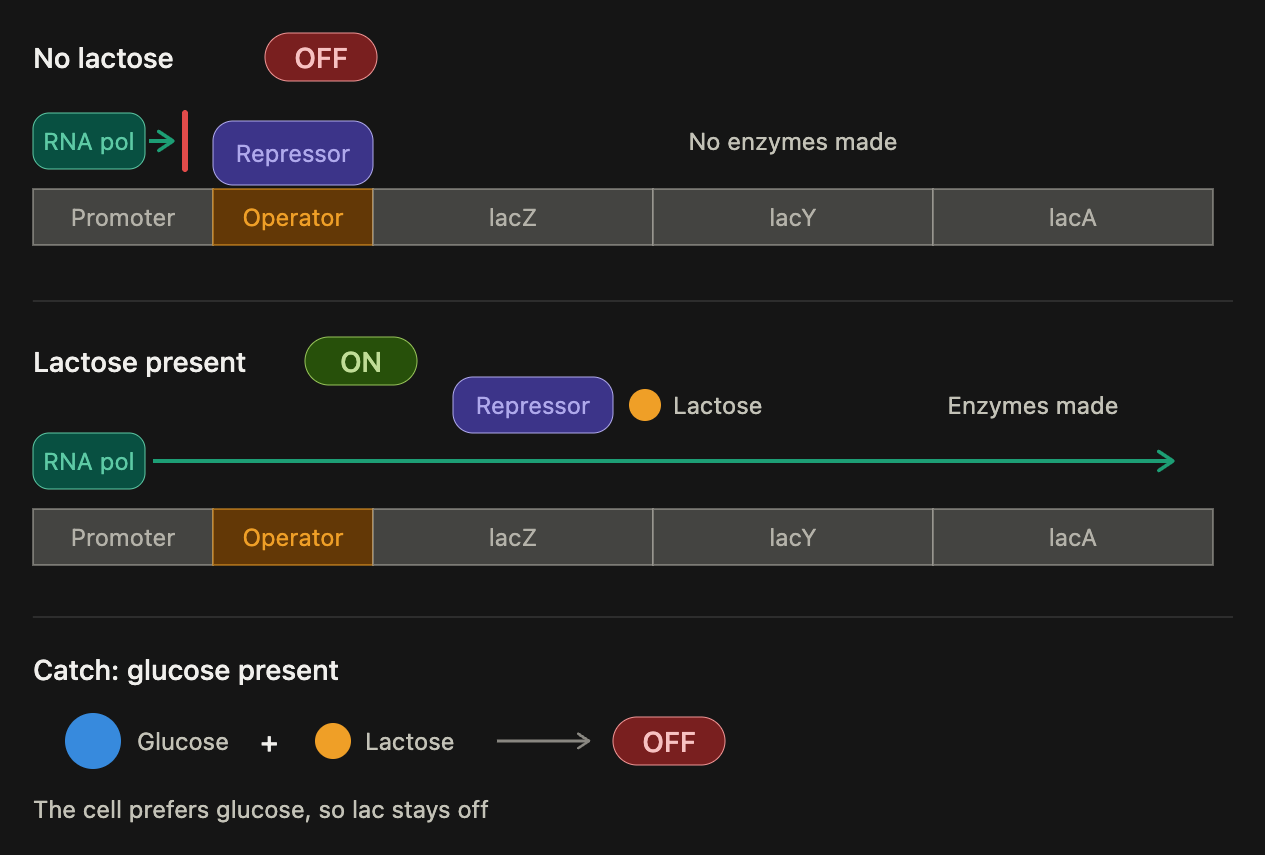
How does the lac operon work when lactose is absent versus present?
Because it's inducible, it's normally OFF. With no lactose, the repressor sits on the operator and blocks RNA polymerase, so the lac genes aren't made (no point making lactose-digesting enzymes with no lactose around). When lactose is present, it acts as the inducer: it binds the repressor and changes its shape, so the repressor falls off the operator, RNA polymerase can go, and the cell makes the enzymes. Once the lactose is used up, the repressor goes back on the operator and shuts it off again.
Catch: the lac operon only works when glucose is not available. If there's plenty of glucose, it stays off even with lactose around, because the cell prefers glucose.

What are the main features of repressible operons (the arginine operon)?
A repressible operon is normally ON, because the cell needs arginine to build proteins. When arginine builds up, arginine binds the repressor and activates it, then the repressor binds the operator and blocks transcription, so the cell stops making more. When arginine is used up, there isn't enough to bind the repressor, and the operon turns back on. It's like a factory that stops making a part once the shelf is full.
What is a mutation, and how are mutants identified?
A mutation is a permanent change in the DNA sequence that can change a protein's structure and function. A microbe with the natural, nonmutated trait is the wild type, and one with a mutation is a mutant strain (it may differ in shape, nutrient needs, temperature preference, chemical resistance, and so on).
To find mutants, expose a culture to a mutagen, isolate colonies, and compare their growth on complete vs. incomplete media (a nutritional mutant grows on complete media but not on media missing a nutrient it can no longer make), or compare their growth with selective agents or antibiotics against the wild type.
What are the causes of mutations?
Spontaneous mutations are random mistakes made during DNA replication (rates range from about 1 in 10^3 to 1 in 10^9).
Induced mutations come from mutagens, which are physical or chemical agents that damage DNA (examples: UV light and X-rays; nitrous acid and base analogs).
Real example: too much UV from sunbathing can damage the DNA in skin cells.
What are the types of mutations and their effects?
Think of a typo in a recipe.
Point mutations change one base.
A silent mutation changes the base but not the amino acid, so nothing changes (like a spelling variation: CCU to CCC, both proline).
A missense mutation changes one amino acid, and the effect ranges from nothing to a broken protein (CGC to CAC, Arg to His). Real example: in sickle cell disease, one change swaps glutamic acid (polar) for valine (nonpolar) in hemoglobin.
A nonsense mutation changes a codon into a stop codon, so the protein is cut short and usually doesn't work (UAU to UAA, Tyr to stop).
A frameshift mutation is an insertion or deletion of bases that shifts the reading frame, so every codon after it changes and the protein usually doesn't work. Example: "The fat cat ate the sad rat" with an extra "a" inserted after the T becomes "Tah efa tca tat eth esa dra t".
What are the beneficial and detrimental effects of mutations?
Mutations are the source of genetic variation.
Detrimental: Can lead to nonfunctional proteins, potentially causing disease or death. These mutations are usually selected against.
Beneficial: Can provide an advantage to the organism in its environment, leading to adaptation and increased survival/reproduction. These are the source of genetic variation and are favored by natural selection (e.g., antibiotic resistance). Real example: a bacterium with a mutation that resists an antibiotic survives the drug, reproduces, and passes resistance on (natural selection), which is how resistant populations take over.

What is recombination in bacteria, and what does it involve?
Recombination is the transfer of genetic material from one organism to another, so a bacterium can pick up new genes from another bacterium instead of waiting for a mutation. It often involves plasmids: small DNA circles (a few dozen genes) that copy themselves independently of the chromosome and move easily between cells. They carry bonus genes such as drug resistance, new metabolic abilities (like lactose fermentation), extra virulence, or adaptations to the environment.
Real example: a plasmid carrying antibiotic resistance can spread that resistance to other bacteria. The three types of recombination are conjugation, transformation, and transduction.

How can I tell conjugation, transformation, and transduction apart?
Conjugation: two living cells connect and DNA passes through direct contact (a handshake through a pilus).
Transformation: a cell picks up loose DNA from a dead, broken-open cell, and no contact is needed.
Transduction: a bacteriophage (virus) accidentally carries DNA from one cell to another (a courier delivering the wrong package).
Memory trick: contact, free DNA, virus.
What is the process of conjugation, and what are its outcomes?
Direct transfer of genetic material (plasmid or chromosomal fragment) from a donor cell to a recipient cell through physical contact, often via a pilus.
F+ conjugation: Transfer of an F factor (fertility plasmid) from an F+ donor to an F- recipient, converting the recipient to F+.
Hfr (high-frequency recombination): Occurs when the F factor is integrated into the bacterial chromosome. A portion of the donor chromosome is transferred, potentially integrating into the recipient's chromosome.
What is required for bacterial transformation, and what are its outcomes?
Transformation needs a competent recipient cell (one with special DNA-binding proteins on its cell wall) and free DNA fragments from a dead, lysed cell. No contact is needed, and donor and recipient can be unrelated. The DNA gets built into the recipient's chromosome, which gives it new traits.
Real example: in Griffith's experiment, harmless Streptococcus pneumoniae (R strain, no capsule) took up DNA from dead dangerous S cells (with a capsule) and became deadly. Transformation is also used to genetically engineer organisms.
What are the basic processes of transduction, and what are the end results?
Transduction is DNA transfer by a bacteriophage, and it only works within the same species because phages are host-specific.
In generalized transduction, a phage infects the donor cell, and while new phages are being assembled it accidentally packages a random piece of host DNA instead of viral DNA. The donor lyses, and the phage injects that host DNA into a new cell, which builds it into its chromosome.
In specialized transduction, a prophage (phage DNA inserted in the host chromosome) pops out carrying a specific piece of neighboring host DNA, making a hybrid (chimeric) phage that delivers both bacterial and viral DNA to a new cell, where it inserts into the chromosome.
Why are transposons important to microorganisms?
Transposons ("jumping genes") are DNA segments that can cut themselves out of one spot and insert somewhere else (chromosome to chromosome, chromosome to plasmid, or from one site to many sites). They matter because they create genetic variation and help spread things like drug-resistance genes, and they are also involved in colony morphology and DNA repair. Their effects range from beneficial to harmful. Picture a recipe card that keeps getting stuck into different cookbooks.
What are the major elements of viral genetics?
Viruses have a genome composed of either DNA or RNA (never both), which can be single-stranded or double-stranded.
Viral genomes are typically small, encoding only a few essential genes.
Viruses lack their own metabolic machinery and ribosomes, relying entirely on host cells for replication.
Viral replication can follow a lytic cycle (causing host cell lysis) or a lysogenic cycle (integrating viral DNA into the host genome).
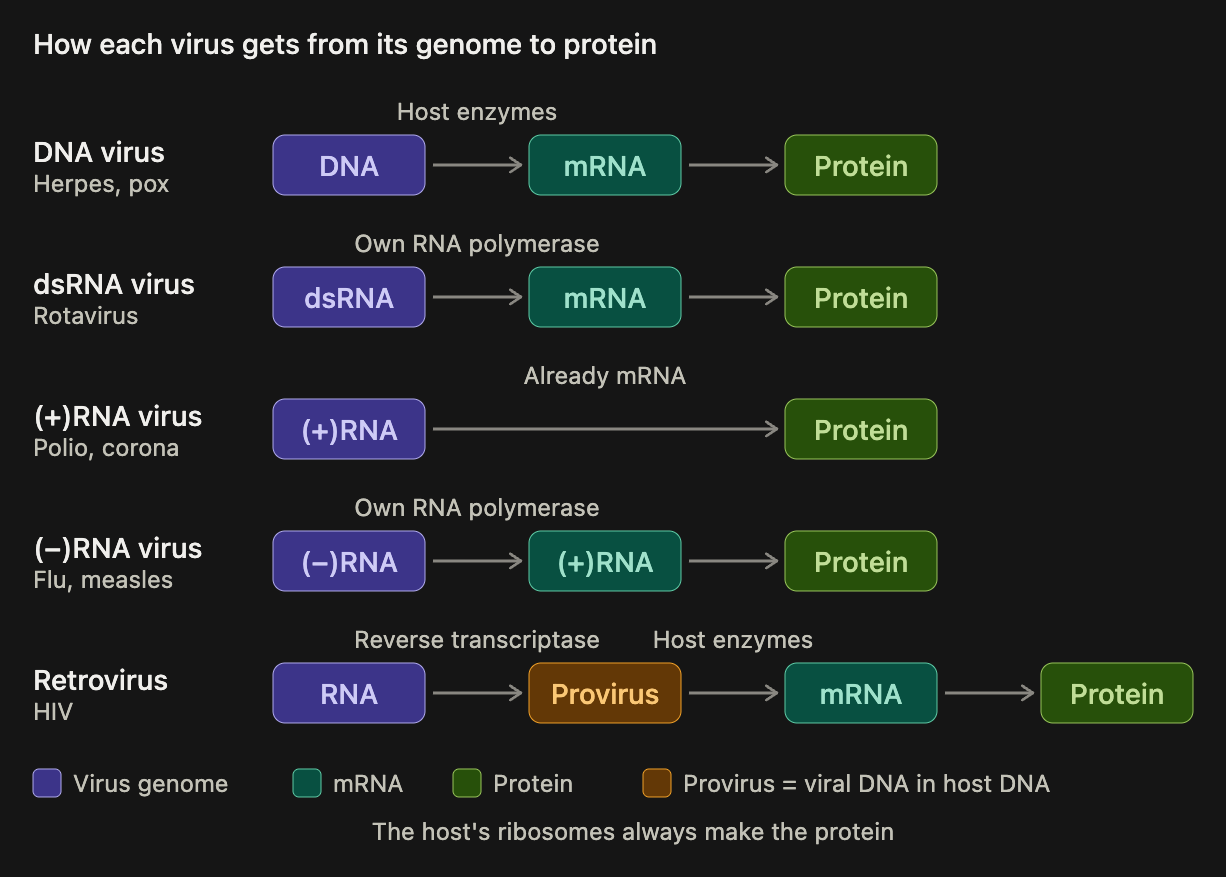
How do the genetics of DNA viruses, RNA viruses, single-strand RNA viruses, and retroviruses compare?
The key idea is that a host cell can only make proteins from mRNA, so each virus type is just a different route to getting mRNA.
DNA viruses (herpes, adenovirus, poxvirus): the host's enzymes, usually in the nucleus, copy the viral DNA into mRNA.
Double-stranded RNA viruses (rotavirus): the virus brings its own RNA-dependent RNA polymerase to make mRNA.
Positive-sense single-strand RNA viruses (poliovirus, coronaviruses): the genome already is mRNA, so the host translates it right away, including the enzyme that copies the genome.
Negative-sense single-strand RNA viruses (influenza, measles, rabies): the genome is a mirror image of mRNA, so the virus brings an RNA-dependent RNA polymerase to copy it into positive RNA first.
Retroviruses (HIV): the virus brings reverse transcriptase to copy its RNA into DNA, the DNA inserts into the host chromosome as a provirus, and the host transcribes it into mRNA like one of its own genes.