Bio defs for unit 4 aos 1
 Call Kai
 Learn
Learn Practice Test
 Spaced Repetition
 Match
Match Flashcards
 Knowt Play
1/41

There's no tags or description
Looks like no tags are added yet.
Name | Mastery | Learn | Test | Matching | Spaced | Call with Kai | Chat |
|---|
No analytics yet
Send a link to your students to track their progress
42 Terms
Pathogens:
Infectious particles that can invade another organism (host) to cause disease. Sources of non-self-antigens.
Can be:
Cellular pathogens = made of cells (e.g. bacteria, parasites, fungi, worms)
Non-cellular pathogens = lack cells (e.g. viruses, viroids, prions)

Prokaryotic
a simple, single-celled organism that lacks a membrane-bound nucleus and membrane-bound organelles
Viral Replication:
Each virus infects specific cells for reproduction.
Host specificity: Viruses infect specific host cells by binding to complementary receptors on their surface.
Replication: Viruses use the host cell's machinery and materials to replicate their nucleic acid and produce viral proteins.
Assembly: Viral nucleic acid and proteins assemble into new virus particles.
Release: New viruses leave through lysis (rupturing and killing the cell) or budding (exiting through the cell membrane).
Latency: Some viruses integrate their genetic material into the host's DNA, where it can remain dormant and be copied when the host cell divides.
Chemical Barriers in Plants/animals:
After physical barriers breached, range of chemicals that help defend against infection.
In animals:
- Stomach acid: very low pH kills pathogens.
- Lysozymes: enzymes in sweat, tears and saliva (enzyme, causes bacteria to lyse (burst)).
In plants: toxins:
- Saponins: able to break down lipids and therefore disrupts the membranes of pathogens.
- Glucanases: defend plants against fungi.
Physical Barriers in Plants/animals:
Act as a primary defense to attack by pathogens (prevent pathogens from entering).
Physical barriers:
In animals:
- Intact skin: toughened and waterproof layer, prevents entry into body
- Mucous membranes: in respiratory and digestive tracts. Trap bacteria, then swept out by cilia, swallowed, blown out through nose, coughed or sneezed out.
In plants:
- Cell wall: a rigid, tough outer layer, provide strength and flexibility.
- Stomata: tiny pores on underside of plant leaves, openings that can be closed when signaled.
Antigens
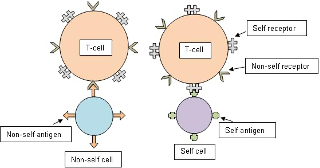
Unique molecule or part of a molecule that initiates an immune response (immunogens when trigger an immune response).
Recognized by T lymphocytes or antibodies (from B lymphocytes).
Expressed on surface of plasma membrane of cells, act as recognition sites for the immune system. Some freely circulate in the body fluids (toxins released by bacteria).
Self and non-self-antigens are presented to T lymphocytes by proteins found on the surface of your body’s cells called major histocompatibility complex (MHC) proteins.
Allergens:
aren’t supposed to cause reactions.
Antigens that result in immediate hypersensitivity reactions. Allergic responses due to a rapid and vigorous overreaction of the immune system to antigens that would otherwise be harmless. (pollen, fur, dust, latex, peanuts).
Endogenous pathogens and Exogenous pathogens
Endogenous pathogens (pathogens inside the cell)
Exogenous pathogens (pathogens outside the cell)
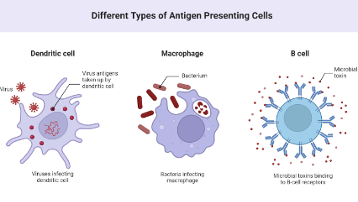
Antigen presenting cells (APCs):
Dendritic cells, Macrophages, B cells.
Only cells that have MHC II molecules.
APCs can engulf exogenous pathogens (pathogens outside the cell).
Dendritic Cells
Messengers
Activate the adaptive immune system (third line of defence).
Phagocytosis of pathogens and presentation of fragment to the adaptive immune response via MHC II marker.
Capture pathogens and travel to lymph nodes. Present antigens to T cells. Link between innate and adaptive immunity.
Macrophages
Big eaters
Engulf and destroy pathogens (phagocytosis) or/and release cytokines to attract/activate other immune cells
Found in tissues.
Recognise pathogens using receptors.
B lymphocytes (B cells):
A type of white blood cell in the adaptive immune system that produces antibodies and forms memory B cells for long-term immunity. FOR extracellular threats. (make antibodies to fight specific pathogens and form memory B cells for faster protection if the same pathogen enters again.)
Clone cells: Plasma cells and B-memory cells.
Clone cells: Copies of the original ‘activated’ B cell.
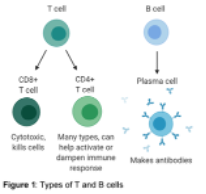
Plasma cells: Most clone cells differentiate into these. Factories for antibody production - they produce lots of identical antibodies as the original B cell to be specific to the antigen that activated the B lymphocyte. They survive a few days.
B-memory cells: Some clone cells differentiate into these. They also produce the same antibody and can survive for life. They can respond very quickly if the same pathogen enters the body a second time = immunity.
Antibodies (immunoglobulins (Ig))
Produced by B lymphocytes and released into the blood and lymph. Protein molecules that bind to specific antigens.
Lymphocytes:
type of leukocyte (white blood cell) that are specialized for adaptive immune responses. B and T lymphocytes (B and T cells) are specific cells of the ‘third line of defense’, produced in the bone marrow from stem cells. B cells develop in the bone marrow and mature in peripheral lymphoid tissues and organs. T cells mature in the thymus.
T Lymphocytes Involved in Cell-Mediated Immunity:
T Lymphocytes: help other immune cells or kill infected cells to fight intracellular threats like viruses.
Helper T lymphocytes (TH cells): ‘Help’ the immune response. In both humoral and cell-mediated immune responses. Don’t directly kill, when recognise antigens presented by APCs: active b cells- to make antibodies, activate cytotoxic T cells- to kill infected cells, and release cytokines- chemical signals that boost the immune response. Activate B cells in the humoral response by releasing cytokines as B cells have specific receptors for cytokines
Memory T lymphocytes: Persist after the infection is resolved, to ensure a stronger and faster response should the same pathogen reinfect the organism.
Cytotoxic T lymphocytes: Recognize and kill foreign, infected or abnormal host cells (e.g. virus-infected self-cells, cancer cells and transplanted organ cells) by releasing toxic compounds. Secrete cytokines such as interferons. Support natural killer cells to destroy cancer cells.
T Cell Receptors (TCRs):
Made up of two polypeptide chains. One antigen-binding site. They bind to fragments of antigens that are presented on the surface of antigen-presenting cells (APCs). This triggers signal transduction in the T cell, resulting in proliferation, cytokine release and activation of cytotoxic function.
Granulocytes (white blood cells with granules (neutrophils, eosinophils, basophils)):
Type of white blood cell (leukocyte) that contain many cytoplasmic granules filled with chemicals used to fight pathogens during an immune response. Neutrophils, basophils, eosinophils and mast cells are all granulocytes and secrete a range of defensive molecules during an innate immune response. Basophils and mast cells also release histamine and are involved in allergic reactions and the inflammatory response.
Neutrophils
First Responder.
Quickly move to infection site and engulf and destroy pathogens(phagocytosis) and release cytokines to attract/activate other immune cells
Most common white blood cell in blood.
Fast but short-lived
Eosinophils
Fight parasites and help with allergy responses
Attack large invaders like worms
Release toxic granules to kill parasites
Involved in asthma and allergic reactions
Mast Cells and Basophils
Release histamine to stimulate vasodilation and increased permeability of blood vessels, causing welling, redness, itching. Help attract other immune cells to the site.
Involved in the allergic reaction and inflammation
Found in tissues near skin, lungs and gut.
Histamine:
A chemical released during injury or infection that causes blood vessels to widen and become more permeable, allowing immune cells to reach the affected area. (starts inflammation by making blood vessels leaky).
Defensive Molecules: Interferons and chemokines are two different types of cytokines.
Interferons: stop viruses from spreading, interfere in viral replication in cells. Proteins that help the body fight viruses and control immune responses.
Attract NK cells, which release cytotoxic peptides to kill the virus-infected cell.
Non-specific.
Also sends warning signals for surrounding cells, causing changes in the surfaces of cells, making it more difficult for viruses to infect them.
Help coordinate immune responses (e.g. attract cells, cause fever)
Chemokines: A type of cytokine that act as chemical attractants. Attract leukocytes to sites of infection and inflammation. Proteins that attract immune cells to areas of infection or injury.
Natural Killer (NK) Cells for viruses and cancer cells.
Kill infected or abnormal body cells (like cancer cells).
Detect cells with missing self-markers (MHC I).
Release toxic molecules to trigger cell death, act fast and don’t need prior activation.
Leukocytes (all white blood cells)
white blood cells (WBCs) that are present in the blood and tissues. They are non-specific to a particular pathogen and contain pattern recognition receptors (PRRs). Protect the body from infection and disease.
Phagocytes (White blood cells)
PACMAN, engulf cells and pathogens, "eating cells", neutrophils and macrophages are the main ones): defensive leukocytes that engulf and break down foreign materials/pathogens/dead cells in a process known as phagocytosis. Neutrophils, macrophages, monocytes and dendritic cells are all phagocytes. Monocytes become macrophages when they leave the bloodstream and gather in tissues. Macrophages are particularly active against pathogens that live inside cells (viruses).
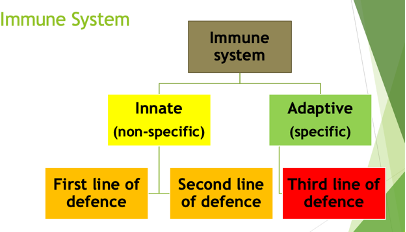
The innate immune response:
Initial response to pathogens.
Rapid and non-specific (same way every time pathogen enters the body). No immunological memory.
Consists of: First line of defense (Barriers to prevent infection (physical, chemical or microbiological)) and second line of defense (Immune responses if barriers are breached (cells, molecules and processes)).
Second Line of Defense:
Not specific, no memory, quick acting. When first line of defense fails.
Includes: Cells (phagocytes, antigen-presenting cells, histamine-releasing cells and natural killer cells), defensive molecules (complement proteins and cytokines including interferons and chemokines), Protective processes (inflammation and fever). Animals can also identify pathogen-associated molecular patterns (PAMPs)
Innate Immune Response in Plants
Main response to infection is a chemical response.
Use pattern-recognition receptors (PRRs) to detect pathogen-associated molecular patterns (PAMPs) which indicates infection by a pathogen.
Plants contain resistance genes, when switched on initiate an overwhelming response which rapidly destroys the pathogen.
Proteins produced when under attack:
Defensins: disrupt the plasma membrane.
Protease inhibitors: inhibit enzymes.
Digestive enzyme inhibitors: proteins that block normal digestion of pathogens.
Hydrolytic enzymes: break down cell walls.
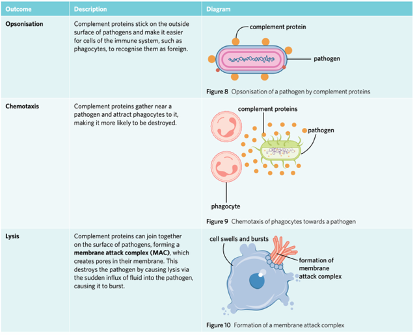
Complement Proteins and Complement system;
Circulate in the blood and can help kill foreign cells (bacteria).
Found in body fluids in an inactive form and are activated as part of the innate immune response. Can also be activated by antigen-antibody complexes which are involved in the adaptive immune response.
Activation results in Trigger a chain reaction (complement cascade) reaction that leads to the lysis (burst pathogens) of the invading pathogens (form membrane attack complexes).
Complement proteins act in the following ways: Opsoniation, Chemotaxis, Lysis.
Clonal selection:
when a cell recognizes a particular antigen and proliferates, creating clones of the original lymphocyte with the specific receptor to match the antigen.
Antigen Presentation:
process by which immune cells display antigens to activate other immune cells.
Self-tolerance:
is the inability of T cells to respond to self-antigens.
Hypersensitivity:
is when the immune system reacts to antigens that pose no threat to the body, causing cell damage and disease.
Immunotherapy: and Cancer Immunotherapy:
Immunotherapy is any treatment that activates/suppresses the immune system to fight disease. Immunotherapy can be used to treat cancer.
Cancer Immunotherapy: Immunotherapy uses immune system to treat cancer and can be more targeted than traditional treatments, improving effectiveness and reducing side effects.
Nonspecific immunotherapy vs Specific immunotherapy
Nonspecific: boosts the overall immune response (e.g. injection of cytokines to stimulate a stronger immune response) but does not directly target cancer cells.
Specific: targets cancer cells by activating the adaptive immune system, including cancer vaccines and monoclonal antibody treatments.
Chimeric mAbs and Humanized mAbs
Chimeric: Antibodies with a mixture of human and mouse components.
Humanized: chimeric mAbs with more human components (or fully human antibodies) produced by transgenic mice. Safer and potentially more effective than mouse antibodies.
Conjugated monoclonal antibodies (mAbs):
mAbs attached to a drug, toxin or radioactive substance. Deliver treatment directly to the cancer cell, reducing damage to healthy cells.
Bispecific monoclonal antibodies (mAbs):
Engineered mAbs that bind to both a cancer cell and an immune cell (such as a T cell) at the same time. Bring these cells together so the immune system can attack the cancer.
An epidemic vs A pandemic vs Endemic
A pandemic: is when the spread of the disease reaches global proportion
Endemic refers to a disease that is present at constant low levels in a population or region/limited to a certain region/geographic area/people
Epidemic refers to an infectious disease that spread rapidly through a nation and affects large numbers of people
Immunity =
the body’s ability to fight off a disease because it knows how to recognise and respond to the pathogen
Host
organism pathogen infects (e.g. humans, animals).