11. Nervous System: Diencephalon & Basal Nuclei

0.0(0)
Studied by 1 person
call kaiCall Kai
learnLearn
examPractice Test
spaced repetitionSpaced Repetition
heart puzzleMatch
flashcardsFlashcards
GameKnowt Play
Card Sorting

1/67

encourage image

There's no tags or description

Looks like no tags are added yet.

68 Terms

1
New cards

diencephalon

consists of multiple nuclei (gray matter)

  • 3 main structures plus nuclei collections deep within cerebrum

    • thalamus → paired structures

    • hypothalamus

    • epithalamus → pineal gland

  • function

    • integration + processing sensory + motor info

    • transmits info to + from cerebral cortex


<p>consists of multiple nuclei (gray matter)</p><ul><li><p>3 main structures plus nuclei collections deep within cerebrum</p><ul><li><p>thalamus → paired structures</p></li><li><p>hypothalamus</p></li><li><p>epithalamus → pineal gland</p></li></ul></li><li><p>function</p><ul><li><p>integration + processing sensory + motor info</p></li><li><p>transmits info to + from cerebral cortex</p></li></ul></li></ul><p></p>
2
New cards

thalamus

(1)

<p>(1)</p>
3
New cards

hypothalamus

(2)

<p>(2)</p>
4
New cards

epithalamus

(3)

<p>(3)</p>
5
New cards

thalamus

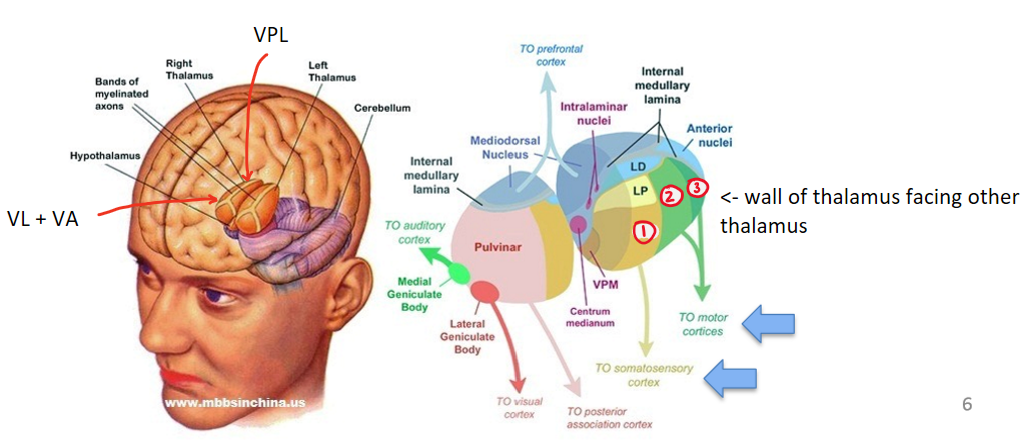
part of diencephalon - 2 oval masses w/ gray matter (nuclei) -

  • bookend third ventricle on each side

  • medial + slightly posteroinferior to basal nuclei

  • functions

    • relation station for sensory info → to different regions of cerebral cortex

      • EXCEPT olfaction

    • relation station for info from cerebellum + basal nuclei → to primary motor cortex

      • coordination

      • control of movement

  • 3 main nucleus

    • ventral posterolateral nucleus (VPL)

    • ventral lateral nucleus (VL) + ventral anterior nucleus (VA)


<p>part of diencephalon - 2 oval masses w/ gray matter (nuclei) -</p><ul><li><p>bookend third ventricle on each side</p></li><li><p>medial + slightly posteroinferior to basal nuclei</p></li><li><p>functions</p><ul><li><p>relation station for sensory info → to different regions of cerebral cortex</p><ul><li><p>EXCEPT olfaction</p></li></ul></li><li><p>relation station for info from cerebellum + basal nuclei → to primary motor cortex</p><ul><li><p>coordination</p></li><li><p>control of movement</p></li></ul></li></ul></li><li><p>3 main nucleus</p><ul><li><p>ventral posterolateral nucleus (VPL)</p></li><li><p>ventral lateral nucleus (VL) + ventral anterior nucleus (VA)</p></li></ul></li></ul><p></p>
6
New cards

nucleus

collection of neuron cell bodies (gray matter) within CNS

7
New cards

ventral posterolateral nucleus (VPL nucleus)

(1) part of thalamus

  • receives peripheral somatic sensory info from body

    • relays to primary somatosensory cortex


<p>(1) part of thalamus</p><ul><li><p>receives peripheral somatic sensory info from body</p><ul><li><p>relays to primary somatosensory cortex</p></li></ul></li></ul><p></p>
8
New cards

ventral lateral nucleus (VL nucleus)

(2) part of thalamus

  • receives input from basal nuclei input

    • relays to primary motor cortex


<p>(2) part of thalamus</p><ul><li><p>receives input from basal nuclei input </p><ul><li><p>relays to primary motor cortex </p></li></ul></li></ul><p></p>
9
New cards

ventral anterior nucleus (VA nucleus)

(3) part of thalamus

  • receives input from basal nuclei input

    • relays to primary motor cortex


<p>(3) part of thalamus</p><ul><li><p>receives input from basal nuclei input </p><ul><li><p>relays to primary motor cortex </p></li></ul></li></ul><p></p>
10
New cards

thalamus

(1)

<p>(1)</p>
11
New cards

third ventricle

(2)

<p>(2)</p>
12
New cards

hypothalamus

part of diencephalon - collection of nuclei forming walls of third ventricle

  • inferior + slightly anterior to thalamus

  • connected via infundibulum to pituitary gland

  • acts as integrating center

  • regulation of visceral body processes

    • receives both somatic/visceral sensory + special sense info

  • link to endocrine + limbic (nervous) systems


<p>part of diencephalon - collection of nuclei forming walls of third ventricle</p><ul><li><p>inferior + slightly anterior to thalamus</p></li><li><p>connected via infundibulum to pituitary gland</p></li><li><p>acts as integrating center</p></li><li><p>regulation of visceral body processes</p><ul><li><p>receives both somatic/visceral sensory + special sense info</p></li></ul></li></ul><ul><li><p>link to endocrine + limbic (nervous) systems</p></li></ul><p></p>
13
New cards

hypothalamus functions

  • regulation of visceral (involuntary) processes

    • paraventricular nucleus:

      • controls + integrates autonomic nervous system activity

    • thirst, appetite, energy stores, temperature regulation

  • production of hormones → endocrine system

    • arcuate nucleus:

      • releasing/inhibiting hormones that regulate pituitary gland hormone release

    • paraventricular + supraoptic nuclei:

      • oxytocin + anti-diuretic hormone/vasopressin

  • learning + memory → limbic system

    • mamillary body:

      • part of Papez circuit


<ul><li><p>regulation of visceral (involuntary) processes</p><ul><li><p><strong>paraventricular nucleus: </strong></p><ul><li><p>controls + integrates autonomic nervous system activity </p></li></ul></li><li><p>thirst, appetite, energy stores, temperature regulation<strong> </strong></p></li></ul></li><li><p>production of hormones → endocrine system</p><ul><li><p><strong>arcuate nucleus: </strong></p><ul><li><p>releasing/inhibiting hormones that regulate pituitary gland hormone release</p></li></ul></li><li><p><strong>paraventricular + supraoptic nuclei:</strong></p><ul><li><p>oxytocin + anti-diuretic hormone/vasopressin </p></li></ul></li></ul></li><li><p>learning + memory → limbic system </p><ul><li><p><strong>mamillary body:</strong></p><ul><li><p>part of Papez circuit </p><ul><li><p></p></li></ul></li></ul></li></ul></li></ul><p></p>
14
New cards

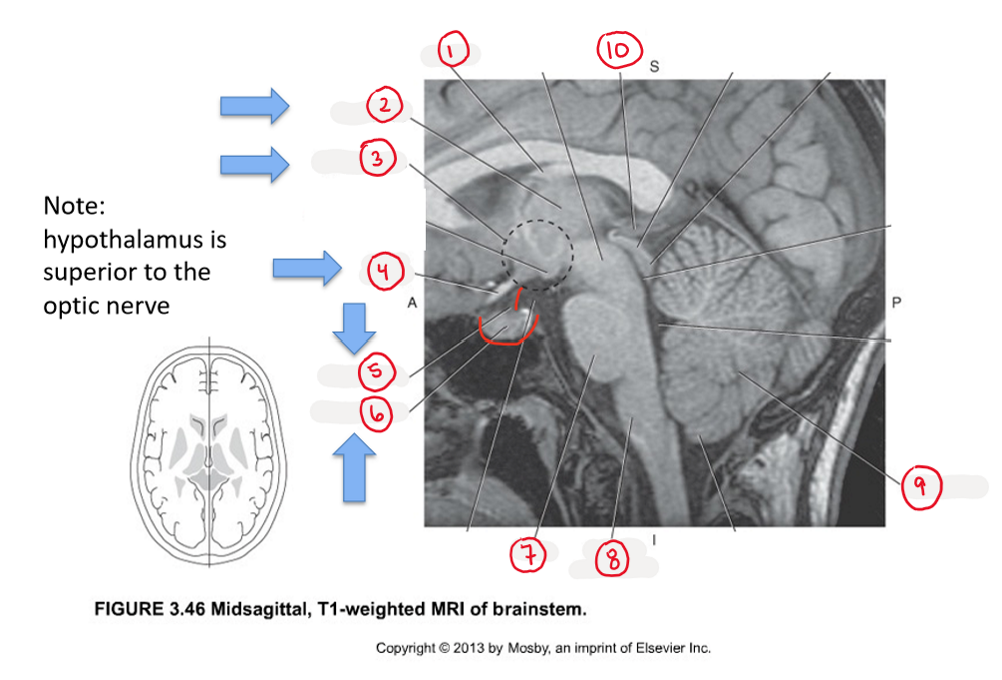
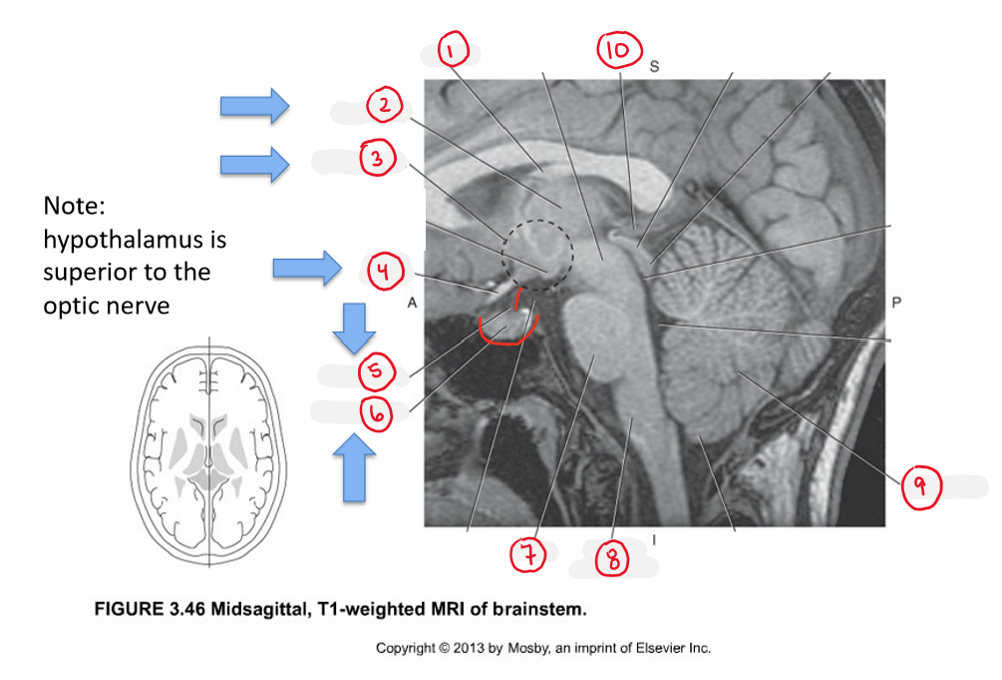
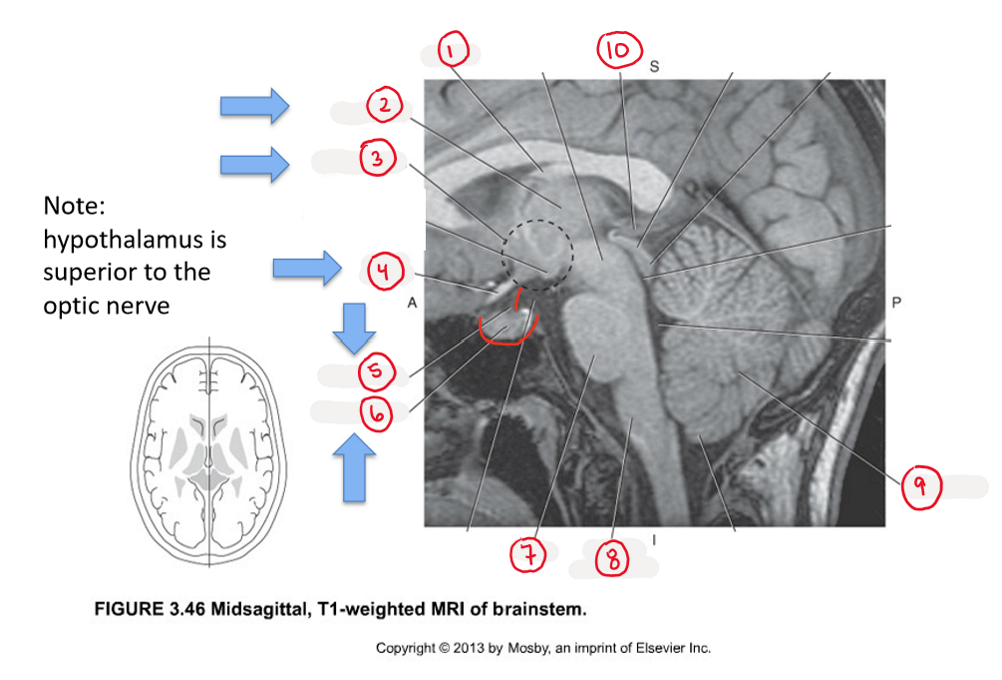
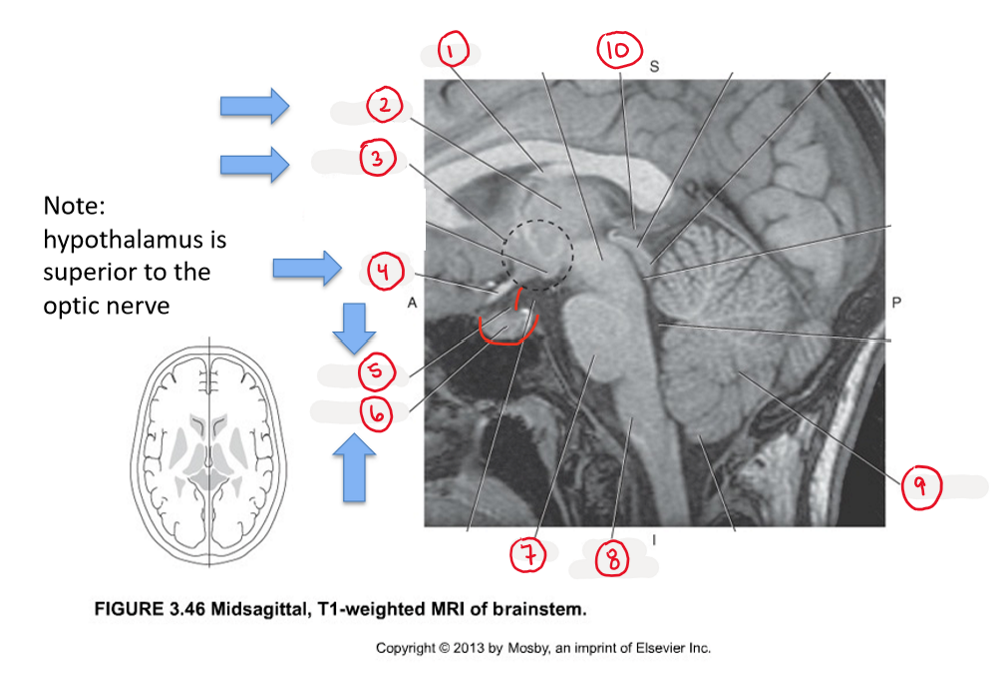
fornix

(1)

<p>(1)</p>
15
New cards

thalamus

(2)

<p>(2)</p>
16
New cards

hypothalamus

(3)

<p>(3)</p>
17
New cards

optic nerve

(4)

<p>(4)</p>
18
New cards

infundibulum

(5)

<p>(5)</p>
19
New cards

pituitary gland

(6)

<p>(6)</p>
20
New cards

pons

(7)

<p>(7)</p>
21
New cards

medulla oblongata

(8)

<p>(8)</p>
22
New cards

cerebellum

(9)

<p>(9)</p>
23
New cards

fornix

(10)

<p>(10)</p>
24
New cards

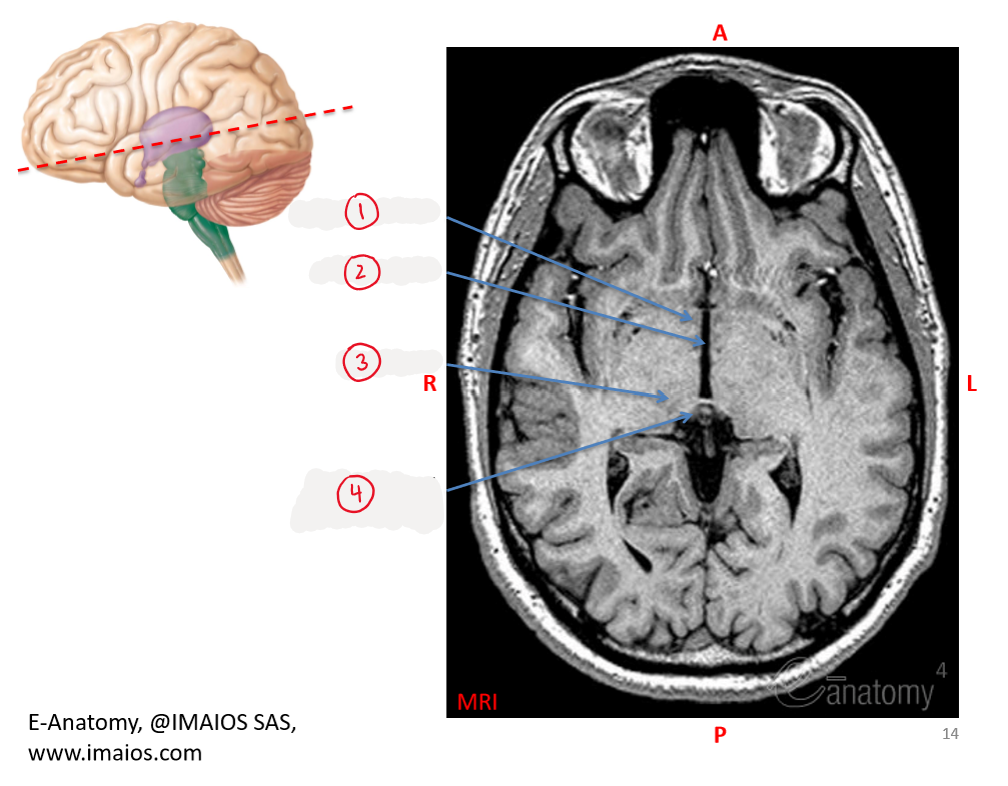
hypothalamus

(1)

<p>(1)</p>
25
New cards

third ventricle

(2)

<p>(2)</p>
26
New cards

thalamus

(3)

<p>(3)</p>
27
New cards

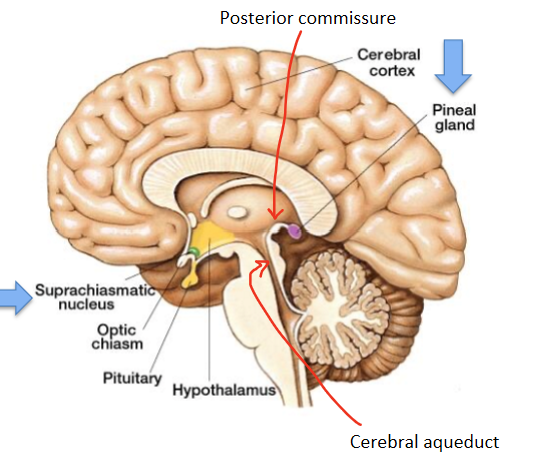
pineal gland

(4) part of epithalamus

28
New cards

epithalamus

part of diencephalon - small region posterior to thalamus

  • contains pineal gland


<p>part of diencephalon - small region posterior to thalamus</p><ul><li><p>contains <em>pineal gland</em></p></li></ul><p></p>
29
New cards

pineal gland

part of epithalamus

  • secretes melanin hormone → regulation of circadian rhythms
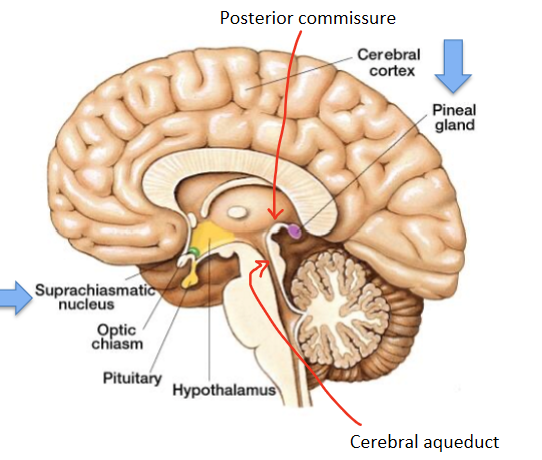

<p>part of epithalamus </p><ul><li><p>secretes melanin hormone → regulation of circadian rhythms </p></li></ul><p></p>
30
New cards

fornix

landmark for anterior commissure

31
New cards

septum pellucidum

thin sheet of nervous tissue connects fornix to corpus callosum

32
New cards

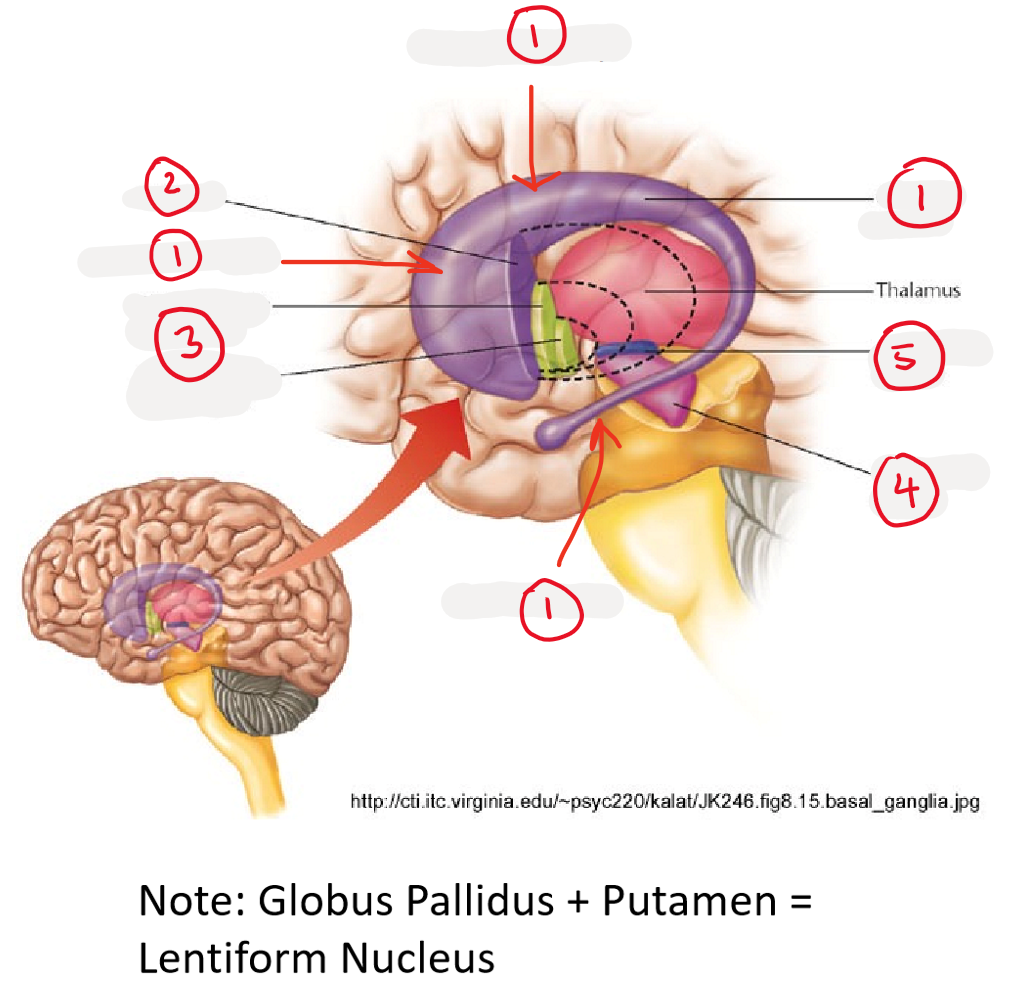
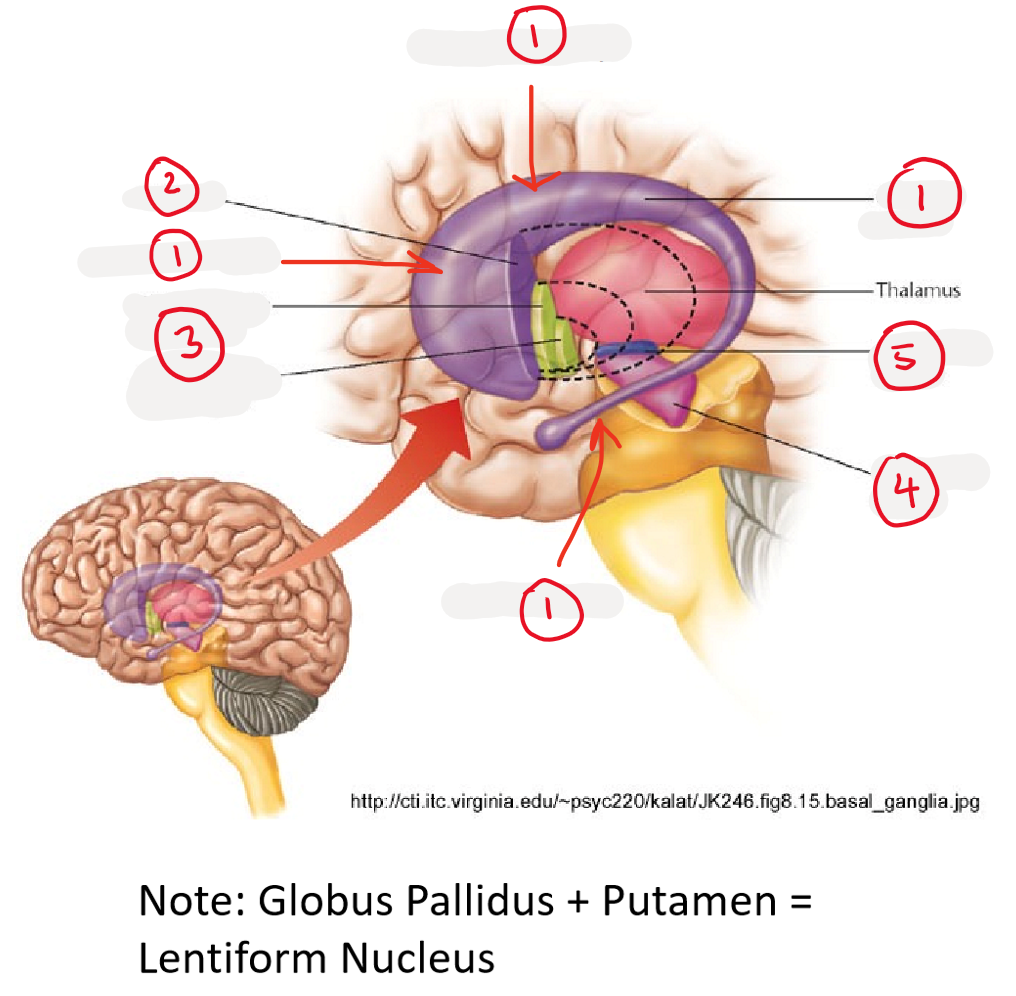
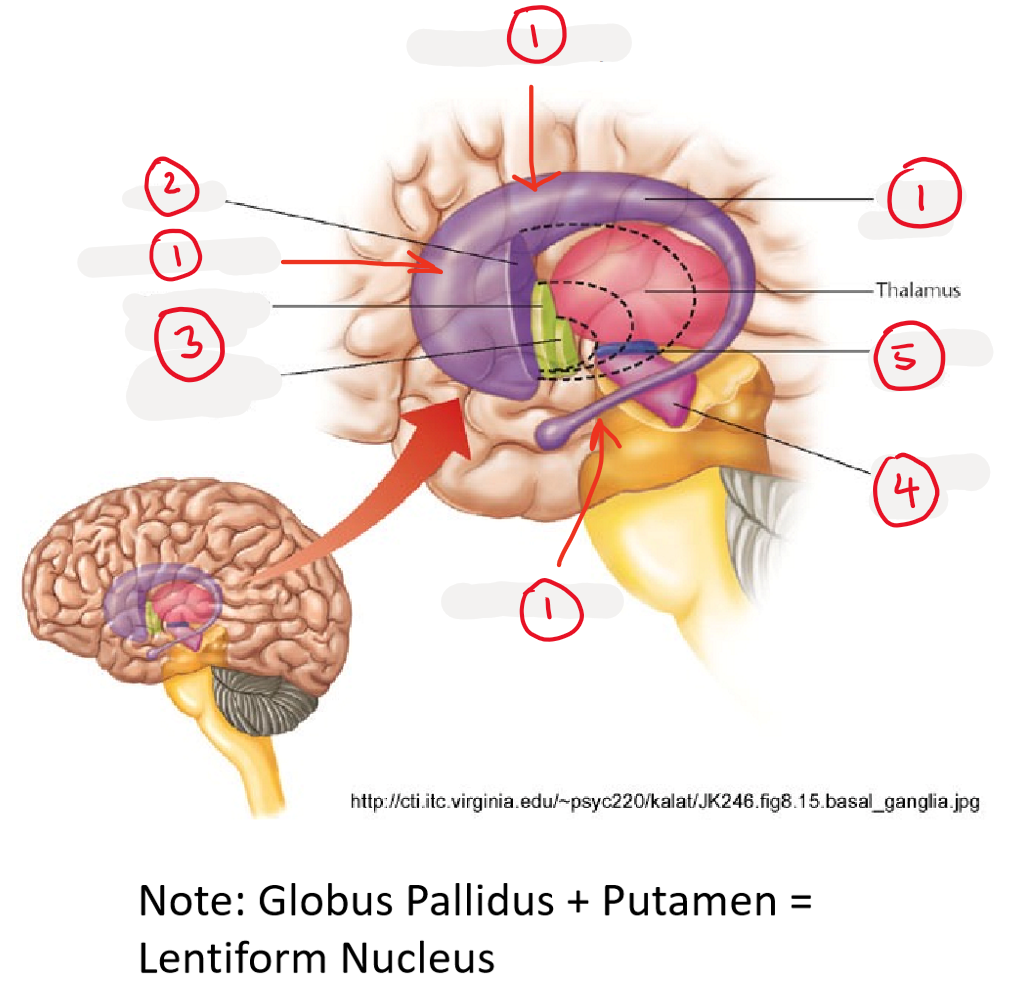
basal ganglia (basal nuclei)

gray matter structures deep within cerebrum + midbrain (substantia nigra)

  • in both cerebral hemispheres → arranged in “comma” shape

  • receives input from cerebral cortex

  • neural circuits involving thalamus → primary cortex output regulation

    • ensures smooth predictable body movements

    • maintenance of posture

    • dysfunction of circuits → Parkinson’s disease

  • includes

    • globus pallidus

    • putamen

    • caudate

    • subthalamic nucleus

    • substantia nigra


<p>gray matter structures deep within cerebrum + midbrain (substantia nigra)</p><ul><li><p>in both cerebral hemispheres → arranged in “comma” shape</p></li><li><p>receives input from cerebral cortex </p></li><li><p>neural circuits involving thalamus → primary cortex output regulation</p><ul><li><p>ensures smooth predictable body movements </p></li><li><p>maintenance of posture </p></li><li><p>dysfunction of circuits → <em>Parkinson’s disease </em> </p></li></ul></li><li><p>includes</p><ul><li><p>globus pallidus</p></li><li><p>putamen</p></li><li><p>caudate</p></li><li><p>subthalamic nucleus</p></li><li><p>substantia nigra</p></li></ul></li></ul><p></p>
33
New cards

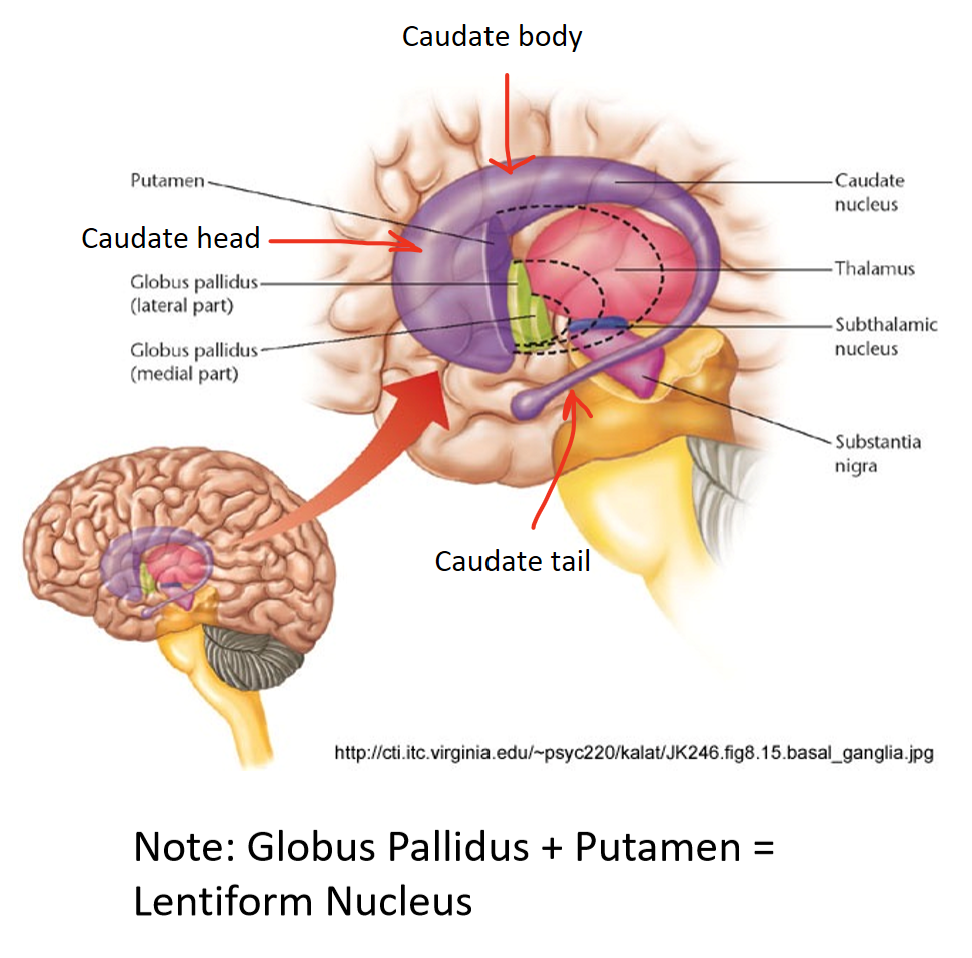
globus pallidus

(3) part of basal ganglia

  • anterolateral to thalamus


<p>(3) part of basal ganglia</p><ul><li><p>anterolateral to thalamus</p></li></ul><p></p>
34
New cards

putamen

(2) part of basal ganglia

  • lateral + extends anterior to globus pallidus


<p>(2) part of basal ganglia</p><ul><li><p>lateral + extends anterior to globus pallidus</p></li></ul><p></p>
35
New cards

caudate

(1) part of basal ganglia

  • superior portion of comma

    • head, body, tail


<p>(1) part of basal ganglia</p><ul><li><p>superior portion of comma</p><ul><li><p>head, body, tail</p></li></ul></li></ul><p></p>
36
New cards

subthalamic nucleus

(5) part of basal ganglia

  • ventral to thalamus


<p>(5) part of basal ganglia</p><ul><li><p>ventral to thalamus </p></li></ul><p></p>
37
New cards

substantia nigra

(4) part of basal ganglia

  • part of midbrain


<p>(4) part of basal ganglia</p><ul><li><p>part of midbrain</p></li></ul><p></p>
38
New cards

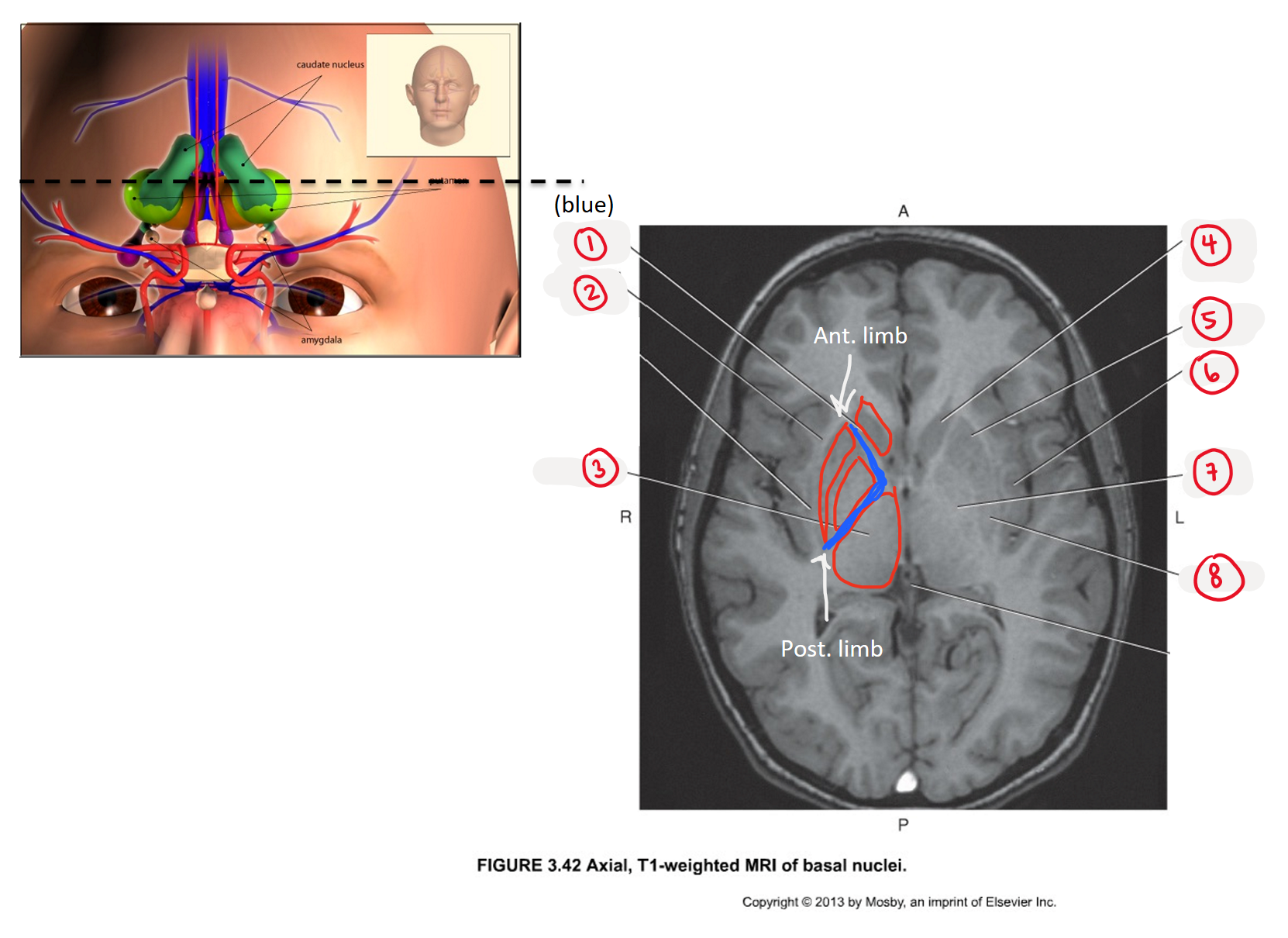
internal capsule

  • anterior limb

    • occupies space b/w putamen + caudate head/body

  • posterior limb

    • occupies space b/w globus pallidus + thalamus
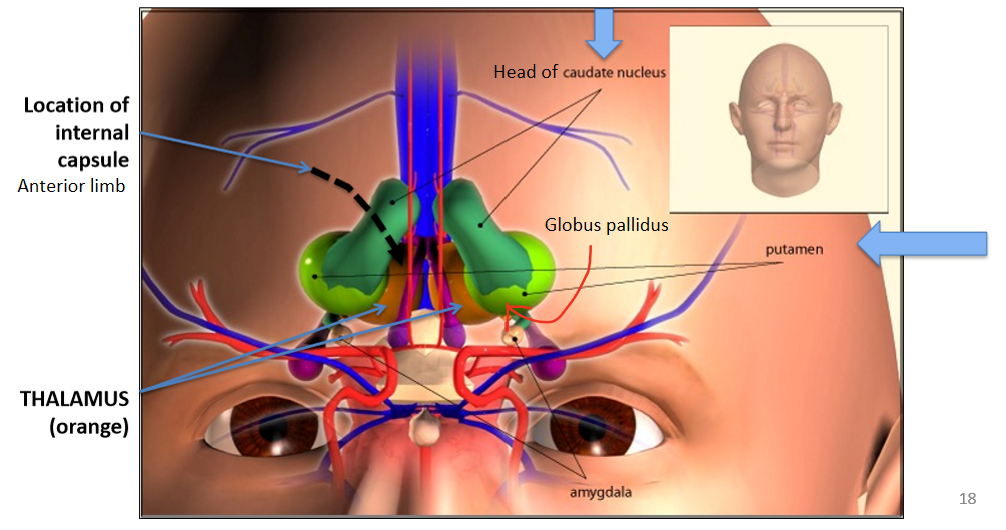

<ul><li><p>anterior limb </p><ul><li><p>occupies space b/w <em>putamen</em> + caudate <em>head/body </em></p></li></ul></li><li><p>posterior limb </p><ul><li><p>occupies space b/w <em>globus pallidus </em>+ <em>thalamus </em></p></li></ul></li></ul><p></p>
39
New cards

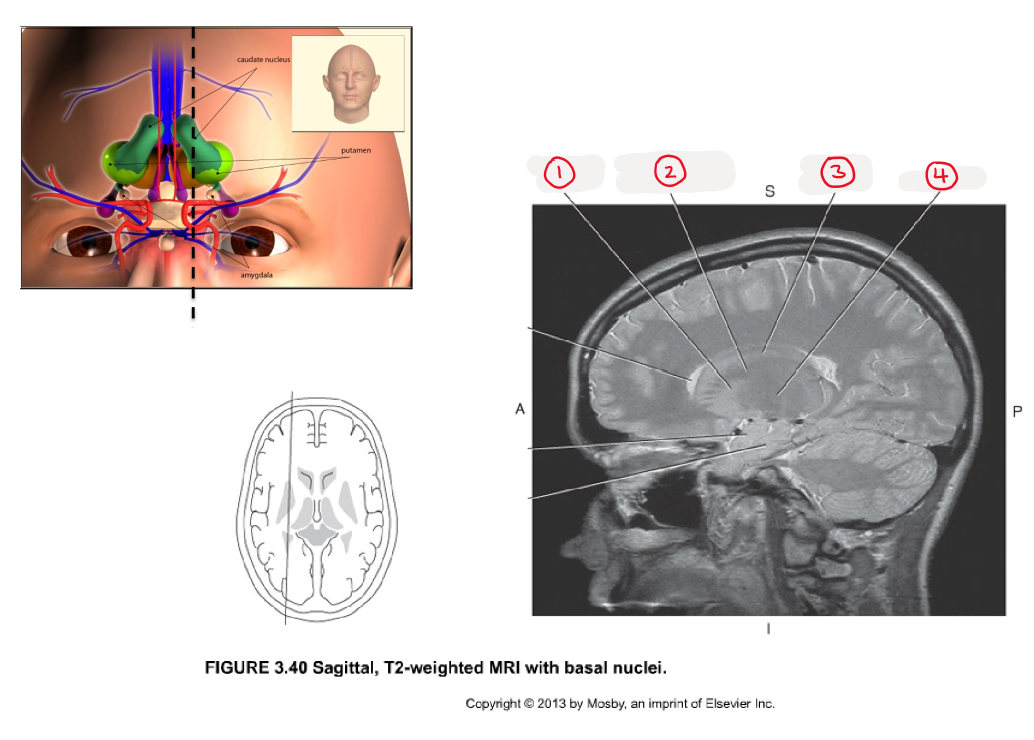
lentiform nucleus

(1) globus pallidus + putamen
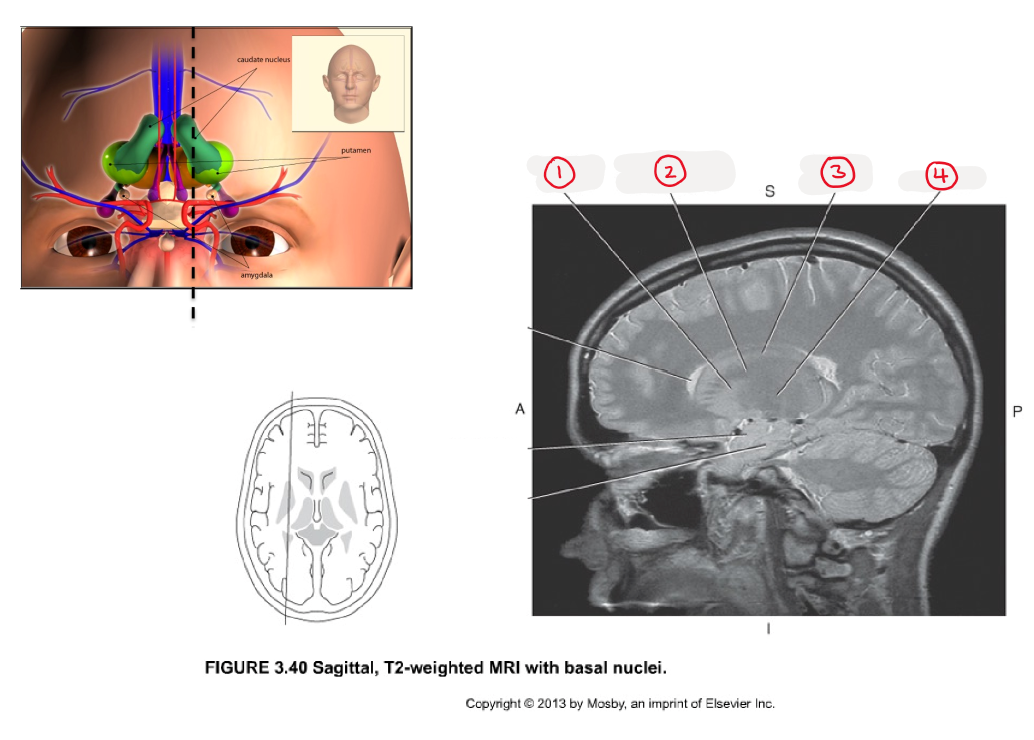
<p>(1) globus pallidus + putamen</p>
40
New cards

internal capsule anterior limb

(2)

<p>(2)</p>
41
New cards

caudate nucleus

(3)

<p>(3)</p>
42
New cards

thalamus

(4)

<p>(4)</p>
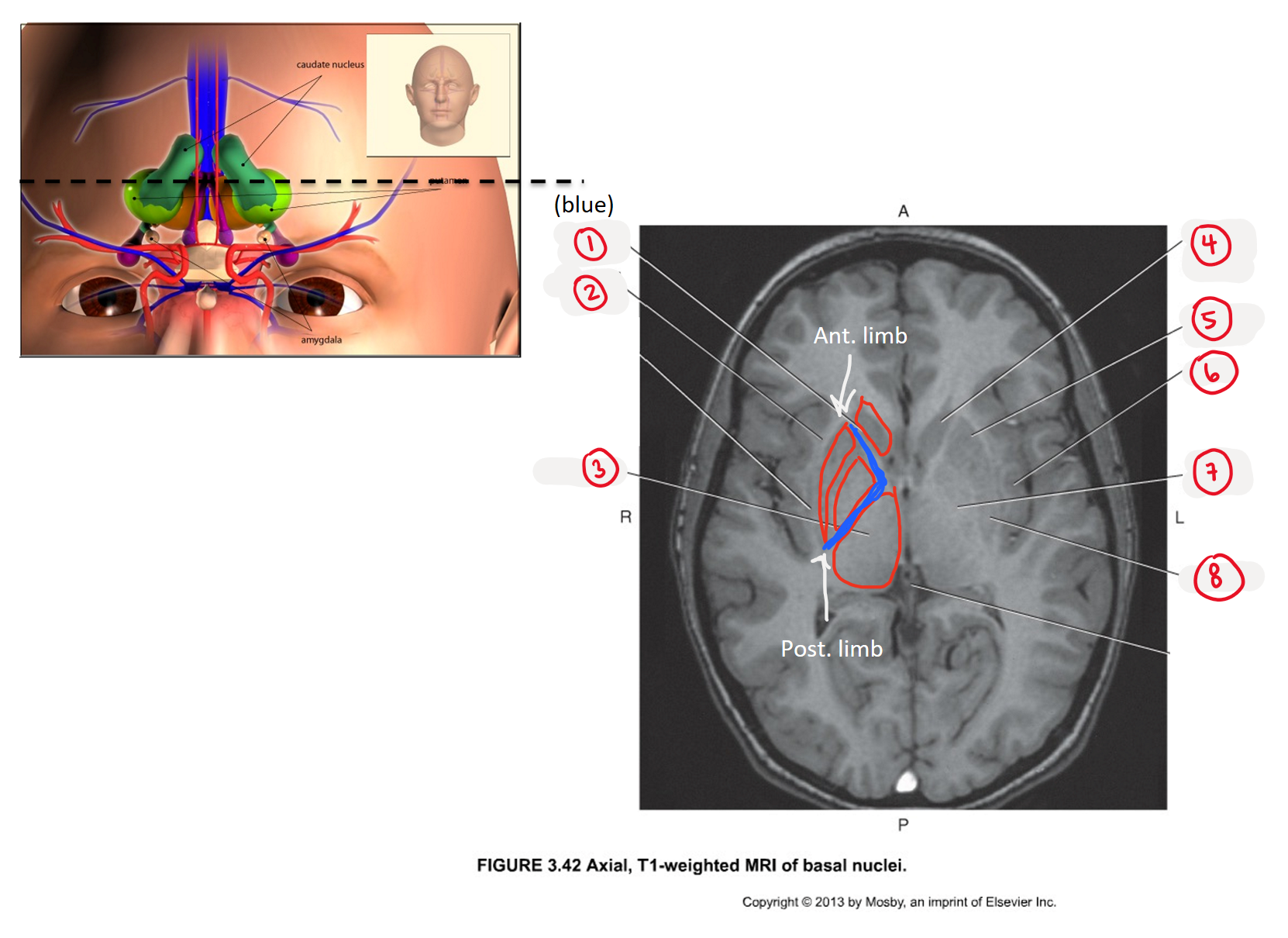
43
New cards

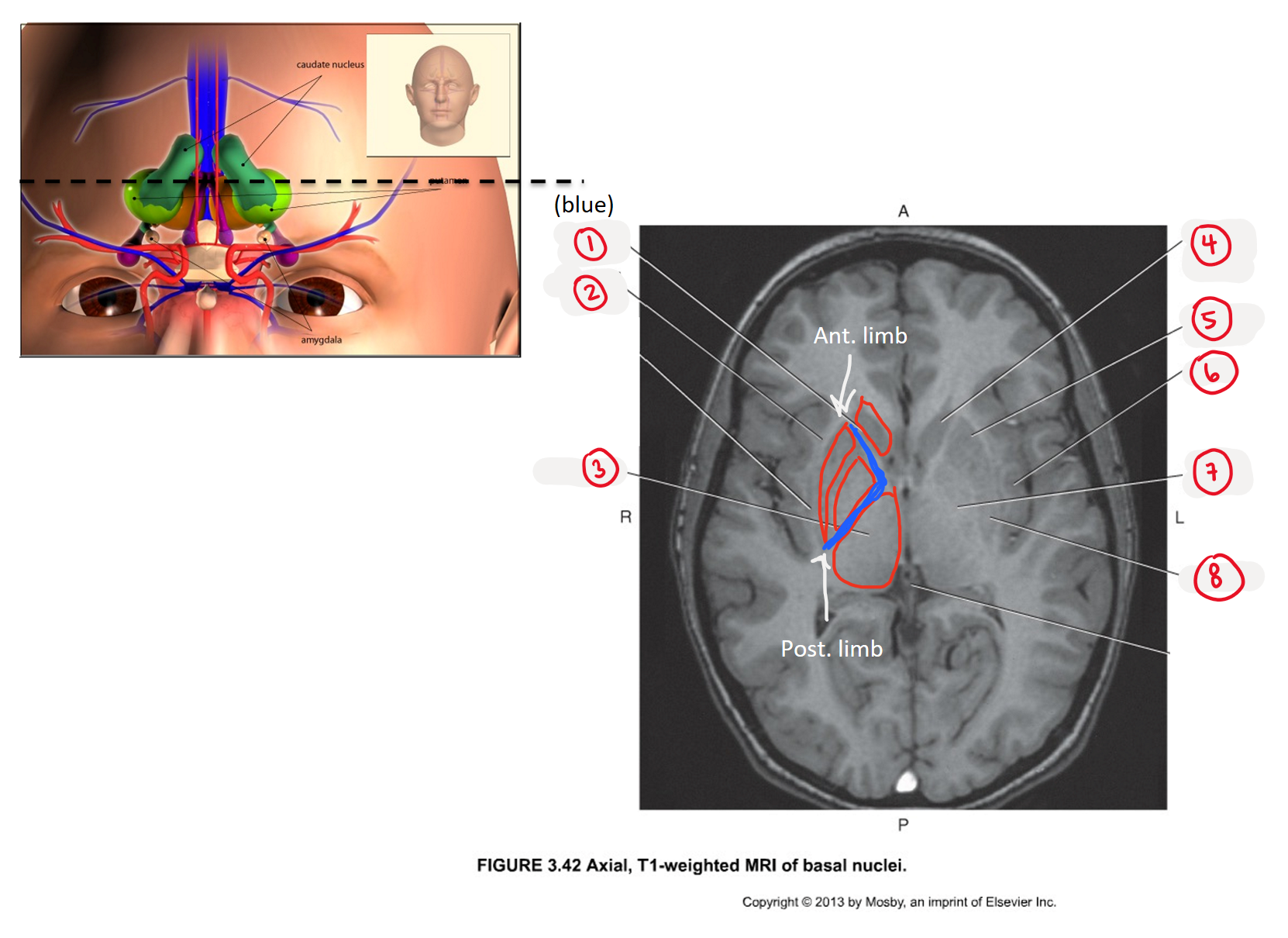
internal capsule

(1)

<p>(1)</p>
44
New cards

external capsule

(2)

<p>(2)</p>
45
New cards

thalamus

(3)

<p>(3)</p>
46
New cards

caudate nucleus head

(4)

<p>(4)</p>
47
New cards

lentiform nucleus

(5) globus pallidus + putamen
<p>(5) globus pallidus + putamen</p>
48
New cards

insula

(6)

<p>(6)</p>
49
New cards

globus pallidus

(7)

<p>(7)</p>
50
New cards

putamen

(8)

<p>(8)</p>
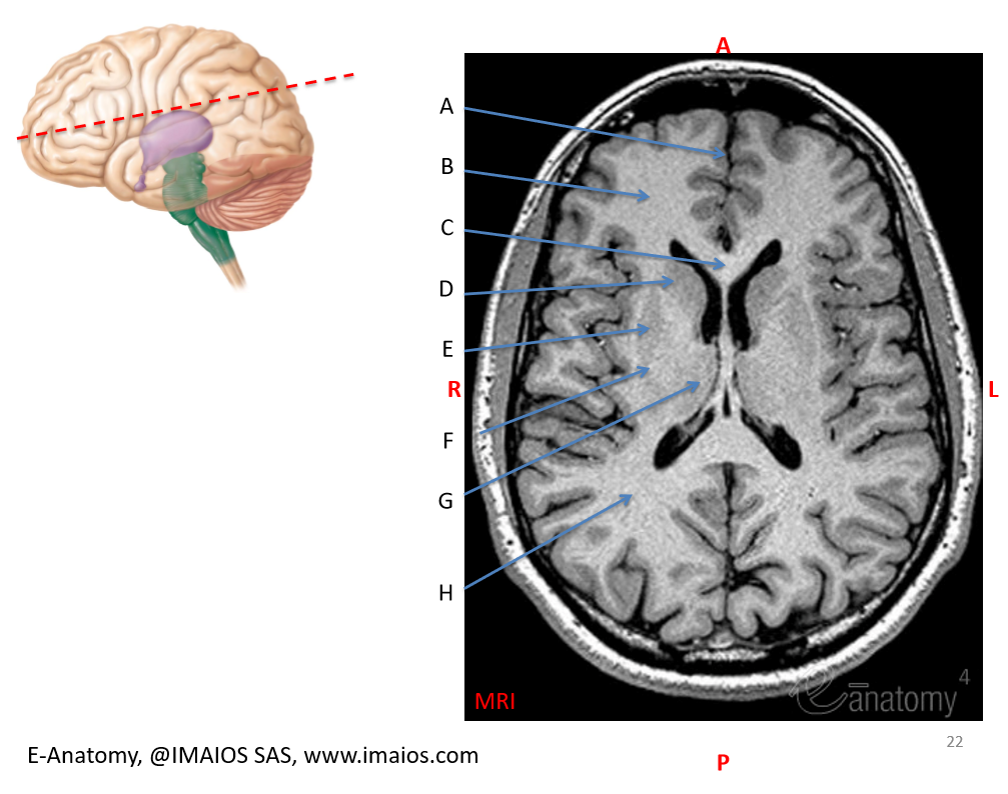
51
New cards

internal capsule

(1)

<p>(1)</p>
52
New cards

external capsule

(2)

<p>(2)</p>
53
New cards

corpus callosum

(3)

<p>(3)</p>
54
New cards

caudate nucleus head

(4)

<p>(4)</p>
55
New cards

lentiform nucleus

(5)

<p>(5)</p>
56
New cards

longitudinal fissure

(A)

<p>(A)</p>
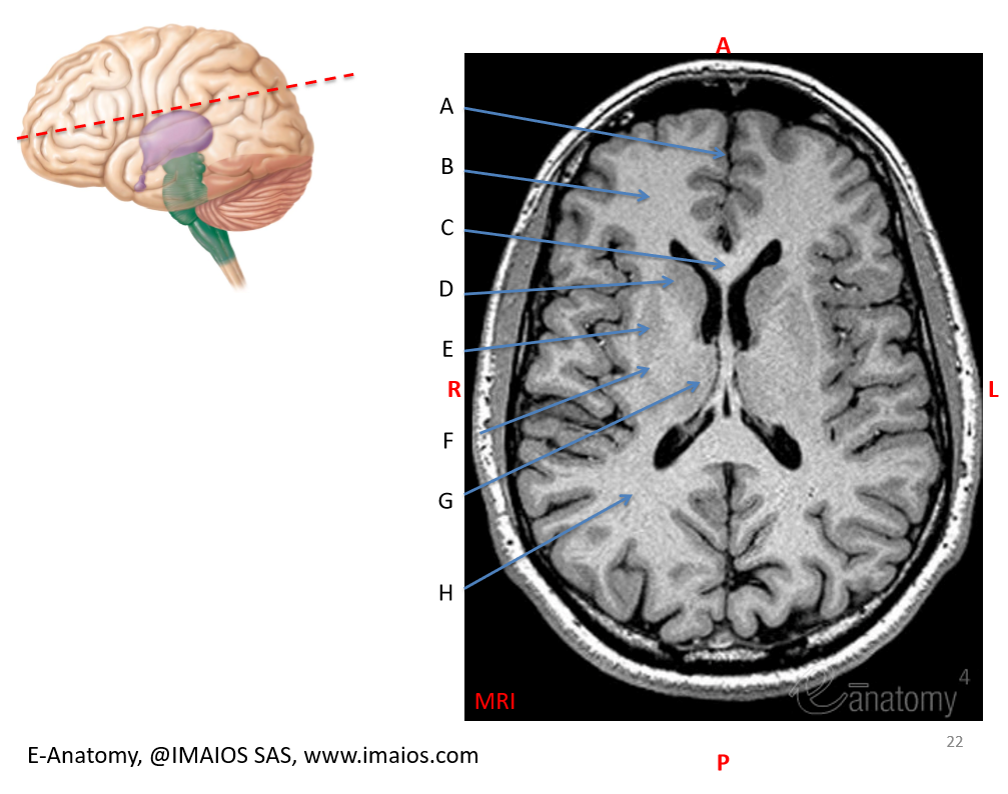
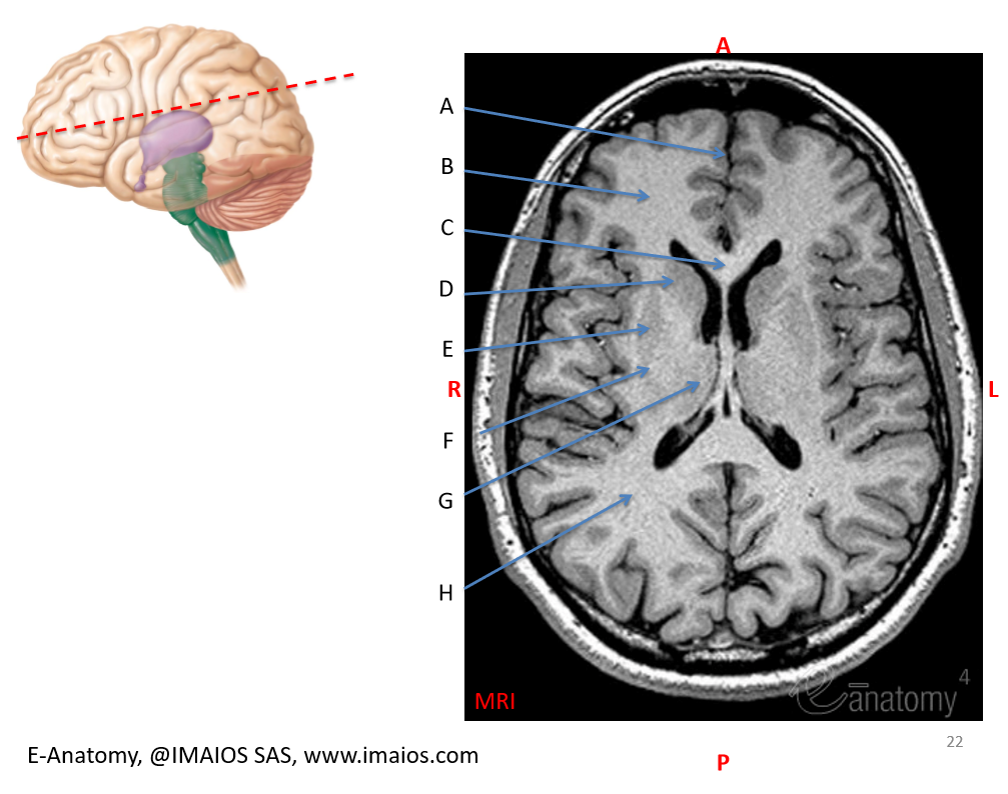
57
New cards

frontal lobe

(B)

<p>(B)</p>
58
New cards

corpus callosum (corpus callosum genu/rostrum)

(C)

<p>(C)</p>
59
New cards

caudate nucleus head

(D)

<p>(D)</p>
60
New cards

putamen

(E)

<p>(E)</p>
61
New cards

globus pallidus

(F)

<p>(F)</p>
62
New cards

thalamus

(G)

<p>(G)</p>
63
New cards

parietal lobe

(H)

<p>(H)</p>
64
New cards

basal nuclei function (basal ganglia function)

  • smooth, controlled, predictable body movements + posture maintenance

    • dependent on skeletal muscles receiving correct amount of stimulation from primary motor cortex

  • basal nuclei receives input from cerebral cortex + substantia nigra

  • prior to initiation of skeletal muscle stimulation → neural circuits in basal nuclei engage to strike right balance b/w:

    • RELEASE brake = direct pathway

      • facilitate certain movements

    • APPLY brake = indirect pathway

      • prevent certain movements


65
New cards

excitatory neuron

pre-synaptic neuron possessing + releasing NTs that cause AP to fire in post-synaptic neuron

  • eg. glutamate, Ach


66
New cards

inhibitory neuron

pre-synaptic neuron possessing + releasing NTs that prevent AP from firing in post-synaptic neuron

  • eg. GABA


67
New cards

Parkinson’s disease (hypokinesia)

  • loss of dopaminergic neurons in substantia nigra that act on neurons of caudate/putamen

    • less excitatory input to caudate/putamen

      • thalamus fires to primary motor cortex = less control

  • progressive symptoms

    • tremor

    • imprecise + involuntary movements

    • muscular rigidity

    • cognitive decline


68
New cards

basal nuclei pathways

involve direct + indirect pathways

  • loss of substantia nigra excitatory stimulation to caudate/putamen = Parkinson’s


<p>involve direct + indirect pathways</p><ul><li><p>loss of substantia nigra excitatory stimulation to caudate/putamen = Parkinson’s</p></li></ul><p></p>