Lecture 19: Neurogenesis, Differentiation, and Migration
 Call Kai
 Learn
 Practice Test
 Spaced Repetition
 Match
 Flashcards
 Knowt Play
1/43

There's no tags or description
Looks like no tags are added yet.
44 Terms
How many neurons is required for proper operation of the nervous system?
100 billion
What are the steps of human brain development?
begins as a tube
neurogenesis, synaptogenesis pathway formation
wiring (establishing correct connections and modify)
fine tuning of wiring based on experience
How does the neural tube and crest form?
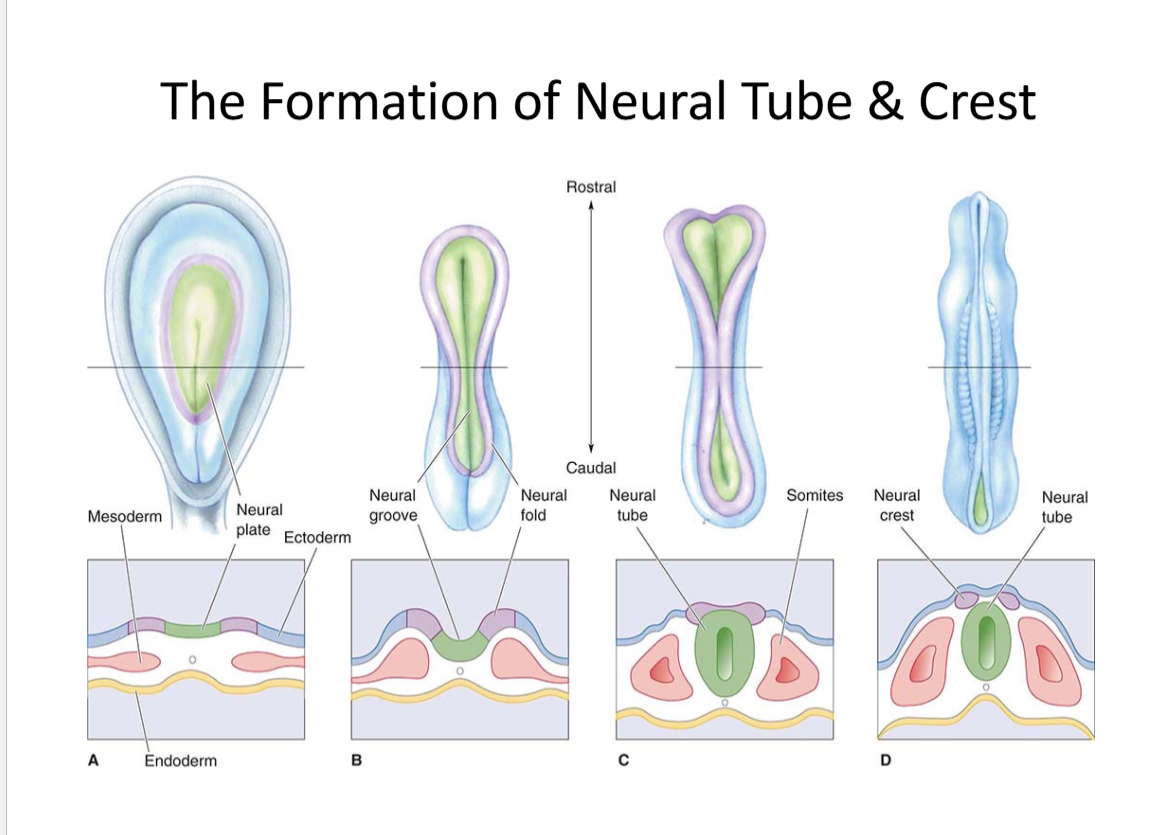
What is anencephaly?
failure to close anterior neurotube, leading to degeneration of the forebrain and skull
What is spina bifida?
failure to close posterior neurotube, leading to the failure of the posterior spinal cord to form the neural plate (skull)
What causes and increase risk of neurotube formation defects?
folic acid deficiency
What happens at the neural plate?
the progenitors of the nervous system arise
What is the molecular mechanism of neural plate induction?
BMP (bone morphogenetic protein) in ventral ectoderm prevents neural induction and promotes epidermis formation
BMP inhibitors (Noggin, Chordin, Follistatin) induces neural tissue/plate in dorsal ectoderm
What happens to the neural plate?
invaginates to become the elongated, dorsally located neural tube
What is the neural crest?
cells between the neural tube and epidermal ectoderm
What does the neural crest give rise to?
the peripheral and autonomic nervous system
What does the neural tube give rise to?
the brain and spinal cord
What is true of the neural primordim?
has intrinsic determinants (proliferative potentials, cellular phenotype) driven by transcription factors
How do the cells in the neuroectoderm become neuroblasts?
Proneural clusters
form clusters of cells that initiate neural fate rather than epidermal fate
Lateral inhibition
cells within the proneural cluster interact to decide which of the cells will ultimately become neurons
What defines the # and pattern of neuroblasts?
cell-cell interactions within the neuroectoderm
Describe step one of cells becoming neuroblasts.
Proneural genes:
cause the cells with proneural clusters to initiate a neural cell fate rather than an epidermal cell fate
proneural genes are basic helix-loop-helix (bHLH) transcription factors (ex. ASH, NeuroD) important for their regulation of nervous system development
Describe step two of cells becoming neuroblasts.
Neurogenic genes:
encode Delta (Dl)-Notch(N) Signaling Pathway genes important for intercellular communication that mediates lateral inhibition
notch signaling pathway activates transcription factors (E(spl)-C) that inhibit proneural genes (AS-C)
What is symmetric mitosis?
increase the number of epithelial neural progenitor cells
What is asymmetric mitosis?
results in a daughter cell that delaminates from the epithelium and becomes neurons.
Where is Numb first expressed?
apically in neural progenitors
Where is Numb maintained?
only in epithelial daughter cells but not the delaminating neural precursor
What do neurons first arise in vertebrates?
glia
What do radial glial cells do?
divide to become oligodendrocytes, astrocytes, ependymal cells, and neural stem cells
Where does adult neurogenesis happen?
Subventricular zone
adjacent to the lateral ventricle where neurons are produced that subsequently migrate to the olfactory bulb via the rostral migratory stream
Dentate gyrus of the hippocampus
where proliferating neural precursors and quiescent neural stem cells are found in a zone immediately adjacent to the dentate gyrus (subgranular zone)
Why are neuroscientists interested in adult neurogenesis?
Postmitotic neurons and oligodendrocytes
in contrast to organs, most cells in the adult mammalian nervous system are permanently postmitotic and thus cannot be regenerated once they die
Integration of adult-born neurons into the nervous system
ABNs contribute to diverse cognitive tasks such as spatial memory, the encoding temporal information into memories, promoting cognitive flexibility, facilitating discrimination between memories of similar events, and mediating memory elimination/forgetting
Aging, AD/ADRD, and chronic injury/inflammation decreases adult neurogenesis
# of neural stem cells, stem cell proliferation and differentiation into neurons, and/or survival of newborn neurons
Therapeutic Potential
Major question: can we reactivate the neurogenesis mechanisms and reinstruct neurogenesis after brain injury or in aged brains?
What is the site of primary neurogenesis in the CNS?
ventricular zone
What end of the neural tube differentiates to form the 3 main cerebral vesicles?
the rostral end
What are neuroepithelial cells?
elongated bipolar cells that span the entire wall of cerebrum
What faces the cerebral vesicles?
the neuroepithelium
Where are neural precursor cells born?
the ventricular layer
In which way do neural precursor cells migrate?
migrate away from the ventricular surface
Where do older neurons lie?
in the deeper layers
How do pyramidal cells and astrocytes migrate?
vertically from ventricular zone by moving along radial glial fiber
What are the other origins of layer I neurons?
rostral and basal forebrain and cortical hem
Describe how cell migration happens.
first neurons to migrate take up residence in subplate/superficial layer which eventually disappears
cells to divide migrate to the cortical plate
the first to arrive at the cortical plate become layer VI followed by V, IV, and so on (inside-out model)
What is the inside-out model?
3H-thymidine birthday dating (cells born later are lighter)
What did Rakic and Sidman do?
used Golgi impregnation to map raidal glial cells in the developing primate neocortex
EM to visualize the relationship of young neurons to the glial fibers
Describe the cellular organization of migrating neurons?
as neurons migrate, the polarity complex mPARa and downstream signaling pathways, polarize migrating cells
mPARa localizes to centrosome
the neurons move along the glia fiber via Myosin IIB-mediated contraction of F-actin in leading process
List the non-radial pathways of neuronal migration.
radial glial pathway
migration of inhibitory interneurons from the basal forebrain into the developing neocortex
migration of neurons from the SVZ to the olfactory bulb along the rostral migratory system
migration of progenitors from the rhombic lip to cerebellar cortex
the precerebellar nuclei of the brainstem
Describe the migration of GABAergic interneurons.
GABAergic interneurons and oligodendrocytes tangentially migrate from ganglionic eminences in the ventral telecephalon into the cortical plate in a mammalian embryo
Do neurons migrate after birth?
human neurons continue to migrate up to 5 months after birth (critical period) and become GABAergic interneurons and may be subjected to experience-dependent circuit recruitment and refinement
What is true of neurons that originate around the anterior pole of the lateral ventricle?
Many of these neurons are oriented radially and appear to migrate to reach the cortex. Ventrally, these neurons migrate using the RMS and the MMS, which target the olfactory bulb and medial prefrontal cortex
What can cause a neuronal migration disorder?
abnormal migration of neurons in the developing brain and nervous system
structurally abnormal or missing areas of the brain in the cerebral hemispheres, cerebellum, brainstem, or hippocampus
What happens in Lissencephaly?
Cause: layer IV is compromised of neurons that migrated a certain distance from the ventricles but failed to reach their normal destinations
Symptoms: severe psychomotor retardation and intractable seizures