bio 190 exam 2 practice questions
 Call Kai
 Learn
 Practice Test
 Spaced Repetition
 Match
 Flashcards
 Knowt Play
 Podcast
1/115

There's no tags or description
Looks like no tags are added yet.
Name | Mastery | Learn | Test | Matching | Spaced | Call with Kai | Chat |
|---|
No analytics yet
Send a link to your students to track their progress
116 Terms
what is the first law of thermodynamics?
energy cannot be created or destroyed; energy can be transferred
what is the second law of thermodynamics?
the transfer of energy from one form to another increases the entropy
exergonic reactions have ___ free energy than reactants therefore free energy is released during the reaction.
less
endergonic reactions have ___ free energy than reactants therefore additional energy is needed during the reaction.
more
___ are ___ in living cells that increase rates of chemical reactions
enzymes; catalysts
what is affinity?
attraction of an enzyme for a substrate
oxidation is the ___ of electrons and reduction is the ___ of electrons.
removal; addition
what are the 4 stages that break down glucose in order?
glycolysis, breakdown of pyruvate into acetyl group, citric acid cycle, oxidative phosphorylation
list the 3 phases of glycolysis.
energy investment phase, cleavage phase, energy liberation phase
what are the products in pyruvate oxidation for 1 glucose?
2 Acetyl coA, 2CO2, 2NADH
1 glucose yields 2 Acetyl coA, which then yields what in the citric acid cycle? Select all that apply
4 CO2
6 NADH
2 FADH2
2 ATP
chemiosmosis refers to the chemical synthesis of ATP as a result of pushing ___ across a membrane through a concentration gradient.
H+
the final electron acceptor at the end of the ETC is...
O2
in the absence of O2 what is the final electron acceptor in anaerobic respiration?
NO3-
fermentation utilizes lactic acid production to oxidize ___ to continue glycolysis.
NADH
diagram the reactions in the chloroplast
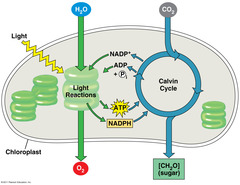
openings in the leaf surface is called the ____, which allows the passage of CO2 and O2
stomata
light consists of energy in the form of...select all that apply
- electric
- magnetic fields
when light encounters a molecule it may...select all that apply
- bounce back off the molecule changing its path towards a different direction
- pass through the molecule
- be absorbed by the molecules (pigments)
___ give a green coloration while ___ give yellow/orange/red coloration
chlorophyll a and b; carotenoids
photosystem I and II generate...select all that apply
- NADPH
- O2
- H+ gradient
what are the two main components of PS I and PS II? select all that apply
- light harvesting complex
- reaction center
in the reaction center, what 2 things are oxidized to generate O2 and e-?
P680 pigment and water
order the 3 phases of the calvin cycle.
1) carbon fixation
2) reduction and carbohydrate production
3) regeneration of RuBP
in the calvin cycle, what is "regeneration of RuBP"?
10 G3P is used to reproduce RuBP using 6ATP and 2G3P used to produce glucose and sugars
in the calvin cycle, what is "reduction and carbohydrate production"?
using 12 ATP as source of energy and 12 NADPH donates high energy electrons, 12 G3P is produced
in the calvin cycle, what is "carbon fixation"?
6CO2 is incorporated and enzyme rubisco catalyzes reaction and 6-carbon intermediate splits to 2 3-carbon molecule
what is it called when rubisco adds O2 to RuBP when levels of CO2 is low and O2 is high, causing a molecule of CO2 to be released, reducing the efficiency of photosynthesis
photorespiration
in CAM plants, stomata open in the ___ and store CO2. stomata close in the ___ to conserve water and calvin cycle takes place.
night; day
why is cell communication necessary? select all that apply
- to respond to changing environment
- to communicate with each other in a system especially for multicellular organisms
what are the 5 types of cell signaling?
- paracrine
- autocrine
- direct-intercelllular
- contact-dependent
- endocrine
what is the function of endocrine cell signalling?
signals (hormones) are released into the blood and affect target cells that are far away
what is the function of paracrine cell signaling?
cells release signaling that affects nearby cells
what is the function of autocrine cell signaling?
cells secrete signaling molecules that bind to their own surface receptors
what is the function of direct-intercellular cell signaling?
cell junctions allow signals to directly pass from one cell to another
what is the function of contact-dependent cell signaling?
molecules bound to the surface of cells serve as signals to cells coming in contact with them
what are the three stages of cell signaling?
1) receptor activation
2) signal transduction
3) cellular response
in cell signaling, what is the purpose of receptor activation?
signal molecule bind causes conformational change in receptor & activates function
in cell signaling, what is the purpose of signal transduction?
activated receptor stimulates proteins, forming signal transduction pathway
in cell signaling, what is the purpose of cellular response?
signal transduction pathway affects functions/amount of cellular protein, creating cellular response
a ligand binds ___ to its receptor with high specificity
noncovalently
when [ligand] is above Kd value, most receptors ___ them; if [ligand] is substantially below the Kd value, most receptors ___ their ligand.
will bind to; will not bind to
what is a dissociation constant?
Kd
what is the equation for the dissociation constant?
Kd = k(off)/k(on)
what is the dissociation constant used for?
quantify affinity receptors for ligands
what does k(off) stand for in the dissociation constant equation?
rate ligand-receptor complex dissociates
what does k(on) stand for in the dissociation constant equation?
rate binding occurs
which of the following are types of cell surface receptors?
- ligand-gated ion channels
- enzyme-linked
- g-protein coupled
GPCR (G-proteins-coupled receptors) interact with intracellular proteins called ___ which can bind ___ and ___.
G proteins; GDP; GTP
what does GPCR stand for?
G-proteins-coupled receptors
what are the 3 cell surface receptors?
- enzyme-linked receptors
- G-protein-coupled receptors
- ligand-gated ion channels
intracellular receptors, found in cytosol or nucleus, bind signal molecules that are small and hydrophobic like...
steroid hormones (estrogen, testosterone)
what criteria must the genetic material fulfill?
information, replication, transmission, variation
based on the avery, macleod, and mccarty experiment, which mouse is not likely to die
mouse injected with dna and dnase
what is the level of complexity of the structure of dna, from lowest to highest?
nucleotides, strand, double helix, chromosomes, genome
one complete turn of a dna is ___ nm and consists of __ base pairs.
3.4; 10
rosalind franklin analyzed dna diffraction patterns which indicated...select all that applies
- helical structure
- uniform diameter of ~2nm, diameter too big to be a single strand
- had repeating structure
during replication, the 2 parental strands separate and serve as ___
template strands
after 2 replications, what is generated based on the semiconservative mechanism?
50%N14N15, 50%N14N14
which is involved in replicating the lagging strand?
- okazaki fragments
- primase
- dna ligase
rna primers are removed by the action of the enzyme ___
dna polymerase
arrange the following proteins int he proper order in which they participate in dna replication
1) helicase
2) single-strand binding proteins
3) primase
4) dna polymerase I
what are the 2 important functional constraints of DNA polymerase?
- dna polymerase cannot begin synthesis on a base template strand, it can only extend the pre-existing strand
- dna polymerase synthesizes dna in a 5' to 3' direction
what is the level of dna compaction from complex to simplest?
chromosomes, heterochromatin, euchromatin, 30-nm fiber, nucleosomes, double helix
what are nucleosomes composed of?
8 histone proteins (2H2A, 2H2B, 2H3, 2H4) and 146/147 base pairs of DNA
___ produces an RNA copy of a gene while ___ interprets the nucleotide sequence in the messenger RNA to build a polypeptide.
transcription; translation
a gene is
an organized unit of nucleotide sequences that enables a segment of DNA to be transcribed into RNA, generating a functional product
what are the 3 stages of transcription?
1) initiation
2) elongation
3) termination
what is the function of initiation in transcription?
a recognition step where the promoter functions as a recognition site
what is the function of elongation in transcription?
RNA polymerase synthesizes RNA
what is the function of termination in transcription?
RNA polymerase reaches a terminator, releases transcript, dissociate from DNA
the basic features of transcription are similar among all organisms but eukaryotes
involves more proteins
what is the significance of the 5' cap in eukaryotic mRNA?
it is recognized by a variety of proteins and is needed for the mRNA to exit the nucleus and bind to ribosomes
what is the significance of the 3' poly A tail in eukaryotic mRNA?
increases the stability of the mRNA in the cytosol
___ contains an anticodon that is complementary to ___
tRNA; mRNA
the polypeptide is synthesized from the ___ to the ___.
N-terminus; C-terminus
the ribosomal binding site on an mRNA is...
before the start codon
tRNA's of all species share common features: select all that apply
- 2D cloverleaf structure
- 3' single-stranded region is amino acid attachment
- 3D structure involves an additional folding
what is aminoacyl-tRNA synthetase?
an enzyme that catalyzes the attachment of amino acids to tRNA molecules
what is elongation in translation?
ribosome moves in the 5' to 3' direction from start to stop codon, synthesizing a polypeptide
what is true of bacterial ribosomes?
ribosome composition includes 70S, 30S, 50S
what is the equation for photosynthesis?
6CO2 + 6H2O →light energy→ C6H12O6 + 6O2
what is the equation for cellular respiration?
C6H12O6 + 6 O2 → 6 CO2 + 6 H2O + ATP energy
what is photosystem I?
when light strikes, high energy electron is removed from P700 and transferred to primary electron acceptor making NADPH
what are the products of photosynthesis?
O2, NADPH, ATP
where is O2 produced in phtosynthesis?
thylakoid lumen
where is NADPH produced in photosynthesis?
stroma
where is ATP produced in photosynthesis?
stroma
what is photosystem II?
the initial step where light excites electrons in pigment molecules P680 to pheophytin; oxidizes water, generates O2 and adds H+ to thylakoid lumen
what is the electron transport chain?
protein complex group and small molecules in inner membranes where e- is passed from one component to next through redox reactions and produces H+ electrochemical gradient
what is the process of photosystems in order?
1) photosystem II
2) electron transport chain
3) photosystem I
what is photophosphorylation?
ATP synthesis in chloroplasts
what happens in the reaction center of photosystems?
redox reactions; P680 is transferred to primary electron acceptor
what happens in the light-harvesting complex of photosystems?
absorbs photons of light
in bacteria, transcription and translation are located in the ___.
cytoplasm
in eukaryotes, transcription occurs in the ___, whereas translation occurs in the ___.
nucleus; cytosol
what is made during the breakdown of pyruvate?
NADH
what molecules breakdown pyruvate?
CO2 and acetyl group
what enzyme complex oxidized the breakdown of pyruvate?
pyruvate dehydrogenase
in photosynthesis, where do light reactions take place?
thylakoid membrane