C2 Stoichiometry
 Call Kai
 Learn
 Practice Test
 Spaced Repetition
 Match
 Flashcards
 Knowt Play
1/16

There's no tags or description
Looks like no tags are added yet.
17 Terms
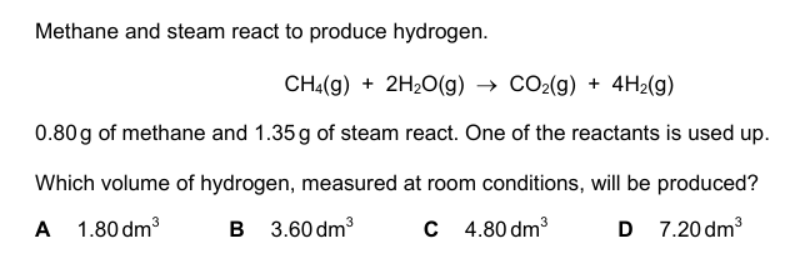
B

B — 2/3 mol
Multiply the H2S half-equation by 2 to cancel 4e−:
2H2S + SO2 → 3S + 2H2O
Therefore:
2 mol H2S → 3 mol S
For 1 mol S:
H2S = 2/3 mol

C — 50 cm³
10 cm³ CH3SH needs 30 cm³ O2, so O2 left = 30 cm³.
10 cm³ CH3SH produces:
10 cm³ CO2
10 cm³ SO2
H2O is liquid at room temperature, so it is not counted.
Total gas = 30 + 10 + 10 = 50 cm³.

C
Water lost:
mass H2O = R − S
moles H2O = (R − S) / 18
LiOH left:
mass LiOH = S − Q
moles LiOH = (S − Q) / 23.9
Since LiOH·xH2O means:
1 mol LiOH : x mol H2O
x = moles H2O / moles LiOH
= [(R − S)/18] ÷ [(S − Q)/23.9]
= 23.9(R − S) / [18(S − Q)]
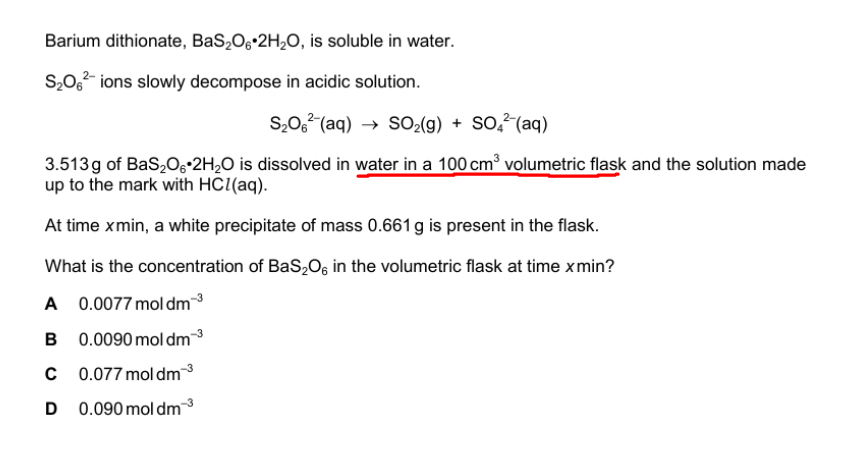
You’re right. The back needs the chemistry chain first, otherwise the maths feels random.
Front:
3.513 g of BaS₂O₆·2H₂O is dissolved and made up to 100 cm³ with HCl. At time x, 0.661 g of white BaSO₄ precipitate is present. Find the concentration of BaS₂O₆ remaining.
Back:
First understand the chemistry:
BaS₂O₆ dissolves:
BaS₂O₆ → Ba²⁺ + S₂O₆²⁻
The question says:
S₂O₆²⁻ → SO₂ + SO₄²⁻
So:
1 mol S₂O₆²⁻ gives 1 mol SO₄²⁻
Then the SO₄²⁻ reacts with Ba²⁺:
Ba²⁺ + SO₄²⁻ → BaSO₄(s)
Therefore:
1 mol S₂O₆²⁻ decomposed → 1 mol BaSO₄ formed
Now calculate.
Mr(BaS₂O₆·2H₂O)
= 137.3 + 2(32.1) + 6(16) + 2(18)
= 333.5Initial moles hydrate
= 3.513 / 333.5
= 0.01053 mol
1 mol hydrate contains 1 mol BaS₂O₆, so:
Initial BaS₂O₆ = 0.01053 mol
Mr(BaSO₄)
= 137.3 + 32.1 + 4(16)
= 233.4Moles BaSO₄
= 0.661 / 233.4
= 0.00283 mol
Because the ratio is 1:1:
BaS₂O₆ decomposed = 0.00283 mol
BaS₂O₆ remaining
= 0.01053 − 0.00283
= 0.00770 molVolume = 100 cm³ = 0.100 dm³
Concentration
= moles / volume
= 0.00770 / 0.100
= 0.077 mol dm⁻³
Answer: C
12.0 g malachite, Cu(OH)₂·CuCO₃, is added in excess to 30.0 cm³ of 1.50 mol dm⁻³ HNO₃. What mass of malachite is left?
Balanced equation:
Cu(OH)₂·CuCO₃ + 4HNO₃ → 2Cu(NO₃)₂ + CO₂ + 3H₂O
So:
1 mol malachite : 4 mol HNO₃
Moles HNO₃:
n = cV
= 1.50 × 0.0300
= 0.0450 mol
HNO₃ is the limiting reactant because malachite is in excess.
So all 0.0450 mol HNO₃ reacts.
From the 1:4 ratio:
moles malachite reacting
= 0.0450 ÷ 4
= 0.01125 mol
Mass malachite reacting:
m = nMr
= 0.01125 × 221
= 2.49 g
Mass left:
12.0 − 2.49
= 9.51 g
Answer: D — 9.51 g

First compare percentage mass loss.
Pb(NO₃)₂
For 1 mol:
Pb(NO₃)₂ → PbO + 2NO₂ + 0.5O₂
Mr(Pb(NO₃)₂) = 331.2
Mr(PbO) = 223.2
PbO is solid, so it stays behind.
Mass lost:
331.2 − 223.2 = 108.0 g
% mass loss:
108.0 / 331.2 × 100 = 32.6%
NH₄NO₃
For 1 mol:
NH₄NO₃ → N₂ + 0.5O₂ + 2H₂O(l)
There is no solid product, so no solid residue remains.
Therefore percentage mass loss = 100%
So:
NH₄NO₃ has greater % mass loss.
Now compare gas collected after NaOH.
Pb(NO₃)₂
Produces:
2NO₂ + 0.5O₂
NO₂ reacts with NaOH, so it is removed.
Only 0.5 mol O₂ is collected.
NH₄NO₃
Produces:
1 mol N₂ + 0.5 mol O₂
N₂ and O₂ do not react with NaOH.
So collected gas:
1 + 0.5 = 1.5 mol
Therefore:
NH₄NO₃ gives greater gas volume.
So both answers are NH₄NO₃.
Answer: A

At r.t.p.:
1 mol gas = 24 000 cm³
moles CO₂
= 108 / 24 000
= 0.00450 mol
Each CO₂ contains 1 C atom.
So:
moles C = 0.00450 mol
Find mass of carbon:
1 mol C = 12 g
mass C
= 0.00450 × 12
= 0.0540 g
Total carbide mass = 0.216 g.
So mass Al:
0.216 − 0.0540
= 0.162 g
Find moles Al:
moles Al
= 0.162 / 27
= 0.00600 mol
Mole ratio:
Al : C
= 0.00600 : 0.00450
Divide both by 0.00450:
= 1.333 : 1
Multiply both by 3:
= 4 : 3
Therefore:
Al₄C₃ ✅

For hydrated salts:
x = moles H₂O / moles anhydrous salt
Moles H₂O:
Mr(H₂O) = 18
1.91 / 18 = 0.106 mol
Moles Na₂SO₄:
Mr(Na₂SO₄) = 142.1
1.51 / 142.1 = 0.0106 mol
Find the ratio:
H₂O : Na₂SO₄
= 0.106 : 0.0106
= 10 : 1
So:
x = 10
Answer: C
Sample X is diluted with water to a total volume of 200 cm³, giving 0.100 mol dm⁻³ HCl.
Which is X?
A. 10 cm³ of 1.00 mol dm⁻³ HCl
B. 30 cm³ of 0.90 mol dm⁻³ HCl
C. 50 cm³ of 0.40 mol dm⁻³ HCl
D. 100 cm³ of 0.30 mol dm⁻³ HCl
Adding water is dilution.
Moles of HCl do not change when water is added.
Final solution:
200 cm³ = 0.200 dm³
n = cV
= 0.100 × 0.200
= 0.0200 mol HCl
So X must also contain 0.0200 mol HCl.
Check C:
50 cm³ = 0.050 dm³
n = cV
= 0.40 × 0.050
= 0.0200 mol
✅ Answer: C
Heating 10.000 g of a mixture of NaHCO₃ and Na₂CO₃ leaves 8.708 g of solid. How do you use a mass ratio to find the starting mass of each substance?
Heating 10.000 g of a mixture of NaHCO₃ and Na₂CO₃ leaves 8.708 g of solid. How do you use a mass ratio to find the starting mass of each substance?
Back: Only NaHCO₃ releases gas when heated.
2NaHCO₃(s) → Na₂CO₃(s) + CO₂(g) + H₂O(g)
Gas released = 10.000 − 8.708 = 1.292 g.
From the equation, 168 g of NaHCO₃ releases 62 g of gas (44 g CO₂ + 18 g H₂O).
Let x be the starting mass of NaHCO₃. Put NaHCO₃ mass on top and gas mass underneath on both sides: 168/62 = x/1.292.
NaHCO₃ = 1.292 × 168/62 ≈ 3.50 g. The remaining 6.50 g was Na₂CO₃.
A 10.000 g mixture of CaCO₃ and MgCO₃ is heated to constant mass. The solids left weigh 5.096 g. What percentage of the original mixture was each carbonate by mass?
1. Work out what escaped. Both carbonates release CO₂ when heated. The metal oxides stay in the container.
CaCO₃(s) → CaO(s) + CO₂(g)
MgCO₃(s) → MgO(s) + CO₂(g)
Mass of CO₂ released = 10.000 − 5.096 = 4.904 g.
2. Convert the CO₂ to moles.
Moles of CO₂ = 4.904 ÷ 44.0 ≈ 0.11145 mol.
3. Write the total-moles equation. Let x be the starting moles of CaCO₃ and y be the starting moles of MgCO₃.
x mol of CaCO₃ releases x mol of CO₂.
y mol of MgCO₃ releases y mol of CO₂.
Together they released 0.11145 mol of CO₂, so x + y = 0.11145. We leave x and y separate because each carbonate could have supplied a different amount.
4. Write the total-mass equation. Use mass = moles × molar mass.
x mol of CaCO₃ weighs 100.1x g.
y mol of MgCO₃ weighs 84.3y g.
The original mixture weighed 10.000 g, so 100.1x + 84.3y = 10.000.
5. Solve the simultaneous equations. From the first equation, y = 0.11145 − x. Put that into the second equation (keeping extra digits on the calculator):
100.1x + 84.3(0.11145 − x) = 10.000
100.1x + 9.396 − 84.3x ≈ 10.000
15.8x ≈ 0.604
x ≈ 0.03825 mol of CaCO₃
6. Convert to grams, then percentages.
Mass of CaCO₃ = 0.03825 × 100.1 ≈ 3.83 g.
Mass of MgCO₃ = 10.00 − 3.83 = 6.17 g.
CaCO₃ = (3.83 ÷ 10.00) × 100 = 38.3%
MgCO₃ = (6.17 ÷ 10.00) × 100 = 61.7%
A 5.00 g mixture of MgSO₄·7H₂O and CuSO₄·5H₂O is heated until 3.00 g of anhydrous salts remains. What percentage of the original mixture was MgSO₄·7H₂O?
What escaped? Both salts lost water. Total water lost = 5.00 − 3.00 = 2.00 g.
What does x mean? Let x = grams of MgSO₄·7H₂O at the start. Then 5.00 − x = grams of CuSO₄·5H₂O at the start.
Water from the magnesium salt: Every 246.4 g of hydrate releases 7 × 18 = 126 g of water. So x grams releases (126/246.4)x grams of water.
Water from the copper salt: Every 249.6 g of hydrate releases 5 × 18 = 90 g of water. So 5.00 − x grams releases (90/249.6)(5.00 − x) grams of water.
Add the two water masses. Only their sum is 2.00 g.
(126/246.4)x + (90/249.6)(5.00 − x) = 2.00
0.51136x + 1.80288 − 0.36058x ≈ 2.00
0.15078x ≈ 0.19712
x ≈ 1.307 g of MgSO₄·7H₂OPercentage by mass = (1.307 ÷ 5.00) × 100 = 26.1%.
4 dm³ of H₂S is burned in 10 dm³ of O₂.
2H₂S(g) + 3O₂(g) → 2H₂O(g) + 2SO₂(g)
What is the final volume of the gas mixture? Give the volume of each gas.
At the same temperature and pressure:
gas volume ratio = mole ratio
From the equation:
2 H₂S : 3 O₂ : 2 H₂O : 2 SO₂
So 4 dm³ H₂S needs:
4 × 3/2 = 6 dm³ O₂
O₂ left:
10 − 6 = 4 dm³ O₂
Because the ratios are 2:2:
4 dm³ H₂S produces:
4 dm³ H₂O(g)
4 dm³ SO₂
Final gases:
4 dm³ O₂ + 4 dm³ H₂O + 4 dm³ SO₂
= 12 dm³ total
15 cm³ of a gaseous hydrocarbon is exploded with 60 cm³ of O₂.
After combustion and cooling, the gas volume is 45 cm³.
After treatment with NaOH, which removes CO₂, the gas volume decreases to 15 cm³.
Water produced is liquid.
Find the formula of the hydrocarbon.
After cooling, H₂O is liquid, so the 45 cm³ gas contains only:
CO₂ + excess O₂
NaOH removes CO₂.
After NaOH, 15 cm³ remains.
So:
excess O₂ = 15 cm³
CO₂ produced:
45 − 15 = 30 cm³ CO₂
Now compare hydrocarbon : CO₂:
15 : 30
= 1 : 2
So the hydrocarbon contains 2 C atoms:
C₂Hᵧ
Now find O₂ used:
60 − 15 = 45 cm³ O₂
Hydrocarbon : O₂:
15 : 45
= 1 : 3
So:
C₂Hᵧ + 3O₂ → 2CO₂ + 2H₂O
Now count H:
2H₂O contains 4 H
Therefore:
y = 4
✅ Hydrocarbon = C₂H₄