Spinal dx
 Call Kai
 Learn
 Practice Test
 Spaced Repetition
 Match
 Flashcards
 Knowt Play
1/58

There's no tags or description
Looks like no tags are added yet.
59 Terms
What hx elements should you ask when presented with a spinal dx case?
Signalment (age & breed)
Duration of signs
Speed of onset
Progressive or not
Pain
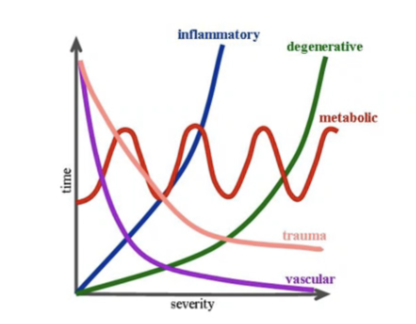
What grades can be used in initial assessment of spinal dx?

ambulatory = walking w/o support
non-ambulatory = unable to walk unless supported
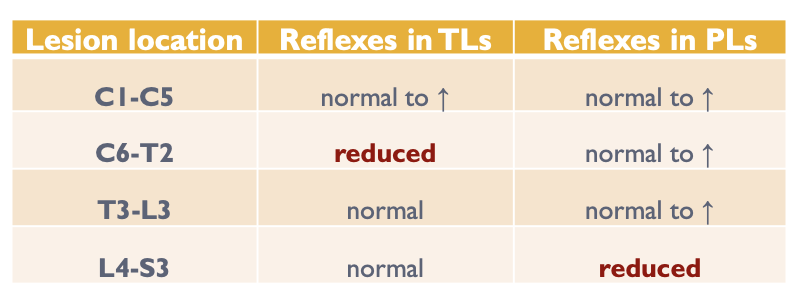
How do you localise a lesion in the spine using reflexes?
What is your differential list for spinal disease?

What are your differentials in a peracute spinal dx case?
Vascular
Fibrous cartilagenous embolism (FCE) (dogs)
Stroke (cats)
Trauma
Acute non-compressive annulus pulposus extrusion (ANNPE)
Fracture/ luxations
atlanto-axial luxation if traumatic
How do ischaemic myelopathies present (FCE/Stroke)?
Dogs only, non-chondrodystrophic dogs i.e. large breed
Fibrocartilage from nucleus pulposus embolises in spinal cord vasculature —> FCE
Blood supply to spinal cord interrupted
Per-acute, non painful
Signs often very lateralise
Usually at exercise

What is the main differential for FCE?
ANNPE (acute non-compressive nucleus pulposus extrusion)
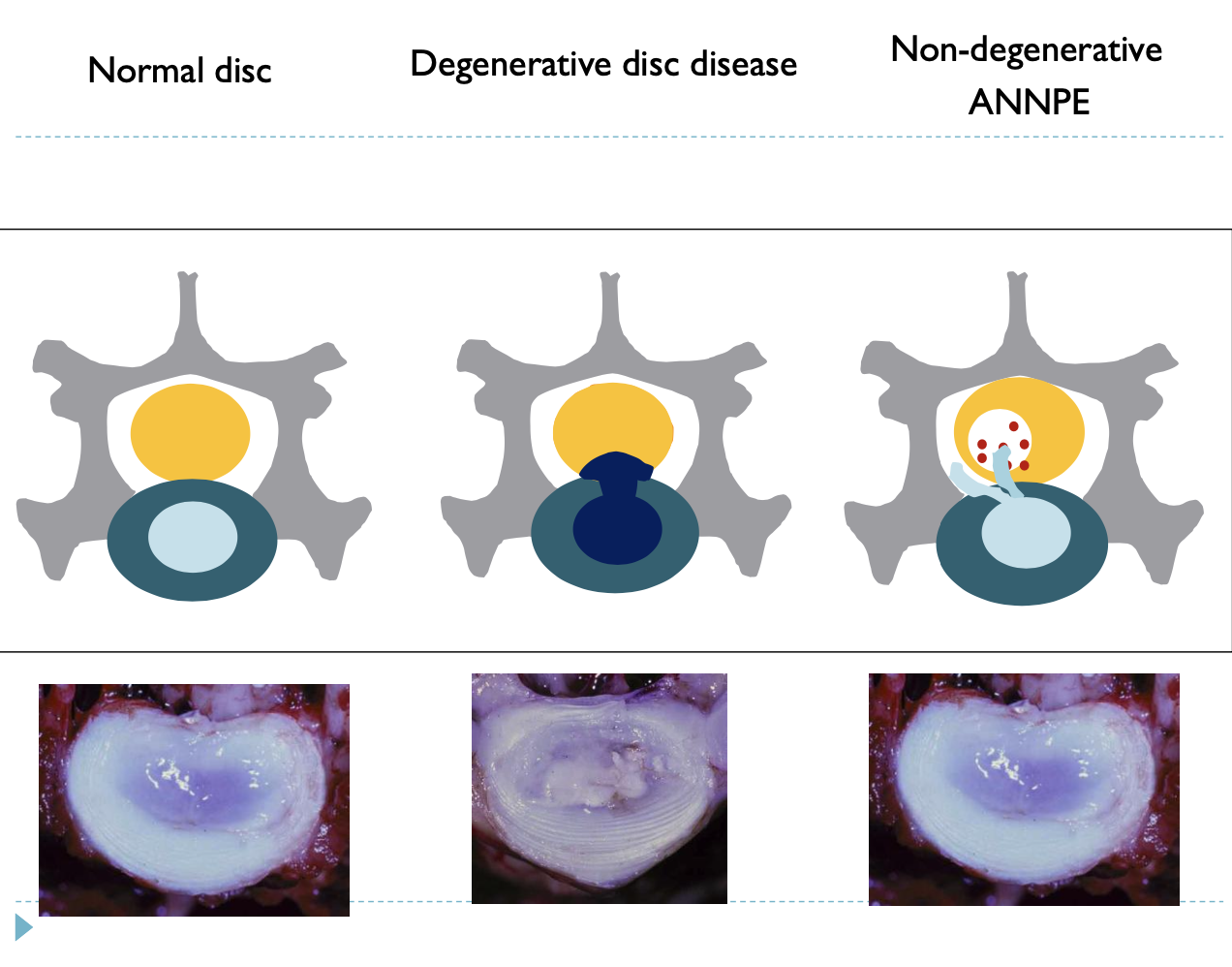
What are the features of ANNPE?
Trauma —> following intense exercise usually / RTA / fall from height
Acute onset, non painful, non progressive
Herniated nucleus pulposus is non-mineralised causing mainly cord contusion w/ minimal compression
How are FCE & ANNPE treated?
Surgery not indicated —> nothing to remove / stabilise
Supportive care & physio
make sure able to urinate
Median time to ambulation ~2 wks
Maximal recovery ~3 months
not super painful —> may need NSAID or paracetamol for comfort
What does prognosis of FCE & ANNPE depend on?
Neuro score @ presentation & extension of lesion on MRI
How are spinal fractures & luxations diagnosed?
Careful neuro exam —> want to do as much as poss with patient lying down → don’t want to make worse
Thoracic & abdo rads
Survey lateral radiographs of spine
Orthogonal views essential
CT/MRI may be helpful
How do you treat spinal fractures and luxations?
Initial —> stabilise & analgesia (NSAIDs rather than steroids)
Conservative vs surgical
Use 3 compartement rule → if unstable surgery or splint
one compartment affected? —> unlikely to affect stability of spine → rest & pain relief
two compartments affected? —> likely to affect stability of spine → surgical stabilisation required
Decompression if fragments compressing spinal cord
If trasnporting patient —> splint to avoid displacing fracture
What is the prognosis of fracutres & luxations of the spinal cord?
If lack of deep pain perception → < 5% (usually ass. w/ spinal cord laceration) —> PTS recommended
severe vertebral displacement, other injuries, wt & age, time to referral
What are your differentials for acute/subacute onset presentation of spinal dx?
IVDD type I (extrusion)
Infectious/inflam
SRMA (Steroid-responsive meningitis-arteritis)
Discospondylitis
Spinal MUO (meningomyelitis)
What are the different presentations of chondrodystrophic vs non-chondrodystrophic breeds?
Chondrodystrophic —> during 1st 2yrs, chondroid metamorphosis
IVD dehydrates & nucelus invaded by hyaline cartilage; nucleus can mineralise
Non-chondrodystrophic breeds —> after middle age, fibroid metamorphosis
IVD dehydrated & nucleus invaded by fibrocartilage; mineralisation less common
Large breeds —> disc protrusion
Small breeds —> disc extrusion
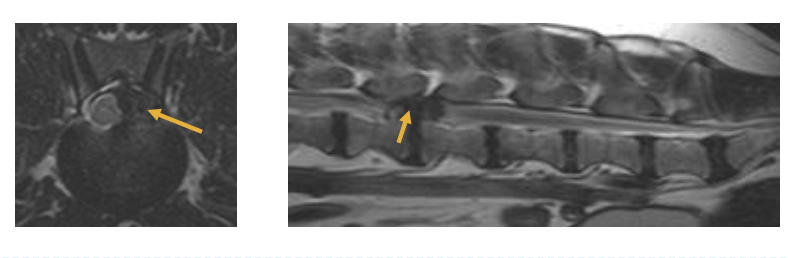
Describe intervertebral disk extrusion
Herniation of nucleus pulposus through annular fibres & extrusion of nucelar material into spinal canal
How does disc extrusion present?
3-6y chondrodystrophic & 6-8y non- chondrodystrophic breeds
Peracute/acute onset, progressive
Typically painful
Describe intervertebral disc protrusion
Annular protrusion caused by shifting of central nucelar material, commonly ass. w/ fibroid disc degen
How does disc protrusion present?
Older, non-chondrodystrophic breeds
Slowly progressive, chronic onset
Spinal pain may or may not be present
Typically less severe signs
How is intervertebral disc dx diagnosed?
Nothing seen on rads
Myelogram —> contrast agent will show pushing on spinal cord
no longer done because MRI & CT more readily available
MRI —> can see disc material & spinal cord, but requires GA
CT most ideal —> cheaper (only requires sedation rather than GA) & faster than MRI —> shows mineralisation
How is IVDD treated?
Conservative
Strict rest for 4-6 wks i.e. no exercise at all
Analgaesia
Surgical considered if:
Severe neuro deficits (grades 3-5)
Severe / recurrent pain
Lack of improvement with rest
What is the prognosis of IVDD cf to the grade?

myelomalacia —> liquid spinal cord due to inflammatory processes
What is the most common cause of neck pain in young dogs w/ immature immune system? At what age does it present?
Steroid responsive meningitis-arteritis (SRMA)
Immune mediated cause suggested
beagles predisp
Presents @ 6-18 months —> so NOT ddx for disc dx
What are the clinical signs of SRMA?
Lethargy, anorexia & fever
Cervical rigidity & spinal pain
Often concurrent immune mediated polyarthritis
How is SRMA diagnosed?
CSF analysis
Neutrophilic pleocytosis in acute form
Mononuclear pleocytosis in chronic form
+/- Spinal radiographs, CT, MRI
How is SRMA treated?
Corticosteroids for 6months (+/- azathioprine or ciclosporin)
Monitoring w/ repeated CSF analysis / CRP
Very good although potential for relapse
What is discospondylitis?
Infection of intervertebral disc & adjacent vertebrae, most common @ L7-S1
Marked spinal pain
What is the main differential of discospondylitis?
Brucellosis (zoonotic —> wear PPE if discospondilitis suspected)
How is discospondylitis diagnosed?
Imaging —> rads (2-4 weeks); MRI or CT (more sensitive than rads)
narrowing of IVD space
roughening of endplates
proliferation of adj bone
Bacteriology —> blood, urine, CSF, IVD
How is discospondylitis treated?
1. AB for at least 8 wks
2. Analgesia
What is MUO?
Meningomyelitis of unknown origin → neuro deficits
Subacute, progressive, can be asymmetrical, can be painful
Often multifocal (sometimes affects brain)
Care as same breeds & often similar presentation to IVDD
How is MUO diagnosed?
MRI —> variable findings
CSF —> mononuclear / mixed pleocytosis
How is MUO treated?
Corticosteroids +/- other immunosuppressive drugs
What are your differentials for chronic onset presentation spinal disease?
Neoplasia
Degenerative
IVDD type II (protrusion), CSM (Cervical spondylomyelopathy), LSDS (Lumbosacral Degenerative Stenosis), DM (degen myelopathy)
Anomalous
Spinal malformations, CM/SM, AA instability (if congenital)
What are the different neoplasia that can affect the spinal cord?
Extradural —> primary vertebral, metastatic, lymphoma
Intradural extramedullary —> meningioma, nephroblastomas, nerve sheath, metastatic
Intradural intramedullary —> gliomas, ependymomas, metastati
How is spinal neoplasia treated?
Decompressive surgery
Radiation
Palliative
What is Cervical spondylomyelopathy (“Wobblers”)? What breed is it common in?
Neck problem but signs worse in pelvic limbs (paresis, ataxia)
back legs wide & ataxic
front legs stiff & choppy w/ little steps
Short stilted gait & muscle atrophy in thoracic limbs
Dobermanns predisp
What are the two main types of CSM?
Disc ass. CSM (affects dobermanns)
Osseous ass. CSM (younger large breeds that have had period of fast growth)

What are the causes of CSM?
Mulifactorial
Protrusion of IVD (type II IVDD)
Hypertrophy of ligamentum flavum & dorsal
Longitudinal lig
Hypertrophy of synovial membrane
Stenosis of spinal canal
Degenerative joint dx of facets
How is CSM treated?
Conservative tx (generally will worsen)
anti-inflammatories, rest & moderate lifestyle
Surgical treatment (£££ & doesn’t work very well)
decompression vs. distraction-stabilisation
disc spacer
Usually PTS
What are the signs of lumbosacral degenerative stenosis?
Anything that puts pressure on L7-S1 area (i.e. lumbosacral area)
Reluctance to exercise, rise, jump into car, do stairs
+/- lameness, lumbosacral pain, mono or paraparesis (proprioceptive deficits, reduced withdrawal reflex), urinary & / or faecal incontinence
commonly mistaken for hip dx
What can cause lumbosacral degenerative stenosis?
Disc extrusions / protrusions
Foraminal stenosis
Ventral subluxation of sacrum, etc…
How is lumbosacral stenosis treated?
Conservative tx
Anti-inflams (NSAIDS), gabapentin, epidural steroids
Surgical tx
Dorsal laminectomy +/- stabilisation
Foraminotomy
List some vertebral and spinal anomalies
Spinal arachnoid diverticulae (SAD) —> pugs & frenchies —> pockets of fluid that compress spinal cord —> seen on MRI
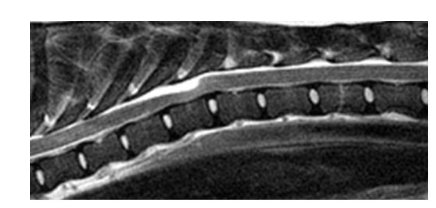
Butterfly vertebrae
Block vertebrae
Transitional vertebrae
Hemivertebrae (pic attached) etc
typically non-painful, CT & MRI, surgical decompression ± stabilisation
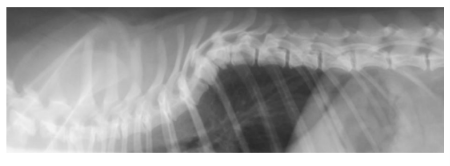
How does degenerative myelopathy present?
Older dogs only!
Insidious, progressive ataxia & paresis of pelvic limbs → paralysis (over 6-18m)
T3-L3 myelopathy
Usually asymmetrical
Not painful
How is degenerative myelopathy diagnosed & treated?
MRI + genetic test (SOD mutation)
No tx but physio prolongs QOL
How does atlantoaxial (AA) instability present?
Young dogs, Toy breeds
Acute / chronic, often waxing /waning
Ass. w/ aplasia/hypoplasia of dens in toy breeds & sometimes w/ trauma
What are the clinical signs of AA instability?
Neck pain
Ataxia or tetraparesis
How is AA instability treated?
Conservative splint for 6-12wks —> ~60% success
Surgical (ventral stabilisation)
What is chiari like malformation?
Small skull for size of brain —> puts pressure on cerebellum, diff pressure in CSF between brain & spinal cord
Mismatch between caudal fossa volume & its contents (cerebellum and brainstem) with cd displacement of the cerebellum through foramen magnum
Affects basically all cavaliers
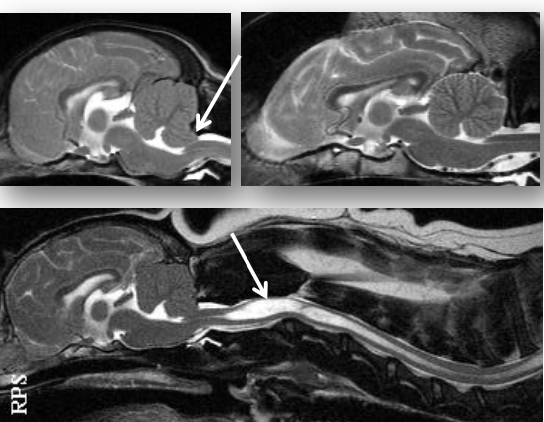
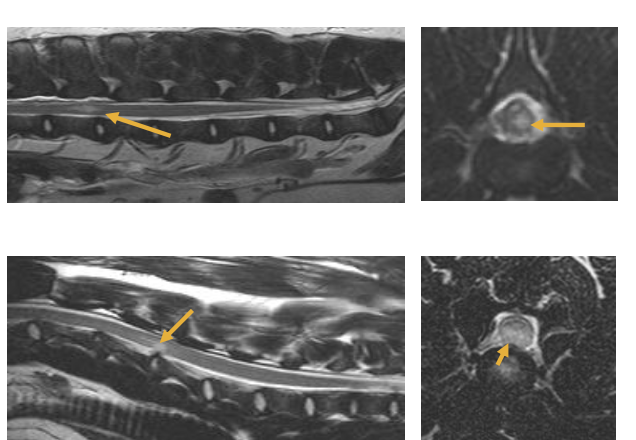
^ 2nd image shown syringomyelia
What does chiari like malformation lead to?
Syringomyelia —> fluid filled cavitation
(hydromyelia —> dilation of central canal
syringohydromyelia = both)
What are the clinical signs of chiari-like malformation?
Neck pain
Neck scratching —> “air guitar”
Torticollis / scoliosis
Thoracic limb weakness and atrophy
What is the medical tx of chiari like malformation?
Gabapentin (pregabalin) amantidine
NSAIDs
Furosemide, omeprazole, acetazolamide
Corticosteroids, paracetamol, opioids
Can do surgery also but doesn’t correct syrinx & high recurrence rate of C/S
What are your top differentials for spinal dx in cats?
Neoplasia
Inflam / infectious (abscess, FIP, discospondylitis, Toxoplasmosis, etc.)
always investigate
When is neurosurgery indicated?
IVDD
CSM
LSDS
trauma
neoplasia
malformations
infectious diseases
What are the diff approaches of neurosurgery?
Hemilaminectomy —> removal of one half of vertebral arch (lamina, articular process & pedicle), mainly used in thoracolumbar spine
access to lateral & ventral spinal cord —> allows for IVD fenestration
Dorsal laminectomy —> removal of dorsal spinous prrocess & laminae
Lumbosacral area mainly, more painful as go through a lot of muscle
Ventral slot —> slot-like ventrally through IVD & cr & cd endplates of cervical vertebrae
recover quicker because less muscle
What supportive care can you provide to a spinal disease patient?
Analgaesia
NSAIDs
Gabapentin/pregabalin
Paracetamol
Amantadine/memantine
Opioids
Phsyio & hydrotherapy
Bladder management
What medical management can we use for bladder management in a spinal disease case?
Diazepam —> reduce urethral tone (skeletal m.)
Prazosin / phenoxybenzamine —> reduce urethral tone (smooth m.)
Bethanecol —> detrusor contraction (cholinergic stim)
Recall the difference between UMN bladder & LMN bladder?
