Homeostasis and Principles of Negative Feedback
 Call Kai
 Learn
 Practice Test
 Spaced Repetition
 Match
 Flashcards
 Knowt Play
1/21

Earn XP
Description and Tags
Vocabulary practice flashcards covering the key concepts, mechanisms, control loops, and hormonal regulators of homeostasis in mammals.
22 Terms
Homeostasis
The process of maintaining constant internal body conditions to ensure the maintenance of optimal conditions for enzyme action and cell function.
Stomata
Control the diffusion of gasses in and out of leaves
Stomatal aperture
Balances thé need for Carbon dioxide uptake by diffusion with the need to minimise water loss by transpiration
When stomata are open, leaves:
Gain Carbon dioxide For photosynthesis , Lose, large, Amounts of water by transpiration
When stomata are closed, leaves:
Retain water
Have a reduced supply of Carbon dioxide so the rate of photosynthesis decreases
Negative Feedback
A homeostatic control mechanism in which a physiological factor is continuously monitored; if the factor increases, the body responds to make it decrease, and if it decreases, the body responds to make it increase, opposing the original change and promoting stability.
Positive Feedback
A control mechanism that amplifies the original change and drives a process further in the same direction, typically operating in specific processes with a defined endpoint (such as oxytocin release during childbirth).
Stimulus
A detectable change in a physiological condition or environmental factor.
Internal Stimuli
Detectable changes arising inside the body, including changes in blood glucose concentration, blood temperature, blood water potential, and blood pH.
External Stimuli
Detectable changes originating outside the body, including changes in environmental temperature, light, sound, and touch.
Receptor (Sensor)
A sensory structure in a homeostatic control loop that detects a stimulus associated with a condition or physiological factor.
Coordination System
A bodily system (the nervous system or the endocrine system) that transfers information between different parts of the body.
Effector
An organ, tissue, or cell (specifically muscles and glands) that carries out a response instructed by central control.
Set Point
The reference value or ideal value around which a physiological factor is regulated and normally fluctuates.
Nervous System
A mammalian coordination system in which information is transmitted as electrical impulses that travel along neurones.
Endocrine System
A mammalian coordination system in which information is transmitted as chemical messengers called hormones that travel in the blood.
Hormones
Chemical messengers secreted into the blood that travel to target cells, binding to specific receptors to trigger internal cellular responses.
Insulin
A hormone released by the pancreas when blood glucose levels rise that stimulates liver and muscle cells to take up excess glucose and convert soluble glucose into insoluble glycogen.
Glucagon
A hormone released by the pancreas when blood glucose levels fall that stimulates liver cells to break down glycogen into glucose and release it into the bloodstream.
Adrenaline
A hormone that speeds up the conversion of glycogen into glucose during 'fight or flight' situations.
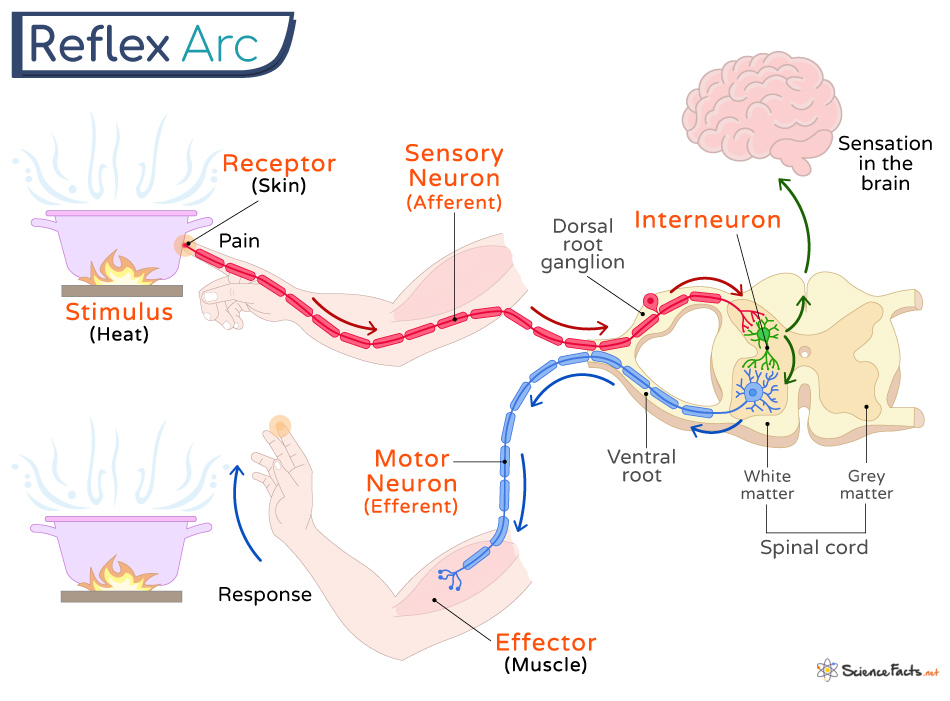
Reflex Arc
A neural transmission pathway wherein a stimulus detected by a receptor initiates an electrical impulse through an afferent sensory neuron to a spinal interneuron, continuing through an efferent motor neuron to an effector muscle to yield a response.