APUSH Period 4: Jacksonian Era
 Call Kai
 Learn
 Practice Test
 Spaced Repetition
 Match
 Flashcards
 Knowt Play
1/22

There's no tags or description
Looks like no tags are added yet.
23 Terms
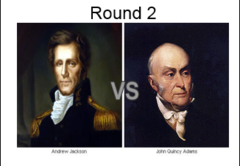
Election of 1828/Jacksonian Revolution
The name attributed to the first presidential race with a "common man" winner because the president was not an aristocrat born into wealth, but rather gained his fame from serving his country in the War of 1812. It emphasized the representation of the common man in government positions
Corrupt Bargain
Refers to the claim from the supporters of Andrew Jackson that John Quincy Adams and Henry Clay had worked out a deal to ensure that Adams was elected president by the House of Representatives in 1824

Tariff of Abominations (1828)
Tariff with such high rates that it set off tension between northerners and southerners over tariff issues (called the Nullification Crisis)

What did the Tariff of Abominations tax?
wool, hemp, molasses
Nullification Crisis of 1832
Caused by the Tariff of 1828, South Carolina opposed tax due to how extreme they were.
- Ended by Henry Clay's Compromise Tariff of 1833 and the Force Bill

Compromise Tariff of 1833
Passed as a measure to resolve the nullification crisis, it provided that tariffs be lowered gradually and that South Carolina rescinds its neutrality

Force Bill (1833)
Passed by Congress alongside the Compromise Tariff, it authorized the president to use the military to collect federal tariff duties
Spoils System
A system of public employment started by Andrew Jackson based on rewarding party loyalists and friends

Two-Party System
An electoral system with two dominant parties that compete in national elections
Why was the property voting requirement removed?
Farmers that lost land due to Panic of 1819 outraged over having no say in elections
What was the effect of the removal of the voting requirement?
Political Sectionalism grew, 'common man' more represented
Democratic Party
A political party formed by supporters of Andrew Jackson that celebrated the 'common man' and were suspicious of industry and monied interests
What types of people were in the Democratic Party?
Planters, urban workers, artisans, immigrants, and Catholics
Whigs Party
A political party that supported government programs, reforms, and public schools. They called for internal improvements like American System
What types of people were in the Whigs Party?
Bankers, merchants, industry owners
Indian Removal Act of 1830
Passed by Congress under the Jackson administration, removed all Indians east of the Mississippi to an "Indian Territory" where they would be "permanently" housed

Seminole War
Conflict that began in Florida between the seminole indians and the us army when the seminoles resisted removal

Worchester vs Georgia (1832)
Conflict over Cherokee and Creek in Georgia led to case, court ruled that Georgia law doesn't apply to Cherokees so they can't be forced to leave by the US government
Did Jackson enforce the ruling of Worchester vs Georgia?
No, stated, "John Marshall has made his decision, let him enforce it, if he can."

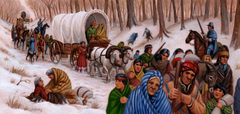
Trail of Tears (1838-1839)
The forced removal of about 15,000 Cherokee, Choctaw, Creek, Chickasaw, and Seminole Indians west; a quarter of them died along the way
Bank War (1832)
Battle between President Andrew Jackson and Whigs over the Bank of the United States renewal in 1832. Jackson vetoed the Bank Bill, arguing that the bank favored moneyed interests at the expense of western farmers
Pet Banks
State banks that Jackson placed the governments money into based on favoritism and bias
Were pet banks better than the national bank?
No, both styles of banking failed at making responsible loans and ultimately caused economic depressions