DNA
 Call Kai
 Learn
 Practice Test
 Spaced Repetition
 Match
 Flashcards
 Knowt Play
1/47

There's no tags or description
Looks like no tags are added yet.
48 Terms
virulent definition
the ability to cause disease or death
describe griffith’s bacterial experiment
he took two strains of the same bacteria type. one was virulent, was contained in a polysaccaride capsule, and looked smooth S , the other was not lethal, had no capsule, and looked rough R.
what were the results of griffith’s bacterial experiment
griffith killed some virulent S cells by boiling them then injected it into mice who survived - the carcasses of the cells do not cause death. a mixture of heat killed virulent S and nonvirulent R did kill the mice - the live R cells were transformed into live S cells by picking up some chemical component of the dead S cells.d
what are the three key properties of hereditary material
accurate replication of the genetic material at every cell division is cruical
Structural features of the genetic material must have information content
the structure of genetic material must be stable enough for an organism to rely on its encoded information but leaves some room for mutation as genetic material must be able to change on rare occasion.
what are the three components of DNA
phosphate
deoxyribose
four nitrogenous bases
what are the four nitrogenous bases of DNA
Adenine, Guanine, Cytosine, and Thymine
what is deoxyribose sugar
the sugar in DNA contains ribose sugars that are missing an oxygen atom

which of the nitrogenous bases of DNA are called purines
two of the nitrogenous bases, adenine and guanine have a double-ring structure characteristic of a class of chemicals called purines
which of the nitrogenous bases of DNA are called pyrimidines
two of the nitrogenous bases, cytosine and thymine have a single-ring structure characteristic of a class of chemicals called pyrimidines
what are deoxynucleotides
the chemical subunits of DNA
Chargaffs rules of base composition
the total amount of purine nucleotides always equals the total amount of pyrimidine nucleotides
the amount of A always equals the amount of T, same for G and C
A + T is not necessarily equal to G + C but it usually is the same in different tissues of the same organism
what does it mean for a genome to be AT-rich
it means that the genome has almost twice as much A +T than it does G + C
what does it mean for a genome to be GC- rich
it means that the genome has almost twice as much G + C than A + T
what does each base pair consists of
one purine base and one pyrimidine base
structure of DNA
DNA is a right-handed helix, twisting in a clockwise motion. the two strands are held together by hydrogen bonds between purine and pyrimidine bases of strand. outside the double helix is a sugar-phosphate backbone
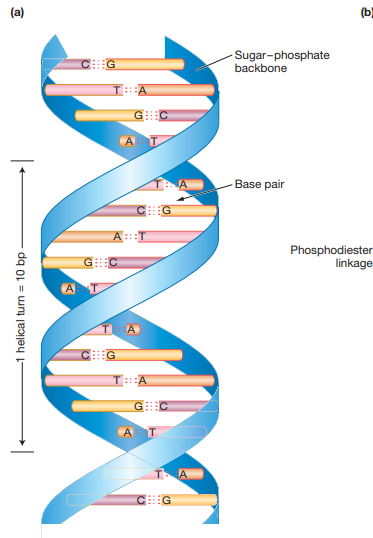
what is the sugar phosphate backbone of DNA
the strand is formed by alternating phosphate and deoxyribose sugar units that are connected by phosphodiester linkages which will connect the 5- carbon atom of one deoxyribose to the 3- carbon atom of the adjacent deoxyribose

what direction are each sugar-phosphate backbone
they all have5- to 3- polarity
number of hydrogen bonds between C - G
three hydrogen bonds
number of hydrogen bonds between A - T
two hydrogen bonds
what could you predict by knowing the amount of hydrogen bonds between nitrogenous bases
that DNA containing many G-C base pairs would be more stable than DNA containing many A-T base pairs.
what part of DNA adds stability
Base pair stacking at the center of the double helix, which stabilizes the structure by excluding water molecules.
what are deep minor grooves
in DNA its occurs where the sugar-phosphate backbones are close together
what are shallow major grooves
in DNA it occurs where the sugar-phosphate backbones are far apart
why is the geometry of base pairs important
the geometry of base pairs creates shallow wide major grooves and narrow, deep minor grooves along the DNA helix, proteins that bind DNA interact specifically with either major or minor grooves
explain the semiconservative model for DNA replication
the double helix is unwound and each strand acts as a template to direct assembly of complementary bases. in semiconservative each of the new helices conserves one of the original strands (parent) and the other strand is new (daughter)

explain the conservative replication model
the parent DNA double helix is conserved, and a daughter double helix is produced consisting or two newly synthesized strands

explain the dispersive replication model
two new DNA double helices are produced, with each strand containing segments of both parental DNA and newly synthesized daughter DNA

what is a replisome
a large, multiprotein molecular machine that carries out DNA replication at the replication fork
how do the replisomes open the helix and prevent overwinding
the replisome contains proteins called helicases and topoisomerases respectively
what are helicases
enzymes that disrupt hydrogen bonds that hold the two strands of the double helix together
how do helicases work
helicase encircles single-stranded DNA at the replication fork where it uses energy from ATP hydrolysis to rapidly unzip the double helix ahead of DNA synthesis
how does unwound DNA stay that way
DNA stays unwound because of single-strand DNA-binding (SSB) which bind to the single-stranded DNA and prevent the duplex from re-forming
what does unwinding of DNA cause
unwinding of DNA causes extra twisting to occur ahead of repelication forks, and supercoils form to release the strain of the extra twisting
how does topoisomerases work
topoisomerases relax supercoiled DNA by breaking either a single DNA strand or both strands, which allows DNA to rotate into a relaxed molecule. They finish their job by religating the strands of the now relaxed DNA
what is the origin of replication called in E. coli
origin of chromosomal replication is oriC
what is oriC
it is the origin of replication for E. coli and it is 245 base pairs long and contains five copies of 9 -base pair sequences called DnaA and an adjacent DNA unwinding element that is AT-rich
what is the first step in replisome assembly
the binding of a protein called DnaA to the DnaA boxes, which helps other copies of DnaA bind at the origin in a process called oligomerization
what happens when DnaA is binding to the AT-rich region
this promotes unwinding to form a single-stranded DNA bubble. the A-T pairs are weaker and easier to separate
what happens when unwinding begins
with DnaA coating the origin, two DnaB helicases now bind and slide in a 5’ to 3’ direction to begin unzipping the helix at the replication forks
what purpose does DnaA have in DNA replication
DnaA is necessary for the assembly of the replisome. its job is to bring the replisome to the correct place in the circular chromosome of bacteria for the initiation of replication
what are the three functions of DNA polymerase 1
1) a polymerase activity that catalyzes DNA chain growth in the 5’ to 3’ direction
2)a 3’ to 5’ exonuclease activity that removes mismatched nucleotides
3) a 5’ to 3’ exonuclease activity that degrades single strands of DNA or RNA
what is exonuclease
an enzyme that removes nucleotides one at a time from the end of a DNA or RNA polynucleotide chain
what can and can’t DNA polymerases do
DNA polymerases can extend a chain but cannot start a chain. Synthesis must be initiated by a primer
what are primers synthesized by
primers are synthesized by a set of proteins called primosomes of which a central component is an RNA polymerase called primase
what does primase do
it copies the template DNA in the 5’ to 3’ direction, producing a short RNA of about 11 nucleotides.
what happens because DNA polymerases synthesize DNA only in the 5’ to 3’ direction
DNA replication is semidiscontinuous. only one of the two DNA template strands can serve as a temple for replication in the same direction as movement of each replication fork.
what direction does DNA pol 3 read the template strand
in the 3’ to 5’ direction
what direction does DNA pol 3 create new strands
5’ to 3’