sKELETAL SYSTEM REVIEW
 Call Kai
 Learn
 Practice Test
 Spaced Repetition
 Match
 Flashcards
 Knowt Play
1/43

There's no tags or description
Looks like no tags are added yet.
44 Terms
Spongy bone
Porous, lightweight bone tissue containing red bone marrow, found inside the ends of bones.
Compact bone
Dense, hard bone tissue that forms the protective exterior layer of bones.

Epiphysis
The expanded end of a long bone.
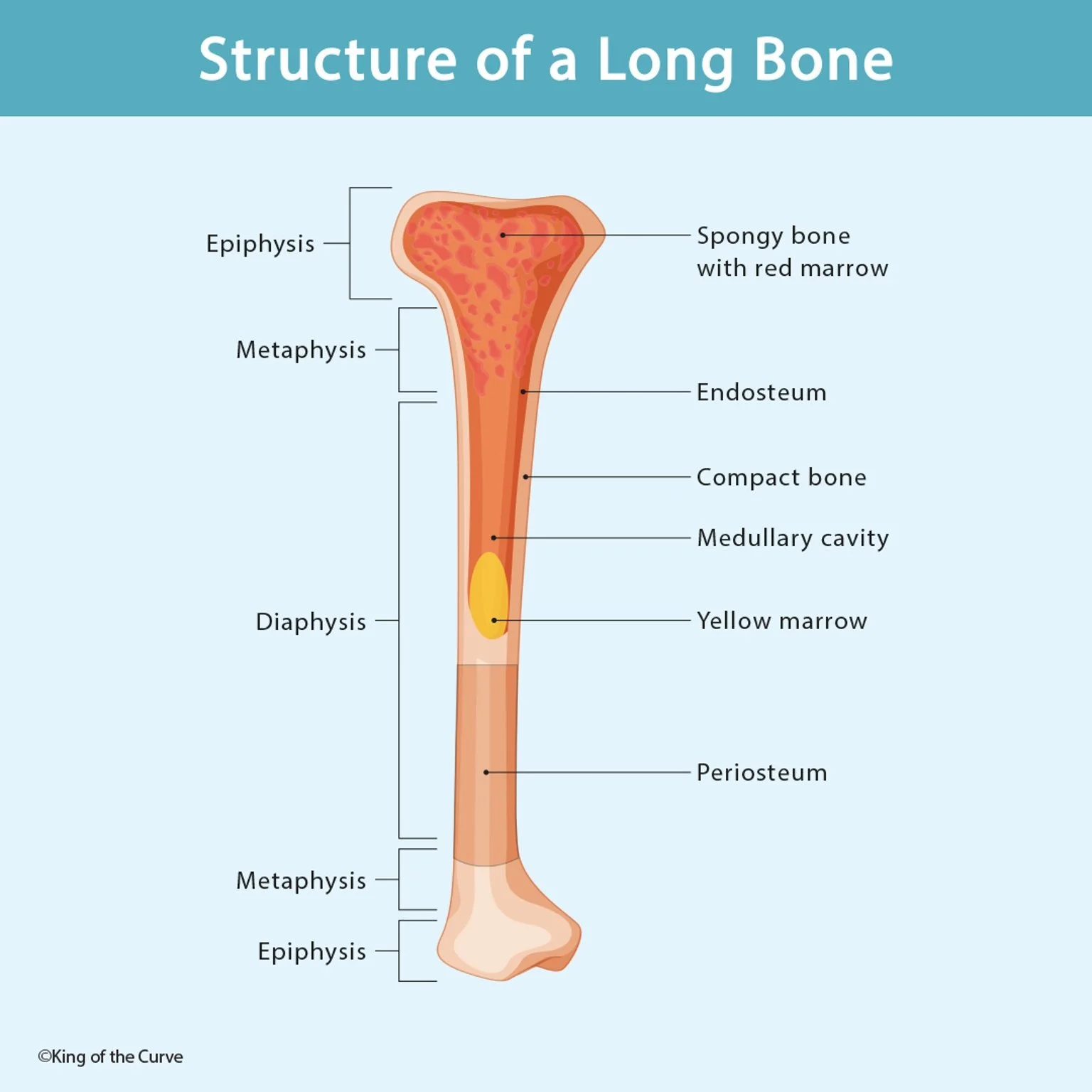
Diaphysis
The central shaft of a long bone.
Periosteum
A dense fibrous membrane covering the outer surface of bones.
Osteon
The structural unit of compact bone, consisting of concentric rings.
Haversian (Central) canal
The central channel in an osteon containing blood vessels and nerves.
Lacuna
A small cavity in bone matrix containing an osteocyte.
Osteoblasts
Bone cells responsible for building new bone tissue.
Osteocytes
Mature bone cells that maintain daily bone tissue.
Osteoclasts
Bone cells responsible for breaking down/resorbing bone tissue.
Difference between compact and spongy bone
Compact bone is dense and solid for strength and protection; spongy bone is porous and lightweight to house bone marrow.
Functions of cells
Osteoblasts build bone, osteocytes maintain bone, and osteoclasts break down bone.
Importance of blood vessels
They supply living bone cells with oxygen and nutrients while removing waste.
Osteoblasts and osteoclasts working together
Osteoclasts break down damaged or old bone, and osteoblasts replace it with new bone to keep the skeleton healthy and remodeled.

Tubercle
A small, rounded projection or process.

Tuberosity
A large, rough, elevated projection.
Fossa
A shallow depression or basin in a bone.

Condyle
A large, smooth, rounded articular prominence that forms joints.

Facet
A smooth, flat articular surface.

Sulcus
A narrow groove or furrow.
Purpose of bone markings
To serve as sites for muscle/ligament attachment, help form joints, and allow passage for nerves/vessels.
Help muscles/ligaments attach
Projections (like tubercles and tuberosity) provide rough surfaces for tendons and ligaments to anchor securely.
Help form joints
Smooth surfaces (like condyles and facets) fit cleanly against other bones.
Difference between projection and depression
Projections grow outward from the surface (e.g., tuberosity); depressions are indentations or recesses (e.g., fossa).
Markings involved in joints
Condyles, facets, and heads.
Fibrous joints
Allow little to no movement; connected by fibrous tissue (e.g., skull sutures).
Cartilaginous joints
Allow slight movement; connected by cartilage (e.g., pubic symphysis).
Synovial joints
Allow free movement; feature a fluid-filled joint cavity (e.g., knee).
What is a joint
The point where two or more bones meet.
Why joints are important
They allow movement and flexibility in the skeletal system.
Joint with most movement
Synovial joints.
Purpose of synovial fluid
To lubricate the joint, reduce friction, and nourish cartilage.
Why movement ranges differ
Joint structure dictates function; fibrous/cartilaginous joints are tightly bound restricting motion, whereas synovial joints have space and fluid allowing wide mobility.
Bone density as people age
It progressively decreases because bone breakdown outpaces new bone formation.
What is osteoporosis
A condition where bones become fragile, porous, and weak.
Osteonecrosis - Effect on bone strength
It drastically lowers bone strength, increasing fracture risk.
When breakdown exceeds formation
It results in net bone mass loss, leading to conditions like osteopenia or osteoporosis.
Three ways to maintain density
Engage in weight-bearing exercise, consume adequate calcium and vitamin D, and avoid smoking/excessive alcohol.
Why calcium and vitamin D are important
Calcium provides the hard mineral structure, and vitamin D is required for the body to absorb calcium.
How regular exercise helps
Weight-bearing stress stimulates osteoblasts to lay down new, stronger bone tissue.
Why older adults have greater fracture risk
Due to age-related bone density loss combined with a higher likelihood of falls.
Effect on quality of life
Can lead to chronic pain, loss of mobility, loss of independence, and reliance on caregivers.
Why a broken hip is serious
It often requires surgery and prolonged immobility, which carries high complication and mortality risks in older adults.