Lecture 5: Breathing circuit
 Call Kai
 Learn
 Practice Test
 Spaced Repetition
 Match
 Flashcards
 Knowt Play
1/67

There's no tags or description
Looks like no tags are added yet.
68 Terms
Resistance
there is friction inside the tubing that is holding back on the airflow going forward (pressure at outlet is lower than inlet)
What is the significance of resistance?
strain on patient if they are spontaneously ventilating (increase resistance to flow will cause patient to work harder to breathe)
Laminar flow
a smooth pattern of flow and fastest in the center

Turbulent
not parallel to wall, particles moving in different direction of flow
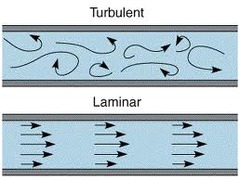
What is important in laminar? What is important in turbulent?
Laminar: viscosity
turbulent: density
can you have both types of flow in a system?
yes
how to minimize resistance in breathing circuit
minimal length, maximal internal diameter, no sharp curves, sudden changes in diameter
what can be a source of more resistance in a breathing system
endotracheal tube (bigger tube=less resistance)
compliance
How much something can expand under pressure
how to calculate delivered volume
Tidal volume- compliance loss
how to calculate compliance loss
multiply peak airway pressure (cmH2O) and compliance loss (mL/cmH2O)
rebreathing
inhaling previously expired gas and CO2 may or may not have been removed
factors that influence rebreathing
Fresh gas flow, mechanical dead space, system, design
Fresh gas flow: if greater than equal to minute ventilation,there is _______ breathing
no
mechanical deadspace
artificial airways including ventilator circuits
how does deadspace compare in unidirectional flow vs bidirectional flow?
unidirectional: no dead space
bi-directional: lots of dead space
altered gas tensions
depends on how much exhaled gases are rebreathed and whether these gases pass to alveoli or only to anatomical dead space (affects O2, CO2, inhaled agents by diluting them)
rebreathing benefits
gases are warmed and moistened
components of breathing circut
connection point, connectors, reservoir bag, corrugated breathing tube, APL valve, PEEP, HME
Mapelson breathing system components
resistor bag, corrugated tubing, APL valve, fresh gas inlet, Pt connection
how to prevent CO2 rebreathing in maples circut
fresh gas flow 2-3 x minute ventilation
Type A Mapelson
best for spontaneous ventilation

Type D Mapleson
(bain) used in transport and controlled ventilation

Type E Mapleson
(T piece) often used with intubated SV patients
Type F maples (Jackson-reese)
used for transport in pets cases
which maples circuit is most efficient for controlled ventilation
Modified maples D
advantaged to mapleson
simple, reliable, no moving part, resistance to flow is minimal, can be used in remote locations
disadvantages to mapleson
high FGF, no scavenging, gases are cold/not humidified
compoments of basic circle breathing breathing system
fresh gas inflow, insp/exp unidirectional valves, insp/exp corrugated tubing, Y piece connector, APL, resevior bag, CO2 absorber
what does circle breating system have that mapleson does not
CO2 absorber, FGF inflow, undirectional tubing, undirectional valves, Y piece
circle breathing system
gases flow in circle through seperate insp and exp channels

how does circle system prevent rebreathing of CO2
FGF cannot enter circut b/w pt and exp valve, APL ccan't be located b/w pt and insp valve. unidirectonal valve b/w pt and resiovior bag

during spontaneous ventilaton
he patient draws inspiratory gas from the reservoir bag and through the absorber, where it joins with the fresh gas and flows to the patient
gas flow during sponetanous ventilation
During SV at exhalation, exhaled gases pass into reservoir bag until full then excess gases are vented thru APL valve. Since inspir valve is closed, fresh gas flows retrograde toward absorber pushing gas toward APL valve. The higher the fresh gas flows, the farther the gas that has flowed through the absorber will be pushed back toward the APL valve. During low fresh gas glows, there may be no retrograde flow through the absorber
inspiration with manual ventilation
Squeezing the bag for manual ventilation:. Fresh gas flowing to pt will be mixture of FG and exhaled gas from absorber
exhaltion with manual ventilation and low FGF
If the fresh gas flow is low, fresh gas does not enter the absorber.
exhaltion with manual ventilation and high FGF
If FGF is high, it will enter retrograde through absorber during exhalation
exhaltion with mechnaical ventilation
exhaled gases will flow into the ventilator bellows. Fresh gas will flow retrograde through the absorber. Excess gases are vented through the spill valve in the ventilator during the latter part of exhalation. The longer the exhalation time and the higher the fresh gas flow, the more likely it is that fresh gas will pass retrograde into the absorber.
inhaled mixture in mechanical ventilation
combination of fresh gas and previously exhaled gas from which the CO2 has been removed
coaxial breathing tube
gas flow is undirectional, and resistance in increased

If there is a break in the inspiratory tube or the inspiratory tube becomes retracted, there will be an ________ in dead space.
increase
basic principal for CO2 absorbent
neautralize an acid (CO2 with H2O)
-creates water and a carbonate
common types of CO2 absorbants
Soda lime, baralyme (no longer used), Amsorb
Soda Lime reaction
CO2 + H2O -> H2CO3
H2CO3 + 2NaOH -> Na2CO3
Na2CO3 + Ca(OH)2 -> CaCO3 + 2NaOH
End product = Ca carbonate & Na hydroxide

hazards of absorbent
can produce compound A and CO and pt can breathe this in
Soda lime can produce
laryngospasm, bronchospasm, pneumonia, KOH and NaOH
what is the best indicator for if absorbent is exhausted
prescence of inspired CO2
wall effect
gas traveling preferentially along the periphery of the canister where there is less resistance to flow
channeling effecr
gas flows through pathways of least reistsance (creates line straight down)
regenreation of soda lime
can reverse color (may become white again)
LOOK FOR INSPIRED CO2
which absorbent type has desiccation indicator
Amsorb
carbon monoxide levels are highest with
baralyme, higher temps in absorber, dry abosrbent, high anesthetic concentrations (MAC des=6%)
disadvatnges of circle breathing system
many parts, difficult to clean, bulky, high compliance, long time constanst
advanatges to circle breathing system
low FGF, PaCO2 depends on ventilation, prevention of pollution, conservation of heat/mouisture, maintenance of stable inspired gas, length of tubing may be varied
amsorb and carbon monoxide
will not produce
sevoflurane and compound A
(LD50: Lethal dose where 50% of animal test subjects die from exposure)
what does FDA recommend with sevo?
2L/min flow
connection point
breathing circut ends at elbow attatched to EET/LMA/Masl
connectors (elbow adapter)
increase dead space
reservior bag (typically 3L for adults)r
resivior for VA, ventilation assited/controlled, visual perception of Pt sponatneous breathing, protects against excessive pressure
corrugated breathing tube
prevents kinks and increases flexibility
APL valve
only gas exit in sponatneous breathing, control breathign in the breathing system when off vent
Postitve end expiratory pressure valve (PEEP)
improve oxygenation
Define: Mechanical Dead Space
- volume in breathing system occupied by gases without change in composition- found where there is BI-DIRECTIONAL FLOW (ie LMA/ETT)

Formula: Total Deal Space *
Total dead space = anatomical dead space + alveolar dead space + mechanical dead space
Conditions for Minimal Resistance
- minimum length- maximum internal diameter- no sharp curves or sudden changes in diameter
Source of Most Resistance in a Circuit
ETT
why is pressure you of air you give lower at the end compared to the beginning
there is friction inside the tube that folds back on air going foward (resistance)