Ch 5.3 & 5.4
 Call Kai
 Learn
 Practice Test
 Spaced Repetition
 Match
 Flashcards
 Knowt Play
1/22

Earn XP
Description and Tags
Ch 5.3 & 5.4 A&P
23 Terms
Hypodermis functions
store fat
cushion structures
insulate from cold
Dermcidin
an antibiotic in sweat that protects skin from bacteria
Meissner corpuscle (tactile corpuscle)
receptor in skin that responds to light touch
abundant in finger tips
Pacinian corpuscle (lamellaed corpuscle)
receptor in skin that responds to vibration
Metastasis
spread of cancer cells from a source to other parts of body
Basal Cell Carinoma
cancer that originates from basal cells in epidermis of skin
most common cancer in USA
grows as uneven patch, bump, or growth, or scar on skin surface
Squamous Cell Carcinoma
type of skin cancer that starts in stratum spinosum of epidermis
2nd most common skin cancer
affects keratinocytes
more aggressive than basal cell carcinoma
Melanoma
type of skin cancer that starts from melanocytes of epidermis
develops from mole
most fatal skin cancer
asymmetrical brown and black patches raised
ABCDE Mnemonic to diagnose early stage melanoma
A ssymetry
B orders
C olor
D iameter
E volving
2 common skin disorders
Eczema
Acne
Eczema
skin condition due to allergic reaction
manifests as dry, itchy patches of skin that resemble rash
can also have swelling, flaking, or bleeding
Acne (atrophic scar)
skin condition due to infected sebaceous glands
occurs in face and back usually
bacteria forms onto oxidized sebum
Healing Damaged Skin Steps
Formation of blood clot to stop flow of blood and scabs over with time
Fibroblasts rapidly divide to repair tissue, via collagen deposition to form granulation tissue
Blood capillaries increase blood circulation and oxygen to area
Immune cells, (such as macrophages) roam and engulf foreign matter to reduce infection chances
1st degree burn
superficial burn that only injuries epidermis
skin is painful and swollen
heals in a few days

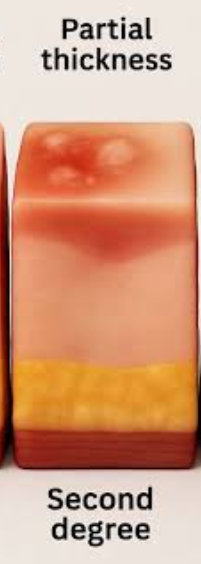
2nd degree burn
partial-thickness burn that injuries epidermis and a part of dermis
swelling and blistering of skin
keep clean
heals within several weeks
3rd degree burn
burn that penetrates and destroys full thickness of skin (epidermis and dermis)
affects nerve ending
Need medical attention and will heal slowly without it

4th degree burn
burn in which full thickness of skin and underlying muscle and bone is damaged
requires debridement or amputation then grafting

Scar
collagen-rich skin formed after process of wound healing that is different from normal skin
made by fibroblasts collagen
does not allow accessory structures to regenerate
Keloid (hypertrophic scar)
type of scar that has layers raised above skin surface
caused by overproduction of scar tissue, even when wound is healed
Bedsore (decubitus ulcers)
sore on skin that develops when regions of body start necrotizing due to constant pressure and lack of blood supply
Stretch mark
mark formed on skin due to sudden growth spurt and expansion of dermis beyond its elastic limits
Callus
thickened area of skin that arises due to constant abrasion
Corn
type of callus that is named for its shape and elliptical motion of abrasive force