Orgo Complete Set
 Call Kai
 Learn
 Practice Test
 Spaced Repetition
 Match
 Flashcards
 Knowt Play
1/85

There's no tags or description
Looks like no tags are added yet.
86 Terms
Triacylglycerols
serve as the primary long-term energy storage molecules in animals and plants, provide thermal insulation and organ protection, and function as dietary lipid components
Sphingolipids
act as structural components of cell membranes, insulate nerve fibers, and mediate cell signaling and recognition
Prostaglandins
regulate key physiological and inflammatory processes throughout the body
What are heterocyclic aromatic compounds
cyclic chemical structures where at least one carbon atom in the ring is replaced by a "heteroatom" (most commonly nitrogen, oxygen, or sulfur), and the ring exhibits special stability through complete electron delocalization
To form a hemiacetal or a hemiketal…
You react the carbonyl with one equivalent of alcohol
To form a ketal or acetal…
You react the carbonyl with two equivalents of alcohol
For imine formation, a carbonyl reacts with…
R-NH2
What does an imine look like?

For enamine formation, a carbonyl reacts with…
R2-NH
What does an enamine look like?

How is an enolate formed from a ketone?
A base removes an α-hydrogen, forming a C=C bond while the C=O electrons move onto oxygen.
Enolate
an organic anion derived from the deprotonation of a carbonyl compound (such as an aldehyde, ketone, or ester) at the alpha-carbon
What determines which enolate forms?
Which α-hydrogen is removed: removal from different α-carbons can produce different enolates.
What is a kinetic enolate?
The enolate that forms faster; generally has the less substituted C=C bond.
What is a thermodynamic enolate?
The more stable enolate; generally has the more substituted C=C bond.
What conditions favor the kinetic enolate?
Lower temperatures, bulky strong bases, and conditions that favor rapid, irreversible deprotonation.
What conditions favor the thermodynamic enolate?
Higher temperatures and reversible conditions that allow the enolates to equilibrate.
Why does the kinetic enolate form faster?
Its formation generally has a lower activation barrier due to more accessible α-hydrogens and less steric hindrance.
If a carbonyl reacts with LDA and an aprotic solvent at low temps, what kind of enolate product is formed?
The Kinetic enolate
Keto-enol tautomerization
The reversible conversion between a carbonyl compound (keto form) and an enol, involving the transfer of an alpha hydrogen and a shift of a double bond.
What si the first step for an aldol condensation?
To perform a self aldol reaction (attacks itself to form carbonyl and alcohol)
What is the seocnd step of an aldol condensation?
To add heat which turns OH into a leaving group and then forms a double bond. So final product will have double bond and carbonyl
What is the order of decreasing acidity of alcohols?
Methyl>1°>2°>3°
The less substituted the alcohol…
The stronger the acid
Strong oxidizing agents…
Oxidize as far as it can go as long as a free hydrogen is present
Weak oxidizing agents…
Only oxidizes one step
Can tertiary alcohols go through oxidation?
No because they’re tertiary, they have no free hydrogens availabile
Alcohol + HX (HBr or HCl/ZnCl₂): Which substitution mechanism occurs?
3° and 2° alcohol → SN1
1° alcohol or methanol → SN2
Alcohol + PBr₃: Which substitution mechanism occurs?
1° and 2° alcohols → SN2
Alcohol + SOCl2: Which substitution mechanism occurs?
1° and 2° alcohols → SN2
Alcohols can be turned into ______ and _____ which are good leaving groups and can then participate in substitution reactions
Mesylates (OMs) and Tosylates (TsCl)
SN2 reactions are one or two steps
One step
What is the rate law for SN2 reactions?
Rate = k[electrophile][nucleophile]
The product of SN2 reactions displays an ______
Inversion of configuration
SN1 reactions are one or two steps?
Two steps
What is the rate law for SN1 reactions?
Rate = k[electrophile]
The product of SN1 reactions displays an ______
Racemic mixture
Which substitution reactions partakes in a carbocation rearrangment
SN1
Which nucleophile is required for SN2 reactions?
Strong nucleophile
Which electrophiles are required for SN2 reactions?
CH3>1°>2°
CH3 is most reactive and then 1° and then 2°
Which solvent is required for SN2
Polar aprotic
What type of nucleophile is required for SN1 reactions?
Weak is ok
Which electrophiles are needed for SN1 reactions?
3°>2°
3° is most reactive and then 2°
Which solvent is needed for SN1 reactions?
Polar protic
Both SN1 and SN2 reactions require good leaving groups, what are the rankings for good nucleophiles?
I>Br>Cl>F
For substitution, the carbon with the leaving group must be an ______
sp3 carbon
What is the difference between polar protic and polar aprotic solvents?
Polar protic solvent can hydrogen bond
Polar aprotic solvents cannot
If there is an impurity in a product, what effect will it have on the melting point?
It will always lower the melting point range
What are the two types of extractions?
Simple Aqueous Extractions
Acid/Base Extractions
What are simple aqueous extractions
Occurs when solutes are separated between immiscible aqueous (polar) and organic (not polar) phases
What is the purpose of acid/base extractions
To make functional groups soluble in water
What are the types of acid/base extractions?
Amines removed by HCl
Carboxylic acids removed by NaHCO3 or NaOH
Phenols removed by NaOH
What are simple distillations?
Separates a liquid from a nonvolatile solute or liquids with widely different boiling points. The more volatile component distills first.
What are fractional distillations?
Repeated vaporization and condensation in a fractionating column; separates miscible liquids with closer boiling points.
What is the difference between fractional and simple distillations
Fractional distillation is essentially multiple simple distillations occurring in a fractionating column.
Gas chromatography
Separate is due to differences in boiling point and polarity/solubility. The compound with the lower boiling point is eluted first
Column Chromatography
Separation due to a difference in polarity.
What is the stationary phase in column chromatography?
Polar beads
In column chromatography the more ______ compounds have longer retention times
polar
Why do polar compounds have longer retention times with polar stationary phases
Because polar compounds are attracted to polar stationary phases, so they stick to the stationary phase longer instead of moving with the mobile phase.
Thin Layer Chromatography
Separation due to differences in polarity
More polar solutes have a _____ Rf value in TLC
Lower
What if the lowest-priority group (#4) is in the plane when assigning R/S?
Swap #4 with the group on the dashed wedge, determine R/S using 1 → 2 → 3, then flip the answer because one swap reverses the configuration.
For fischer projections, horizontal lines are ______ and vertical lines are ______
on wedge; on dash
Meso compounds have an….
Internal mirror plane, therefore even though they have chiral centers they are achiral
Constitutional isomer
Same molecular formula, different connectivity (bonding arrangement).
Stereoisomers
Same molecular formula and connectivity, different 3D spatial arrangement.
Enantiomer
Stereoisomers that are non-superimposable mirror images of each other.
Diastereomer
Stereoisomers that are NOT mirror images of each other.
Constitutional isomers vs. stereoisomers
Constitutional isomers differ in connectivity; stereoisomers have the same connectivity but differ in 3D arrangement.
How do you rank Acids and Bases
These rules are for bases so when comparing acid turn to conjugate bases:
CARDIO
C - Charge: More negatively charged species are typically more basic and more positively charged species are typically more acidic
A - Atom: The larger and/or more electronegative the atom with a negative charge, the more stable it is
R - Resonance-stabilization: More resonance means more stable
DI - Dipole Induction: EWGs near the atom with negative charge stabilizes teh ion/molecule
O - Orbitals: A pair of electrons is more stable as follows sp>sp2?sp3
What is the overarching rule for determining the strength of bases?
The more stable the base, the weaker the base is
What is the overarching rule for determining the strength of acids?
The more stable the conjugate base, the stronger the acid
How do you find the conjugate base
Use bronsted lowry definitions
Bronsted Lowry Acids donate H+ to form conj base
Most strong nucleophiles have what?
A negative charge or a lone pair of electrons at the very least
What is the trend for nucleophile strength in aprotic solvents?
Nucleophile strength increases up the table and to the left
What is the trend for nucleophile strength in protic solvents?
Nucleophile strength increases down the table and to the left
What are characteristics of electrophiles
They are electron pair acceptors
What are the common electrophiles
Alkyl halides, carbonyl groups, and carbocations
EDGs make nucleophiles _____ and electrophiles _____
Stronger; weaker
EWGs make nucleophiles ______ and electrophiles ______
Weaker; stronger

Adenine

Guanine

Cytosine

Uracil
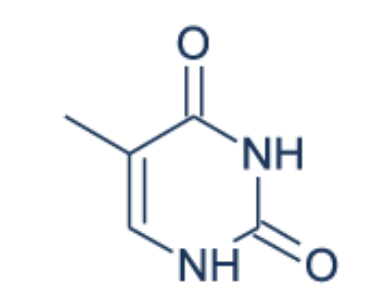
Thymine