Chem Final
 Call Kai
 Learn
Learn Practice Test
 Spaced Repetition
 Match
Match Flashcards
 Knowt Play
1/40

There's no tags or description
Looks like no tags are added yet.
Name | Mastery | Learn | Test | Matching | Spaced | Call with Kai | Chat |
|---|
No analytics yet
Send a link to your students to track their progress
41 Terms
Short Answer Questions
Double replacement, net ionic, redox rxtns
% yield / stoichiometry / limiting reactant
Gas Laws
Thermodynamics
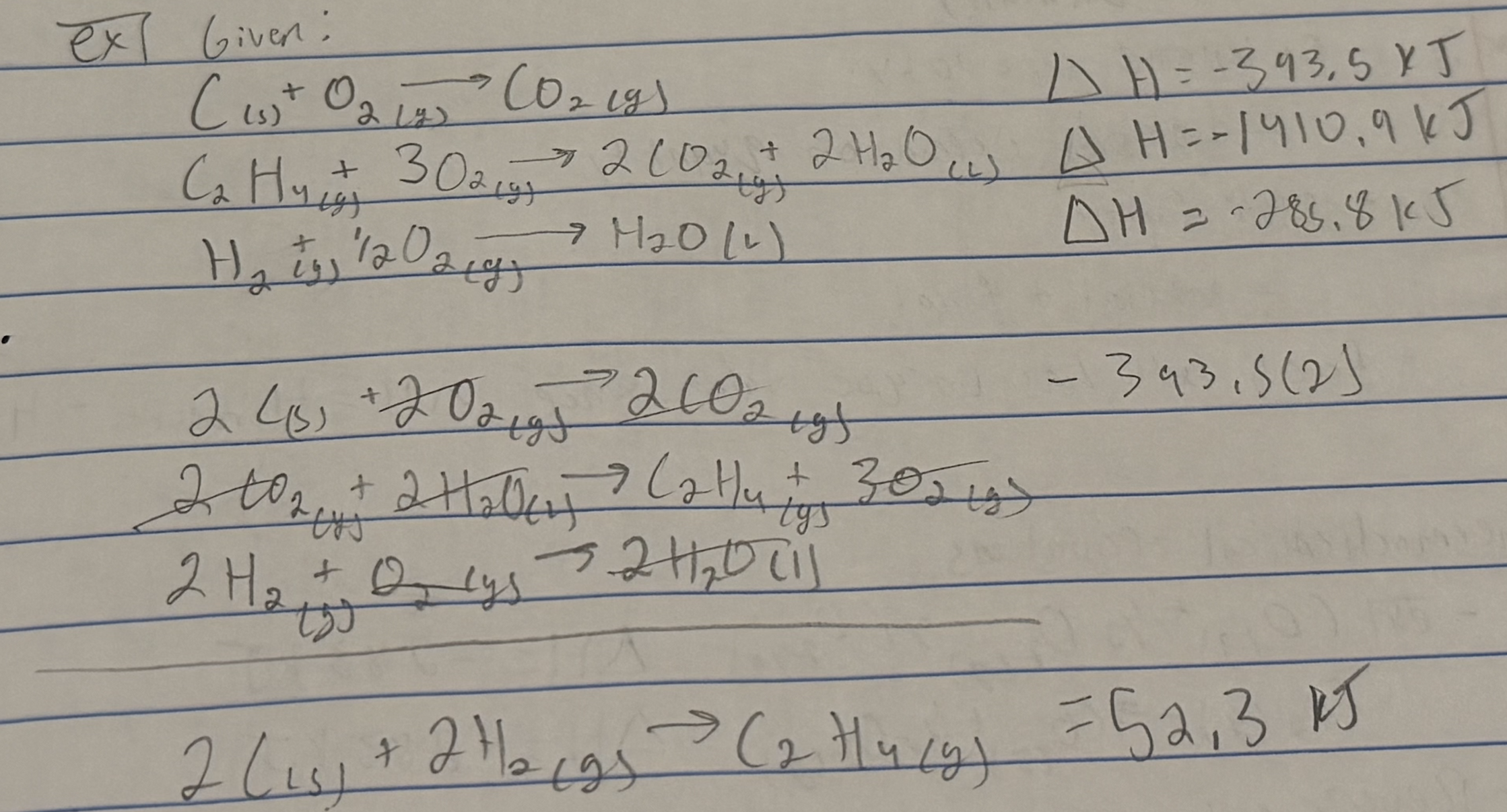
Hess’s Law
Law of Conservation of Mass
Mass can not be created or destroyed
Diatomic elements
Br2, I2, N2, Cl2, H2, O2, F2
Double displacement
ab + yz → az + yb
Single displacement
a + yb → y + ab
Synthesis
a + b → ab
Decomposition
ab → a + b
Combustion
CxHx + Ox → CO2 + H2O
Percent Yield
Actual ÷ Theoretical
0 → +2
Oxidized RA
+2 → 0
Reducing OA
Kinetic nrg is directly proportional to ___
temp
Elastic collision
100 % of nrg is transfered, none is lost
(gas) 5 postulates
particles are in constant, rapid, straight line motion
result: gases expand to fill their containers shape and volume
gases are fluids
collisions between gas particles, other particles, and the container wall are elastic collisions
result: pressure is exerted when the particles hit the sides of the container
Gas pressure is caused by collisions of gas particles
increase of temp causes this
the temp in gas (kelvin) is directly proportional to the average kenetic energy of the particles
if temp doubles so does kinetic energy
at same temp- lighter gas particles are faster
there are no forces of attraction between gas particles
the volume of individual gas particles is nearly zero
result: gases are mostly empty space
Real Gases
Have almost no volume, small amounts of attractive forces, and behave like ideal at low pressure and high temp
Attractive Forces
Solids, then liquids, then gases
crystalline solids
most solid substances are these
particles are arranged in orderly, repeating, three dimentional patterns
shape reflects arrangement of particles
amorphous solids:
not arranged in any particular order
like liquid particles but in fixed positions
don’t have a definite melting point while crystalline solids do
Which of the 3 are fluids
liquids and gases
Solids
closely packed together in fixed positions
only vibrate in place
have definite shape and volume
forces of attraction are much stronger in solids than in liquids or gases
lowest amount of kinetic energy
Changes of States of Matter
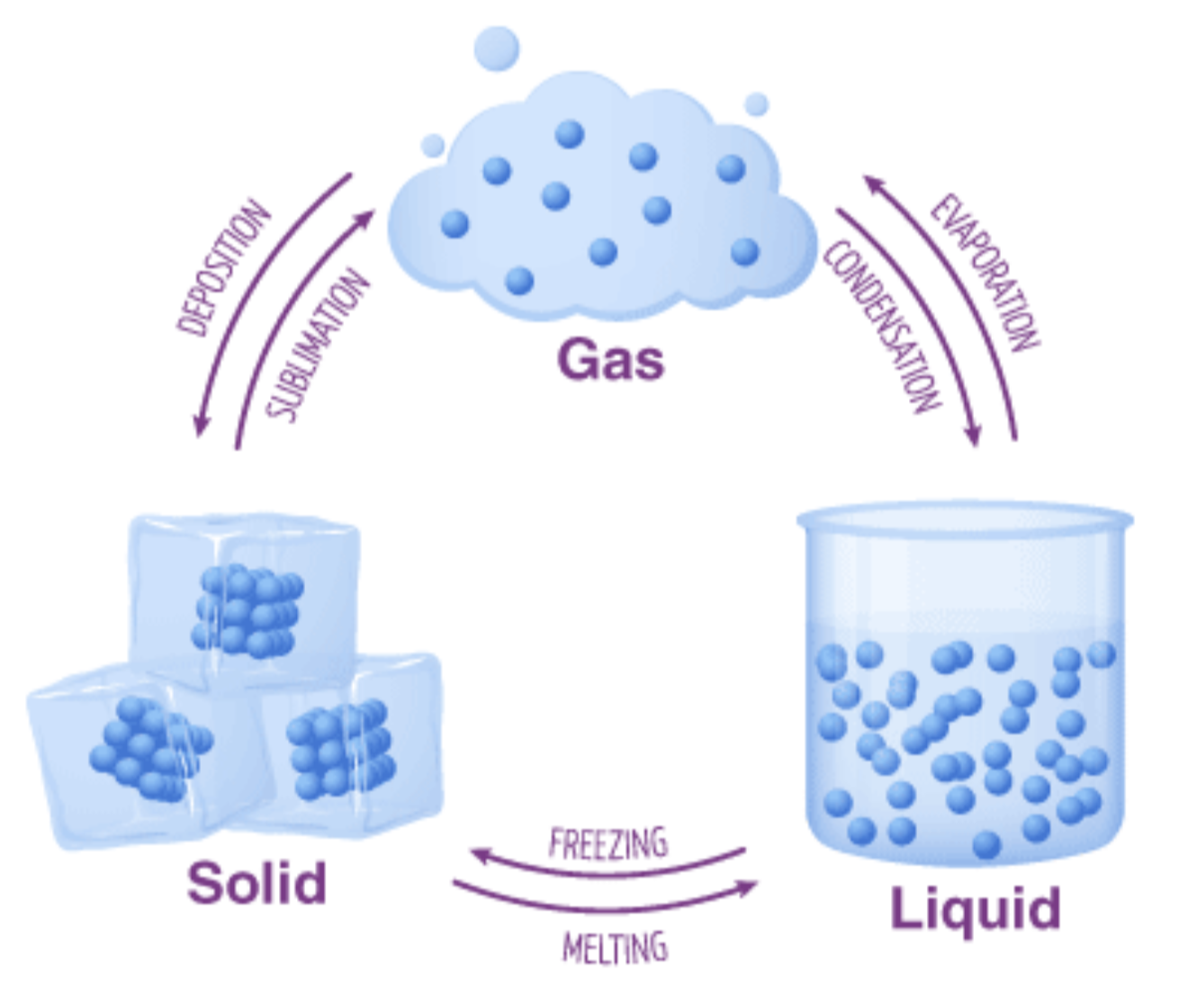
What does increased temp do to vapor pressure
Increases it
Endothermic (KMT)
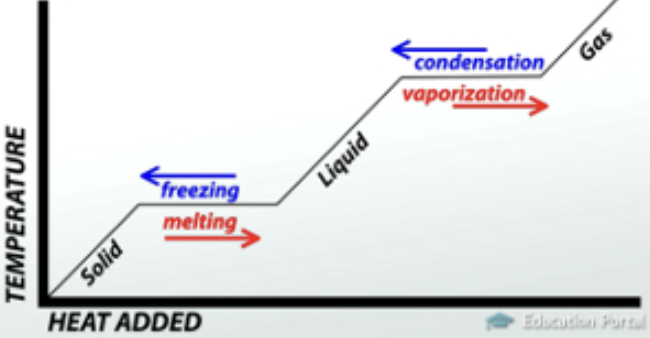
liquid + energy —> gas
boiling and evaporation; energy needs to be added
Exothermic (KMT)
gas —> liquid + energy
condensation; energy needs to be removed
Heating & Cooling curve
Phase Diagram
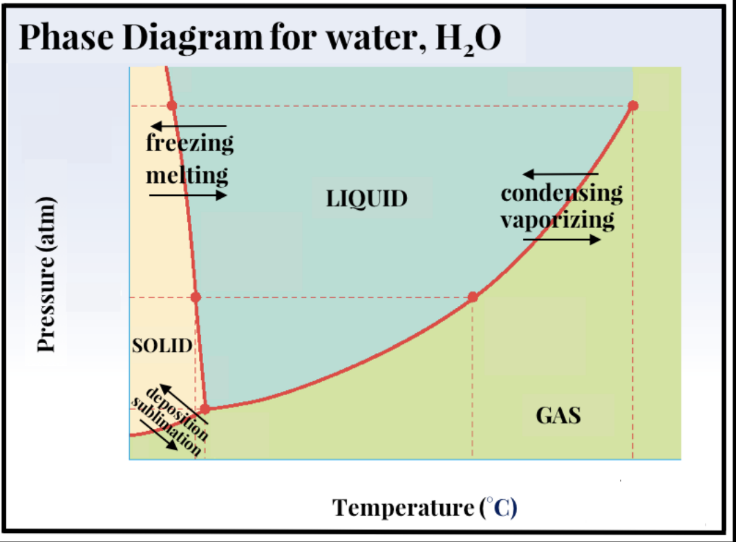
Triple Point
Where the solid, liquid, and gas can exist at equilibrium with one another
Atmospheric Pressure
Force exerted by the weight of air the atmosphere
Decreases as altitude increases because there is less air above you
Formula for heat required to melt solid/vaporize (liquid to gas)
Q = mH fus/vap
Q- heat, m- mass, H- enthalpy (nrg), fus- fusion, vap- vaporization
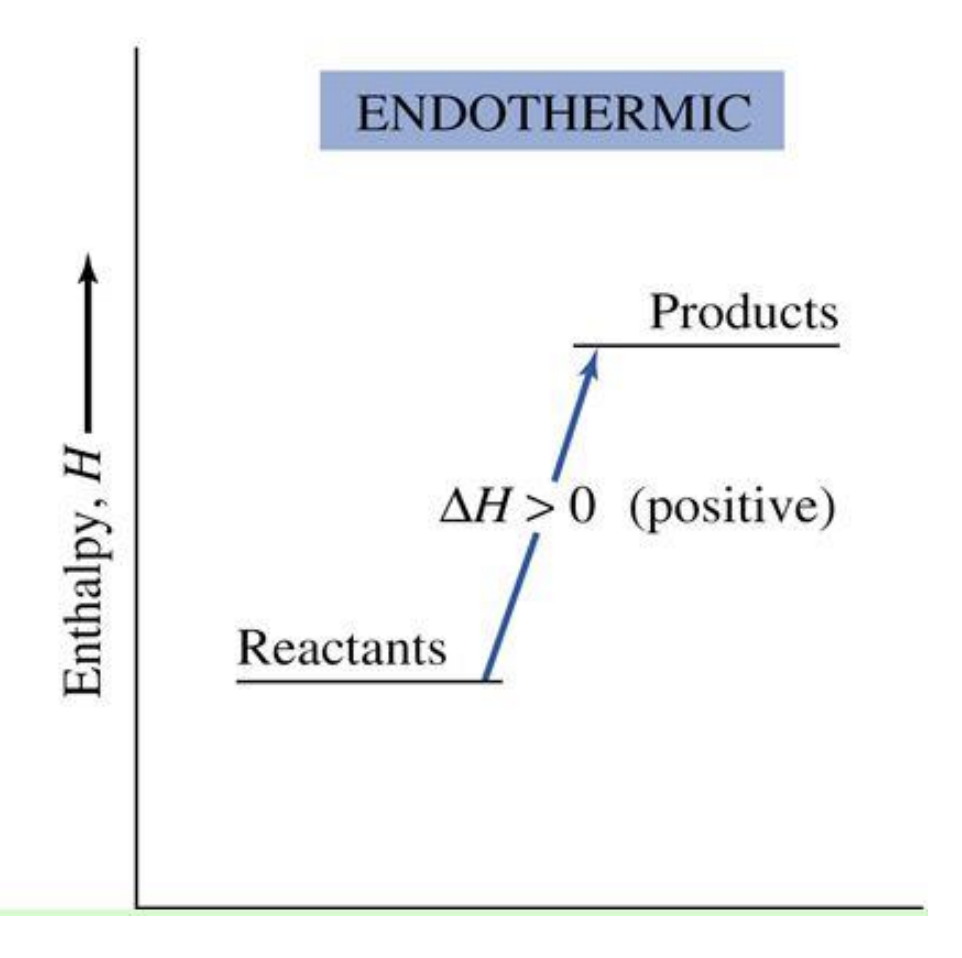
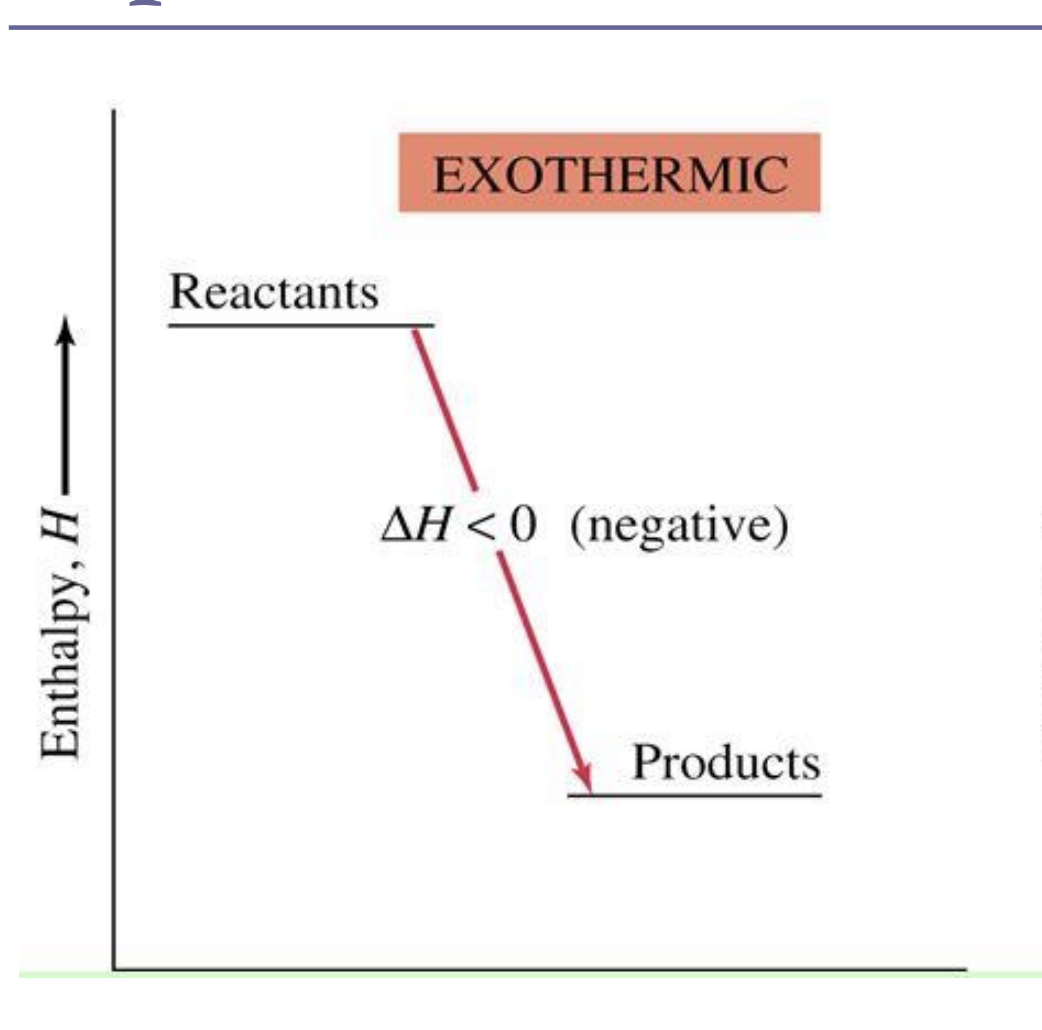
Endothermic (Thermodynamics)
Heat goes from surroundings to system, temp increases, ΔT is pos
Exothermic (Thermodynamics)
Heat goes from system to surrondings, temp decreases, ΔT is neg
Specific Heat Capacity Formula
Q = mCΔT
Q- heat, m- mass, C- specific heat capacity, ΔT- change in temp
Enthalpy
State function: look at initial & final not middle
Heat content of a rxtn
Heatfinal - Heatinitial
Heat capacity
Heat required to raise an objects temp by 1o C
Calorie
Heat required to raise the temp of 1g/water by 1o C
Specific Heat
Heat required to raise temp of 1g by 1o C
Hess’s Law ex. problem
Stoichiometry: Moles to Moles
Moles of atom to moles of diff atom
Stoichiometry: Moles to mass
Times molar mass over 1 mol
Stoichiometry: Mass to Moles
Moles over grams
Stoichiometry: Mass to Mass
Times Molar mass over 1, molar ratio, 1 over molar mass