Ch 15 - Chemical Kinetics
 Call Kai
 Learn
Learn Practice Test
 Spaced Repetition
 Match
Match Flashcards
 Knowt Play
1/54

There's no tags or description
Looks like no tags are added yet.
Name | Mastery | Learn | Test | Matching | Spaced | Call with Kai | Chat |
|---|
No analytics yet
Send a link to your students to track their progress
55 Terms
Chemical Kinetics
study of the rate of chemical reactions and factors that affect reaction rate.
Reaction rate
how quickly reactants are consumed or products are formed
Measured as the change in concentration over time

decreases, increases
In a reaction, reactant concentration ______ over time and product concentration ______ over time
equilibrium
Reactions stop because either reactants are used up, or the reaction reaches ____

Average Rate
Rate over a specific time interval t1 to t2.
Gives the overall rate during a time interval.

Instantaneous Rate
Rate at a specific moment in time
Found from the slope of the tangent line at that point on a concentration-vs.-time graph.
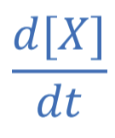
relative rates
Stoichiometric coefficients determine the ___ ____ at which reactants are consumed and products are formed.
Divide each concentration change by its stoichiometric coefficient.

Measuring Reaction Rates: Polarimetry
Measures changes in optical rotation.
Useful when concentration of chiral substances changes

Measuring Reaction Rates: Spectroscopy
Measures absorbance or emission related to concentration.

Measuring Reaction Rates: Pressure measurement
Tracks pressure changes in gas-phase reactions.
Measuring Reaction Rates: Titration
Samples reaction mixture at specific times and determines concentration.
Measuring Reaction Rates: Gravimetric analysis
Determines amount of a substance based on mass.
Measuring Reaction Rates: Gas chromatography
Separates and measures substances in a reaction mixture

rate law
A ___ ___ describes how reaction rate depends on reactant concentrations.
Overall reaction order
sum of all exponents in rate law eqn
Reaction Order
The order with respect to a reactant is the exponent of that reactant in the rate law.

Zero Order
Rate is independent of [A]
Doubling [A] → no change in rate.
Rate is equal to k since [A]0 = 1
![<p>Rate is independent of [A]</p><p>Doubling [A] → no change in rate. </p><p>Rate is equal to k since [A]0 = 1</p>](https://assets.knowt.com/user-attachments/6bbc3af2-141a-4638-b957-39c81b413ca3.png)
First Order
Rate is directly proportional to [A].
Doubling [A] → rate doubles.
![<p>Rate is directly proportional to [A]. </p><p>Doubling [A] → rate doubles.</p>](https://assets.knowt.com/user-attachments/8c5fe0f0-140c-4f86-ad7b-3c267995a627.png)
Second Order
Rate is proportional to [A]^2.
Doubling [A] → rate quadruples.
![<p>Rate is proportional to [A]^2. </p><p>Doubling [A] → rate quadruples.</p>](https://assets.knowt.com/user-attachments/25462d17-1d82-488b-b20f-957641cecfc9.png)
Integrated rate laws
describe how reactant concentration changes with time
Used to:
-Calculate concentration at a certain time.
-Calculate the time needed to reach a certain concentration.
-Calculate half-life.

Half-Life
the time required for the concentration of a reactant to decrease to half of its initial concentration.
depends on the order of the reaction
The relationship between ___ ___ and initial concentration is different for zero-, first-, and second-order reactions.
First-Order Reactions
Order where the half-life is constant.
It is independent of the initial concentration.
Therefore, every successive half-life takes the same amount of time.
As reaction proceeds, rate slows down
Rate=k[A] → [A] decreases → rate decreases.
![<p>Order where the half-life is constant. </p><p>It is independent of the initial concentration. </p><p>Therefore, every successive half-life takes the same amount of time. </p><p>As reaction proceeds, rate slows down</p><p>Rate=k[A] → [A] decreases → rate decreases.</p>](https://assets.knowt.com/user-attachments/bae68cec-441f-4029-815f-d6f40d5f62a4.png)
Zero-Order Reactions
Order where the half-life depends on the initial concentration.
Increasing [A]_0 increases the half-life time.
k[A]^0 = k → concentration has no effect on rate
![<p>Order where the half-life depends on the initial concentration. </p><p>Increasing [A]_0 increases the half-life time. </p><p>k[A]^0 = k → concentration has no effect on rate</p>](https://assets.knowt.com/user-attachments/9555141a-0737-4b36-8ada-88e795e73c5f.png)
Second-Order Reactions
Order where the half-life depends on the initial concentration.
Increasing [A]_0 decreases the half-life.
As reaction proceeds, rate slows down
Rate=k[A]^2 → [A] decreases → rate decreases.
![<p>Order where the half-life depends on the initial concentration. </p><p>Increasing [A]_0 decreases the half-life. </p><p>As reaction proceeds, rate slows down</p><p>Rate=k[A]^2 → [A] decreases → rate decreases.</p>](https://assets.knowt.com/user-attachments/e5cc9d1c-9a0d-4191-93f7-142294a5c502.png)
Activation Energy (Ea)
minimum energy required for a reaction to occur.
Reactions have an energy barrier that reactants must overcome to form products.

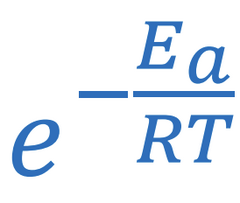
Increasing
______ temperature:
Makes the Arrhenius exponent less negative.
Increases k.
Increases reaction rate.
Allows more molecules to overcome Ea.
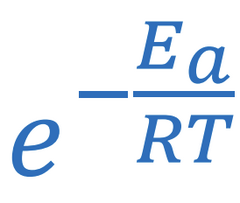
Decreasing
_____ temperature:
Makes the exponent more negative.
Decreases k.
Decreases reaction rate.
Fewer molecules can overcome Ea.
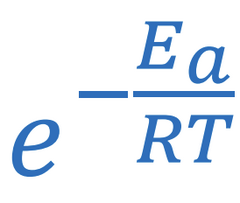
Exponential Factor
Has a value between 0 and 1.
Represents the fraction of the approaches that are successful in surmounting the activation barrier and forming products
larger, larger
smaller, smaller
Higher T → ____ exponential factor → ____ k.
Higher Ea → ____ exponential factor → ____ k

Two-Point Arrhenius Equation
Equation used to calculate activation energy or an unknown k/T.

Collision Theory
explains how molecular collisions affect reaction rates
Molecules must collide for a reaction to occur.
Not every collision produces a reaction.
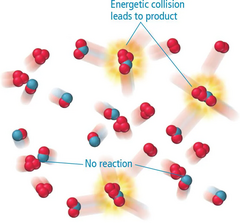
Requirements for an Effective Collision
1. Molecules must have enough energy to overcome Ea.
2. Molecules must have the correct orientation.
Effective collisions form the activated transition state, which then leads to products.
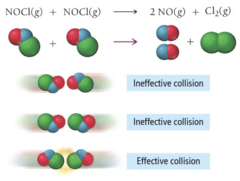
Increasing
______ temperature:
-Increases molecular energy.
-Increases collision frequency.
-Increases the fraction of collisions with enough energy.
-Increases the number of effective collisions.
-Increases reaction rate.
Collision Frequency
Related to the frequency factor A.
Represents how frequently molecules collide.

Orientation Factor (p)
__ represents the likelihood of molecules having the correct orientation.
__ < 1 for complex molecules.
__ > 1 in some electron-transfer reactions.

Reaction mechanism
sequence of elementary steps that describes how a reaction occurs.
Overall reactions can occur through multiple elementary steps.

Intermediates
substance that is:
-Produced in one elementary step.
-Consumed in a later elementary step.
-It does not appear in the overall reaction.

valid
For a proposed reaction mechanism to be ____, two conditions must be met:
The elementary steps in the mechanism must sum to the overall reaction
The rate law predicted by the mechanism must be consistent with the experimentally observed rate law
Molecularity
number of reactant particles involved in an elementary step
Unimolecular
1 reactant particle

Bimolecular
2 reactant particles

Termolecular
3 reactant particles.
Rare because the probability of three particle simultaneously colliding is small

reactants
For an elementary step, the rate law is based directly on the ____ in that step.

Rate-Determining Step (RDS)
mechanism step that is much slower than the others.
It controls the overall reaction rate.

highest, smallest
The Rate-Determining Step (RDS) usually has:
____ activation energy
_____ rate constant
Catalyst
changes the rate of a reaction without being consumed overall.
May be consumed in one step.
Is regenerated in a later step.

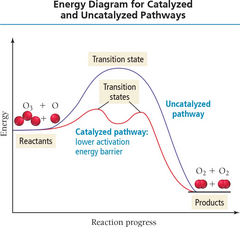
activation energy
Catalysts provide an alternative reaction mechanism with a lower ___ ___.
Results in more effective collisions and faster reaction
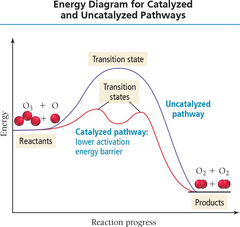
reactants, products
A catalyst changes the reaction pathway and rate, but does not change the overall _____ and _____.
Homogeneous Catalyst
Catalyst and reactants are in the same phase.
Helps reactant molecules:
-Achieve the correct orientation.
-Break bonds during collisions.
-Form products more easily.

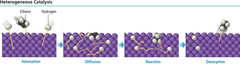
Heterogeneous Catalyst
Catalyst and reactants are in different phases.
Interacts with reactants to form a more stable activated complex.
Provides a pathway with lower activation energy.
biological
Many _____ reactions are too slow without catalysts.
Enzymes
protein molecules that catalyze biological reactions.
lowers the activation energy

substrate
The _____ fits into the enzyme's active site in a specific way.
Proper binding positions the _____ for reaction.

consumed, produced
A catalyst is ____ in the first step and ______ in a later step
produced, consumed
An intermediate is _____ in the first step and _____ in a later step