All of Module 2
 Call Kai
 Learn
 Practice Test
 Spaced Repetition
 Match
 Flashcards
 Knowt Play
1/89

There's no tags or description
Looks like no tags are added yet.
90 Terms
What is relative isotopic mass?
The mass of an isotope compared with 1/12 of the mass of a carbon-12 atom.
relative atomic mass
Weighted mean mass compared with 1/12th mass of carbon-12
What is the definition for isotopes?
atoms of the same element with different numbers of neutrons and different masses
What is the formula for finding moles using Avogadro's constant?
Moles = number of particles/ 6.02x10²³
What is a standard solution
solution of known concentration
How do you prepare a standard solution?
1. Weigh solid accurately on a watch glass.
2. Transfer to beaker, rinse watch glass to include all solid.
3. Dissolve solid in distilled water, stir with glass rod.
4. Transfer to volumetric flask, rinse beaker and rod into flask.
5. Fill to graduation line carefully (use pipette for final drops).
6. Invert flask several times to mix thoroughly.
What is the formula for the % uncertainty?

What is the formula for % yield?

What is the limiting reagent?
The reactant that is completely used up first. All of its moles react, so it limits the amount of product formed.
What is the formula for atom economy?

What is the definition of an acid?
proton donor
What do alkalis release in aqueous solution?
OH-
When bases react with acids what is formed?
salts
What is the definition for strong acids?
proton donors that completely dissociate in aqueous solution
What is the definition of weak acids?
proton donors that partially dissociatie in aqueous solution
What is the definition for a base?
a proton acceptor
Why is ammonia classed as an alkali?
when added to water, NH4+ and OH- is formed.

What is neutralisation?
when an acid reacts with a base to form a salt and water
What is the maximum number of electrons in the 1st, 2nd, 3rd, and 4th electron shells?
1st shell = 2 electrons
2nd shell = 8 electrons
3rd shell = 18 electrons
4th shell = 32 electrons
What is the definition of an orbital?
a region around the nucleus that can hold two electrons, with opposite spins
What is the shape of a s-subshell?
sphere
What is the shape of a p sub-shell?
dumbbell
How many subshells do the s,p,d,f sub shells contain in order?
1,3,5,7
True or false, the p-orbitals can each hold 6 electrons
False, (orbitals can only hold 2)


What atoms do the s block contain?
atoms whose outer electrons are in the s subshell.
What type of chemical bond is in NaBr?
Ionic
What type of chemical bond is in S8
Covalent bonds
S₈ is a simple molecular substance with strong covalent bonds within the molecule and weak IDDI between molecules.
What is the definition of a covalent bond?
strong electrostatic attraction between a shared pair of electrons and the nuclei of bonded atoms
What is a dative covalent bond?
a covalent bond where only one of the bonded atoms donates both electrons being shared.
Linear?
(2 bonding pairs, 0 lone pairs)Bond angle: 180°
Trigonal planar?
(3 bonding pairs, 0 lone pairs)Bond angle: 120°
Pyramidal?
(3 bonding pairs, 1 lone pair)Bond angle: ~107°
Non-linear?
(2 bonding pairs, 2 lone pairs)Bond angle ~104.5°
Tetrahedral?
(4 bonding pairs, 0 lone pairs)Bond angle: 109.5°
Octahedral?
(6 bonding pairs, 0 lone pairs) Bond angle: 90°
What is electronegativity?
Electronegativity is the ability of an atom to attract electrons in a covalent bond
What is the most electronegative element?
Fluorine

Explanation of this shape including bond angle and shape name.
electron pairs repel to get as far as possible
PH3 has 3 bonding pairs and 1 lone pair
Lone electron pairs repel more than bonding pairs
Therefore the shape is pyramidal and bond angle is 107
What are intermolecular forces?
forces occuring between molecules
What do intermolecular forces occur only in?
simple covalent substances
How does the strength of the induced dipole-dipole interactions increase?
number of electrons in the molecule or an atom increases
surface contact of the molecules or atoms increases
What is the definition of electronegativity?
the ability of an atom to attract the bonding electrons in a covalent bond
Can a non-polar molecule have polar bonds and if so, how?
Yes, polar bonds can be present, but the molecule is non-polar, due to being symmetrical and the dipoles cancelling out
How can we tell a molecule is symmetrical?
all atoms around the central atom are the same
no lone pairs on the central atom
How can we tell a molecule is unsymmetrical?
central atom has 2 or more different atoms attached
central atom has 1 or more lone pairs
Why does the boiling point increase as you go across the series of HCl, HBr, HI, HAt (not PDDI)
increasing IDDI due to more electrons leads to higher boiling points
What is the definition of a hydrogen bond?
intermolecular bonding betwen molecules containg N, O or F and the H atom of NH, OH, HF
What are the two anomalous properties of water?
Higher melting/boiling point than expected
solid form is less dense than the liquid (ice floats on water)
Why does water have a higher boiling/ melting point than expected?
strong hydrogen bonds holding the water molecules together, so lots of energy required to overcome the intermolecular forces
Why is the solid form of water less dense than the liquid?
hydrogen bonding holds the molecules apart in an open lattice structure

Do simple covalent molecules have a high or low melting/boiling point and why?
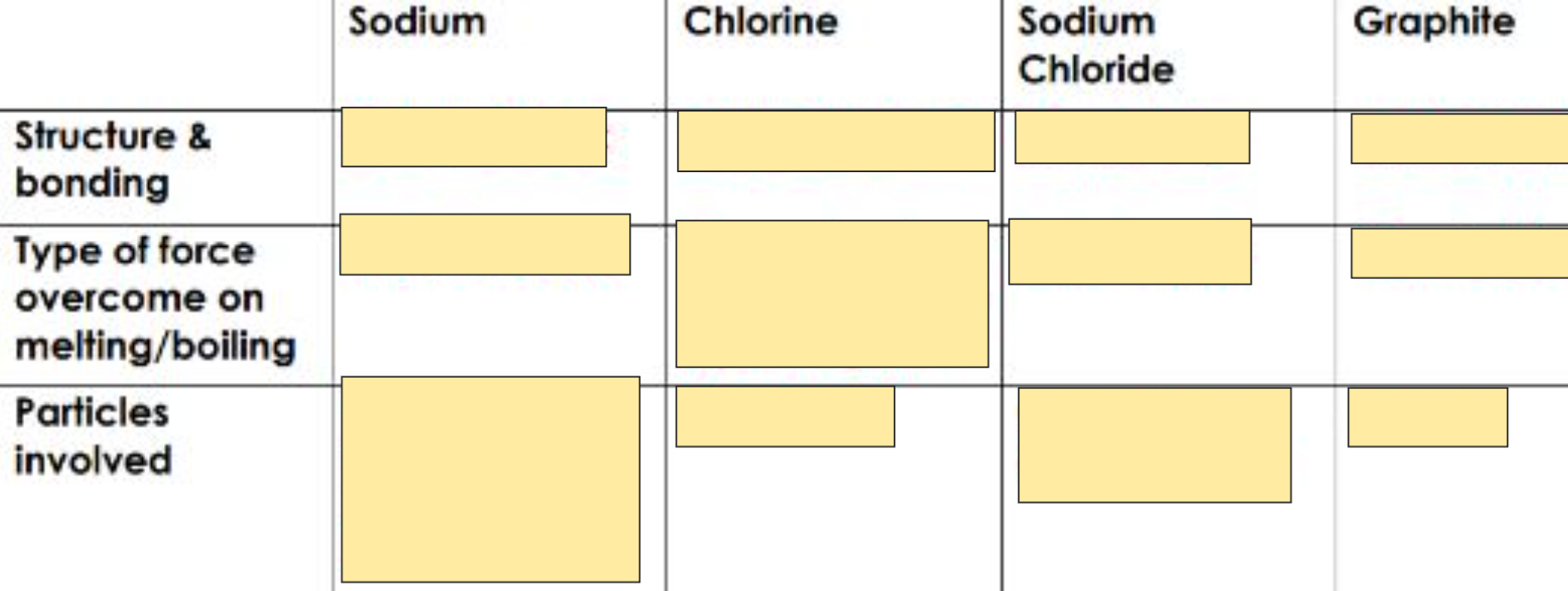
low melting/boiling point because the forces are relatively weak and require little energy to break
Are simple covalent molecules soluble? Explain answer.
no, because non-polar substances cannot interact with water molecules
Do simple covalent molecules conduct electricity? Explain why.
no mobile charge carries so do not conduct electricity.
What are the 3 types of giant covalent lattices we learn?
graphite, graphene, diamond
Do giant covalent lattices have a low or high melting point? Explain why.
very high melting points because structure is held together by strong covalent bonds which require alot of energy to break.
Do giant covalent substances have solubility? Explain why.
they do not interact with water molecules so are insoluble in water.
Do giant covalent substances conduct electricity?
most molecules do not contain mobile charge particles so do not conduct electricity.
but graphite and graphene can because they both contain mobile delocalised electrons
What elements (non-metals) also form giant covalent lattices?
boron, silicon, silicon dioxide
Do giant ionic substances have a high or low melting point? Explain why.
high melting points because oppositely charged ions are held together by strong ionic bonds which require a lot of energy to break
Do giant ionic substances have solubility? Explain why.
tend to be soluble as they dissociate into ions when in water, which interact with water molecules.
Do giant ionic substances conduct electricity? Explain why.
when solid, no mobile ions so do not conduct
when molten ( or in aq solution ) ions are mobile so can conduct electricity
What is the definition of a an ionic bond?
the electrostatic attraction between oppositely charged ions
What is the definition of a metallic bond?
strong electrostatic attraction between cations and delocalised electrons
Do giant metallic substances have a high or low melting point? Explain why.
high melting points because they have strong electrostatic attractions holding together cations and delocalised electrons, these metallic bonds require alot of energy to break.
Do giant metallic substances have solubility? Explain why.
do not interact with water molecules and are therefore insoluble in water
Do giant metallic substances conduct electricity?
when both solid and molten, they have mobile delocalised electrons that can conduct.
What does anhydrous mean in terms of water of crystallisation?
Contains no water of crystallisation.
What does hydrated mean in terms of water of crystallisation?
Contains water of crystallisation (water molecules within its structure).
What is the ideal gas equation and what are the units?
pV=nRT
p = pressure (Pa, pascals)
V = volume (m³, cubic metres)
n = amount of substance (mol, moles)
R = gas constant (8.31 J mol⁻¹ K⁻¹)
T = temperature (K, kelvin)
What are the sustainability benefits of developing chemical processes with a high atom economy?
High atom economy reactions are preferred because they:
- Use raw materials efficiently
- Produce less waste
- Are cheaper and more environmentally friendly
Low atom economy reactions:
- Produce more waste, increasing disposal and separation costs
- Can still be used if by-products are useful for other reactions
What salts does sulfuric acid produce?
Sulfuric acid (H₂SO₄) → produces sulfates (SO₄²⁻)
What salts does hydrochloric acid produce?
Hydrochloric acid (HCl) → produces chlorides (Cl⁻)
What salts does nitric acid produce?
What happens when ammonia reacts with acids?
Ammonia (NH₃) + acid → ammonium salt
NH₃ + H₂SO₄ → ...
(NH₄)₂SO₄ (ammonium sulfate)
NH₃ + HNO₃ → ...
NH₄NO₃ (ammonium nitrate)
cm³ → m³
÷ 10⁶
dm³ → m³
÷ 10³
What are the properties of ionic compounds? In terms of MP/BP, solubility, electrical conductivity
Melting/Boiling Points:
- Very high because strong ionic bonds throughout the lattice require lots of energy to break.
Solubility:
- Usually dissolve in water because water is polar.
- Polar water molecules attract and pull ions away from the lattice.
Electrical Conductivity:
- Solid: ions are fixed → do not conduct electricity.
- Molten or dissolved: ions are mobile → conduct electricity.
How do electron pairs affect bond angles?
- Electron pairs repel each other to be as far apart as possible.
- Lone pairs repel more strongly than bonding pairs.
- Each lone pair reduces bond angles by ~2.5°.
Hydrogen's oxidation number in metal hydrides
-1
Oxygen's oxidation number in peroxides
-1
Redox reactions definition
oxidation and reduction both occur at the same time
What is a disproportionation reaction?
Disproportionation is a type of redox reaction in which the same element is simultaneously oxidised and reduced.
What is different about the electron configurations of chromium and copper?
Chromium (Cr, Z = 24)
Expected: [Ar] 3d⁴ 4s²
Actual: [Ar] 3d⁵ 4s¹
Copper (Cu, Z = 29)
Expected: [Ar] 3d⁹ 4s²
Actual: [Ar] 3d¹⁰ 4s¹
A half-filled or full 3d subshell is more stable