APk2100c - Ch. 10: The Muscular System
 Call Kai
 Learn
Learn Practice Test
 Spaced Repetition
 Match
Match Flashcards
 Knowt Play
1/60

There's no tags or description
Looks like no tags are added yet.
Name | Mastery | Learn | Test | Matching | Spaced | Call with Kai | Chat |
|---|
No analytics yet
Send a link to your students to track their progress
61 Terms
contractility, excitability, extensibility, elasticity
(4) functional properties of muscle that distinguish it from other tissues
contractility
property of muscle tissue: forceful shortening of muscle cells via myofilaments
excitability
property of muscle tissue: nerve cells send signals that travel the length of the muscle cell membrane, initiating a response
extensibility
property of muscle tissue: can be stretched (either by opposing muscle contraction, in skeletal muscles, or by contents of the organ, in smooth muscle-lined hollow organs)
elasticity
property of muscle tissue: recoils passively to resting length
sarcolemma
plasma membrane of a muscle cell

sarcoplasm
cytoplasm of a muscle cell
sarcoplasmic reticulum
specialized endoplasmic reticulum of muscle cells; stores calcium

produce movement, open and close passageways, maintain posture and stabilize joints, generate heat
(4) main functions of muscle tissue
striated muscle
muscle consisting of cross-striped fibers; skeletal and cardiac muscle
muscle fibers
either a smooth or skeletal muscle cell; long, slender, and cyllindrical; multinucleated

epimysium
a sheath of dense irregular CT proper covering a muscle (organ)

fascicle
discrete bundle of muscle cells, segregated from the rest of the muscle by a dense irregular CT sheath
perimysium
a sheath of dense irregular CT proper covering a fascicle

endomysium
a sheath of loose (areolar) CT proper covering a myofibril

myofibril
rodlike contractile organelle that occupies most of the muscle cell volume; composed of sarcomeres and arranged withs bands aligned to adjacent members

sarcomere
the contractile unit of a myofibril, composed of contractile proteins

thick (myosin) filaments
located in the center of the sarcomere; contain ATPase enzymes

thin (actin) filaments
extend from Z disc toward the center of the sarcomere; contain contractile protein as well as regulator proteins troponin and tropomyosin

cardiac muscle
muscle tissue of the heart wall

smooth muscle
musculature consisting of spindle-shaped, nonstriated muscle cells; present in the wall of most visceral organs
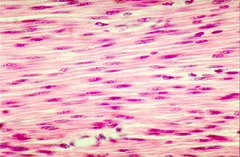
visceral muscle
muscle connected to internal organs; cardiac and smooth muscle
tendon
cord of dense regular CT proper that attached muscle to bone; continuous with epimysium, perimysium, and endomysium
origin
attachment of a muscle that remains relatively fixed during muscular contraction
insertion
movable part or attachment of a muscle
direct (fleshy) attachment
epimysium fused to periosteum of bone or perichondrium of cartilage
indirect attachment
connective tissue wrappings extend beyond muscle as ropelike tendon or sheetlike aponeurosis
aponeurosis
fibrous sheet connecting a muscle to the body part it moves
Z discs
narrow, plate-shaped regions of dense material that separate one sarcomere from the next; runs through the center of an I band

actin
contractile protein composing most of the thin filaments in a scarcomere
troponin
globular regulatory protein that binds to actin, tropomyosin, and calcium; attached tropomyosin to actin molecule

tropomyosin
thin, strand-like regulatory protein that spirals around actin molecule, covering binding sites for the thick myofilament, myosin

A band
dark area in a sarcomere; extends length of the thick filaments (including overlap with thin filaments)

H zone
the central part of an A band, where no thing filaments reach

M line
supporting proteins that hold the thick filaments together in the H zone

I bands
two regions on either side of an A band that contain only thin filaments

titin
springlike molecule in sarcomeres that resists overstretching; extend from Z disc to thick filament and run within the thin filament to attach to the M line
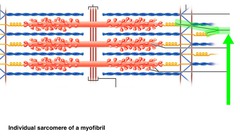
Holds thick filaments in place; helps recoil after stretch; resists excessive stretching
functions (3) of titin
terminal cisterns
dilated end-sacs of sarcoplasmic reticulum that form perpendicular cross channels over A-I junctions
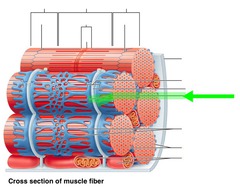
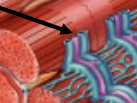
T (transverse) tubules
invagination of the sarcolemma that conduct action potentials to the deepest regions of the muscle fiber

triad
complex of the T-tubule flanked by two terminal cisterns
concentric contraction
muscle shortens and does work
eccentric contraction
muscle generates force as it lengthens
sliding filament mechanism
how thick and thin filaments slide relative to one another during striated muscle concentric contraction to decrease sarcomere length
motor neurons
nerve cells that innervate muscle fibers
Neuromuscular Junction (NMJ)
synapse between the axon terminal of a motor neuron and the section of the membrane of a muscle fiber with receptors for the acetylcholine released by the terminal
synaptic cleft
the narrow gap that separates the presynaptic neuron from the postsynaptic muscle cell

Acetylcholine (ACh)
the neurotransmitter that triggers muscle contraction
active
exocytosis of neurotransmitters from an axon terminal is an __________ process
Acetylcholinesterase (AChE)
the enzyme that breaks down acetylcholine in the synaptic cleft; stored in the basal lamina of the sarcolemma's invaginations
motor unit
a motor neuron and all the fibers it innervates

fine
muscles that require _______ control have few muscle fibers per motos unit
powerful
muscles that require _____________ movement have many muscle fibers per motor unit
recruitment
the addition of motor units to accomplish a movement; the more force required, the more motor units are stimulated
slow oxidative fibers (SO)
obtain energy from aerobic metabolic interactions; least powerful

myoglobin
oxygen-binding pigment in muscle fibers; its concentration determines how "dark" a muscle fiber appears under a microscope
postural muscles
slow-oxidative fibers are resistant to fatigue, and are therefore found in large proportion in...
Fast Glycolytic Fibers (FG)
obtain energy via anaerobic pathways; contain few mitochondria but many glycosomes; most myofilaments per fiber; most powerful

Fast Oxidative Fibers (FO)
"intermediate" muscle fibers in terms of myoglobin concentration, fiber diameter, power, and energy pathway

lower limbs
fast oxidative fibers are not as powerful or fast as FG fibers, but more fatigue-resistant than SO fibers; therefore, they are found in abundance in the...
satellite cells
small immature muscle cells scattered in muscle tissue outside fibers; when myofilaments increase in number (due to resistance training), they fuse with the stimulated fibers to contribute the additional nuclei needed to accommodate the protein demands of the additional myofilaments