ch15 - adaptive immune response, unfinished

0.0(0)
Studied by 0 people
call kaiCall Kai
learnLearn
examPractice Test
spaced repetitionSpaced Repetition
heart puzzleMatch
flashcardsFlashcards
GameKnowt Play
Card Sorting

1/17

encourage image

There's no tags or description

Looks like no tags are added yet.

Last updated 6:30 PM on 10/15/26
Name
Mastery
Learn
Test
Matching
Spaced
Call with Kai
Chat

No analytics yet

Send a link to your students to track their progress

18 Terms

1
New cards

strategy of the adaptive immune response

first response to an antigen → primary response

  • may take a week or more to develop

immune system remembers pathogen on subsequent exposure → secondary response

  • gets rid of the pathogen before you even know you encountered it

  • vaccine exploits phenomenon of immunologic memory

  • for long term protection, very important: memory B cells will differentiate into plasma cells → rapid production of antibodies


2
New cards

strategy of the adaptive immune response - humoral and cell-mediated immunity*

adaptive (acquired) immunity divided into

  • humoral immunity

    • eliminates extracellular pathogens

    • mediated by B cells

      • mature in bone marrow

      • *some become plasma (b?) cells that produce antibodies

      • some become memory cells

        • allows rapid secondary response if encounter antigen again

  • cell-mediated immunity

    • eliminates intracellular pathogens

    • mediated by T cells

      • mature in thymus

      • cytotoxic T cells, helper T cells, regulatory T cells (suppressor T cells)

  • for every T cell that is stimulated by a specific antigen, there’s a B cell that produces specific antibodies


3
New cards

overview of the adaptive immune response

both parts work together to produce a strong immune response

<p>both parts work together to produce a strong immune response </p>
4
New cards

the nature of antigens

antigen

  • antibody or generator

  • any compounds that elicit an immune response (immunogen) → antibody production

epitopes

  • antigenic determinants on surface of microbes that trigger response

  • macromolecules

    • proteins, lipids, and polysaccharides


<p>antigen </p><ul><li><p>antibody or generator </p></li><li><p>any compounds that elicit an immune response (immunogen) → antibody production </p></li></ul><p>epitopes </p><ul><li><p>antigenic determinants on surface of microbes that trigger response </p></li><li><p>macromolecules </p><ul><li><p>proteins, lipids, and polysaccharides </p></li></ul></li></ul><p></p>
5
New cards

the nature of antibodies

antibodies also called immunoglobulins

  • structure

    • four chains of amino acids held together by disulfide bonds

    • Y-shaped proteins with two general parts

      • constant region (Fc region)

      • variable region (Fab)

        • unique to each Ab

        • recognizes and binds to a specific Ag


<p>antibodies also called immunoglobulins</p><ul><li><p>structure</p><ul><li><p> four chains of amino acids held together by disulfide bonds </p></li><li><p>Y-shaped proteins with two general parts </p><ul><li><p>constant region (Fc region)</p></li><li><p>variable region (Fab)</p><ul><li><p>unique to each Ab </p></li><li><p>recognizes and binds to a specific Ag</p></li></ul></li></ul></li></ul></li></ul><p></p>
6
New cards

the nature of antibodies - protective outcomes of antibody-antigen binding

neutralization

  • prevents toxins, viruses from binding

immobilization and prevention of adherence

  • binding to bacterial flagella or pili

cross-linking

  • clumping of bacterial cells by specific antibody

  • enhances phagocytosis

opsonization

  • enhances phagocytosis


<p>neutralization</p><ul><li><p>prevents toxins, viruses from binding </p></li></ul><p>immobilization and prevention of adherence</p><ul><li><p>binding to bacterial flagella or pili</p></li></ul><p>cross-linking</p><ul><li><p> clumping of bacterial cells by specific antibody </p></li><li><p>enhances phagocytosis</p></li></ul><p>opsonization</p><ul><li><p>enhances phagocytosis </p></li></ul><p></p>
7
New cards

the nature of antibodies - Ab divided into 5 classes

based on constant region of the antibody

  • IgM

  • IgG

  • IgA

  • IgD

  • IgE


8
New cards

five classes of antibodies - IgM

  • pentamer

  • first Ab produced in primary response to infection

  • more forgiving (recognition is less specific)

  • only Ab that can be formed by the fetus


<ul><li><p>pentamer</p></li><li><p>first Ab produced in primary response to infection</p></li><li><p>more forgiving (recognition is less specific) </p></li><li><p>only Ab that can be formed by the fetus</p></li></ul><p></p>
9
New cards

five classes of antibodies - IgG

  • second to be produced

  • most protective and most specific

  • most abundant Ab in blood (80-85%) and long lasting

  • only Ab that can cross the placenta and found breast milk

    • last 6 months to several in child

  • the antibody of memory ⭐


<ul><li><p>second to be produced </p></li><li><p>most protective and most specific </p></li><li><p>most abundant Ab in blood (80-85%) and long lasting</p></li><li><p>only Ab that can cross the placenta and found breast milk</p><ul><li><p>last 6 months to several in child </p></li></ul></li><li><p>the antibody of memory <span data-name="star" data-type="emoji">⭐</span></p></li></ul><p></p>
10
New cards

five classes of antibodies - IgA

  • most form dimer

  • found in secretions, important in mucosal immunity

  • found in breast milk, mucus, tears, and saliva


<ul><li><p>most form dimer </p></li><li><p>found in secretions, important in mucosal immunity </p></li><li><p>found in breast milk, mucus, tears, and saliva </p></li></ul><p></p>
11
New cards

five classes of antibodies - IgD

  • help in maturation of antibody response (IgG)

  • function well not understood


<ul><li><p>help in maturation of antibody response (IgG)</p></li><li><p>function well not understood </p></li></ul><p></p>
12
New cards

five classes of antibodies - IgE

  • barely detectable in circulation

  • active in allergic reaction → produces histamines

  • tightly bound via Fc region to basophils and mast cells

    • allows these cells to detect, respond to antigens


<ul><li><p>barely detectable in circulation</p></li><li><p>active in allergic reaction → produces histamines</p></li><li><p>tightly bound via Fc region to basophils and mast cells </p><ul><li><p>allows these cells to detect, respond to antigens </p></li></ul></li></ul><p></p>
13
New cards

clonal selection and expansion of lymphocytes

antigen in body → antibody production

  • process called clonal selection

    • B cell bind antigen, divides and

      • differentiate into plasma cells → produce lots of antibodies

      • become memory cells

        • responsible for secondary response

without sustained stimulation, cells undergo apoptosis
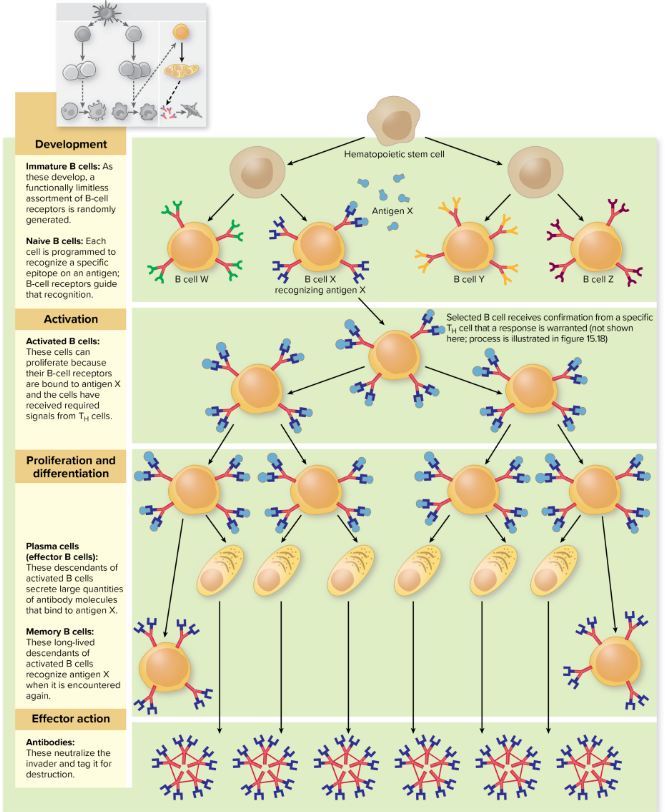
<p>antigen in body → antibody production</p><ul><li><p>process called clonal selection</p><ul><li><p>B cell bind antigen, divides and</p><ul><li><p>differentiate into plasma cells → produce lots of antibodies</p></li><li><p>become memory cells</p><ul><li><p>responsible for secondary response </p></li></ul></li></ul></li></ul></li></ul><p>without sustained stimulation, cells undergo apoptosis </p>
14
New cards
<p>The B-Cell Response: Humoral Immunity</p>

The B-Cell Response: Humoral Immunity

Primary Response

  • occur after first encounter with antigen

  • takes 10-14 days for substantial antibody accumulation

    • activated B cells divides and become plasma cells as long as antigen is present

    • net result = increase in antibody titer

Secondary Response

  • occurs after subsequent exposures

  • fast, more effective response due to memory cells

    • pathogens usually eliminated before causing harm

  • vaccine exploits this natural phenomenon of immunologic memory


<p>Primary Response</p><ul><li><p>occur after first encounter with antigen </p></li><li><p>takes 10-14 days for substantial antibody accumulation</p><ul><li><p>activated B cells divides and become plasma cells as long as antigen is present </p></li><li><p>net result = increase in antibody titer </p></li></ul></li></ul><p>Secondary Response</p><ul><li><p>occurs after subsequent exposures </p></li><li><p>fast, more effective response due to memory cells</p><ul><li><p>pathogens usually eliminated before causing harm </p></li></ul></li><li><p>vaccine exploits this natural phenomenon of immunologic memory </p></li></ul><p></p>
15
New cards

T Cell Response: Cell-Mediated Immunity

involves T cells

  • two types: cytotoxic T cells and helper T cells

  • interact directly with target cells

  • never produce antibodies


<p>involves T cells</p><ul><li><p>two types: cytotoxic T cells and helper T cells </p></li><li><p>interact directly with target cells </p></li><li><p>never produce antibodies </p></li></ul><p></p>
16
New cards

Two major T cell populations - Cytotoxic T Cells

have CD8 marker

activated by dendritic cells

recognize antigen display by MHC class I cells (all nucleated cells)

  • release of proteases and perforin to induce apoptosis

destroy infected or cancerous “self” cells

<p>have CD8 marker</p><p>activated by dendritic cells</p><p>recognize antigen display by MHC class I cells (all nucleated cells)</p><ul><li><p>release of proteases and perforin to induce apoptosis</p></li></ul><p>destroy infected or cancerous “self” cells </p>
17
New cards
<p>Two major T cell populations - Helper T Cells </p>

Two major T cell populations - Helper T Cells

have CD4 marker

recognize antigen presented on MHC class II from antigen-presenting cells (APCs)

orchestrate immune response

  • activate B cells and macrophages

  • stimulate other T cells


<p>have CD4 marker</p><p>recognize antigen presented on MHC class II from antigen-presenting cells (APCs)</p><p>orchestrate immune response </p><ul><li><p>activate B cells and macrophages </p></li><li><p>stimulate other T cells </p></li></ul><p></p>
18
New cards

Natural Killer (NK) Cells

induce apoptosis in abnormal “self” cells

  • recognize foreign proteins on cell membrane bound by antibodies

    • bind, deliver perforin - and protease - containing granules to cell, initiating apoptosis

  • also recognize host cells lacking MHC class I

    • some viruses interfere with antigen presentation


<p>induce apoptosis in abnormal “self” cells </p><ul><li><p>recognize foreign proteins on cell membrane bound by antibodies</p><ul><li><p>bind, deliver perforin - and protease - containing granules to cell, initiating apoptosis </p></li></ul></li><li><p>also recognize host cells lacking MHC class I</p><ul><li><p>some viruses interfere with antigen presentation </p></li></ul></li></ul><p></p>



