Textbook ch. 2 rad physics
0.0(0)
Studied by 0 people Call Kai
 Learn
Learn Practice Test
 Spaced Repetition
 Match
Match Flashcards
 Knowt Play
Card Sorting
1/49

There's no tags or description
Looks like no tags are added yet.
Last updated 8:01 AM on 9/28/26
Name | Mastery | Learn | Test | Matching | Spaced | Call with Kai | Chat |
|---|
No analytics yet
Send a link to your students to track their progress
50 Terms
1
New cards
Which electrons have the greatest binding energy?
K-shell
2
New cards
What type of electrical charge does the electron carry?
Negative
3
New cards
Which term describes two or more atoms that are joined by chemical bonds?
Molecule
4
New cards
Which statement describes ionization?
Atom that loses an electron
5
New cards
Which term describes the process by which unstable atoms undergo spontaneous disintegration in an effort to attain a more balanced nuclear state?
Radioactivity
6
New cards
Which is not a type of particulate radiation?
Nucleons
7
New cards
Which is not a type of electromagnetic radiation?
Electrons
8
New cards
Which statement is incorrect?
Wavelength is the distance between waves.
9
New cards
Which statement is incorrect?
X-rays travel at the speed of sound.
10
New cards
Which statement is correct?
X-ray has more energy than light
11
New cards
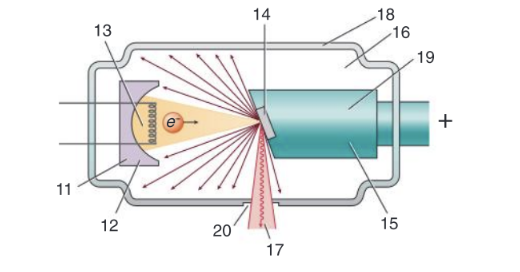
In Figure 2-27, identify structure 11.
Cathode
12
New cards

In Figure 2-27, identify structure 12.
Filament
13
New cards

In Figure 2-27, identify structure 13.
Focusing cup
14
New cards
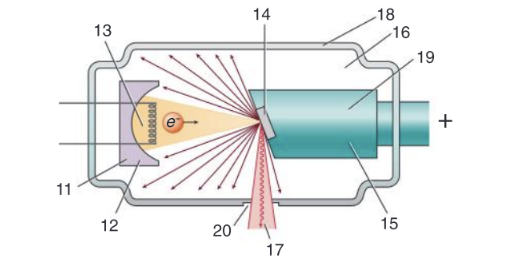
In Figure 2-27, identify structure 14.
Tungsten target
15
New cards

In Figure 2-27, identify structure 15.
Anode
16
New cards

In Figure 2-27, identify structure 16.
Copper stem
17
New cards

In Figure 2-27, identify structure 17.
X-ray beam
18
New cards

In Figure 2-27, identify structure 18.
Glass envelope
19
New cards

In Figure 2-27, identify structure 19.
Lead glass housing
20
New cards
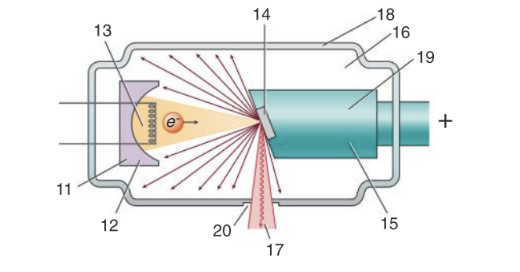
In Figure 2-27, identify structure 20.
X-rays
21
New cards

In Figure 2-28, identify structure 21.
Aluminum disks
22
New cards

In Figure 2-28, identify structure 22.
Lead collimator
23
New cards

In Figure 2-28, identify structure 23.
Position-indicating device (PID)
24
New cards

In Figure 2-28, identify structure 24.
Seal
25
New cards
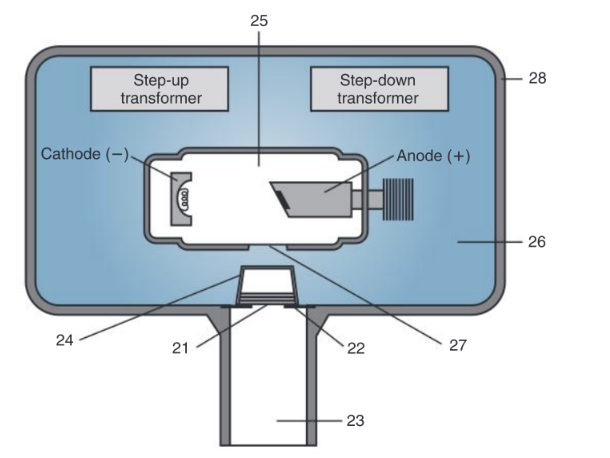
In Figure 2-28, identify structure 25.
X-ray tube
26
New cards

In Figure 2-28, identify structure 26.
Insulating oil
27
New cards

In Figure 2-28, identify structure 27.
Tubehead seal
28
New cards
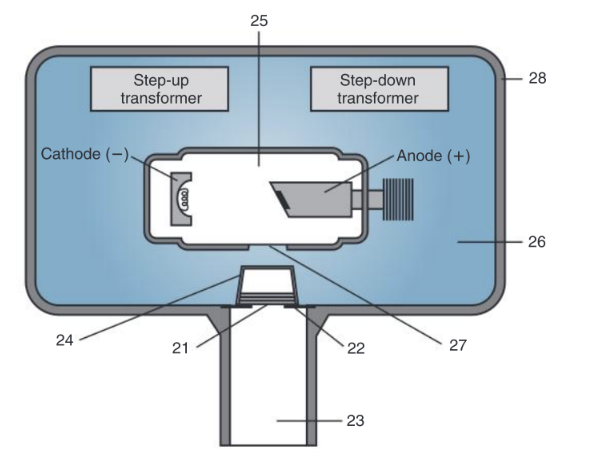
In Figure 2-28, identify structure 28.
Metal housing
29
New cards
Which regulates the flow of electrical current to the filament of the x-ray tube?
Low-voltage circuit
30
New cards
Which is used to increase the voltage in the high-voltage circuit?
Step-up transformer
31
New cards
Which does not occur when the high-voltage circuit is activated?
unit has an audible and visible signal
32
New cards
Which is the location where x-rays are produced?
Positive anode
33
New cards
Which is the location where thermionic emission occurs?
Negative cathode
34
New cards
Which accounts for 70% of all the x-ray energy produced at the anode?
General radiation
35
New cards
Which occurs only at 70 kV or higher and accounts for a very small part of the x-rays produced in the dental x-ray machine?
Characteristic radiation
36
New cards
Which describes primary radiation?
Radiation that exits the tubehead
37
New cards
Which describes scatter radiation?
Radiation thats been deflected from its path by interacting with matter
38
New cards
Which type of scatter occurs most often with dental x-rays?
Compton
39
New cards
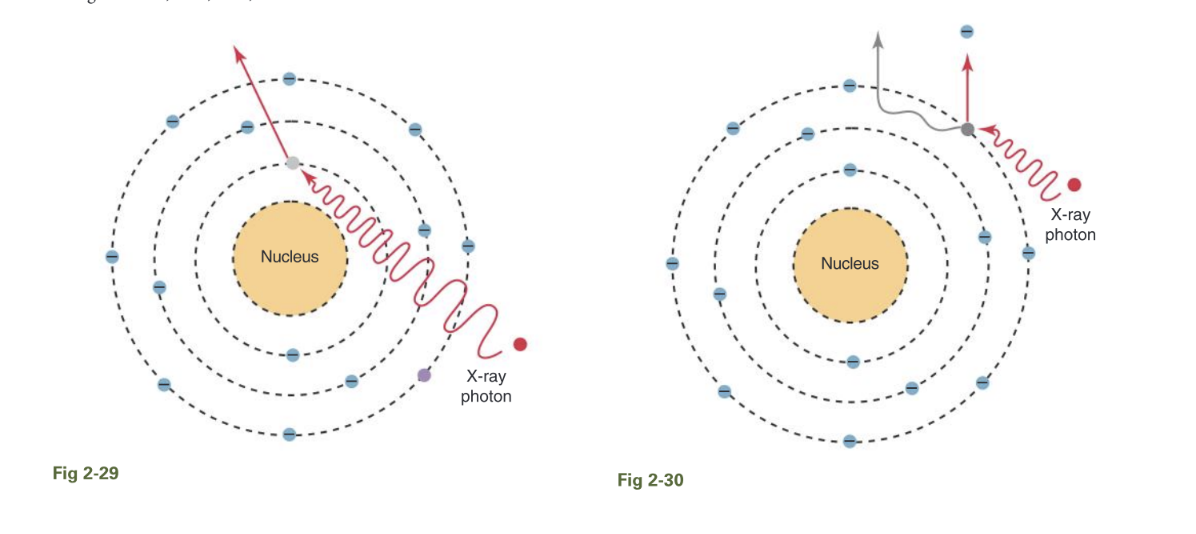
Identify the x-radiation interaction with matter in Figure 2-29.
Photoelectric effect
40
New cards

Identify the x-radiation interaction with matter in Figure 2-30.
Compton scatter
41
New cards
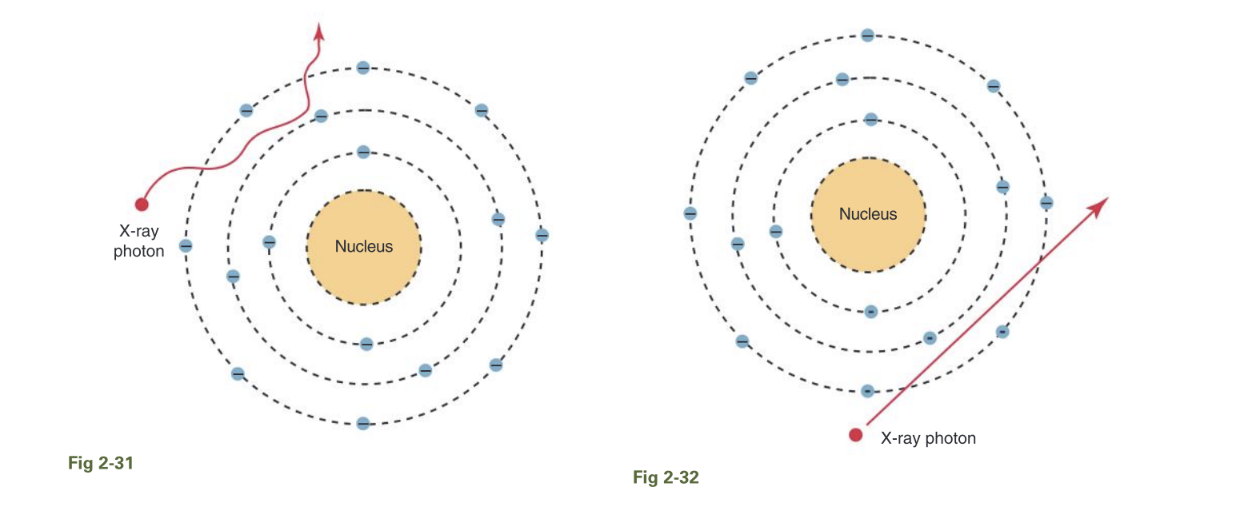
Identify the x-radiation interaction with matter in Figure 2-31.
Coherent scatter
42
New cards
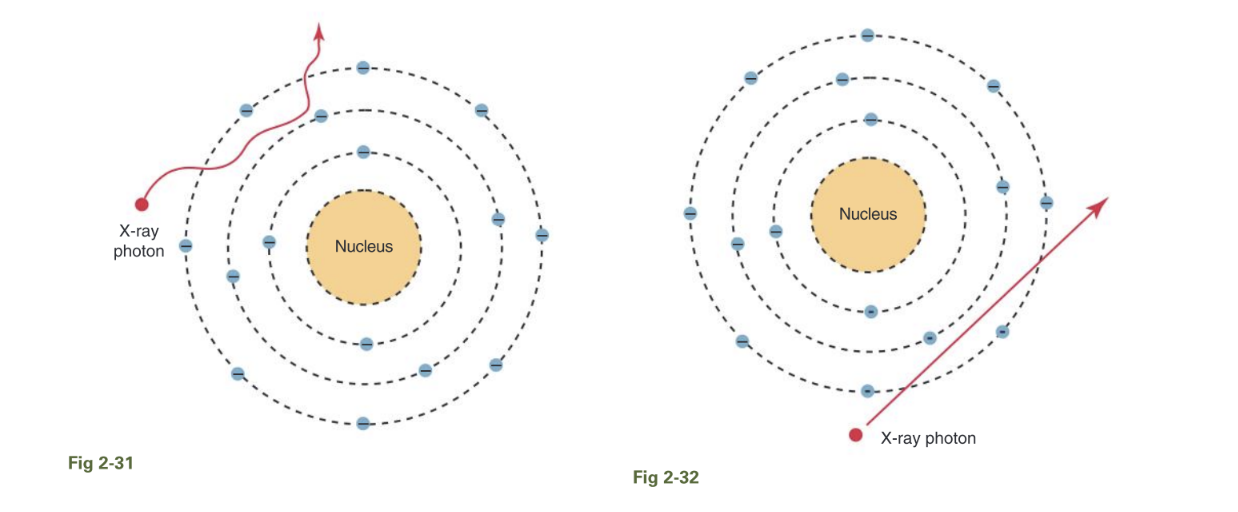
Identify the x-radiation interaction with matter in Figure 2-32.
No interaction
43
New cards
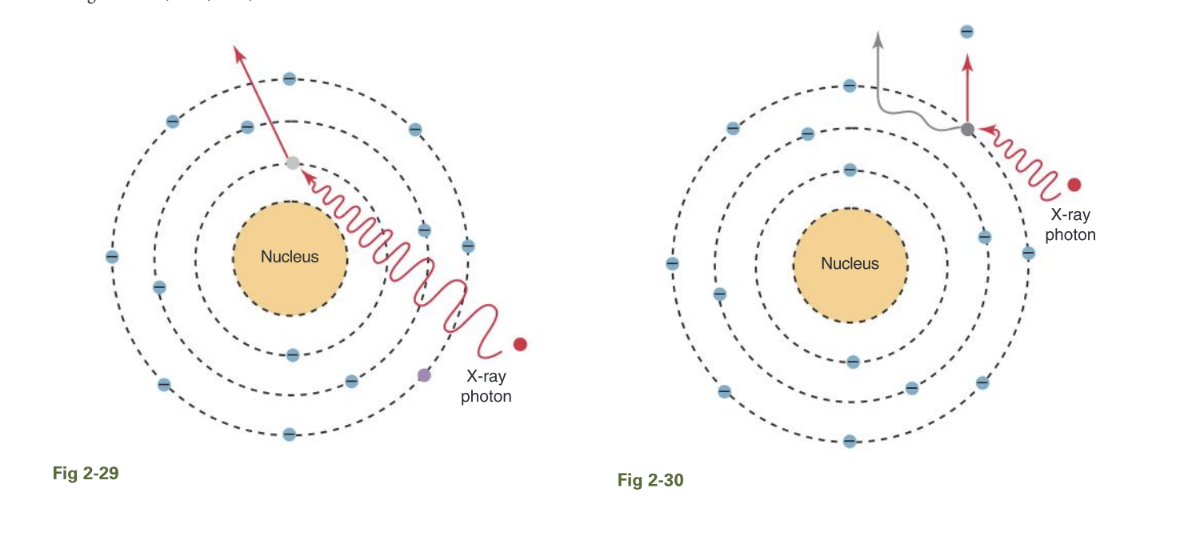
The interaction of x-radiation with matter illustrated in Figure 2-29 demonstrates:
No scatter; ionization
44
New cards
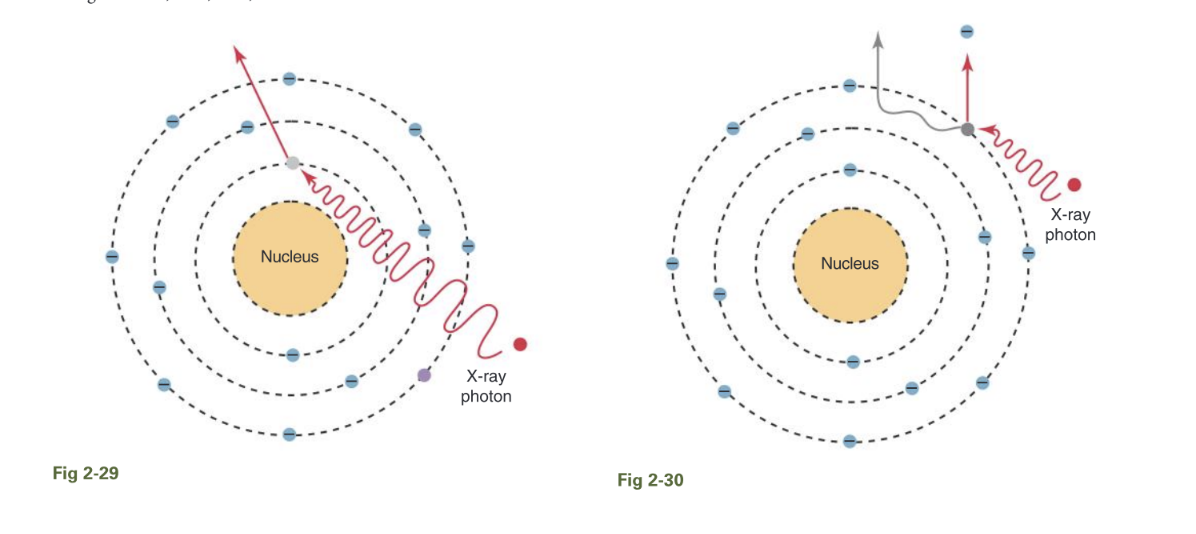
The interaction of x-radiation with matter illustrated in Figure 2-30 demonstrates:
Scatter; ionization
45
New cards

The interaction of x-radiation with matter illustrated in Figure 2-31 demonstrates:
Scatter; no ionization
46
New cards

The interaction of x-radiation with matter illustrated in Figure 2-32 demonstrates:
No scatter; no ionization
47
New cards
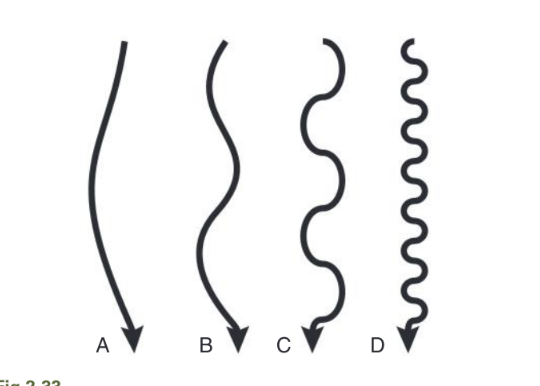
Which has the shortest wavelength?
D
48
New cards

Which has the longest wavelength?
A
49
New cards

Which has the lowest frequency?
A
50
New cards

Which has the highest frequency?
D