Week 6: Pelvis + Hips
 Call Kai
 Learn
 Practice Test
 Spaced Repetition
 Match
 Flashcards
 Knowt Play
1/109

Earn XP
Description and Tags
Bones, joints (anterior + posterior), innervation, dermatomes + myotomes, CVS of Pelvis + Hip, + MUSCLES
110 Terms

Where is the Sacrum?
The sacrum is the triangular bone located at the base of the spine.

Where is the coccyx?
The tip of the sacrum, aka the tailbone.

what are the ⭐️3⭐ ️bones that make up the hip?
Illium, ischium, and pubis.

What are the TWO joints in the pelvis?
sacroiliac + pubis symphysis
What does the sarcoliliac joint articulate with?
sacrum and ilium.
What does the pubis symphysis connect?
two pubic bones anteriorly.
What’s the difference between the true and false pelvis?
The true pelvis holds pelvic organs and plays a role in childbirth, whereas the false pelvis constains bones and does not play a role in childbirth.

What is the ligament in the green?
Illiolumbar ligament
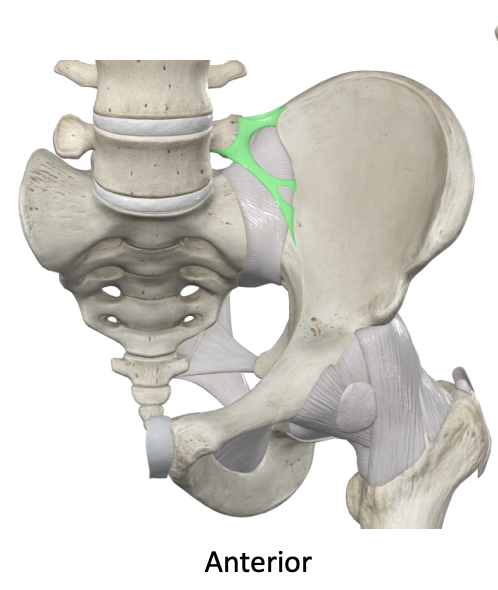
What does the illiolumbar ligament do?
the illiolumbar ligament provides support to the pelvic girdle.

What is the ligament highlighted by the green?
The Anterior Sacroililac ligament

What does the Anterior Sacroiliac ligament do?
The anterior Sacroiliac joint thickens and protect the anteriorinferior aspect of the joint capsule.

What is the ligament highlighted in green?
The Iliofemoral ligament.
What does the iliofemoral ligament do?
The ilifemoral ligament stabilize and increase the excursion and capacity of the hip joint.

What is the ligament highlighted in green?
The pubofemoral ligament

what does the pubofemoral ligament do?
The pubofemoral ligament helps stabilize the hip joint and tightens and contracts during hip aduction.
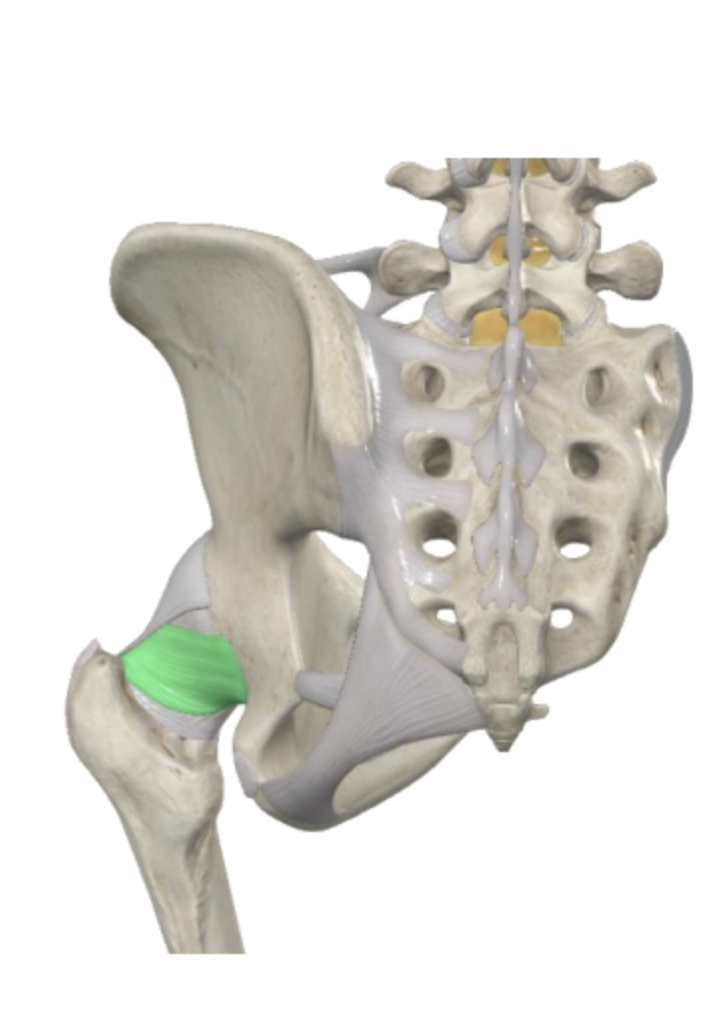
What is the ligament highlighted in green, and what does it do?
The ischiofemoral ligament; helps stabilize the hip joint and increase the hip joint’s excursion and capacity.

What is the ligament highlighted in the green; what does it do?
The Sacrotuberous ligament ; stabilizes the pelvis and creates a pathway for neruovascular structures.

What is the ligament highlighted in green; what does this ligament support?
The Sacrospinous ligament; the pelvis.

What is the ligament highlighted in green; what does it provide stability for?
The Posterior Sacroiliac ligament; pelvis.

What is the ligament highlighted in green; what is its’ function?
The Interosseous Sacroiliac Ligament; functions to resist anterior movement of the sacarl bone.

What is the ligament highlighted in green; what is its’ function?
The Supraspinous Ligament; provide stability to the Lumbar vertebra + minimise movement to the vertebral column.
What nerves make up the lumbar plexus; what areas do theses nerve innervate ?
L1 to L4; lower abdominal wall, pelvis, and lower limbs.
What is the origin, course, and function of the illiohypogastric nerve (AKA L1)?
the origin is the ventral ramus of L1; L1 runs between the psoas major and lumborum muscles, then divides into an anterior and posterior branch; provides sensory innvervation to the skin in the lateral gluteal, inguinal, and upper part of the pubic regions.
What is the origin, course, and function of the illiioinguinal nerve (AKA L1)?
ventral ramus of L1; inferiorly along the iliac crest and enters the inguinal canal; provides sensory innervation to the upper medial thigh, root of the phallus, mons pubis, labia majora, and transversus abdominis, and internal oblique muscles.
What is the origin, course, and function of the gentiofemoral nerve (AKA L1-L2)?
ventral rami of L1 - L2; travels through the psoas major to the genital and femoral branch; provides sensory innervation to the anterior scrotum’s skin, mons pubis, labia majors, and femoral triangle.
What is the origin, course, and function of the Lateral Femoral Cutaneous nerve (AKA L2-L3)?
ventral rami of L2-L3; lateral border of psoas, iliacus muscle to the anterior thigh; sensory innervation to the anterolateral thigh.
What is the origin, course, and function of the Femoral Nerve (AKA L2-L4)?
ventral rami of L2-L4; passes under the inguinal ligament to the anterior thigh; motor innervation to the quadriceps femoris, sensory innervation to the skin of the anterior thigh and medial leg.
What is the origin, course, and function of the Obturator Nerve (AKA L2-L4)?
ventral rami of L2-L4; ecists the pelvis via obturator canal and enters the medial area of the thigh; motor innervation to adductor muscles, sensory innervation to the medial thigh.
What areas do the Sacral + Coccygeal Plexus Nerves supply motor and sensory innervation to?
pelvis, perineum, and lower limbs.
What is the origin, course, and function of the Superior Gluteal Nerve (AKA L4-S1)?
ventral rami of L4-S1; exit from pelvis via greater sciatic foramen, above piriformis; motor innervation to the glute medius, minimus, and tensor fasciae, to help stabilise during and perform hip abduction.
What is the origin, course, and function of the Inferior Gluteal Nerve (L5-S2)?
ventral rami of L5-S2; exit pelvis via greater sciatic foramen below piriformis muscle; motor innervation to the glute max., for hip extension and lateral rotation.
What is the origin, course, and function of the Sciatic Nerve (AKA L4-S3)?
ventral rami of L4-S3; exits pelvis via greater sciatic foramen, below or through the piriformis muscle; motor and sensory innervation to posterior thight, leg, and foot.
What is the origin, course, and function of the Pudendal Nerve (AKA S2-S4)?
ventral rami of S2-S4; pelvis exit via greater sciatic foramen, re-enters via lesser sciatic foramen; motor and sensory innervation of the perineum, external anal sphincter
What is the origin and function of the Coccygeal plexus (AKA S4-S5)?
ventral rami of S4-S5 and coccygeal nerve; innervates muscles and skin of the coccyx region.

Fill in the blanks (counter clockwise) of the Femoral Triangle
Lateral border, femoral nerve, common femoral artery, femoral vein, medial border, and superior border.

What area does the L1 dermatome cover?
uppermost area of the thigh, above the inguinal ligament

What area does the L2 dermatome cover?
anterior and media areas of the upper thig
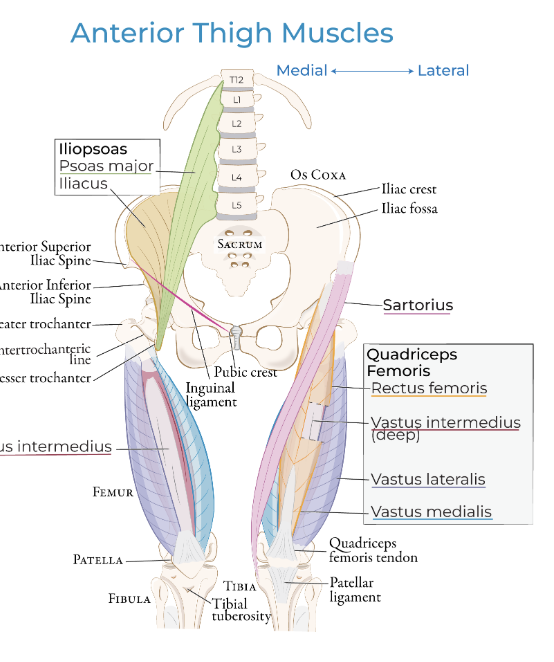
What areas does the L3 dermatome cover?
anterior part of the thigh to the knee joint

What areas does the S1 dermatome cover?
posterior area of the leg and knee, and down to the lateral + plantar aspects of the foot

What muscles and functions the L2 myotome responsible for?
ilioposoas, iliacus, and psoas major; hip flexion and external rotation

What muscles and function is the L3 myotome responsible for?
quadriceps femoris; knee extension
What muscles and functions is the S1 myotome responsible for?
Gastrocnemuis and soleus; plantarflexion of the foot
What muscles and functions is the S2 myotome responsible for?
Hammies, i.e, biceps femoris, semitendinosis, and semimembranosus; hip extension and knee flextion.
What muscles and functions is the S3 myotome responsible for?
Glute MAX; hip extension and lateral rotation
What organs does the lumbopelvic CS supply oxygenated blood and drain deoxygenated blood from?
Kidneys, pelvic organs, and lower limbs.

What blood vessel is highlighted by the pink star?
Abdominal Aorta.
What are the three branches of the abdominal aorta?
Celiac trunk, superior mesenteric artery, and inferior mesenteric artery.
What are four arteries that branch off of the abdominal aorta?
renal arteries
lumbar arteries
middle suprarenal arteries
gonadal arteries
Where are the iliac arteries located?
4th lumbar vertebra
What does the internal iliac arteries supply blood to?
pelvic organs, gluteal region, and pelvic walls.
What does the external iliac arteries supply blood to?
anterior abdominal wall.
What are the 3 deep vein involved in lower limb blood drainage?
femoral vein
popliteal vein
tibial vein
What are the 2 superficial veins involved in lower limb blood drainage?
great saphenous vein
small saphenous vein
What is the longest vein in the body; describe its’ journey in the body?
great saphenous vein; medial aspect of the foot, to the inner side of the leg, and passes thru the groin to join the common femoral vein.
Describe the journey of the small saphenous vein?
starts at the lateral aspect of the foot, travels along the back of the calf, and drained into the popliteal vein.
What are the veins in the thighs called?
Deep femoral veins
What connects the deep veins and the lower limb’s superficial veins?
perforating veins.
What do the gonadal veins do?
the gonadal veins drain blood from the gonads into the corresponding common iliac vein.
What region do the gluteal veins drain blood from?
the gluteal region
What are the 3 deep veins of the lower limbs?
femoral vein
popliteal vein
tibial veins
Where is the femoral vein located?
inguinal ligament to the thigh
Where is the popliteal vein located?
behind the knee, calf, and into the femoral region
Where are the Tibial veins located?
tibia to calf
Describe the journey of the inferior vena cava?
It begins with the common iliac veins (i.e., internal, external), lumbar veins, renal veins, hepatic veins, then suprarenal veins.
What are the 3 functions of the lumbopelvic lymphatic system?
fluid balance
immune response
transport of fat
What drains interstitial fluid, protein, and waste products in the lumobpelvic lymphatic system?
lymphatic capillaries
In the lumbopelvic lymphatic system, what ensures one-way flow of lymphatic fluid?
lymphatic collecting vessels
What are the 3 different nodes of the lumbopelvic lymphatic system; what are their roles?
inguinal, iliac, and lumbar; immune response via filtering and surveilling the body.
what does the superficial lymphatic pathway do?
collecting lymphatic fluid from the superficial muscles, skin, of the lower limb
what does the deep lymphatic pathway do?
collects lymphatic fluid from the deeper structures of the lower limbs.
What are the four main muscle groups of the hip?
gluteal muscles
hip flexor muscles
hip adductor muscles
hip external rotator muscles
What are the three muscles of the glutes?
gluteus maximus
gluteus medius
gluteus minimums

What muscle is highlighted with a pink star; what is the origin, insertion, and action of this muscle?
gluteus maximus
origin = posterior ilium, aspect of sacrum and coccyx, and sacrotuberous ligament
insertion = tibial tubercule along the iliotibial tract, gluteal tuberosity of the femur
action = extension, lateral rotation, and abduction of thigh

What muscle is highlighted with a pink star; what is the origin, insertion, and action of this muscle?
gluteus medius
origin = ilium region between gluteal lines
insertion = greater trochanter of femur, lateral aspect
action = medial rotation + abduction of the thigh

What muscle is highlighted with a pink star; what is the origin, insertion, and action of this muscle?
Gluteus minimus
origin = ilium region between anterior and inferior gluteal lines
insertion = greater trochanter of femur, anterolateral aspect
action = medial rotation + abduction of thigh
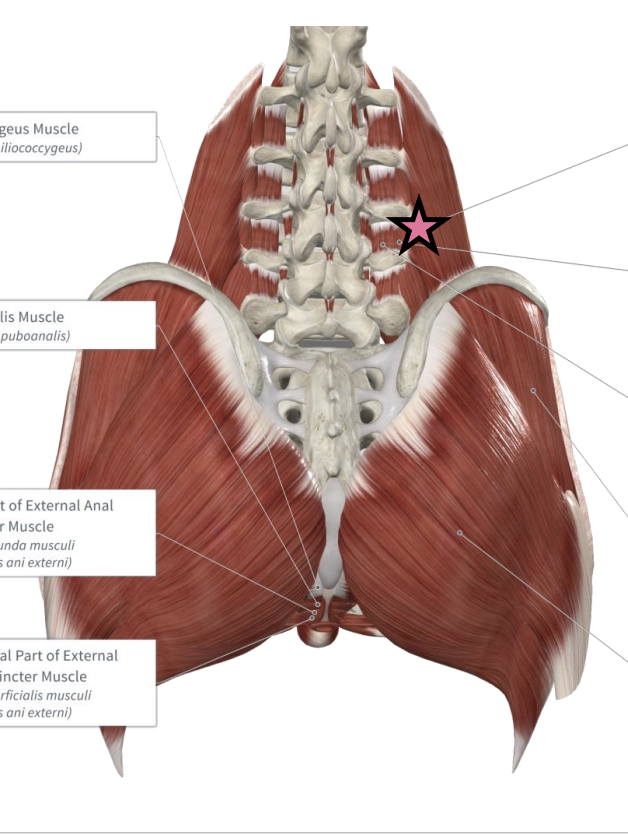
What is this muscle and its’ function and role?
Quadratus lumborum
function = laterally flexes and stablilizes the spine; elevation of pelvis during contraction
role = maintain proper posture and stability during lifting + twisting

What is this muscle, and what does it bend?
Rectus sheath
the rectus sheath bends the rectus abdominis muscle (aka 6 pack)
What are the 4 hip flexor muscles located anteriorly?
ilioposoas
rectus femoris
pectineus
sartorius muscles
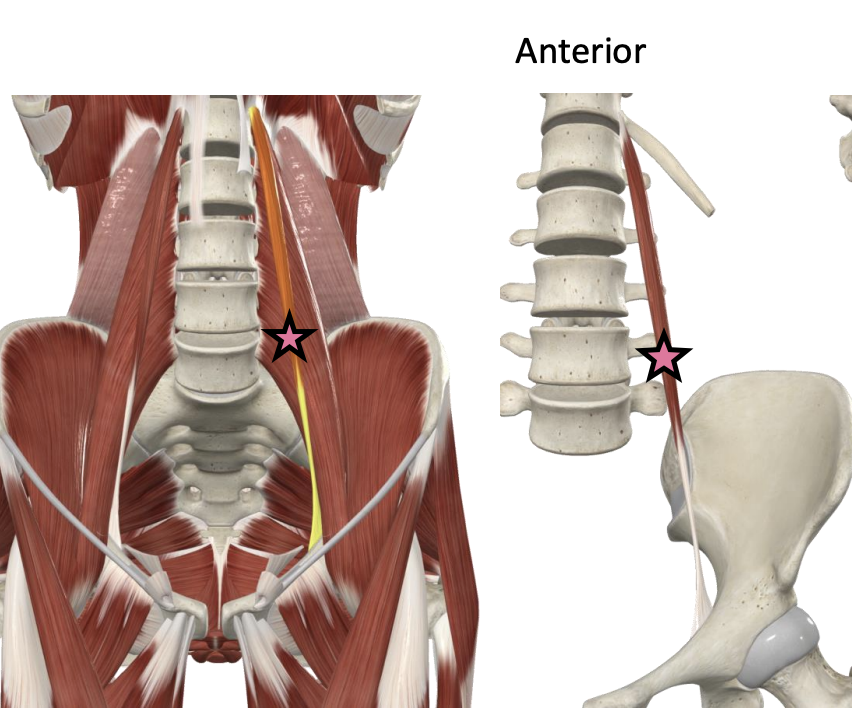
What muscle is highlighted with a pink star; what is the origin, insertion, and action of this muscle?
Psoas minor muscle
origin = ventral body, T12, L1
Insertion = iliopectineal eminence, pecten pubis
action = trunk flexion

What muscle is highlighted with a pink star; what is the origin, insertion, and action of this muscle?
Psoas major muscle
origin = transverse process of vertebrae (L1-L5), vertrabral bodies (T12-L5)
insertion = lesser trochanter of femur
action = flexion of thigh @ hip joint, flexion of trunk
What are the 5 hip adduction muscles?
adductor brevis
adductor longus
adductor magnus
gracilis
obturator externus muscles
What are the ⭐️6⭐️ hip external rotator muscles?
piriformis
gemellus superior
gemellus inferior
obturator internus
obturator externus
quadratus femoris

What muscle is highlighted with a pink star; what is the origin, insertion, and action of this muscle?
Piriformis muscle
origin = sacral pelvic surface, sacrotuberus ligament
insertion = greater trochanter of femus, superior border
action = lateral rotation of thigh, transverse abduction of thigh

What muscle is highlighted with a pink star; what is the origin, insertion, and action of this muscle?
Iliacus
origin = iliac crest, superior iliac fossa, sacrum ala, + sacroiliac ligament (anterior)
insertion = lesser trochanter of femur
action = flexion of thigh @ hip, flexion of trunk

What muscle is highlighted with a pink star; what is the origin, insertion, and action of this muscle?
Pectineus
origin = superior pubic ramus
insertion = pectineal line of femur
action = adduction + flexion of thigh

What muscle is highlighted with a pink star; what is the origin, insertion, and action of this muscle?
Adductor brevis
origin = pubis body, inferior pubic ramus
insertion = medial lip of femoral linea aspera
action = adduction of thigh
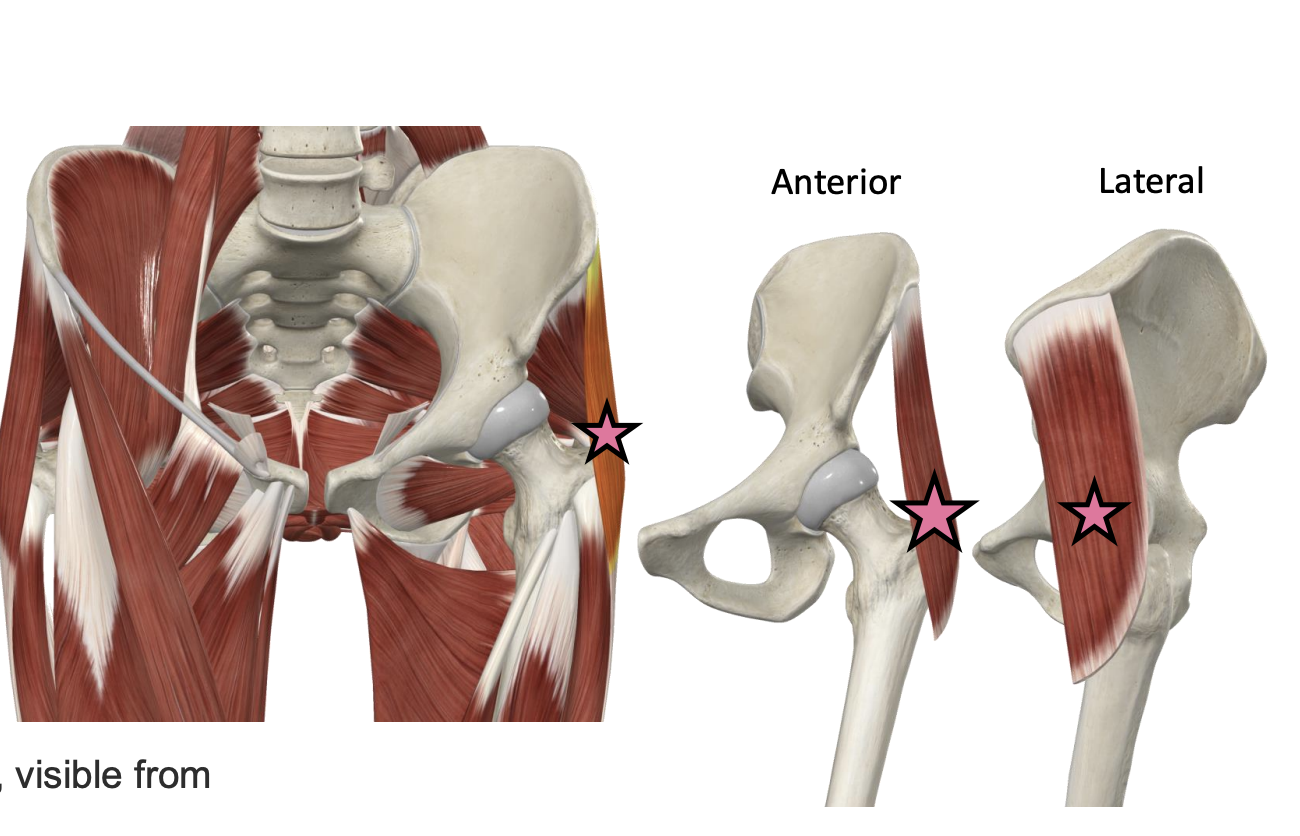
What muscle is highlighted with a pink star; what is the origin, insertion, and action of this muscle?
Tensor Fasciae Latae (TFL)
origin = superior iliac spine (anterior), iliac crest lip (anterior)
insertion = tubercle of iliotibial tract
action = medial rotation, abduction, and flexion of thigh

What muscle is highlighted with a pink star; what is the origin, insertion, and action of this muscle?
obturator externus
origin = obturator membrane external surface
insertion = trochanteric fossa of femur
action = lateral rotation of thigh

What muscle is highlighted with a pink star; what is the origin, insertion, and action of this muscle?
Coccygeus muscle
origin = ishcial spine
insertion = sacrum + coccyx (anterolateral aspect)
action = structural support for the adjacent pelvic structures

What muscle is highlighted with a pink star; what is the origin, insertion, and action of this muscle?
iliococcygeus
origin = ishcial spine, tendinous arch of levator ani
insertion = coccyx, iliococcygeal raphe, + anococcygeal ligament
action = structual support for pelvic structures + faecal continence

What muscle is highlighted with a pink star; what is the origin, insertion, and action of this muscle?
superior gemellus
origin = ischial spine
insertion = greater trochanter of femur (medial aspect)
action = lateral rotation of thigh, transverse abduction of thigh

What muscle is highlighted with a pink star; what is the origin, insertion, and action of this muscle?
inferior gemellus
origin = ischial tuberosirt
insertion = greater trochanter of femur (medial aspect)
action = lateral rotation of thigh, transverse abduction of thigh
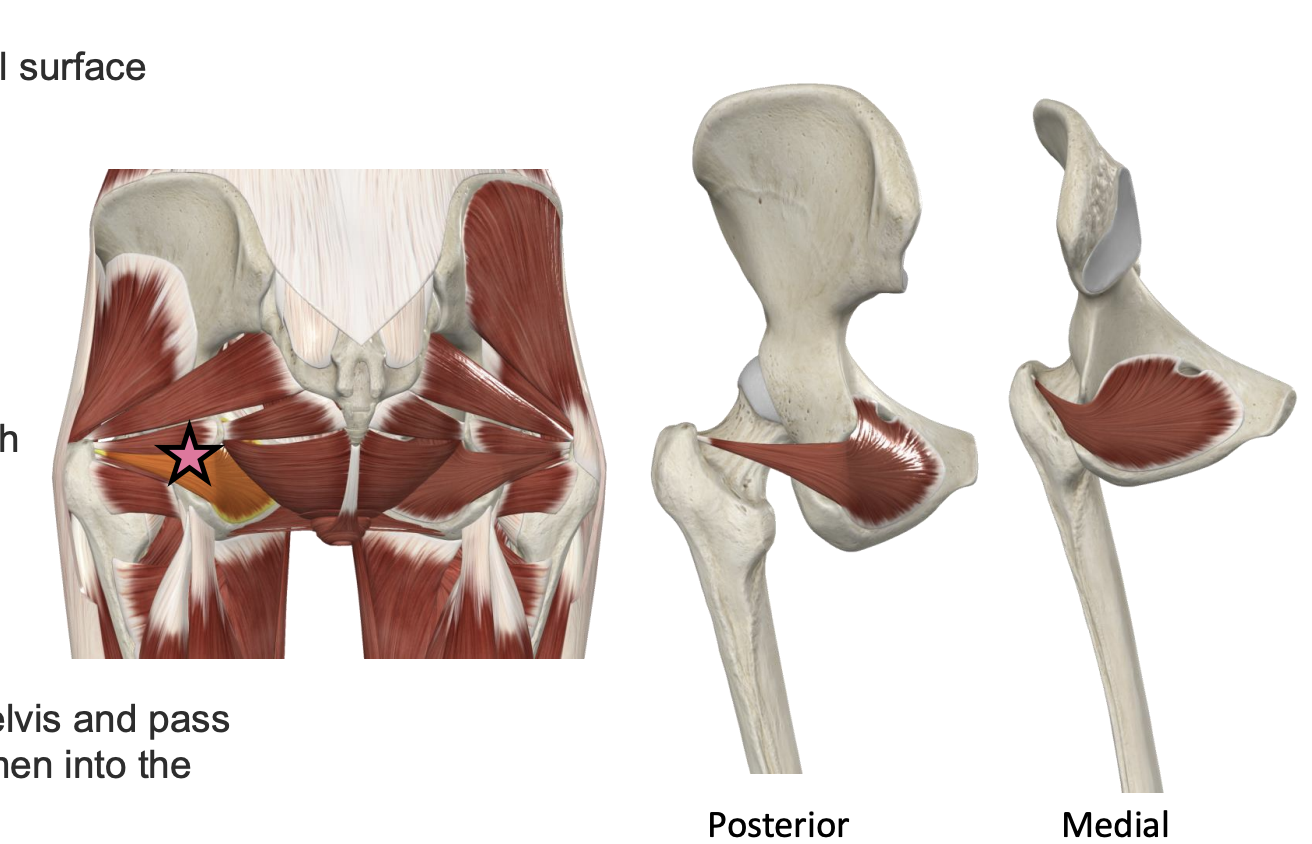
What muscle is highlighted with a pink star; what is the origin, insertion, and action of this muscle?
obturator internus
origin = obturator membrane internal surface
insertion = greater trochanter of femur (medial aspect)
action = lateral rotation + transverse abduction of thigh

What muscle is highlighted with a pink star; what is the origin, insertion, and action of this muscle?
quadratus femoris
origin = ischial tuberosity lateral origin
insertion = quadrate tubercle of femur
action = lateral rotation of hip
What 3 muscles form the sling like structure of the pelvis?
levator ani
coccygeus
pubococcygeus muscle
What ddoes the obturator internus do in the pelvic floor?
support and stabilize the pelvic region
What is the piriformis’ role in the pelvic region?
stabilize the pelvic region
What is the coccygeus muscle role in the pelvic region?
stabilize the pelvic floor
what are the 3 levator ani muscles and what are their roles?
pubococcygeus muscle: supports the pelvic organs
puborectalis: forms a structure akin to a sling to support the rectal region, and maintains continence
illiococcygeus: provides support to pelvic floor
What are the gender differences in the perineal muscles?
for the gals, the perineal muscles include the urethrovaginal spinctor, which helps with urinary continence
for the fellas, the perineal muscle include the ischioanal fossa muscles, which help with movment in the anal canal during shitting