Chem Lab Final Labs 4-6 Orgo 2
 Call Kai
 Learn
 Practice Test
 Spaced Repetition
 Match
 Flashcards
 Knowt Play
1/22

There's no tags or description
Looks like no tags are added yet.
23 Terms
reactions in Kinetic and thermodynamic control lab
cyclohexanone + semicarbazide
furfural + semicarbazide
cyclohexanone + semicarbazide
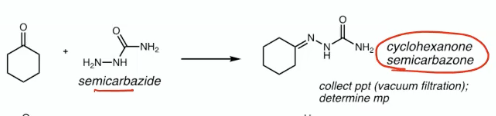
furfural + semicarbazide

general reaction for making a semicarbazone:
aldehyde or ketone + semcarbazide to semicarbazone

semicarbazone is an imine!
competition experiment
see if semcarbazide prefers to react with cyclohexanone or furfural under high vs. low temperature
which product do these reactants make? what is the stochiometic byproduct of the reaction?

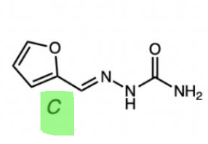
stoichiometric biproduct of the reaction is H20
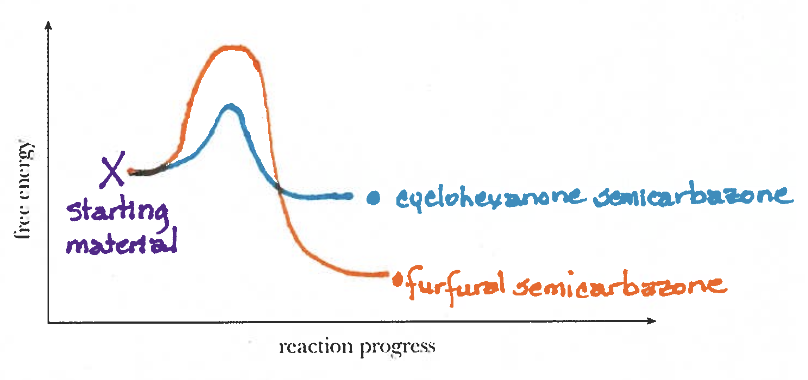
Kinetic product
kinetic reaction conditions favor formation of the product with lower activation barrier, results in a higher energy/less stable product when compared with thermodynamic product
Cyclohexanone semicarbazone has lower Ea than furfural semicarbazone so it is the kinetic product
Thermodynamic product
has higher EA than kinetic product. Results in a more stable, lower energy product
furfural semicarbazone is the thermodynamic product
graph of thermodynamic vs. kinetic product
Melting Point analysis
used to identify unknown products + compare them directly with known standards
which starting materials could be used to make this product?
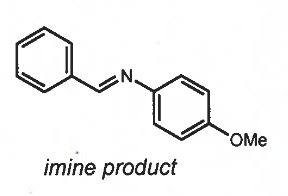
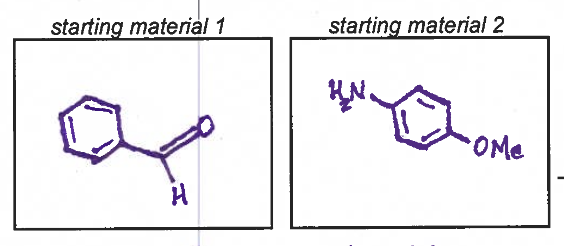
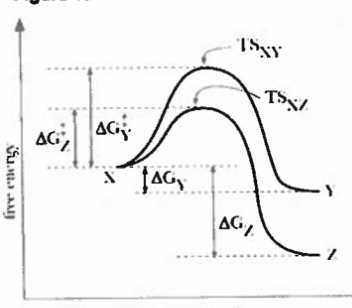
what is product Z?
product Z is the kinetic and thermodynamic product! It has lower EA (kinetic) and results in a more stable, lower energy product (thermodynamic)

draw the product of this reaction


compare these graphs
1 - Z is thermodynamic (stable) + kinetic (lower EA) product
2 - B is thermodynamic (stable) + A is kinetic (lower EA) product
Reaction 1 in Grignard reagent lab: making grignard

Procedure 2 in grignard lab: reaction with ester

react 2 eq of grignard with an ester electrophile and use quenching acidic work up, makes 3’ alcohol
Quenching
quenching with H2So4 and ice is needed to neutralize any unreacted girgnard and to make the alkoxide intermediate the final alcohol product
Tituration
separation of a product and byproduct based on different solubility in certain solvents
used to separate biphenyl product from triphenylmethanol
Petroleum ether in tituration
biphenyl is unpolar, will dissolve in petroleum ether to purify triphenylmethanol product
solvent used in grignard reaction
Et2O (diethyl ether)
formulas for M


1.) determine M of starting material
2.) divide by M of grignard
3.) x1000 to get mL

