Intro To Psychology Exam 1
 Call Kai
 Learn
Learn Practice Test
 Spaced Repetition
 Match
Match Flashcards
 Knowt Play
1/68

Earn XP
Description and Tags
Intro, 1, 2, 5
Name | Mastery | Learn | Test | Matching | Spaced | Call with Kai | Chat |
|---|
No analytics yet
Send a link to your students to track their progress
69 Terms
Psychology
The scientific study of the mind and behavior
What does psychology involve
understanding ourselves and others
Stories to remember about trusting your intuition and being critical
Story about lady asking for money for landlord, lady asking for money to buy diapers
Patient X
Man who had stroke and lost sight (1/2 pathways to vision were blocked, the high road) this revealed a second pathway, low road, for sight
The Amygdala
extracts emotional meaning from non verbal messages (emotional subtext from low road)
What is psychology based on
scientific method; observation and documentation
What does psychology believe about behavior
it is multi-factorial causation of behavior- never a single cause
Psychologist who studied world cup penalty shots
noticed that anxiety, pressure, perceived control, speed, emotional contagions of teammates and crowd impact performance
Psychology is theoretically diverse
It is based on a variety of perspectives, there are many areas of psychology
Capuchin monkey
Like cucumbers, love grapes. When one monkey was given cucumbers but the other was given grapes, the one given cucumbers got really mad. They have an idea of fairness.
How is our experience of the world
Highly subjective; influenced by mood, culture, background, attention, and perspective
Why science
Curiosity (why people do what they do)
Complexity (human behavior is unpredictable)
Challenge (our own behaviors, emotions, and behaviors can be confusing to even ourselves.)
Empiricism
experience is the soul source of knowlege
Skepticism
an attitude of doubt
Hans the horse
Was famous for being able to count and do math; in reality, he was trained to read human behavior
Scientific Methods
observation (leads to description, surveys, case studies; mom with baby)
correlation (a relationship between two variables that vary together. correlation v. causation)
experimentation (used to discern cause and effect, manipulating factors.)
Correlation V. Causation
Correlations can be explained by a 3rd variable like age or weather. Correlation does not equal causation. Ex. taking vitamins and being a drug user. Leads to prediction and indicates the possibility of causation.
Experimentation factors
Independent Variable
Dependent Variable
(in mom and baby video, independent variable was the moms face and the dependent variable was the baby’s reaction)
Experimental v. Control Group: experimental was moms face, control was just being normal.
Who are psychologists
those with education and training
5 yrs for MA/Phd
3yrs for marriage and family therapy
psychiatrists earn MD in med school (different)
Founders of Psychology
Wilhelm Wundt, William James, John B. Watson
Wilhelm Wundt
structuralism (structure of the brain)
William James
Functionalism (what parts of the brain do what)
John B. Watson
Behaviorism (why we do what we do)
What three ideas make up psychology
Structuralism
Functionalism
Behaviorism
Falling in love
dopamine, oxytocin, vasopressin
Anxiety
amygdala, cortisol, adrenaline
Memories
hippocampus, structural brain changes
Neuropsychology
Everything psychological is simultaneously biological
Mental Health
Imbalances in serotonin
Nervous system
Electrochemical communications system, including peripheral nervous system (PNS), central nervous system (CNS), and neurons (nerve cells), Neurotransmitters
Peripheral nervous system
No bones, just nerves
Somatic (voluntary) vs. Automatic (self-regulating)
Automatic includes sympathetic (arousing) and parasympathetic (calming, think of parachute)
Somatic nervous system
Voluntary control of our skeletal muscles, ½ components of peripheral nervous system.
Automatic nervous system
Controls glands and internal organ muscles, ½ components of peripheral nervous system
Also includes Sympathetic (arouses and expends energy) and Parasympathetic (calms you down and conserves energy) WHY? to maintain homeostasis
Optic Nerve
carries signals from eyes to brain (allows us to see)
Auditory nerve
conducts acoustically for hearing (allows us to hear)
Vagus
longest nerve, controls heart rate, stomach, and s*x arousal
Central Nervous System (CNS)
has bone surrounding it, neurons talking to other neurons, brain and spinal cord. Neural networks, short and fast connections, neurons that fire together wire together, connect peripheral nervous system and the brain
Neurons
Nerve cells!! electrical and chemical, all or none response.
Mirror neurons!!
each nerve cell is a decision making device
Mirror Neurons
respond to what you see others do as if you were them. people with autism have broken mirror neurons.
mimicry, bonding, sympatico

1
Dendrites (receives neurotransmitters from sending neutron)
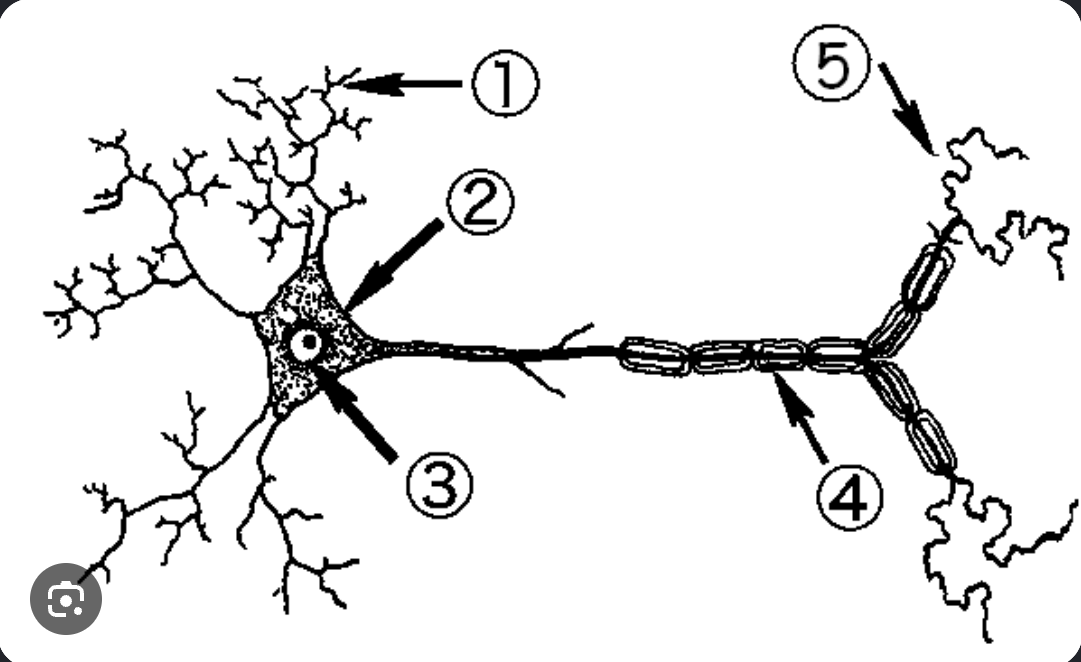
2
Cell Body

4
myelin sheath covering axon

5
Axon Terminals (send neurotransmitters to the recieving neuron)
Neurotransmitters
either excitors (sending message) or inhibitors (stop message from being sent)
Excitors
Acetylcholine (muscle control, brain function, automatic regulation)
dopamine (drugs)
endorphins (natural pain killer, think runners high)
serotonin (boosts mood)
adrenaline/epinephrine (Fight or flight, body response)
Inhibitor
GABBA inhibitor (slows you down, anti-anxiety, often used in anesthesia)
Types of drugs
Agonist (increases a neurotransmitters action, mimics neurotransmitter)
Antagonist (blocks neurotransmitters, decreased action)
Narcotics (increase pleasure, decrease pain. To make numb or sleep.)
Organization of the brain
brain stem (automatic survival system, begins where spinal cord swells as it enters the skull)
limbic system (emotional states, drives)
cortex (receives and processes information, makes decisions, directs voluntary actions.)
geographical divisions of the brain
Frontal (in front)
Parietal (top)
occipital (back)
Temporal (by temples)
Divided brain
it is possible to sever the corpus callosum to prevent seizures, separating the two hemispheres of the brain (left and right)
video of woman able to write what she saw though she couldn’t tell researcher what she saw.
3 weeks
first brain cells
7 weeks
brain stem
8 weeks
face, hands, feet
15 weeks
grasp, frown, squint, grimmace
20 weeks
taste and smell
22
cortex controls limbs
age of viability
28 weeks
interneurons form linking cells
30 weeks
sleep and wake patterns
Nature V Nurture
Genes v experience
Genetic factors (40-50% of personality) make up nature
prenatal and postnatal chemical factors, general and individual experimental factors, and traumatic factors (50-60% of personality) make up nurture
Marshmallow study
Kids were given a marshmallow and told if they could wait to eat it, they could have 2! Those who could wait had more prefrontal cortex activity, while those who couldn’t wait had more pleasure circuitry which is linked to addictions.
Stages of development
Zygote (0-2 weeks)
Embryo (2-8 weeks)
Fetus (8+ weeks)
Teratogens
potentially harmful viruses or chemicals (alcohol, drugs, x-rays, measles)
Motor Development and reflexes
Rooting reflex (tendency to open mouth and search for nipple when touched on cheek)
Newborn preferances
Human voices and faces, smell and sound of parents
Harlow’s studies
baby monkeys were more likely to cling to a cloth monkey than a wire monkey even though the wire monkey was where they were fed.
Physical touch with pre-mature infants
pre-mature infants were rubbed and given physical affection, and the babies who were touched were released from the hospital around 30 days before those who were not touched.
Jean Piaget
studied how knowledge is acquired, focusing on errors in cognition, thinking, and knowing; studied schemas (assimilations/accommodations)
Egocentrism
toddlers think that the world revolves around them.
6 contemporary perspectives of psychology
Biological, Behavioral, Cognitive, psychodynamic, humanistic, and sociocultural