Chapter 9.2: The Ionic Bonding Model
 Call Kai
 Learn
 Practice Test
 Spaced Repetition
 Match
 Flashcards
 Knowt Play
1/7

8 Terms

Energy transfer
This occurs during ion formation
Energy input is required to break electron bonds
Energy output as heat occurs as bonds are formed
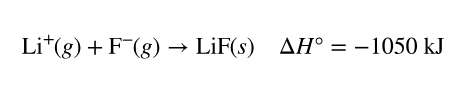
Energy release
This occurs when a compound forms from its elements in ionic bonding, due to a decrease in potential energy
Energy absorption
This occurs when an atom loses an electron or changes into a greater energy state, due to an increase in potential energy from the input needed
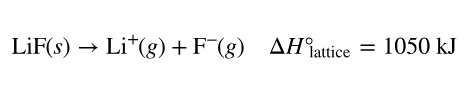
Lattice energy (ΔH°lattice)
The enthalpy change associated with one mol of ionic solid separating into gaseous ions
Equal to the opposite of the last step of ionic bond formation
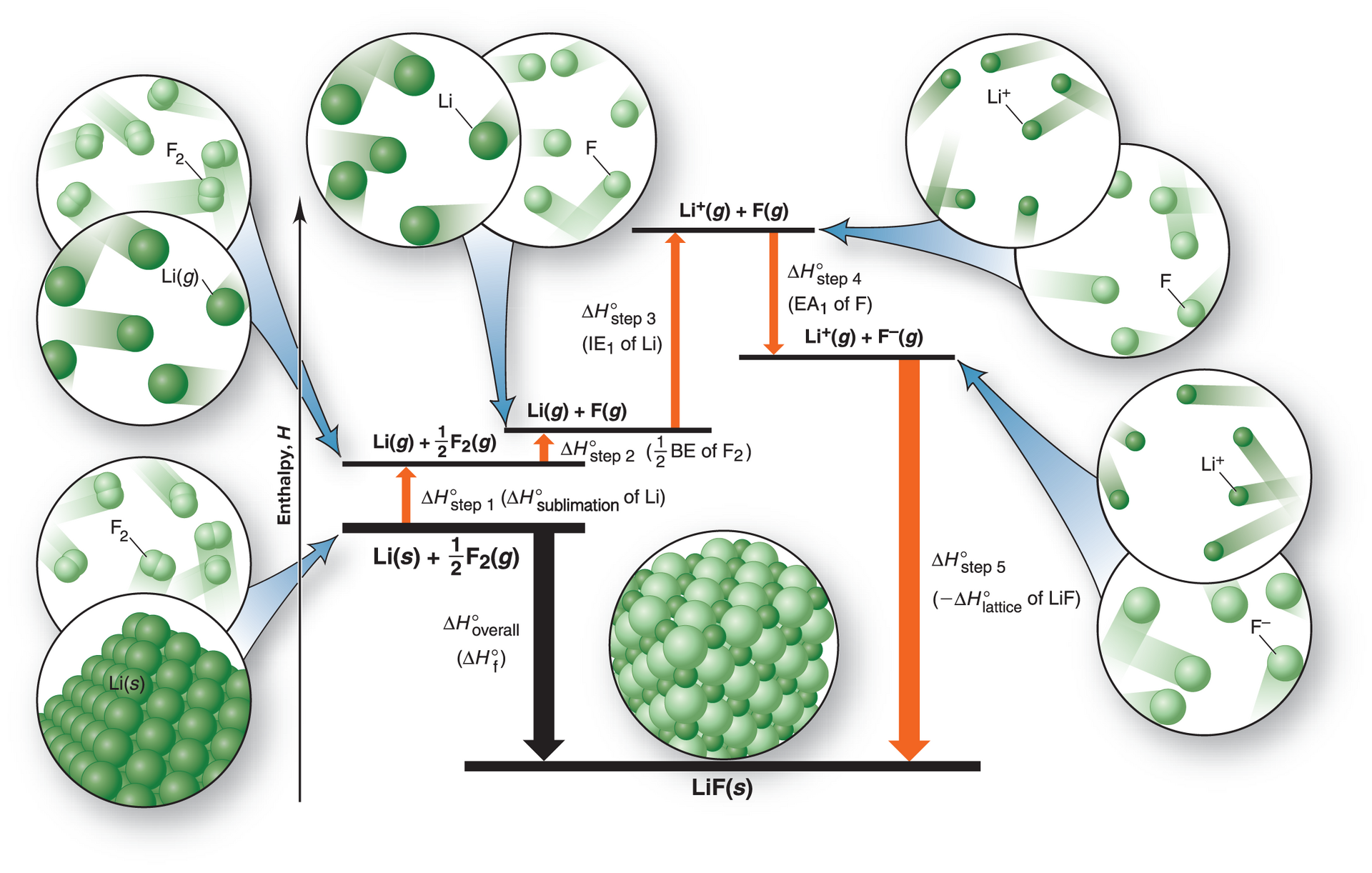
Born-Haber cycle
A series of steps and enthalpy changes that converts elements to an ionic compound, used to calculate the lattice energy from known enthalpies of formation
Based on Hess’s law, stating that ΔH°f = ΣΔH°steps
Requires adding individual ΔH values in order to form elements, then solving for the last step to obtain lattice energy
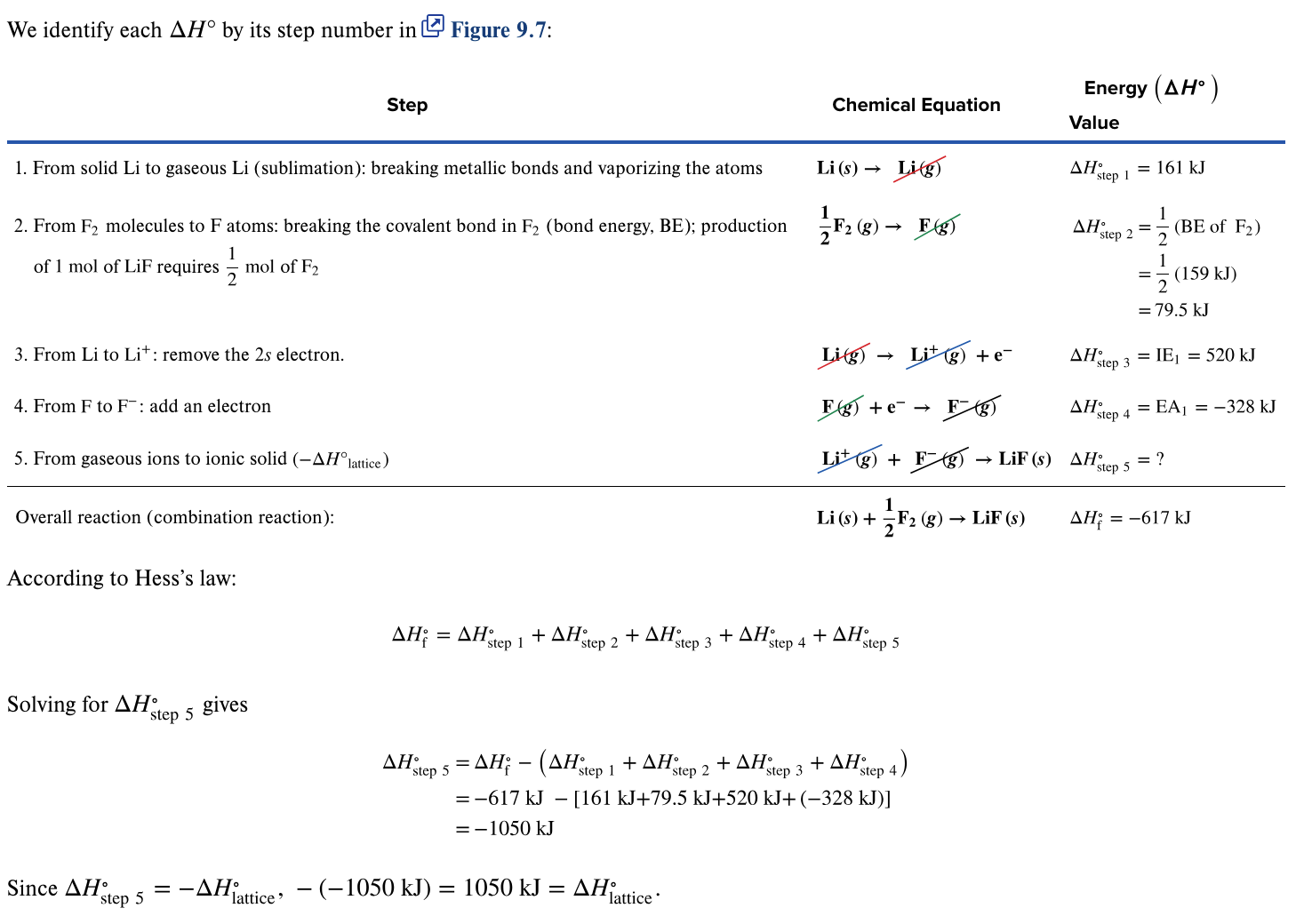
List out your given ΔH°f values.
Determine the order and sign of the individual steps to add.
Using Hess’s law, solve for -ΔH°lattice (the last step).
Take the opposite of the last step to find ΔH°lattice.
How do I solve for an equation using the Born-Haber cycle?

Coulomb’s law
States that the electrostatic energy between particles is directly proportional to the product of their charges and inversely proportional to the distance between them
Expressed as E = (Charge A ⋅ Charge B) / Distance
Greater charges, then smaller ion sizes, increase energy
Directly proportional to ΔH°lattice
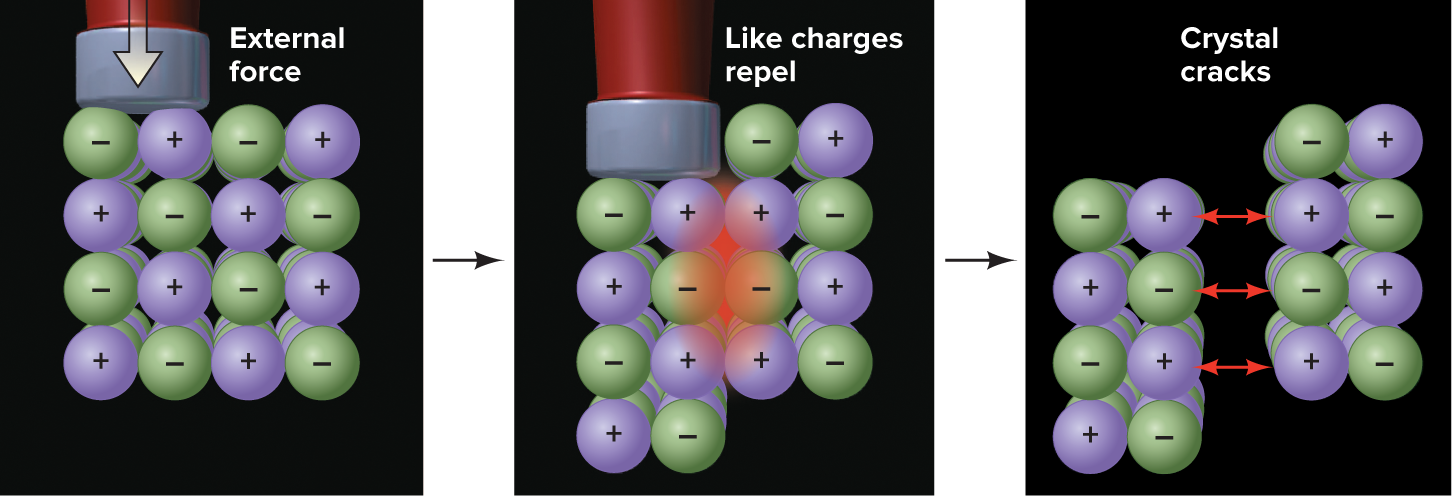
Ionic bonding model
This explains the properties of ionic solids, as:
Ions in specific positions make for a hard, brittle, and rigid solid
Ions dissolve and carry a current in water
Ions require large amounts of energy for separation due to high lattice energies, creating ion pairs in gaseous states instead of individual ions