Economic Development After World War One: The Interwar Economy
 Call Kai
 Learn
 Practice Test
 Spaced Repetition
 Match
 Flashcards
 Knowt Play
1/59

Earn XP
Description and Tags
The interwar economy: Between world war one and world war two (1918-1939)
60 Terms
When was the long 19th century?
1789-1913, before 1914
Why was the long 19th century a century of modernisation?
Political reforms in Europe and the Americas
The industrial revolution: Mechanisation and steam power
The transport revolution: Steamships and railways
The communication revolution: Telegraph and telephone
How was the long 19th century a century of globalisation?
It marked the period of the first globalisation, 1870-1913
Trade between the core and the periphery
Mass migration and. large international capital flows
The international gold standard
Liberal international order: Pax Britannica
Explain the Pax Britannica
Britain helped shape an international system that encouraged trade between countries
Britain’s powerful navy protected major sea routes
Britain’s economic and financial influence helped encourage international trade and investment
This made it easier for goods, money, and people to move across borders
However, this peace was relative and the system often favored Britain
Give a timeline of the different conflicts that occured during the short 20th century
1914-1945: “The second thirty years war”- Churchill
1917-1949: “The European civil war” - Nolte
1947-1989: The cold war
When was the short 20th century?
1914- 1991, after 1914
When did world war one happen?
1914-1918
When did world war two happen?
1939-1945
Why is the short 20th century considered a century of calamities?
Global wars
Revolutions
Economic crises
Pandemics
Why is the short 20th century considered a century of disintegration?
Deglobalisation due to the globalisation backlash of 1914-1945
Decolonisation
Who is Kuznets?
An economist who studied long term economic growth and how economies change as they develop, he helped develop ways to measure national income and won the nobel prize in 1971.
How did Kuznetsk define modern economic growth?
The spreading application of science to production and social organisation.
What are some defining features of Kuznets’ modern economic growth?
Sustained rise in per capita product: 15-30% per decade
Faster growth of population and consumption; Rising saving and investment ratios
Structural change: Output and consumption shifted from agriculture to manufacturing and services
Rising international flows of goods, services, and factors but they not at a constant rate and with occasional reversals
Timeline of globalisation
1860-1913: The first globalisation
1914-1945: Globalisation backlash
1945+: Slow re-integration
1990s: Second globalisation
But labor mobility never returned to pre 1914 levels
Where was modern economic growth first realized, how did it spread?
Before 1914:
England
Belgium, France, Switzerland, Rhineland, US
Prussia and Scandinavia
Parts of Russia, central and southern europe, canada, argentina, oceania
Japan was the only robust case outside of European settlement before 1914

Give the years and key points for each of the four phases of modern economic growth
1870-1913: Fast growth driven by globalisation and tecnhological progress + strong divergence between the west and the rest
1913-1950: World wars and the great depression + slow growth in Europe and Asia + New global powers became the US and the Soviet union
1950-1973: The golden age of economic growth
Post 1973: Slowdown in the west and a rise of the east
Why was world war one considered a global armed conflict?
Although it was mostly fought on European soil, it also extended to the colonies. It was also larger than any previous war in size, scope, and destruction
The thirty years war
1618-1648
Series of conflicts fought mainly in the Holy Roman Empire
Ended with the peace of westphalia
What did world ware one mark and what were some of its effects?
World war one marked the end of the long 19th century and it was a watershed in history with economic, social, political, and even cultural repercussions
What were some economic consequences of World War One?
Human casualties
Disruption of world trade
Crisis of global finance
Peace settlements meant redrawn borders and war reparations
The dissolution of the four empires: Russia, Prussia, Austro-HUngary, and the Ottoman empire from 1917-1919 meant the creation of many new nation states
The victors of world war one
The allied powers
UK
FranceRussia until march 1918
Italy from 1915
USA from 1917
The defeated of world war one
The central powers
Germany
Austria-Hungary
Ottoman empire
Bulgaria from 1915
The neutrals of world war one
Sweden
Switzerland
Netherlands
Denmark
Norway
Spain

Explain the human costs of world war one for the different countries involved
Russia had the largest absolute losses with 3.3 million dead
Germany had the largest military death toll with 2.05 million
France had the heaviest relative loss with 4.3% of the population
Italy had a large civillian toll of 589,000 equivalent to 3.5% of the population
The United states had marginal losses of 0,13% because they entered late and fought far from home
What was the result of world war one’s losses falling on Europe?
Losses falling on Europe is considered part of the reason why Western Europe’s growth fell behind the United States
When did the influenza pandemic take place and what was it called?
The spanish flu (1918-1920)
What was the spanish flu, how many did it affect, and how many died?
It was a H1N1 Influenza A virus that infected 500 million people worldwide in 3 waves and killed 30-100 million
What was the influenza pandemic called in different places?
Europe= Spanish flu
West Africa= Brazilian flu
Brazil= German flu
Spain= The naples soldier
How did the war play a role in the nfluenza pandemic?
Contagion spread by allied armies and navies, it was carried into Europe by US troops
Wartime censorship limited information and policy response
Mass mobilisation had increased state capacity
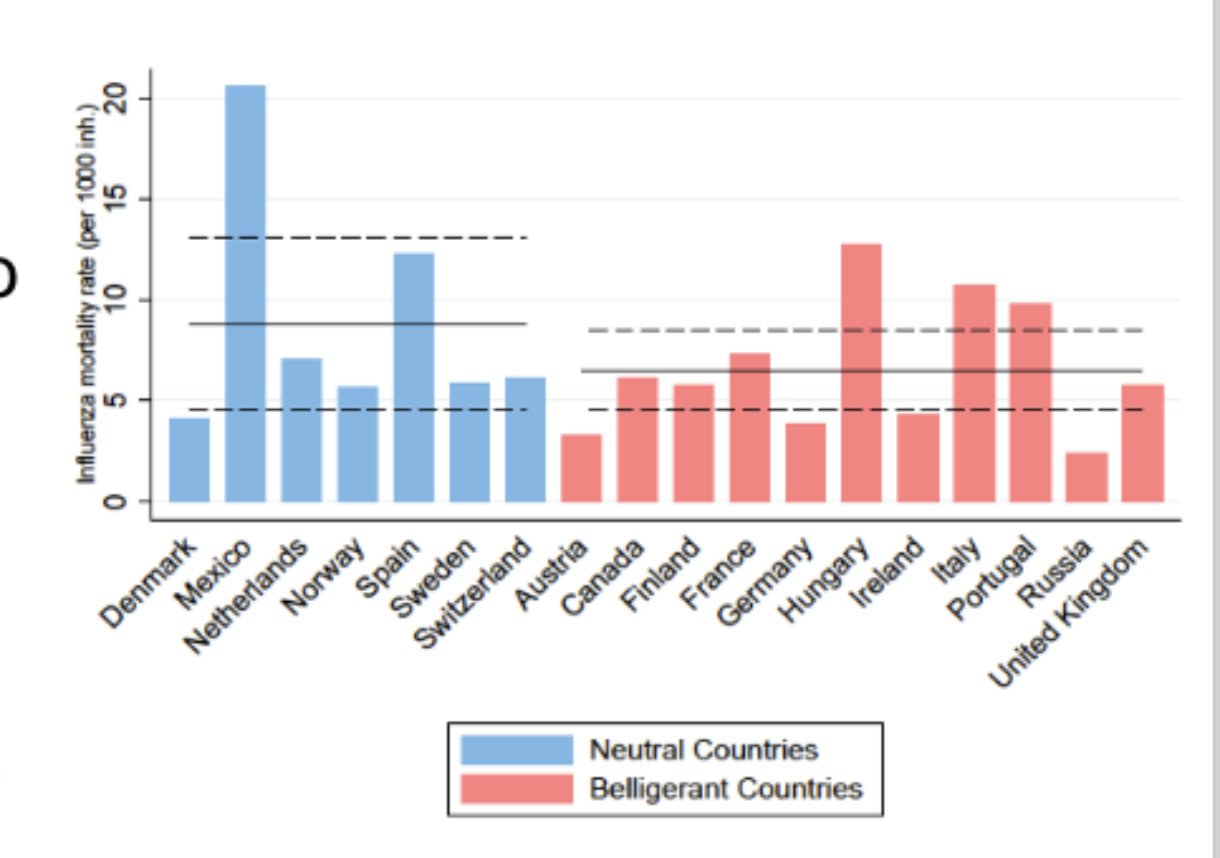
Did the war make the flu deadlier?
Average mortality was actually higher among neutrals, but there is no clear difference
Large variations existed within each group
War may have spread the virus but taking part in the war or not does not predict where mortality was highest

Where was the flu’s death toll concentrated?
The largest death tolls were in Asia: India, china, and the dutche east indies
Each of them had a death toll in the millios
There were also substanttial tolls in subsaharan africa: The french west and equitorial afria, the belgian congo, and south africa
Substantial tolls were also seen in the Americas: US, Mexico, and Brazil
Europe’s absolute toll was small by comparison
The Dutch East Indies
The Netherlans former colony is southeast asia, mainly Indonesia
What are the five stylised facts about the interwar economy?
The slowdown was worldwide but hit the regions differently
Overall slowdown combined fairly satisfactory growth in the 1920s with dismal performance in teh 1930s
International trade declined in real terms, out of line with output (Globalisation backlash)
High and structural unemployment was the shocking new phenomenon
Labor productivity grew faster than in 1890-1913, especially in the 1920s
Growth differed by war participation and by exit from gold

How did the interwar economy slowdown hit regions differently? Remember the difference between 1920s and 1930s
Per capita growth slowed down in 1913-1950 in every region except for the soviet union
Western europe was hit the hardest because two global conflicts were fought on european soil
Between the wars (1921-1938) Europe outgrew the US: Strong 1920s and milder 1930s
In the 1930s dismal was seen everywhere except for Japan
Soviet union had growth of 4.9% a year in 1929-1938, this was cited as proof of the superiority of socialism but the west feared the end of capitalism, this saw rise to a third way created by people like Mussolini and Hitler
What were the two forces pushing in opposite ways that led to globalisation backlash?
Technology kept lowering costs, partly due to wartime military research and development:
Larger more energy efficient ships and motor transporation competing with rail and the rise of passenger airlines
Telephone and radio had a strong effect on financial market intergration
Political factors pushed the other way:
Hostile international relations, tensions, and lack of cooperation from 1919-1938
Tarrif and non tariff barriers, limits on migration, and controls on cross border finance
Gold standard was rebuilt in the 1920s but collpased in the early 1930s
Leage of nations and the bank for international settlements were almost powerless
What was the net result of the two factors creating the globalisation backlash?
Man made obstacles outweighed technology, and nineteenth century globalisation went into reverse.
Decline of Europe in world trade, the united states became the dominant economy
The end of mass migration and large caipital flows

How did the annual average growth of exports change in different regions from 1913-1950?
1870-1913: World exports grew by 3.35% a year
1913-1950: World exports grew only 0.89% a year, almost stagnating after 1929
Western Europe actually drove the collapse:
0.21% in 1913-1929
-0.32% 1929-1950
Its share of world exports fell from 60.1% in 1913 to 41.1% in 1950: The center of the world economy moved away from Europe
The united states was 2x the world average in the 1920s (3.33) and still well above it after 1929 (1.68)
Japan was 7 in 1913-1929 then -0.97 after 1929 despite output growth (A shift to autarky under the military regime)
This was all a strong contrast with the golden age where world exports grew 7.88% a year in 1950-73
Autarky
An economic policy of trying to make a country self-sufficient by producing what it needs at home and relying less on imports and international trade.
What ended the century of mass migration?
World war one
What were some restrictive policies placed on migration?
US quotas against less favored countries
Restrictions on immigration in Latin America
Restriction on emigration in places like the USSR
1930s: Mass unemployment in the new world further cut transatlantic flows and European intra-migration declined
What were some policies implemented by the United states to restrict immigration?
Chinese immigrants excluded in 1882
Japanese immigrants excluded in 1908
All asian immigrants excluded in 1917
Literacy tests introduced selective immigration in 1917
Quotas by national origin from the 1920s, mainly aimed at Southern and Eastern Europe
How did other countries besides the United States implement immigration policies?
Argentina, Chile, Australia, and New Zealand reduced assistance for immigrants
Australia, New Zealand, and Canada introduced literacy tests
Quotas in other places like South Africa and Brazil
What was the remaining migration characterized by?
It was mainly forced migration.
Groups fleed authoritarian regimes: Jews leaving Germany and central Europe in the 1930s, and spaniards leaving for mexico during the civil war
Poles and Baltic people deported to siberia, ethnic minorities were resettled after border changes
How were cpaital flows affected during the interwar period?
Capital flows were at their all time peak in 1913 but were then depressed for two decases because of
Exchange controls
Exchange rate uncertainty
How was mass unemployment before 1914?
It was basically unknown, unemployment was cyclical and of shorter duration

What were unemployment levels like in the 1920s?
8.3% similar to the 80s and 90s
Europe had increasing unemployment but the United States had full employment

What were unemployment levels like in the 1930s?
15.8%, alomst double the 1920s and 6x as much as 1960-1973
Both sides of the Atlantic suffered
How was unemployment recorded?
Through artists, writers, and oral traditions in the 1930s: Homeless, que for free meals, idle workers, discouraged long term unemployed
Not seen as very different between the US and Europe
Why was unemplyment high? Explain the classical and the Keynesian view
Classical view:
Labor markets were flexible
Unemployment was voluntary
Fiscal policy was not needed to create employment
Keynesian view:
Wages were stikcy and did not adjust to deflation
Unemployment was involuntary
Government needs to boost aggregate demand

Classical unemployment model
Wages and prices are flexible
Labor supply and demand determine the wages and the quantity of labor employed at that wage
Unemployment is voluntary:
Unemployed people are workers who find the wage too low
Any excess supply of labor decreases real wage to the equilibrium wage, and so involuntary unemployment cannot persist
Voluntary army explanation to unemployment
Its unrealistic that workers chose to earn nothing for years
How did Benjamin and Kochin explain unemployment and when?
They suggested a neo liberal explanation in 1979 that said that the United Kingdom was generous with their unemployment benefits, the unemployment insurance act of 1920 covered 11 million workers. With benefits, workers did not need to accept low wages, because benefits raised the wage below workers preffered not to work.
The keynesian interpretation to unemployment
1925 Britain returned to the gold standard at the pre war parity, not adjusted for wartime inflation and so the sterling was overvalued
Other countries like the United States also restored the gold standard but had less inflation and western countries returned to gold only after devaluing
Keynes mechanism:
The overvalued sterling meant British goods were expensive abroad
A less competitive industry increased imports and decreased exports
The fall in aggregate demand led to deflation
Money wages fall less than prices and so real wages rise
Higher real wages meant a decreased demand for labour which led to unemployment

Sticky wages and involuntary unemployment model
Start at equlibrium wage and labor
Deflation with sticky wages raises the real wage
At the new higher wage, firms demand less than workers supply
This gap is involuntary unemployment
People who are willing to work at this new wage cannot find a job
This persists as long as the real wage cannot fall back
Keyne’s remedy to involuntary unemployment
Raise aggregate demand and prices
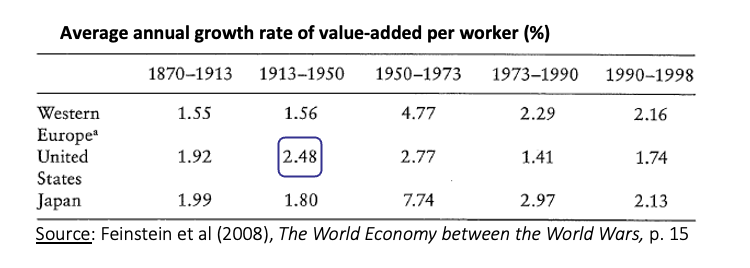
How were productivity rates in different regions?
Western Europe:
1.56% increase a year in 1913-1950, the sam pace as 1870-1913
US:
Faster than before 1914 (2.48 vs. 1.92) so its lead widened
Japan:
Slowed (1.8 vs. 1.99)
All were far below the golden age
How did productivity keep growing throughout the interwar economy?
Technology:
Many second industrial revolution inventions had a measuravle aggregate effect only during or after the war
Internal combustion engine
Ford’s assembly line
Electrical network and motor
Human Capital:
Continued expansion of primary and secondary education and investment in higher education with a lagges effecr on productivity
Composition (1930s):
Layoffs hit the least productive workers first, which raised measured average productivity
How does the interwar economy explain the post 1945 boom?
Slow growth and depression were manmade
Once the manmade obstacles were removed, Europe could exploit the large backlog of tech and human cpaital
The role of technology in the interwar economy
Biases technical change existed: New technology was capital and knowledge intensive
Industrialised countries rich in capital and human capital grew faster
What were some important general purpose technologies from the interwar period?
Electrification: Power supply, electric motors, railways, trams, and lighting meant round the clock production
Motorisation: Faster ships and diesel locomotives as well as new modes of transport on roads and air
The united states led in both.