Final Exam Micro
 Call Kai
 Learn
 Practice Test
 Spaced Repetition
 Match
 Flashcards
 Knowt Play
1/199

Earn XP
Description and Tags
Exam Date : 12/04/2026
200 Terms
A commensal bacterium
may also be an opportunistic pathogen.
Which of the following statements is TRUE?
At least one member must benefit in a symbiotic relationship.
A healthcare-associated infection (traditionally known as a nosocomial infection) is
acquired during the course of hospitalization.
The major significance of Robert Koch's work is that
microorganisms cause disease.
Which of the following is NOT a verified exception in the use of Koch's postulates?
Some diseases are noncommunicable.
Which of the following diseases is NOT spread by droplet infection?
botulism
Biological transmission differs from mechanical transmission in that biological transmission
involves reproduction of a pathogen in an arthropod vector prior to transmission.
Which of the following definitions is INCORRECT?
epidemic: a disease that is constantly present across the world
Focal infections initially start out as
local infections.
The rise in herd immunity amongst a population can be directly attributed to
vaccinations
Koch observed Bacillus anthracis multiplying in the blood of cattle. What is the condition specifically called when bacteria are multiplying in the blood?
septicemia
Which one of the following does NOT contribute to the incidence of healthcare-associated infections?
gram-negative cell walls
Transient microbiota differ from normal microbiota in that transient microbiota
are present for a relatively short time.
Which of the following statements about healthcare-associated infections is FALSE?
The patient was infected before hospitalization.
One effect of washing regularly with antibacterial agents is the removal of normal microbiota. This can result in
increased susceptibility to disease.
Which of the following is NOT a reservoir of infection?
None of the answers is correct; all of these can be reservoirs of infection
Which of the following is NOT a communicable disease?
tetanus
Which of the following is a fomite?
a hypodermic needle
Which of the following statements about biological transmission is FALSE?
Houseflies are an important vector.
Which of the following definitions is INCORRECT?
secondary infection: a long-lasting illness
Symptoms of disease differ from signs of disease in that symptoms
are changes felt by the patient
The science that deals with when diseases occur and how they are transmitted is called
epidemiology

Figure 14.1 shows the incidence of influenza during a typical year in the northern hemisphere. Which letter on the graph indicates the endemic level?
d

In Figure 14.1, which letter on the graph indicates the epidemic level?
a

In Figure 14.1, which letter indicates the gradual end of the epidemic outbreak?
c

in figure 14, Would you expect the graph to change if this was for the southern hemisphere, rather than the northern hemisphere? If so, how?
Yes, because the seasons are reversed in the southern hemisphere. While weather doesn't directly cause influenza outbreaks, the cold, dry air and human crowding indoors contribute to increased cases. The southern hemisphere would still have a peak, but it would be at a different time of year than the northern hemisphere.
Emergence of infectious diseases can be attributed to all of the following EXCEPT
The emergence of infectious diseases can be attributed to all of these.
Which of the following pairs is mismatched?
malaria – foodborne transmission
Which of the following can contribute to postoperative infections?
All of the answers are correct.

In Figure 14.2, when is the prevalence the highest?
February

In Figure 14.2, which one of the following choices has the highest morbidity rate?
December
A cold transmitted by a facial tissue is an example of
fomite
A researcher has performed a prospective study on a disease. To which specific kind of epidemiological study is this referring?
descriptive
The CDC is located in
Atlanta, GA.
A disease in which the causative agent remains inactive for a time before producing symptoms is referred to as
latent
A needlestick is an example of
indirect contact transmission by fomite.
Which of the following is NOT a predisposing factor of disease?
All of these are predisposing factors of disease.
In which of the following diseases can gender be considered a viable predisposing factor?
urinary tract infections
In which of the following patterns of disease does the patient experience no signs or symptoms?
both incubation and convalescence
S14.1: During a six-month period, 239 cases of pneumonia occurred in a town of 300 people. A clinical case was defined as fever ≥ 39°C lasting >2 days with three or more symptoms (i.e., chills, sweats, severe headache, cough, aching muscles/joints, fatigue, or feeling ill). A laboratory-confirmed case was defined as a positive result for antibodies against Coxiella burnetii. Before the outbreak, 2000 sheep were kept northwest of the town. Of the 20 sheep tested from the flock, 15 were positive for C. burnetii antibodies. Wind blew from the northwest, and rainfall was 0.5 cm compared with 7 to 10 cm during each of the previous three years.
Situation 14.1 is an example of
a zoonosis
S14.1: During a six-month period, 239 cases of pneumonia occurred in a town of 300 people. A clinical case was defined as fever ≥ 39°C lasting >2 days with three or more symptoms (i.e., chills, sweats, severe headache, cough, aching muscles/joints, fatigue, or feeling ill). A laboratory-confirmed case was defined as a positive result for antibodies against Coxiella burnetii. Before the outbreak, 2000 sheep were kept northwest of the town. Of the 20 sheep tested from the flock, 15 were positive for C. burnetii antibodies. Wind blew from the northwest, and rainfall was 0.5 cm compared with 7 to 10 cm during each of the previous three years.
The etiologic agent of the disease in Situation 14.1 is
Coxiella burnetii.
S14.1: During a six-month period, 239 cases of pneumonia occurred in a town of 300 people. A clinical case was defined as fever ≥ 39°C lasting >2 days with three or more symptoms (i.e., chills, sweats, severe headache, cough, aching muscles/joints, fatigue, or feeling ill). A laboratory-confirmed case was defined as a positive result for antibodies against Coxiella burnetii. Before the outbreak, 2000 sheep were kept northwest of the town. Of the 20 sheep tested from the flock, 15 were positive for C. burnetii antibodies. Wind blew from the northwest, and rainfall was 0.5 cm compared with 7 to 10 cm during each of the previous three years.
The method of transmission of the disease in Situation 14.1 was
vehicle
Which of the following is NOT an example of microbial antagonism?
bacteria causing disease
The yeast Candida albicans does NOT normally cause disease because of
antagonistic bacteria.
If a prodromal period exists for a certain disease, it should occur prior to
illness
Which one of the following is NOT a zoonosis?
All of these are zoonoses.
Pseudomonas bacteria colonized the bile duct of a patient following his liver transplant surgery. This is an example of a
nosocomial infection.
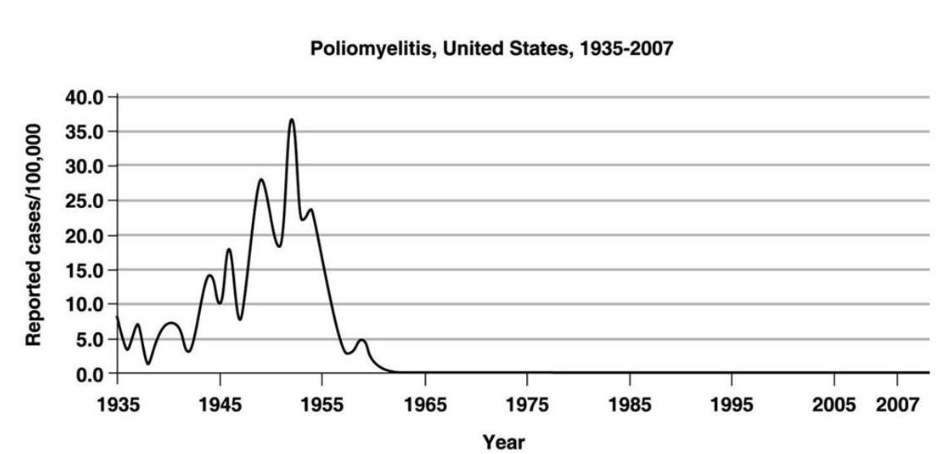
The graph in Figure 14.3 shows the incidence of polio in the United States. The period between 1945 and 1955 indicates a(n)
epidemic level.

Interpreting this graph, can we conclude that polio has been eradicated globally? Why or why not?
No, because the graph only depicts incidence of polio in the United States.
Which of the following statements is FALSE?
The M in MRSA stands for mannitol.
The most frequently used portal of entry for pathogens is the
mucous membranes of the respiratory tract.
The ability of some microbes, such as Trypanosoma or Giardia to alter their surface molecules and evade destruction by the host's antibodies is called
antigenic variation.
Most pathogens that gain access through the skin
enter through hair follicles and sweat ducts.
The ID50 is
the dose that will cause an infection in 50 percent of the test population.
All of the following contribute to a pathogen's invasiveness EXCEPT
toxins
Which of the following statements is FALSE?
Coagulase destroys blood clots.
Which of the following statements about exotoxins is generally FALSE?
They are resistant to heat.
Endotoxins are
part of the gram-negative cell wall.
Which of the following is NOT a membrane-disrupting toxin?
A-B toxin
Cytopathic effects are changes in host cells due to
viral infections.
Which disease-associated fungi or fungal characteristics are mismatched?
Claviceps purpura - aflatoxin
All of the following are methods of avoiding host antibodies EXCEPT
membrane-disrupting toxins.
Siderophores are bacterial proteins that compete with the host's
iron-transport proteins.
The fimbriae of Neisseria gonorrhea and enteropathogenic E. coli are examples of
adhesins and ligands.
All of the following are examples of entry via the parenteral route EXCEPT
hair follicle.
Superantigens produce intense immune responses by stimulating lymphocytes to produce
cytokines
Botulism is caused by ingestion of a proteinaceous exotoxin; therefore, it can easily be prevented by
boiling food prior to consumption
All of the following organisms produce exotoxins EXCEPT
Salmonella typhi.
Which of the following cytopathic effects is cytocidal?
release of enzymes from lysosomes
All of the following are used by bacteria to attach to host cells EXCEPT
A-B toxins.
Symptoms of protozoan and helminthic diseases are due to
tissue damage due to growth of the parasite on the tissues, waste products excreted by the parasite, and products released from damaged tissues.
Which of the following statements about staphylococcal enterotoxin is FALSE?
It is produced by Staphylococcus aureus growing in the host's intestines.
Which of the following contributes to the virulence of a pathogen?
numbers of microorganisms that gain access to a host, evasion of host defenses, and toxin production
Lysogenic bacteriophages contribute to bacterial virulence because bacteriophages
give new gene sequences to the host bacteria.
Twenty-five people developed symptoms of nausea, vomiting, and diarrhea three to six hours after attending a church picnic where they ate a ham and green bean casserole with cream sauce. The most likely cause of this case of food intoxication is
staphylococcal enterotoxin.
Which of the following statements about M protein is FALSE?
It is readily digested by phagocytes.
Symptoms of intense inflammation and shock occur in some gram-positive bacterial infections due to
superantigens.
Which of the following is an example of direct damage due to bacterial infection?
the invasion and lysis of intestinal cells by E. coli
Polio is transmitted by ingestion of water contaminated with feces containing polio virus. What portal of entry does polio virus use?
mucous membranes only
All of the following bacteria release endotoxin EXCEPT
Clostridium botulinum.
Cholera toxin polypeptide A binds to surface gangliosides on target cells. If the gangliosides were removed,
polypeptide B would not be able to enter the cells.
Bacteria such as E. coli and Salmonella produce invasins that bind host cells, thus causing the cells to
engulf the bacteria
Which of the following mechanisms is used by gram-negative bacteria to cross the blood-brain barrier?
inducing TNF
Injectable drugs are tested for endotoxins by
the Limulus amoebocyte lysate test.
Endotoxins in sterile injectable drugs could cause
septic shock symptoms.
Gram-negative septic shock results from the following events. What is the second step?
LPS is released from gram-negative bacteria.
Antibiotics can lead to septic shock if used to treat
gram-negative bacterial infections.
Which of the following is NOT a cytopathic effect of viruses?
toxin production

Table 15.1 shows the ID50 for Staphylococcus aureus in wounds with and without the administration of ampicillin before surgery. Based on the data, the administration of ampicillin before surgery
decreases the risk of staphylococcal infection.

Which organism in Table 15.2 most easily causes an infection?
Legionella pneumophila

Which organism in Table 15.2 causes the most severe disease?
It cannot be determined from the information provided.
Bacteria that cause periodontal disease have adhesins for receptors on streptococci that colonize on teeth. This indicates that
streptococcal colonization is necessary for periodontal disease.
Nonpathogenic Vibrio cholerae can acquire the cholera toxin gene by
lysogenic conversion
In response to the presence of endotoxin, phagocytes secrete tumor necrosis factor. This causes
a decrease in blood pressure.
Patients developed inflammation a few hours following eye surgery. Instruments and solutions were sterile, and the Limulus assay was positive. The patients' inflammation was due to
endotoxin
The best description of direct damage by a pathogen is
host cells destroyed when pathogens metabolize and multiply.
Which is NOT specifically employed by pathogens to avoid destruction by phagocytosis?
producing superantigens
A retired contract administrator who enjoyed gardening sought medical attention for what appeared to be a sinus infection. He received antimicrobials but the conditioned worsened and he was experiencing severe painful spasms in his jaw. He admitted to injuring himself with a gardening tool while wearing sandals in the yard but did not seek medical attention for the wound. The man is likely experiencing
intoxication caused by a focal C. tetani infection
For what reason might the ID50 for Salmonella Typhi decrease when a rat simultaneously ingests sulfa drugs with the pathogen?
The antimicrobial interferes with the microbiome enabling the pathogen to more easily establish infection.
Which pathogen and virulence factor are mismatched?
Shigella sonnei - coagulase