Chapter 18 SA
 Call Kai
 Learn
 Practice Test
 Spaced Repetition
 Match
 Flashcards
 Knowt Play
1/88

There's no tags or description
Looks like no tags are added yet.
89 Terms
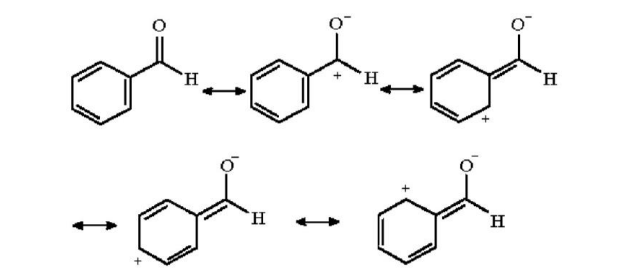
Would you expect the carbonyl carbon of benzaldehyde to be more or less electrophilic than that of acetaldehyde? Explain using resonance structures.
The carbonyl carbon of benzaldehyde would be less electrophilic. Delocalization reduces its partial positive charge as seen in the resonance forms below.
Provide the structure of cyclohexanecarbaldehyde

Provide the structure of 4-oxohexanoic acid.

Provide the proper IUPAC name for PhCH2CH(CH3)CH2CH2CHO
4-methyl-5-phenylpentanal
Provide the proper IUPAC name for CH3CHOHCH2COCH2C(CH3)2CH2CH3
2-hydroxy-6,6-dimethyl-4-octanone
Provide the proper IUPAC name for CH3OCH2CH2CH(CH3)CHO.
4-methoxy-2-methylbutanal
Provide the structure of benzophenone.
PhCOPh
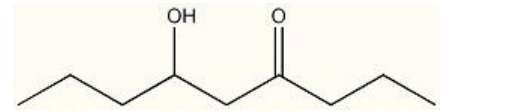
Provide the IUPAC name for the following compound.
6-hydroxy-4-nonanone or 6-hydroxynonan-4-one
Provide the IUPAC name for (CH3)3CCH2CHClCH2CHO.
3-chloro-5,5-dimethylhexanal

Give an IUPAC name to the following compound. Be sure to include configurational information in the name.
(Z)-4-oxo-2-pentenal or (Z)-4-oxopent-2-enal

Provide the IUPAC name for the following compound, including stereochemical designators as appropriate.
(S,Z)-2-bromohex-3-enal
Provide the proper IUPAC name for (CH3)2CHCH2CH2COCH CH2.
6-methylhept-1-en-3-one
Provide the proper IUPAC name for CH3CHBrCH2COCH2CHO.
5-bromo-3-oxohexanal
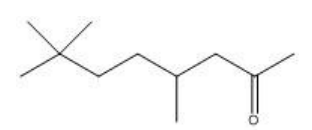
Name the following compound
4,7,7-trimethyl2-octanone or 4,7,7,-trimethyloctan-2-one

Name the following compound
5,5-difluoroheptanal

Name the following compound.
p-chlorobenzaldehyde or 4-chlorobenzaldehyde
Which is more soluble in water, 2-butanone or n-hexane? Explain.
2-Butanone is more soluble in water. The polarization of the carbonyl group gives the molecule a permanent dipole moment. More importantly, the hydrogens of water can hydrogen bond with the carbonyl oxygen.
How might one distinguish an aldehyde from a ketone using IR data alone?
The aldehyde has two C-H stretches at 2700 and 2800 cm-1.

Predict the major organic product of the following reaction sequence


PhCOCH2CH3
Provide the major organic product which results when PhCHOHCH3 is treated with PCC.
PhCOCH3
Propose a synthesis of 3-heptanone from propanal.
1) CH3CH2CH2CH2MgBr, Et2O 2) H3O+ 3) Na2Cr2O7, H2SO4
By which single reaction can benzene be readily converted into acetophenone?
CH3COCl, AlCl3 - a Friedel-Crafts acylation reaction

PhCOCH2CH2CH2CH3
Name the compound generated when ethylbenzene is treated with CO, HCl, AlCl3, and CuCl.
p-ethylbenzaldehyde

Show how you would perform the following synthesis.
Answer: 1) NaNH2 2) BrCH2CH2CH2CH3 3) Sia2BH 4) HOOH, NaOH
Beginning with sodium acetylide (NaCCH), propose a three-step synthesis of hexanal.
Answer: 1. CH3CH2CH2CH2Br 2. Sia2BH 3. H2O2, NaOH

Provide the reagents to perform the following synthesis
Answer: 1) PhLi (excess) 2) H3O+

PhCH2CH2COCH2CH2CH2CH3

Provide the major organic product of the reaction shown below.

How might one prepare 4-heptanone from CH3CH2CH2CN in two steps?
1) CH3CH2CH2MgBr 2) H3O+

Provide the major organic product of the reaction shown below.

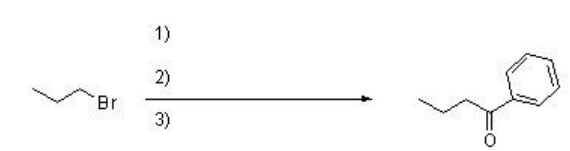
Complete the following reaction by filling in the necessary reagents.


(CH3)2CHCH2CH2CHO

PhCOCH2CH2CH3
What reagent can be used to convert benzophenone into triphenylmethanol?
PhMgBr followed by acidic work up
Provide the structure of the hydrate of cyclopentanone

Draw two major resonance forms of the cation which results when cyclohexanone's carbonyl group is protonated
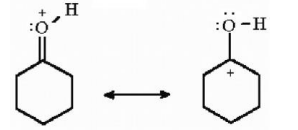
Rank the following compounds in order of their propensity to become a hydrate in water (i.e., start with the least easy to hydrate: CH3COCH2CH3, H2CO, Cl3CCHO, and CH3CH2CHO.
CH3COCH2CH3 < CH3CH2CHO < H2CO < Cl3CCHO

Provide the major organic product of the reaction shown below.


Provide the major organic product of the reaction shown below.


Provide the major organic product of the reaction shown below.

Propose a synthesis of 4-phenylbutan-2-ol from 3-phenylpropanal.
1) CH3MgBr 2) H3O+
Provide a detailed, stepwise mechanism for the base-catalyzed hydration of 2-butanone.

Why are the equilibrium constants for hydration of aldehydes typically greater than those of ketones?
The carbonyl group of an aldehyde is stabilized by only one electron donating alkyl group. Therefore, its carbonyl group has more partial positive charge than that of a ketone. Aldehydes are more electrophilic and less stable than ketones.
Propose a synthesis of 3-methylhept-4-yn-3-ol from but-1-yne.
1) NaNH2 2) CH3COCH2CH3 3) H3O+

Provide the single reagent necessary for the conversion of cyclobutanone to the compound shown below.
CH3CH=PPh3
Through what sequence of steps can toluene be converted into
1) Br2, hν or NBS 2) Ph3P

CH3CH=PPh3

Provide the major organic product of the reaction shown below.


Provide the major organic product of the reaction shown below.

Provide the preferred reagent pair to synthesize 3-ethylpent-2-ene via a Wittig reaction.
CH3CH2COCH2CH3 and CH3CH=PPh3

Show how the following reaction may be accomplished by filling in the correct reagents.
1) LDA or n-BuLi 2) CH3CH3CH=CHCHO

Provide the necessary reagents to complete the following transformation

Propose a Wittig reaction-based synthesis of hex-3-ene using propene as the only carbon source and any other reagents necessary
Prepare hex-3-ene from propene as follows: 1) BH3∙THF 2) H2O2, NaOH 3) PCC 4) CH3CH2CH=PPh3, 1) HBr, peroxides 2) PPh3 3) BuLi Diff: 3
Provide the structure of the compound which results when HCN adds to pentanal.


Provide the major organic product of the reaction shown below
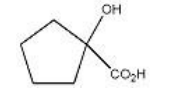

Give the structure of the acyclic compound from which the following imine was formed.


Provide the major organic product of the following reaction


Draw a mechanism for the following reaction

Provide the major organic product of the reaction of aniline with 3-pentanone.
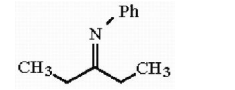

Provide the major organic product of the reaction shown below

Provide a detailed, stepwise mechanism for the acid-catalyzed condensation reaction between benzaldehyde and methylamine.

Conversion of aldehydes and ketones to imines is an acid-catalyzed process. Explain why this conversion is actually hindered by the presence of too much acid
At very low pH, much more of the amine is protonated and can no longer function as a nucleophile.
When H2NCH2CH2CH2CH2COCH3 is heated in the process of an acid catalyst, a reaction occurs. The product has the formula C6H11N. Provide the structure of this product.

Provide the structure of the compound which reacts with a ketone to form its hydrazone derivative.
H2NNH2
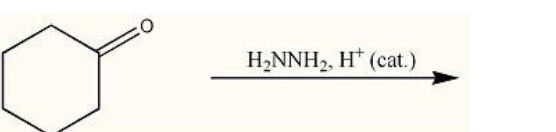
Provide the major organic product of the following reaction.
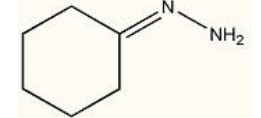

Provide the major organic product of the reaction shown below.

Provide the structure of cyclohexanone oxime.
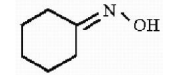
Provide the structure of the major organic product which results when benzaldehyde reacts with hydroxylamine in the presence of acid.
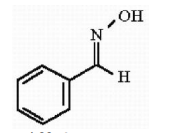

Provide the major organic product of the reaction shown below
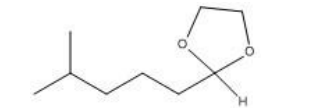
Provide the structure of the semicarbazone derivative of 3-pentanone.

Provide a detailed, stepwise mechanism for the acid-catalyzed condensation reaction between cyclohexanone and H2NOH.
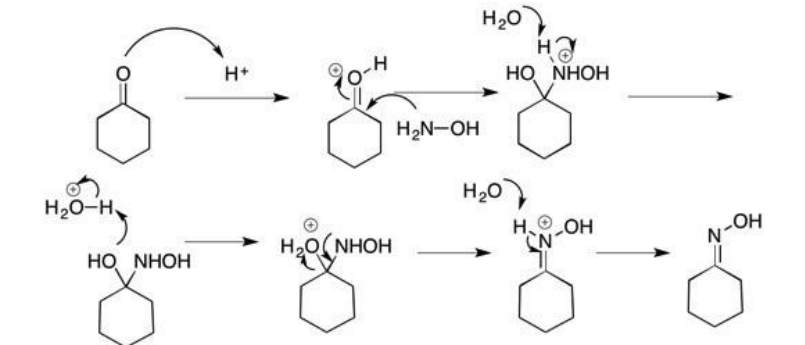

Provide the major organic product of the reaction shown below.

Provide the structure of the diethyl acetal of butanal.
CH3CH2CH2CH(OCH2CH3)2

Provide the major organic product of the reaction shown below.

When HOCH2CH2CH2CH2COCH2CH2CH2CH2OH is heated in the presence of an acid catalyst, a reaction occurs. This product has the formula C9H16O2. Provide the structure of this product.


Propose a sequence of steps to carry out the following conversion.
1) HOCH2CH2OH, H+ 2) CH3CH2CH2MgBr 3) H3O+
Provide a detailed, stepwise mechanism for the acid-catalyzed reaction of 2-butanone with ethylene glycol (HOCH2CH2OH) to produce an acetal

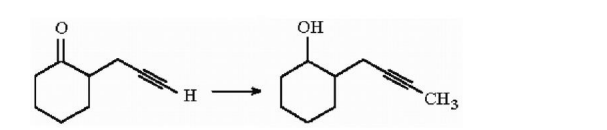
Propose a sequence of steps to carry out the following conversion.
1) HOCH2CH2OH, H+ 2) NaNH2 3) CH3I 4) H3O+ 5) NaBH4 or LiAlH4

Which would be more appropriate as the reduction in the following sequence, a Clemmensen or a Wolff-Kishner? Explain.
Wolff-Kishner. The acidic conditions of the Clemmensen would remove the protecting group causing reduction of the aldehyde as well.

Provide the major organic product of the following reaction.


Provide the major organic product of the reaction shown below.


Predict the major organic product of the following reaction:


Predict the major organic product of the following reaction:
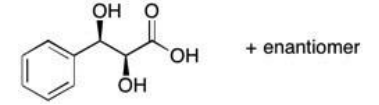

Provide the major organic product in the reaction shown below

How could you convert cyclohexane to 1-methylcyclohexanol?
1) Br2, light 2) NaOH, heat 3) PCC or other oxidant 4) CH3MgBr 5) H3O+
Show the acetonide that is formed when 1,2,4,5-tetrahydroxybenzene reacts with 2 equivalents of acetone under acidic conditions.
