M1 L2 - ADME
 Call Kai
 Learn
Learn Practice Test
 Spaced Repetition
 Match
Match Flashcards
 Knowt Play
1/62

There's no tags or description
Looks like no tags are added yet.
Name | Mastery | Learn | Test | Matching | Spaced | Call with Kai | Chat |
|---|
No analytics yet
Send a link to your students to track their progress
63 Terms
Absorption
movement of a drug from the site of administration to the blood
Distribution
movement of a drug from blood to tissues
Metabolism (biotransformation)
conversion of a drug into a different chemical compound
Excretion
removal of a drug and its metabolites from the body
Parenteral
Medication not by oral route
Common routes of administration
oral
injection
sublingual
buccal
inhalation
rectal/vaginal suppositories
topical (ear/eye drops, nasal, creams/ ointments)
Bioavailability
The percentage of an administered drug that reaches the systemic circulation
Factors affecting bioavailability
drug-related factors:
route of administration:
IV – 100%
other routes – variable but less than 100%
physical properties of the drug (tabs, caps, acidic, alkaline)
food (ex: vit d need fat)
first pass metabolism
other drugs taken concurrently
patient-related factors:
GI factors: e.g., intestinal motility, pH
individual variation: e.g., age, sex, race
pathological conditions: e.g., liver or renal disease
Before absorption
a drug must be released from its vehicles (excipients)
Vehicles (excipients)
Dictates rate of absorption
Where is the main site of absorption
GI
Factors affecting drug absorption
– lipid Solubility
– pH
– transit time
– enzymatic & chemical stability
– food
– dosage form
Which route of administration skips absroption step?
IV route
Lipid soluble drugs ___ cross cell membranes
CAN
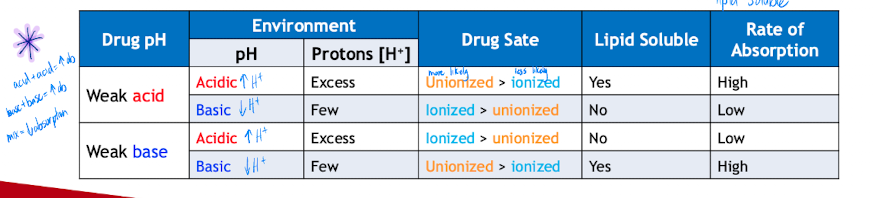
ionized (charges)- a polar environment
harder absorption
Water soluble drugs ___ cross cell membranes
CANNOT
unionized (uncharged)- nonpolar environment
easy absorption
Most drugs are what?
weak acids or bases
Degree of ionization depends on
pH of the environment (e.g. blood (neutral), stomach (acidic), intestine (alkaline), …)
pKa of the drug (pH where a drug is 50% ionized and 50% unionized)
Acetylsalicylic acid (Aspirin) is an ex of a weak _____
acid
release H+ from acid → ionized

Norepinephrine is an ex of a weak _____
base
release H+ from base → unionized

Weak Acids & Bases Chart
Drug absorption Along the GI- Stomach
– first station the drug reaches where it disintegrates and dissolves
– some proportion of drugs are absorbed depending on the pKa
– better absorption for acidic drugs
Drug absorption Along the GI- Small intestine
– high permeability, large surface area, and high blood flow
– primary site for drug absorption
– better absorption for basic drugs
Drug absorption Along the GI- Large intestine
– low permeability and relatively small surface area
– poor site for drug absorption
– some drugs are absorbed because of the long transit period (24-48 hours)
– increased duration in this site = increased possible absorption
Distribution
Different drugs have variable rates & extent of distribution
• Along concentration gradient between blood & tissue (hight o low concentration)
• Distribution determines drug’s:
– onset of action
– intensity of action
– duration of action
Factors Affecting Drug Distribution
Physiological factors:
blood concentration of the drug
cardiac output
organ vascularity & blood flow
capillary permeability
tissue perfusion
Drug properties:
degree of ionization
lipid solubility
binding to plasma proteins & tissue
pH
Volume of Distribution (Vd)
The measure of the apparent space in the body available to contain the drug
Vd = total amount of drug in the body(dose)/ drug concentration in the plasma
L in 70 kg (or L/kg)
Drug reservoirs:
plasma proteins
intracellular space
fat
bones
muscles
Body water content
Intracellular fluids 64%
Interstitial fluid 25%
Plasma 8%
Minor components 3%

Drug Distribution & Elimination
A. No elimination – the graph shows only a steep rise to a maximum followed by a plateau
B. A route of elimination is present – the graph shows a slow decay after a sharp rise to a maximum
C. Drug placed in the 1st compartment (blood) equilibrates rapidly with the 2nd compartment (extravascular volume) but no elimination – the amount of drug in “blood” declines exponentially to a new steady state
D. A more realistic combination of elimination mechanism and extravascular equilibration – the graph shows an early distribution phase followed by a slower elimination phase
In both (B) and (D) the volume of fluid remains constant because of a fluid input at the same rate as elimination

Results of metabolism
– bioactivation
– deactivation
– detoxification
Purpose of metabolism
– increased drug’s water-solubility →
– help elimination from the body
Sites of Drug Biotransformation
LIVER (primary site (main organ, not only organ):
high concentration of metabolizing enzymes
high blood flow
receives blood from GI tract
Other sites:
e.g., kidneys, intestine, lungs, skin
How many phases of drug metabolism is there
2
Phase 1 of drug metabolism
reactions add or unmask a functional group (hydrolysis (+h20), oxidation (+O), reduction (+H)) in order to change the due to be able to pass on to phase 2
Phase 2 of drug metabolism
reactions add a large water-soluble component to allow excretion by the kidney (now water soluble)
glutathione conjugation
suphation
acetylation
glucoronidation
Oxidation reactions
add O2/ lose an electron
via cytochrome P450 (CYPs) enzymes:
CYP3A4 metabolizes about 50% of used drugs
non-cytochrome P450: e.g.,
alcohol ⏤ alcohol dehydrogenase → aldehyde
norepinephrine ⏤ monoamine oxidase → inactivation
Cytochrome P450 is made by what?
The liver
Hydrolysis
add H2O
eg. carboxyl esterases
Reduction
add H/ gain an electron
e.g., nitro group (-NO2) ⏤ nitroreductase → amino group (-NH2)
Conjugation reactions
adding a water-soluble moiety to phase 1 product → water-soluble → easy to excrete
Glucuronidation
via UDP-glucuronosyltransferase (UGT)
added molecule: Glucoronates
Sulfation
via: Sulfotransferase (SULT)
added molecule: Sulfates
Glutathione conjugation
via: Glutathione transferase (GST)
added molecule: Glutathiones
Acetylation
via: N-Acetyl transferase (NAT)
added molecule: Acetates
First Pass Metabolism
Inactivation of orally administered drugs before reaching the systemic circulation
When and where does First Pass Metabolism occur?
before absorption – in the intestine
after absorption – in the liver
What are the results of first pass metabolism?
↓ amount of active drug reaching the blood & site of action
How do you avoid first pass metabolism?
change route of administration e.g., IV – skin – mucosa –
Factors Affecting Biotransformation
Intra-individual differences:
diseases: especially liver disease
drug-drug interactions (DDI)
diet
gut microbiota
Inter-individual differences:
age
sex
genetic factors (fast vs slow metabolizers)
Routes of excretion
KIDNEY (primary route)
GI tract
lungs
body fluids:
sweat, saliva, milk
Renal Excretion
Glomerular function:
filtration:
filtrate = plasma ⎼ plasma proteins
Tubular function:
reabsorption:
water & useful materials → back to blood
secretion:
waste products → urine

What is excretion?
Filtrate - reabsorption + secretion
Drugs & Renal Excretion
Drugs must be water soluble (ionized) to be excreted through the kidney
Lipid soluble drugs can be reabsorbed back into the blood
Some active transporters in the renal tubule move drugs from blood → urine → excreted (e.g., penicillin)
RBF
renal blood flow (what enters the kidneys)
+/⎼ 1200 ml (20-25% of CO)
GFR
Glomeral filtrate rate
GFR = 125 ml/min
↓ GFR → ↓ drug excretion (e.g., renal failure)
CO
cardiac output (heart rate x stroke volume)
Effect of urine pH on drug excretion
acidic urine → ↑ excretion of basic drugs (e.g., opioids)
basic urine → ↑ excretion of acidic drugs (e.g., aspirin)
Penicillin & Active Secretion
+/⎼ 80% of penicillin dose is cleared from the body within 3–4 hours after administration →
↓ concentration & effect
How an we solve Penicillin & Active Secretion
combine penicillin with probenecid
it competitively blocks penicillin excretion
Methods of excretion though GI tract
lack of absorption through the intestine:
drugs with low bioavailability
protein-bound drugs in the intestine
excretion via bile:
drug or its metabolite →
excreted by hepatocytes into bile →
eliminated through GI in the feces
Enterohepatic cycle
the biological pathway where substances travel from the liver into the bile, pass into the intestines, and get reabsorbed back into the bloodstream to return to the liver
Other routes of excretion
Lungs: e.g., gases, alcohol
Sweat; e.g., opioids, amphetamines
Saliva: e.g., caffeine, theophylline
Milk: e.g., caffeine, nicotine, anticonvulsants (caution while breastfeeding)