crim 356 midterm
 Call Kai
 Learn
Learn Practice Test
 Spaced Repetition
 Match
Match Flashcards
 Knowt Play
1/93

There's no tags or description
Looks like no tags are added yet.
Name | Mastery | Learn | Test | Matching | Spaced | Call with Kai | Chat |
|---|
No analytics yet
Send a link to your students to track their progress
94 Terms
Death is described in three ways
Manner of death
Medical cause of death
mode/mechanism/instrument of death
Investigative jurisdiction
In BC, we have a coroner system (governed by the BC Coroner’s Act)
Manner of death = five categories:
Homicide
Suicide
Accidental
Natural
Undetermined
Medical causes of death = specific disease or injury as specified by…
ICD-11 (International Classification of Diseases 11th revision)
Exsanguination
loss of blood
Asphyxiation
loss of air
cardiac arrest
heart attack
What is forensic anthropology?
Subfield of physical (or biological) anthropology
Aids in death investigations by helping determine the manner, medical cause, and instrument of death
What is forensic science?
The application of science to matters of law
Forensic comes from the Latin word forensis: public, to the forum or public discussion; argumentative, rhetorical, belonging to debate or discussion. A relevant, modern definition of forensic is: relating to, used in, or suitable to a court of law.
Membership in the forensic anthropology sections
The role of the anthropologist is to apply methods and theories from the discipline of anthropology to aid death investigations in various contexts (e.g., medicolegal, human rights violations, forensic recoveries)
What are skeletons?
Hard internal or external framework of bones, cartilage, or other rigid material
Mineral storage: 99% calcium and 85% phosphorus
Attachment site for muscles and ligaments to effect movement
Vertebrate skeleton
the internal bony or cartilaginous framework found in humans and other backboned animals that enables movement and shields vital organs
invertebrate skeleton
The outer shell or hard structure (exoskeleton) found in insects and crustaceans is made of materials like chitin
Four types of variation in human skeletal anatomy
Ontogeny (growth)
Sexual dimorphism (biological sex)
Geographic or population-based
Idiosyncratic (individual)
Ontogeny (growth)
Size and shape from fetus to adult
Sexual dimorphism (biological sex)
Size and shape differences between males and females
Geographic or population-based
geographic affinity
Idiosyncratic (individual)
Normal variation between different individuals of the same age, sex and population
Bone is a composite tissue
35% organic component: type 1 collagen
65% inorganic component (minerals) : Hydroxyapatite
Fossilization (Process):
Organism
Dies and is covered⬇
Rapid burial
Over time, pressure⬇
Fossil
Gross anatomy
Immature bones are the first to form prenatally, replaced by mature bone as growth continues.
At the gross level, the adult skeleton has two basic structural components
cortical
trabecular or cancellous tissue
cortical
(the outer, denser envelope which plays a major structural support function) “compact bone”
(80% of the body)
trabecular or cancellous tissue
(the metabolically more active form which is structurally like a fine sponge with numerous small voids) “spongy bone”
(20% of the body)
Fetal growth
Ossification
Fontanel
ossification
the natural biological process of bone formation where specialized cells called osteoblasts replace soft tissues, like cartilage, with hard bone
Fontanel
commonly known as a "soft spot," is a membrane-covered gap between the bones of an infant's skull
Bone remodelling
old bone is removed by osteoclasts and replaced by osteoblasts
Bone remodelling cycle
Basic multicellular unit (BMU) = temporary team of bone cells that work together to remodel and repair tissue
Osteoclasts (bone-removing cells)
Osteoblasts (bone-forming cells)
Osteocytes (controller, listener, communicator)
bone cycle 2.0
Activation (Resting to Remodelling)
Resorption (Breaking Down Bone)
Reversal (Transition)
Formation (Building New Bone)
Retrievable information from skeletal record
Macroscopic analyses: age, sex, geographic affinity, injury, disease, genetic traits, taphonomy
Microscopic analysis (histology)
DNA and biomolecular analyses
Isotopic analysis
Radiographic analyses
Medical imaging: X-ray, MRI, computed tomography
what is taphonomy
the scientific study of what happens to the remains of plants and animals from the moment of death until their discovery as fossils or decayed material
Epiphyseal union
After birth, bone growth occurs in cartilaginous “plates”
Cartilage cells divide by mitosis for growth
Basic molecular units (BMUs) enter via the bloodstream
Minerals are deposited, and bone ossifies
Observations over time
Ossification
Markers of growth
Maturation
BMUs remodel bones
Antemortem
Injuries or events before death
Permimortem
Injuries or events at or near the time of death
Postmortem
Observe damage to the body after death
Fossilation
Mineralization 10k+ years
Antemortem
Injuries or events before death
Perimortem
Injuries or events at or near the time of death
Postmortem
damage to the body after death
Sex estimations
Pelvis = most reliable
Female pelvic bones tend to be:
Less robust
Pelvic inlets are wider
body differences in male and female
trait | Male | female |
Pelvic inlet | Heart shaped | oval/circular |
Subpubic angle | Narrow (<90 degrees) | Wide (>90 degrees) |
Greater sciatic notch | Narrow (maximal expression) | Wide (minimal expression) |
Ventral arc | Usually absent | Usually present |
subpubic angle in women vs men
male = Narrow (<90 degrees)
women = Wide (>90 degrees)

ventral arc
Females have a ‘ventral arc’ which is a flattened, roughly triangular-shaped
Aspect to the ventral (anterior) surface of the pubic symphysis
iliopubic ramus differences
In females, the iliopublic ramus (part of the bone connecting the ilium to the pubic bone) is long relative to the diameter of the acetabulum.
In males, the length of the ilipoubic ramus and the diameter of the acetabulum are roughly equivalent dimensions.
When you’re dealing with the skull, you deal with two types of bones
Facial
Cranial
Impacts on bone formation/remodelling
Old age - osteoporosis (too much bone taken away, not enough put back - thin, brittle bones)
Malnutrition
Disease - rickets (vitamin D deficiency) causes long bones to grow warped; scurvy (vitamin C deficiency) causes:
Injuries - will require bone remodelling to fix the break, rather than simply maintenance
Extreme use/sports - when you build more muscles around the bone, it actually causes more bone to form
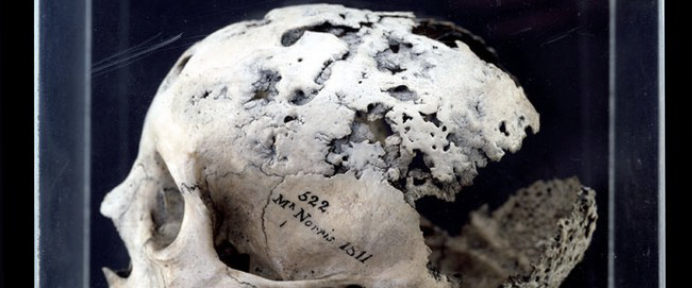
Syphilis
= STI caused by bacterium Treponema pallidum (TP)
Pitting or porous lesions on the skull
Irregular new bone formation
Destructive lesions that alter normal bone surface
Targets bones that are rich with blood supply
Osteoarthritis
Osteoarthritis is the most common form of arthritis, caused by the gradual breakdown of protective joint cartilage that cushions bone ends
Look for:
Lipping around joint margins
Polished joint surfaces
Bone spurs (osteophytes)
Enlargement of joint surfaces

Tuberculosis
a rare and serious infection where tuberculosis bacteria spread from the lungs through the bloodstream into the bones and joints

Pott’s disease (Spinal TB)
this is the most frequent form, affecting the vertebrae and adjacent discs
Causes spinal deformities - such as fa forward curvature (kyphosis/hunchback), sometimes paralysis
Tuberculosis arthritis:
infection in weight-bearing joints like the hips and knees destroys cartilage, narrows joint spaces, and reduces mobility, eventually causing permanent joint stiffness or fusion
TB tends to produce:
Irregular bone destruction
Rounded cavities
Little new bone formation compared with other infections
Unlike pyogenic bacterial infections, TB often leaves bone looking ‘moth-eaten’ rather than heavily thickened
Spina Bifida of the sacrum
Congenital defect in which the posterior (back) part of one or more sacral vertebrae fails to fuse completely during development

Spina Bifida typical signs
Missing spinous processes
A midline cleft in the posterior sacrum
Exposure of the sacral canal
Smooth bone margins, indicating a developmental anomaly rather than trauma
Brucellosis of the vertebrae
Also called brucellar spondylitis, it is an infection of the spine caused by Brucella bacteria, usually acquired from infected animals or unpasteurized dairy products

Anterior vertebral body erosion (Pedro Pons sign)
This is considered a classic feature
Destruction occurs at the anterosuperior corner of a vertebral body
Creates a localized erosive defect
Often accompanied by surrounding sclerosis (dense bone formation)
Polio (poliomyelitis) (legs)
Is a highly infectious,vaccine-preventable viral disease caused by the poliovirus that attacks the nervous system and can cause permanent paralysis or death?
Polio does not directly infect bone tissue, but the nerve and muscle damage it causes leads to significant, long-term structural changes in the skeleton.
Preventable, but no cure
Aquatic death
may be any manner of death - not just accidental
Drowning process
Water enters lungs
Damaged lining
Alveolar collapse
Red blood cells and proteins enter alveoli (pulmonary edema)
Expanded drowning process
Voluntary breath-holding (apnea) as the victim struggles to maintain position above or near the surface of the water
Breaking point, gasping, involuntary inhalation of water. Sometimes includes a spasm of the upper airway
Swallow large amounts of water. Sometimes, vomiting with aspiration of gastric contents into the lungs
Hypoxemia within minutes unless there's an intervention. Lose consciousness. Develop brain/cerebral hypoxia and seizures
Involuntary loss of urine, feces, seminal fluid (sometimes with great pain)
Respiratory arrest, cardiac arrest, then death.
Non-drowning examples
Sequestered - to be stuck in something
Medical
Secondary locations - when people die somewhere else but are tossed into the ocean
Drowning is a diagnosis by exclusion
No singular test that tells you this is the cause of death
You need to test other causes of death to conclude drowning
Stages of decomposition
Terrestrial - on land
Aquatic - in water
Terrestrial stages (continuum is relatively predictable)
Involves the breakdown of proteins, carbohydrates, and fats (scavenging, insect colonization, autocatalysis & putrefaction)
Fresh
Bloated
Active decay
Advanced decay
Dry remains/sketal
Aquatic stages - Continuum is highly dependent on the depositional environment
Fresh
Bloated if conditions are met
Active decay if conditions are met
Advanced decay if conditions are met
Dry remains/skeleton if conditions are met
Below 62 m (200 ft), likely won't bloat. Why?
Tidal action prevents insect colonization
Clothing may inhibit bloating
Cold temperatures inhibit bacterial growth
High pressure prevents expansion of bacteria-produced gases
scavengers/trauma cause torso damage
Decompositional gases are easily compressed and water-soluble
Barotrauma
pressure-induced trauma
conjunctiva
The conjunctiva is a clear mucous membrane covering the white of the eye (sclera) and lining the eyelids

sclera
he tough, white, fibrous outer layer of the eyeball itself
Petechial hemorrhages
small, round, red or red-brown spots on your sclerae and conjunctivae
Caused by increased pressure within the venous system (esp. Veins in the head and neck)
Indicative of increased pressure (associated with asphyxia deaths)
Other ocular changes
Tache noir
Means this could be a secondary location
Lazy eyelid
Corneal opacity/clouding
Rigor mortis
Degrees of rigour - scale of 1 - 10
ATP depletion leads to muscles stiffening
(peaks approx. 12 h after death, lasts 24 hrs or so)
Descriptors of rigour mortis
Not detectable (absent)
Not yet fully established (partial)
Fully established (full, complete)
Leaving the body (passing)
Factors that speed rigour
Excessive environmental heat,
hypothermia,
disease or infection,
physical activity perimortem,
seizures,
poisioning
Livor mortis
red, blue or purple marbling (discolouration) due to gravitational pooling of blood
Blanching = focal absence of lividity due to compression against an object or surface
Can be bright pink, or cherry red in deaths involving carbon monoxide, cyanide, hypothermia, or certain types of poisioning
Note impacts of water pressure, blood loss, bruising, and water movement (currents, postmortem movement)
Happens (approx. 12 h after death)
Algor mortis
cooling of the body to the surrounding (ambient) temp of the depositional environment
In aquatic deaths, take the temperature from the core (into the liver or rectum) by C/ME.
happens (approx. 1 degree F/hr over first 12 hours)
Factors impacting your estimation:
Extreme temperature
Cold water immersion
Clothing
Body habitus
Weather
Temperature
Drug use
Medications
Medical conditions
Saponification
formation of adipocere (grave wave) in wet, anaerobic environments
Osteometric assessments
taking precise measurements of bones to study their size, shape, and proportions.
Done in the lab
Morphological assessments
systematically examining what someone's body or physical features look like.
done in the field
Differences between assessments
Morphological assessments - subjective to the person who's doing them (observational)
Osteometric assessments - more expensive; need fancier equipment; bones used for this are really old - missing elements/fragmented, so you can’t take measurements as well because you don’t have the whole bone.
Early postmortem changes and soft tissue decay
Decompositional pathway
Autolysis (enzymatic self-digestion) and putrefaction (bacterial breakdown causing marbling and bloat)
Mortis triad
Preservation states and differential decay
Mummification
Saponification
Bog bodies
Differential decomposition
mummification
desiccation in arid/dry environments
saponification
formation of adipocere (grave wave) in wet, anaerobic environments
bog bodies
acidic, anaerobic peat preservation
differenetial decomposition
= irregular decay indicating infection, checmical/heat exposure, and/or trauma
Bone diagenesis & enviro. Modification
Diagenesis
Skeletal weathering
Environmental artifacts
diagenesis
chemical and physical post-depositional alterations to bone
Skeletal weathering
6-stage progression based on the Behrensmeyer scale (0-5), driven by solar radiation and thermal/moisture cycles
Environmental artifacts
root etching, metallic discoloration (e.g., copper = green, iron = rust orange), soil staining
Scavenging against and bone trauma
Entomology = knowledge of blow fly oviposition/instects helps to establish PMI; dermestid beetles arrive during dry decay
Carnivores = chew bones and cause: punctures, pits, scoring and furrows (predictable destruction sequence)
Rodents = paired parallel striae from gnawing with incisors
Vultures = cause rapid skeletonization (approx. 3- 24 h) with minimal bone markings left behind
Disarticulation and transport
Terrestrial = animal scavenging and connective tissue breakdown can result in movement either through gravity or intentionally through scavenging
Fluvial (aquatic) transport = sink/float cycles driven by putrefactive gas buildup
Disarticulation sequence = hands, mandible from skull, limbs, pelvis
Estimating postmortem interval (PMI)⬇
Primary method is to use internal temperature rates (>80% rate variation)
⬇
Accumulated degree days (ADD) = thermal heat accumulation above 0 degrees C threshold
⬇
Total body score (TBS) = quantitative anatomical scoring system, applied to regression models
⬇
Multidisciplinary tools: forensic entomology, marine biology (barnacles/algae), botany (root growth)
What are specific taphonomic and forensic factors?
Location of body
Clothing
weather/climate
What scavengers are present in said environment