Computational Solid Modeling
 Call Kai
 Learn
 Practice Test
 Spaced Repetition
 Match
 Flashcards
 Knowt Play
1/10

Earn XP
Description and Tags
Definitions
11 Terms
Why can Plane Stress and Plane Strain be assumed?
Plane stress can be assumed because the aluminium body is very thin (3 mm) compared with its in-plane dimensions (400 mm × 300 mm). Therefore, the out-of-plane stresses can be considered negligible,
However, remember that plane stress does not mean zero out-of-plane strain
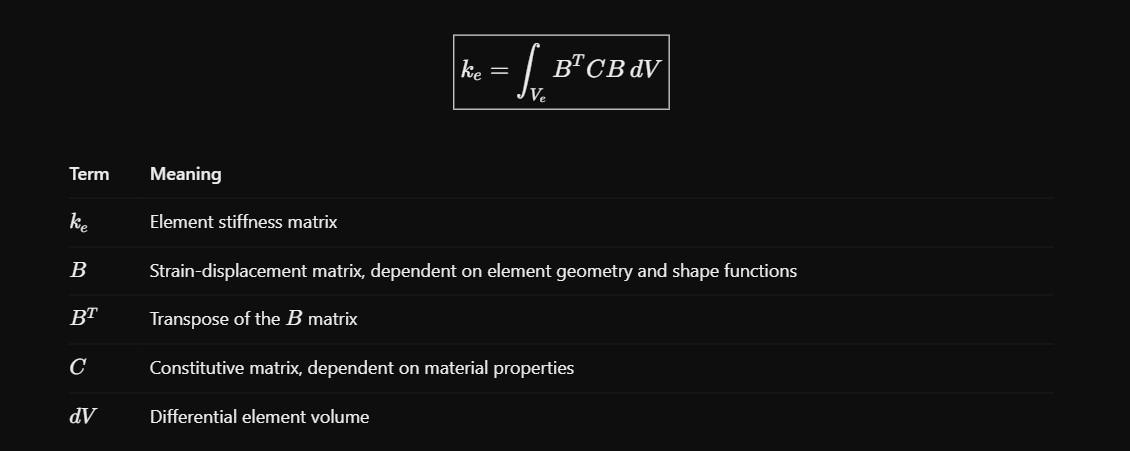
Explain The Element Stiffness Matrix
The element stiffness matrix represents an element's resistance to deformation and relates the forces acting at its nodes to their displacements.
Its values depend on the material properties (Young's modulus and Poisson's ratio), element geometry and dimensions (length, area and thickness), and element type and shape functions
What is reduced integration and its advantages
uses fewer gauss points than full integration when calculating an elements stiffness matrix
reduces computational time and cost
can reduce numerical locking and overly still element behaviour
How do you determine size of global stiffness matrix
Total degrees of freedom = Nodes x Degrees of freedom
Plane Stress vs Plane Strain
Plane Stress
thin Structure
stress in z drn = 0
strain in the z may have a value
Plane Strain
long thick constrained
strain in z = 0
stress z may be non 0
eg long dam
What are shape functions
interpolate the displacement field within an element using its nodal displacements.
Shape functions interpolate the displacement field within a finite element from its nodal values. They satisfy the Kronecker delta property, where each shape function equals one at its own node and zero at other nodes, and the partition of unity property, where all shape functions sum to one.

Linear vs Quadratic Finite Elements
Linear Elements
First order interpolation
Nodes primarily at corners
straight sided edges
lower comp cost
les accurate for curved displacement
Quadratic Elements
Second order interpolation
additional mid side nodes
can represent curved edges
higher comp cost
better interpolation accuracy
Advantages and Disadvantages of triangular shapes
Advantages
simple math formula
eaasier to mesh
smaller individual matrices
good for complex shapes
Disadvantages
constant strain
less accurate
requires finer mesh
increase comp time
Direct Strain vs Shear Strain
Direct Strain - measures relative change in length in a material in a specific direction
Shear Strain - measures change in angle between two originally perpendicular material directions
Strain displacement matrix B and material matrix C
B - relates nodal displacements to strains within an element, depends on shape functions and geometrys
C - Relates strains to stresses using material properties , depends on youngs modulus and poissons ratio
Why are truss members assumed to resist only axial loads?
Ideal frictionless pin connections transmit axial tensile and compressive forces, but not bending moments.