Lecture 13 (Fatty acid Metabolism)
 Call Kai
 Learn
 Practice Test
 Spaced Repetition
 Match
 Flashcards
 Knowt Play
1/31

There's no tags or description
Looks like no tags are added yet.
32 Terms
Proton pumping and ATP yield
10 NADH + 2 FADH2
1 NADH → 10 H+ 2.5 ATP (Into intermembrane space)
1 FADH2 → 6 H+ 1.5 ATP (into intermembrane space)
Total = 16 H+ 4 ATP (across intermembrane space)
Total NADH, FADH2 and ATP produced
NADH: 10
FADH2: 2
ATP made by ETC: 28 ATP
total ATP: 32 ATP
Fatty Acid Metabolism
Triacylglycerol (TAG) are a major dietary energy source and long-term energy storage.
Fatty acid oxidation supplies most of the energy required by heart and support liver metabolism.
Fatty acid oxidation produce Acetyl CoA, NADH, FADH2, links fat metabolism to TCA and Oxidative phosphorylation.
Fats better for Long term energy storage
Fatty acids are highly reduced: more energy than carbohydrates
Fats are stored without associated water: stored in anhydrous lipid droplets
Energy density: 9 kcal/g (fats) vs 4 kcal/g (carbs)
Glycogen: short-term energy reserve
Triacylglycerols: long-term energy reserve, hydrophobic
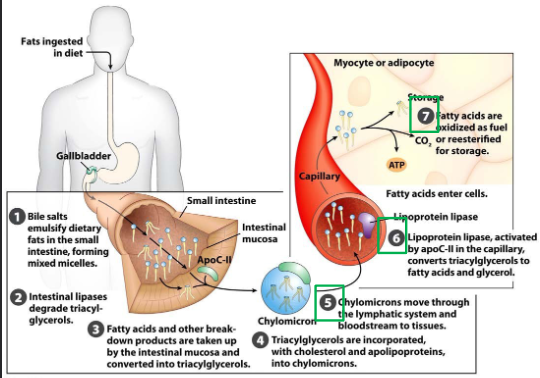
Digestion and absorption of Dietary Fats in the small intestine
Emulsification: Bile salt, disperse large fat droplets into small fat droplets, increase surface area for digestion.
Enzymatic digestion: Pancreatic lipase, assisted by colipase, hydrolyzes TAGs, produce free fatty acid and 2-monoacylglycerols
intestinal absorption: Bile salt helps make fatty acid and monoacylglycerols. Deliver lipids to the intestinal epithelial cells (enterocytes)
Re-esterification: fatty acid and monoacylglycerols are reassembled to TAGs in the ER
Chylomicron formation: newly synthesized TAGs packaged with cholesterol, phospholipids, & apolipoproteins into chylomicrons

Transport of Dietary Fats to Tissues
Chylomicron secretion: chylomicrons released from enterocytes by exocytosis and enter intestinal lymphatic vessels
Lipoprotein lipase (LPL): activated by apolipoprotein C-II (apoC-II) on chylomicrons. Hydrolysis of chylomicrons; releasing free fatty acids
Fatty acid utilization: fatty acids go through β-oxidation to support ATP production
What are Lipoproteins and apolipoproteins
Lipoproteins are transport particles
Apolipoproteins are the ones that determine how those particles interact with enzymes and cells
What happens to Chylomicron remnants
taken by liver through receptor-mediated endocytosis
Structure and Functions of Lipoproteins
ApoC-II (apolipoprotein C-II): activates LPL
ApoB-100: binds LDL receptors, liver being a major site for LDL clearance.
ApoE: mediates uptake of chylomicron remnants by liver.
ApoB-48: Chylomicron assembly and secretion by enterocytes.
Lipoprotein and their function
Chylomicrons: Transports dietary TAGs from the intestine
VLDL: Transport liver-produced TAGs to tissues
LDL: Deliver cholesterol to cells cleared by liver
HDL: Participate in reverse cholesterol transport
Lipoprotein size and density
Size: Chylomicrons > VLDL > LDL > HDL
Density: HDL > LDL > VLDL > Chylomicrons
Mobilization of Stored Fats: Lipolysis in Adipose Tissue
During fasting or high energy demand, Lipolysis breaks down TGAs in adipocytes into 3 fatty acids and glycerol.
Lipolysis involve 3 sequential enzyme:
ATGL: TAG → DAG + fatty acid
HSL: DAG → MAG + fatty acid
MGL: MAG → glycerol + fatty acid
And That’s GoaL. He Shoot Left. Me GoaL. (numonic)
Released fatty acids undergo beta-oxidation
Glycerol is transported to liver to do gluconeogenesis

Catecholamine activates what
Catecholamine activates beta adrenergic receptors
What does Insulin do to lipolysis
Insulin inhibits Lipolysis
ATGL and HSL promote Lipid breakdown in the Liver
Question: can increase lipase activity reduce excess triglyceride accumulation in liver?
Experiment: done on obese mice that received adenoviruses expressing ATGL and HSL
Key finding: Hepatic triglyceride level dropped
Mechanism: increased lipase expression promoted fatty acid oxidation
yes, the lipase expression promotes fatty acid oxidation, breaking down the triglycerides.
Glycerol Metabolism: What happens to glycerol after TAG breakdown?
Glycerol released during lipolysis is transported mainly to liver and kidney
Glycerol kinase: Glycerol → glycerol-3-phosphate, consuming ATP
DHAP can enter glycolysis or gluconeogenesis
Glycerol contributes small fraction of the total energy from TAGs.
Fatty acid activation by conversion to fatty acyl-CoA
Fatty acid needs to be turned to acyl CoA before beta oxidation
Acyl CoA synthetase catalyzes fatty acid using ATP and CoA-SH
2 ATP is consumed. ATP is converted to AMP + PPi (pyrophosphate)
Long-chain fatty acyl groups are transferred to carnitine for transport.
Chemistry of fatty acid activation
carboxylate ion is adenylated by ATP; forming acyl-adenylate and PPi, PPi immediately hydrolyzes to 2 molecules of Pi
Thiol group of coenzyme A attack acyl-adenylate
Why is ΔG° of all 3 step in converting fatty acid to acyl CoA negative?
fatty acid activation is coupled with ATP consumption and pyrophosphate hydrolysis, making the overall process energetically favorable
Carnitine shuttle (not required for short/medium chain)
Long chain fatty acyl-CoAs (14 or more carbons; majority) cannot cross inner mitochondrial membrane
CPT1: transfers fatty acyl group from CoA to carnitine; forms acylcarnitine
Carnitine-acylcarnitine translocase (CACT): Transports acylcarnitine across inner membrane
CPT2: Regenerates fatty acyl-CoA in the matrix; releases carnitine

β-Oxidation Pathway
β-Oxidation occurs primarily in mitochondrial matrix
each cycle has 4 reactions: oxidation, hydration, oxidation and thiolysis
each cycle generates 1 FADH2, 1 NADH, and 1 acetyl-CoA, while shortening the fatty acyl-CoA by 2 carbons.

β-Oxidation: Step 1--- FAD-Dependent Dehydrogenation
1st reaction: Fatty acyl-CoA goes through dehydrogenation; lose 2 hydrogen atoms from the alpha (C2) and beta (C3) carbons.
Trans double bond forms between C2 and C3. produces trans-Δ²-enoyl-CoA.
Enzymes: chain-length-specific acyl-CoA dehydrogenases
VLCAD: inner mitochondrial membrane-associated
MCAD and SCAD: soluble mitochondrial matrix enzymes
Electron transfer: enzyme bound FAD turns to FADH2 (accept 2 hydrogen)
Connection to ETC:
electrons from FADH2 → electron transfer flavoprotein (ETF) → ETF: ubiquinone oxidoreductase → CoQ, entering the ETC without passing through Complex I or II
β-Oxidation: Step 2--- Hydration of the Double Bond
2nd reaction: trans-Δ²-enoyl-CoA undergoes hydration, adding H2O across the double bond
mechanism:
H is added to α-carbon (C2)
OH is added to β-carbon (C3)
Enzyme: enoyl-CoA hydratases
Short and medium chain substrates: Soluble mitochondrial matrix enzyme
Long-chain substrates: Enoyl CoA hydratase
Stereospecificity: enzyme produces L-isomer of 3-hydroxyacyl CoA
Similarity to TCA cycle: going from fumarate to L-malate
Energy production: No NADH, FADH2, ATP produced.
β-Oxidation: Step 3---NAD -Dependent Dehydrogenation
3rd reaction: L-3-hydroxyacyl-CoA oxidizes to a ketone
mechanism: -OH group in C3 is converted to a carbonyl (C=O)
NAD+ turns to NADH
product is 3-ketoacyl-CoA
Enzyme: L-3-hydroxyacyl-CoA dehydrogenase
short and medium chain substrates: Soluble mitochondrial matrix enzyme
Long chain: Dehydrogenase mitochondrial trifunctional protein
Stereospecificity: enzyme specifically recognizes L-isomer of 3-hydroxyacyl-CoA
Similarity to TCA cycle: malate to oxaloacetate, malate dehydrogenase oxidizes alcohol group to carbonyl group
Energy production: 1 NADH
β-Oxidation: Step 4 ---Thiolysis (Release of Acetyl-CoA)
4th reaction: β-Ketoacyl-CoA goes through thiolytic cleavage break C-C bond
Enzyme: β-ketothiolase (3-ketoacyl-CoA thiolase)
Reaction mechanism: cysteine attacks β-ketoacyl-CoA, form covalent acyl-enzyme intermediate and releases Acetyl CoA
Products:
1 acetyl-CoA
1 fatty acyl-CoA shortened by 2 carbons, undergoes another thiolysis
Final cycle: when fatty acyl CoA contain 4 carbon, thiolysis generates 2 acetyl-CoA molecules
Energy production: does not directly generate NADH, FADH2 or ATP
Clinical relevance of lack of LCHAD (L-chain-3-hydroxylacyl-CoA dehydrogenase)
deficiency of LCHAD impairs fatty acid oxidation
Total ATP production from fatty acid oxidation
108 ATP from palmitoyl-CoA
Net 106 ATP from free palmitate after activation
Fatty acid Catabolism
Produces acetyl-CoA
produces NADH and FADH2
takes place in mitochondria.
Fatty acid Anabolism
requires Acetyl CoA and malonyl CoA
requires NADPH
takes place in cytosol for animals and plastids for plants
Malonyl-CoA (3C) supplies 2 C unit after decarboxylation
2 reduction consumes 2 NADPH per elongation cycle
principal product for mammalian fatty acid is palmitate
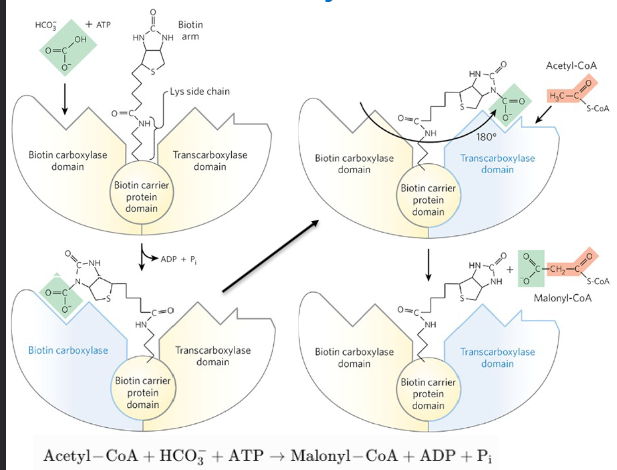
Malonyl-CoA formation is catalyzed by Acetyl-CoA carboxylase
Acetyl-CoA carboxylase catalyzes acetyl-CoA (2C) to malonyl-CoA (3C)
ACC requires Biotin (vitamin B7) as coenzyme
2 step mechanism:
Step 1: ATP-dependent carboxylation of biotin using bicarbonate
Step 2: transfer carboxyl group to acetyl-CoA, forming malonyl-CoA
Malonyl-CoA provides the 2 carbons for fatty acid chain elongation.
Added carboxyl group is released as CO2, helping drive C-C bond formation.
ACC catalyzes the committed, major regulatory step of fatty acid synthesis
Fatty acid synthesis is catalyzed by fatty acid synthase
FAS catalyzes stepwise elongation of fatty acid chain
Acetyl group starts the synthesis, malonyl addes 2 carbon through each elongation cycle
2 NADPH is provide reducing power
repeated until palmitate is formed.
FA synthesis is regulated by acetyl-CoA carboxylase
(The reaction catalyzed by ACC is the rate-limiting step)
Citrate activates ACC, promoting fatty acid synthesis
Palmitoyl-CoA inhibits ACC, providing feedback inhibition
AMPK phosphorylates and inhibits ACC when cellular energy is low
Insulin favors ACC activation and fatty acid synthesis.