Financial Accounting Exam 1
 Call Kai
 Learn
Learn Practice Test
 Spaced Repetition
 Match
Match Flashcards
 Knowt Play
1/57

There's no tags or description
Looks like no tags are added yet.
Name | Mastery | Learn | Test | Matching | Spaced | Call with Kai | Chat |
|---|
No analytics yet
Send a link to your students to track their progress
58 Terms
What is the purpose of accounting
To identify, record, report, and analyze economic transactions to provide useful information to interested parties so that they can make informed decisions.
Who uses financial accounting
Managers (e.g., CEO, CFO)
• Assess company’s performance
• Performance evaluation
• Compensation
Investors
Make investment decisions
Creditors (e.g., banks)
• Assess credit worthiness
Suppliers
• Determine credit terms
Government and regulators
• Enforce laws
• Identify fraud
What would happen if accounting information were unreliable
-The financial markets would cease to function efficiently and effectively
– Investors and creditors would cease to provide capital (invest) to companies
How do individuals raise capital (money) to start a company?
– Those who generate the idea can contribute money
– Investors outside the company can purchase ownership of the company
– Borrow money from banks or other individuals
How do company owners try to gain?
Sell ownership interest for
more than they paid
(appreciation or capital
gains).
Receive a portion of the
company’s earnings in
cash (dividends).
What companies must prepare financial statements and provide them to the SEC and the public?
Publicly traded companies
– Financial statements are typically prepared at the end of each quarter and year
Do private companies have to prepare financial statements?
No, unless required by shareholders or creditors
– Private companies usually prepare financial statements for their owners and for tax purposes
Income Statement
Period of time
Revenue-Expenses = Net Income
Statement of Stockholder’s Equity
Change in these accounts
Period of time
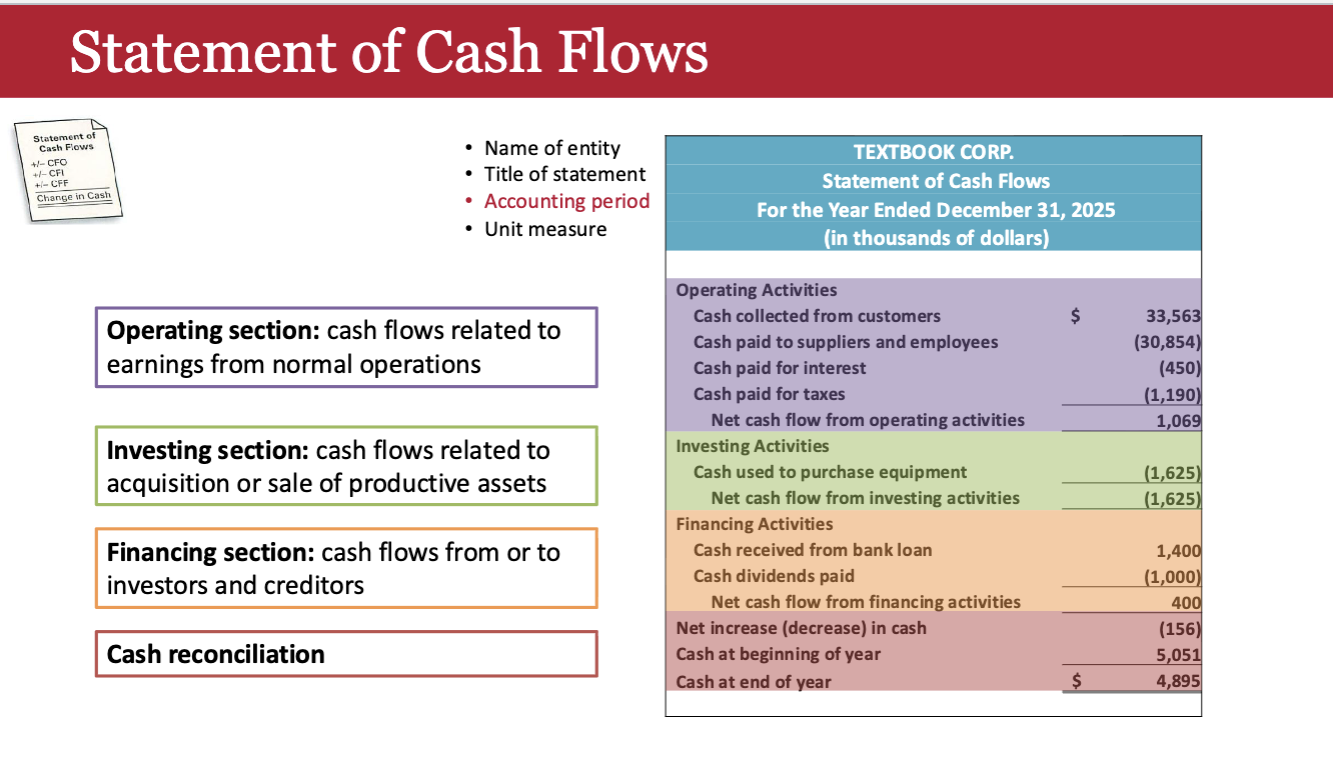
Statement of Cash flows
Changes in cash
Period of time
Balance sheet set up
Name
Title of statement
Specific date (as of)
Unit measure
Assets order
Cash
AR
Inventories
Plants and equipment
Land
Liabilities order
( listed by maturity date)
Accounts Payable
Notes Payable
SE order
Common Stock
Retained Earnings
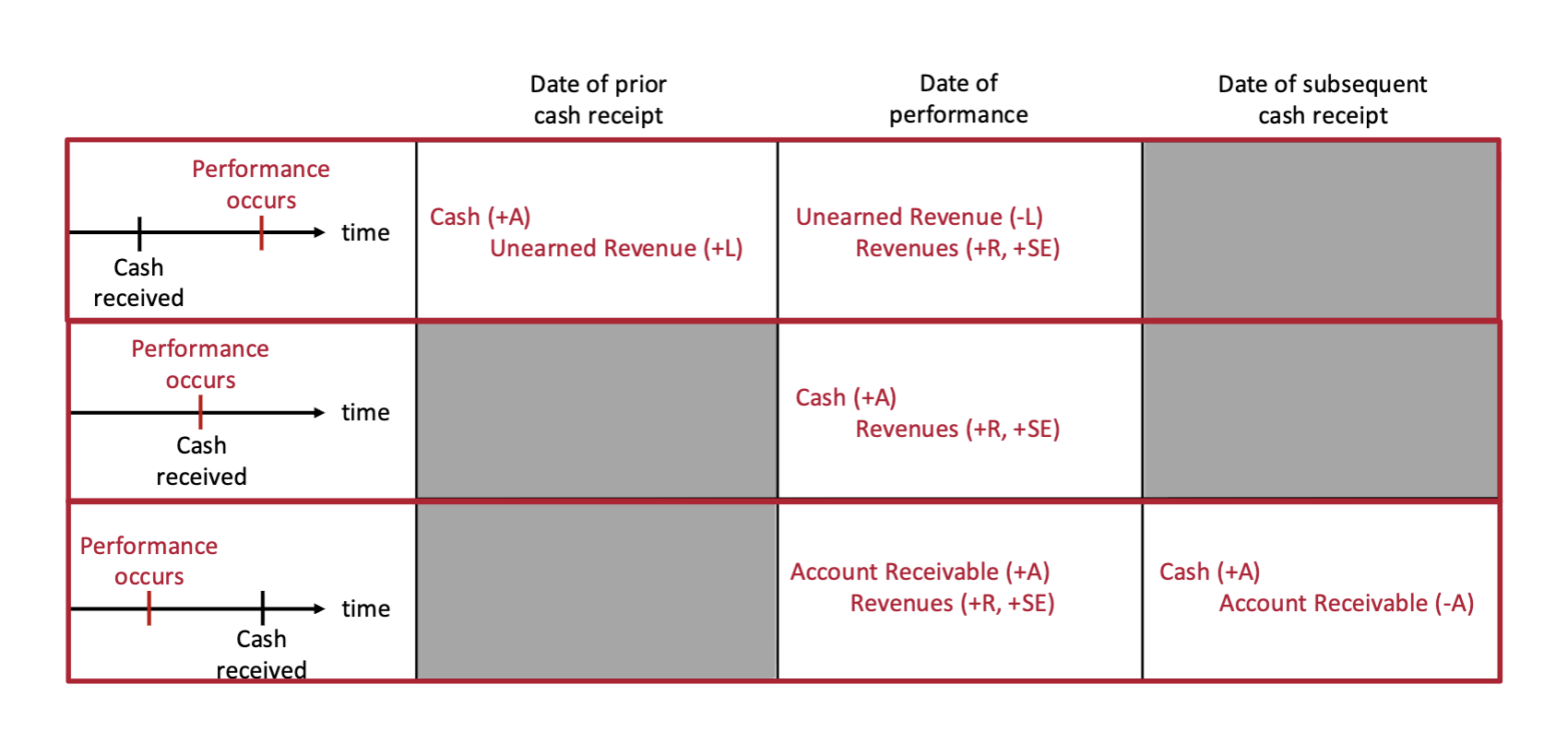
When are revenues recognized
Revenues are recognized when goods and services are delivered, not necessarily in the period when cash is received.
When are expenses recognized
Expenses are recognized in the same period as the revenues to which they relate, not necessarily in the period when cash is paid
Income Statement image

Statement of SE image

Why have both an Income Statement and a Statement of Cash
Flows?
Revenues do not always equal cash collected
– Reported expenses do not always equal cash paid
=> Net income does not usually equal the change in cash for the period
Statement of cash flows image
Three sources of capital for a company
- Equity (i.e., sell stock to investors)
– Debt (i.e., borrow from the bank)
– Profits or retained earnings
What are dividends and how do they affect retained earnings
Dividends are the distribution of a portion of a company’s earnings. They decrease retained earnings.
Separate entity
Business transactions are accounted for separately from the transactions of the owners
Monetary Unit
Financial results are reported in the national monetary unit (e.g., US dollar) without adjustments for inflation
Going Concern
Company is assumed to continue to operate in the foreseeable future
Common stock formula
# Shares issued * par value
Additional paid in capital formula
($ per share – par value) * # shares issued
Historical cost
Assets are recorded this way
cash paid plus
dollar value of all noncash
consideration given on the
date of the exchange
What is an account
An organized format used by companies to accumulate the dollar
effects of transactions on each financial statement
Current ratio formula
Current assets/Current liabilities
What are the two fundamental qualities for accounting information to be useful
Relevance
– Faithful representation (reliability)
What is a T-Account
– A tool to summarize the effect of transactions, determine balances,
and draw inference about a company’s activities.
– Every account has a T-account
What is the general journal
– A chronological record of all transactions affecting a company
– The individual transactions of the company are recorded with journal entries
An journal entry includes
– Date of the event
– Accounts involved
– Direction of the effect
– Dollar amount of the effect
– Brief description of the transaction
What is the general ledger
– A record of all past transactions
organized by account
– All journal entries are posted to
the T-accounts in the ledger
What is a trial balance
– A list of all accounts and their balances.
– Used to check equality of debits and
credits
Classified balance sheet is a formatted trial balance
– Header
– Classified assets and liabilities
– Comparative data (previous years)
Who are the main players in the accounting communication
process
– Regulators
– Managers
– Board of Directors
– Auditors
– Information Intermediaries (e.g., financial analysts)
– Users (e.g., investors, creditors, government, suppliers, managers, etc.)
What is the primary responsibility of the Securities and Exchange
Commission (SEC)
- Protect investors, maintain fair, orderly, and efficient markets, facilitate capital formation
- Bring enforcement actions where fraudulent financial reporting is suspected
What is the primary responsibility of the FASB
- Set Generally Accepted Accounting Principles (GAAP)
What is the primary responsibility of the Public Company
Accounting Oversight Board (PCAOB)
- Set audit standards for independent auditors (CPAs) of public companies
- Inspect public accounting firms’ audits
What is the manager’s role in the accounting communication process
– Produce and prepare the information in the financial statements and disclosures
What is the role of the board of directors in the accounting
communication process
– Ensure that processes are in place for maintaining the integrity of the
• company’s accounting
• financial statement preparation
• and financial reporting
– Oversee the company, including the top executives
Audit opinions
Unqualified opinion:
Financial statements fairly present the financial condition and performance of the company (i.e., the
financial statements conform to US GAAP and are reasonably free of material misstatements).
Qualified opinion:
Financial statements fairly present the financial condition and performance of the company except for:
• a limited number of items in the financial statements deviating from US GAAP and/or
• the audit was limited in scope for a limited number of items in the financial statements
Adverse opinion:
Financial statements as a whole are materially misstated and do not accurately reflect the financial
performance or condition of the company.
Disclaimer of opinion:
Auditors could not obtain sufficient evidence to form an opinion on the financial statements
What is the role of financial analysts and who are their clients
– Specialize in specific industries and companies
– Aggregate and produce information about the company that is useful to their clients
Who are their clients?
– E.g., private investors, creditors, institutional investors
Managements disclosure process
Earnings Announcement
• Press release with quarterly
and annual earnings and
other key financial metrics
Earnings/conference call
Opportunity for public to ask
senior management questions
about the company’s performance
• Additional insights into business
strategy and future expectations
Provide the annual or quarterly reports
Description of the business
• Management’s Discussion
and Analysis (MD&A)
• Four financial statements
and related notes
• Auditor opinion
SEC Reports
Form 10K
Annual financial statements
• Audited by independent auditor
• Generally due <90 days after fiscal year end
Form 10-Q
Quarterly financial statements
• Reviewed by independent auditor NOT audited
• Generally due <45 days after fiscal quarter end
Form 8K
Major events
• Generally due <4 days after event
Proxy Statement
Used to solicit votes from shareholders
• Details about executive compensation
Form 4
Change in ownership by insiders (officers,
>10% ownership)
• Generally due <2 days after transaction
Gross profit
= Net sales - Cogs
Income from operations
= Sales - cogs - operating expenses
Income before income tax
pretax earnings = Sales - all expenses except income tax
Net income
= Sales - all expenses
What are internal controls
Policies and procedures put in place to ensure the reliability of financial reporting and to safeguard assets
Operating cycle
Purchase goods/services - pay suppliers - sell goods/services to customers - collect cash from customers
Revenue recognition journal entries
Elements of the income statement
Operating revenues:
Increases in assets or settlements of
liabilities from the ongoing operations of
the company.
Operating expenses:
Decreases in assets or increases in
liabilities from ongoing operations
incurred to generate revenues.
Other items:
Revenues, expenses, gains, or losses that
result from activities that are not central
to the ongoing operations.
Accounting cycle

Adjusting journal entries
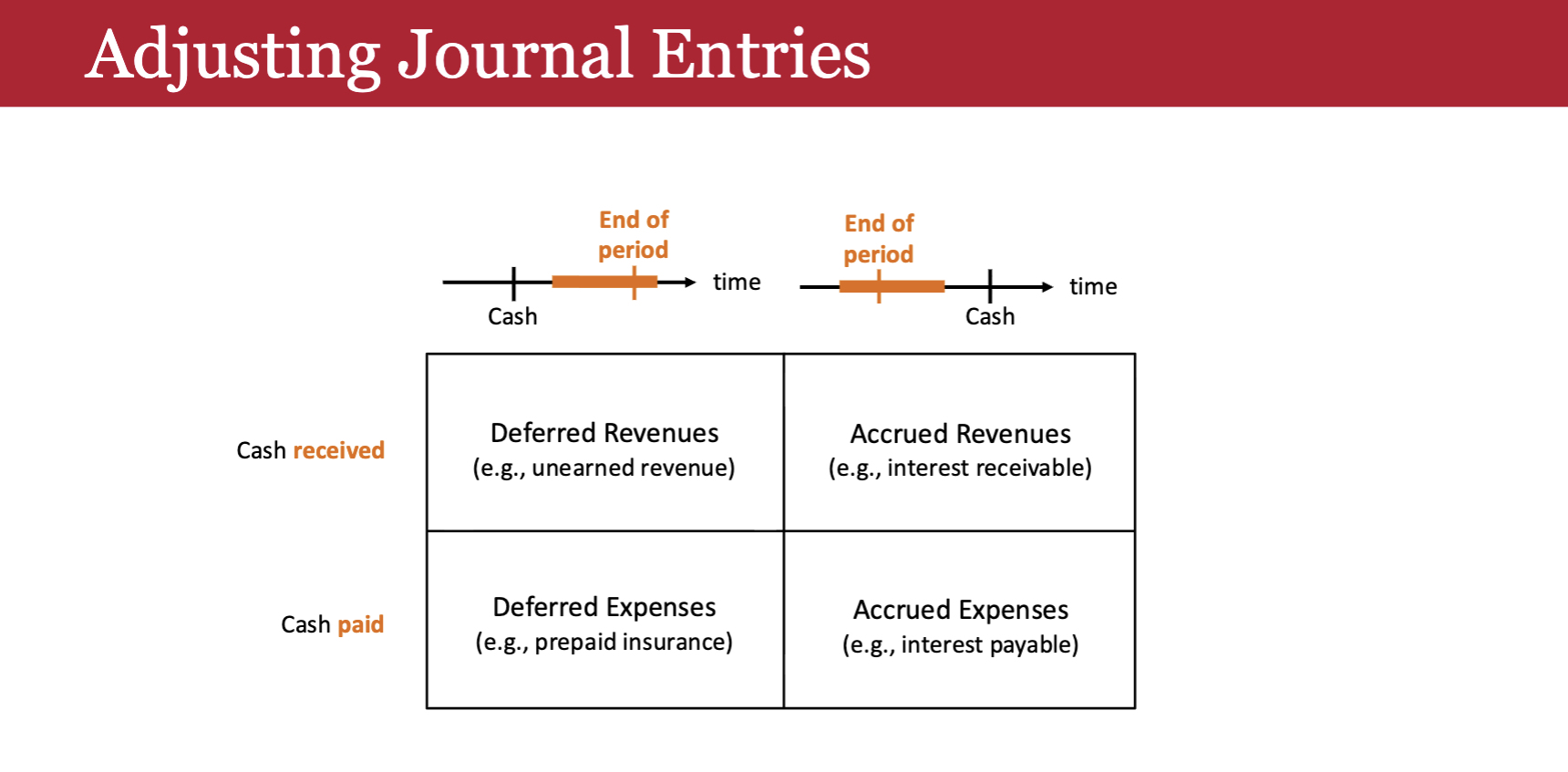
Adjusting journal entries - Revenue
