Equations To Remember For Ch01.04.05.06 Test
 Call Kai
 Learn
 Practice Test
 Spaced Repetition
 Match
 Flashcards
 Knowt Play
1/17

There's no tags or description
Looks like no tags are added yet.
18 Terms
A. (-0.620,109°)
1.A {Standard Form} Graph, as line-segments, the following polar coordinates on Cartesian Coordinate System:
Line segments, closed styles

B. (0.276,61.00°)
1.B {Standard Form} Graph, as line-segments, the following polar coordinates on Cartesian Coordinate System:
Line segments, closed styles
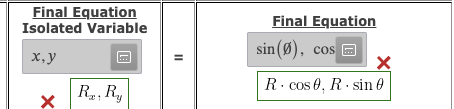
Given the equation "x = A + B + C + D + E", where:
A = 0.11m
B = 0.385m
C = 20030m
D = 42600m
E = 51070m
2.1 {Scientific Notation} Solve for [x].
Transcribing for C, D, E it’s ex: 0DPs [P] 1e-01
Final Answer Value ex: 1.370e + 05 (10^5 100000)

Given the equation "x = A + B + C + D + E", where:
A = 0.11m
B = 0.785m
C = 20030m
D = 42600m
E = 51070m
3.1 {Scientific Notation} Solve for [x].
Transcribing for C, D, E it’s ex: 0DPs [P] 1e-01
Final Answer Value ex: 1.370e + 05 (10^5 100000)
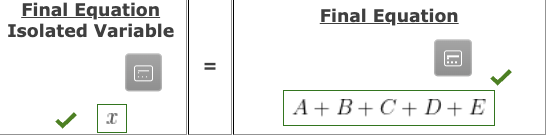
As a fish jumps vertically out of the water, assume that only two significant forces act on it (i.e., an upward force [Fup] exerted by the tail fin and the downward force [Fg] due to gravity). A record Chinook salmon has a length [l] of 1.50m and a mass [m]of 49.5kg. If this fish is moving upward [v0] at 3.00m/s as its head first breaks the surface and has an upward speed [vf] of 6.40m/s after two-thirds of its length has left the surface, determine the following (assuming constant acceleration & g = -9.81m/s2:
4.1 (a) {Standard Form} The salmon's acceleration [ay].
Solve for Δy first: 2/3 times I → 2/3 times 1.30m
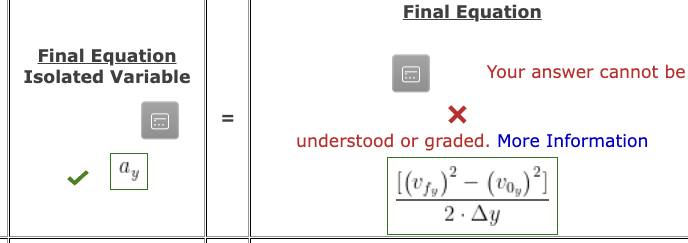
As a fish jumps vertically out of the water, assume that only two significant forces act on it (i.e., an upward force [Fup] exerted by the tail fin and the downward force [Fg] due to gravity). A record Chinook salmon has a length [l] of 1.50m and a mass [m]of 49.5kg. If this fish is moving upward [v0] at 3.00m/s as its head first breaks the surface and has an upward speed [vf] of 6.40m/s after two-thirds of its length has left the surface, determine the following (assuming constant acceleration & g = -9.81m/s2:
4.2 (b) {Standard Form} The magnitude of the force [Fup] during this interval.
Magnitude of F = N


Two packing crates of masses m1 = 10.10kg and m2 = 5.10kg are connected by a light string that passes over a frictionless pulley as in the figure below. The 5.10kg crate lies on a smooth incline of angle [𝜃] of 41.0°. Note: g = 9.81m/s2.
5.1 (a) {Standard Form} What is the acceleration [am2] up the incline of m2?


Two packing crates of masses m1 = 10.10kg and m2 = 5.10kg are connected by a light string that passes over a frictionless pulley as in the figure below. The 5.10kg crate lies on a smooth incline of angle [𝜃] of 41.0°. Note: g = 9.81m/s2.
5.2 (b) {Standard Form} What is the tension [T] in the string?
Tension = N


Objects with masses m1 = 12.0kg and m2 = 7.0kg are connected by a light string that passes over a frictionless pulley as in the figure below. Note: g = -9.81m/s2.
6.1 {Standard Form} If, when the system starts from rest, [m2] falls a distance [h] of 1.50m in a time [t] of 1.74s, determine the coefficient of kinetic friction [𝜇k] between [m1] and the table.
Solve for a: 2h/t²
Solve for N: m1 times |g|
Solve for f: m2 times |g| - (m1+m2) times a

A tension force [T] of 155N inclined at an angle [𝜃] of 30.0° above the horizontal is used to pull a shipping crate, with a mass [m] of 33.0kg, a distance [d] of 5.10m on a rough surface. Note: g = -9.81m/s2.
7.1 (a) {Standard Form} If the crate moves at a constant speed, find the work [WT] done by the tension force [T].
Asking to find the work → J

A tension force [T] of 155N inclined at an angle [𝜃] of 30.0° above the horizontal is used to pull a shipping crate, with a mass [m] of 33.0kg, a distance [d] of 5.10m on a rough surface. Note: g = -9.81m/s2.
7.2 (b) {Standard Form} If the crate moves at a constant speed, find the coefficient of kinetic friction [𝜇k] between the crate and surface.

Hooke's law describes a certain light spring of unstretched length [li] of 34.0cm. When one end is attached to the top of a door frame and an object of mass [m] of 8.00kg is hung from the other end, the length [lf] of the spring is 44.5cm. Note: g = -9.81m/s2.
8.1 (a) {Standard Form} Find, in kilo Newtons per meter, its spring constant [k].
kilo Newtons per meter → kN/m
Convert cm to m → times .01
Divide N/m by 1000 to get k

Hooke's law describes a certain light spring of unstretched length [li] of 34.0cm. When one end is attached to the top of a door frame and an object of mass [m] of 8.00kg is hung from the other end, the length [lf] of the spring is 44.5cm. Note: g = -9.81m/s2.
8.2 (b) {Standard Form} The load and the spring are taken down. Two people pull in opposite directions on the ends of the spring, each with a force [F] of 180.0N. Find, in centimeters, the length [lf] of the spring in this situation.
Divide N by 1000 to get kN
Find Δx= F/k
Times Δx by 100cm/m to get cm


Three objects with masses m1 = 5.40kg, m2 = 13.0kg, and m3 = 18.0kg, respectively, are attached by strings over frictionless pulleys as indicated in the figure below. The horizontal surface exerts a force of friction [fk] of 31.7N on [m2]. Note: g = -9.81m/s2.
9.1 {Standard Form} If the system is released from rest, use energy concepts to find the speed [vavg] of m3 after it moves down [d] 4.10m.


A high-speed photograph of a club hitting a golf ball is shown in the figure below. The club was in contact with a ball, initially at rest [v0], for about a time [t] of 0.00320s.
10.1 {Standard Form} If the ball has a mass [m] of 56.5g and leaves the head of the club with a speed [vavg] of 230.0ft/s, find the average force [Favg], in kilo Newtons, exerted on the ball by the club.
vavg → vf
top answer of equation times 1kg times 1m times 1N / bottom answer of equation times 10³g times 3.281ft times 1 kgtimesm/s² times 10³N

A ball with a mass [m] of 0.150kg is dropped from rest [v0] from a height [yi] of 1.26m. It rebounds from the floor to reach a height [yf] of 0.805m. Note: g = -9.81m/s2 and upward it + y-direction
11.1 {Standard Form} What impulse [I] was given to the ball by the floor?
Asking for impulse → Ns
For for v1: -√(voy)²+2ayΔy
For v2: √(vf)²-2ayΔy
I = kg times m/s² times 1N/kg times m/s = Ns

A railroad car with a mass [mRC] of 2.70 ✕ 104kg moving at a speed [vavgRC] of 3.15m/s collides and couples with two coupled railroad cars, each of the same mass as the single car and moving in the same direction at a speed [vavg2RCs] of 1.26m/s.
12.1 (a) {Standard Form} What is the speed [vavg3RCs] of the three coupled cars after the collision?
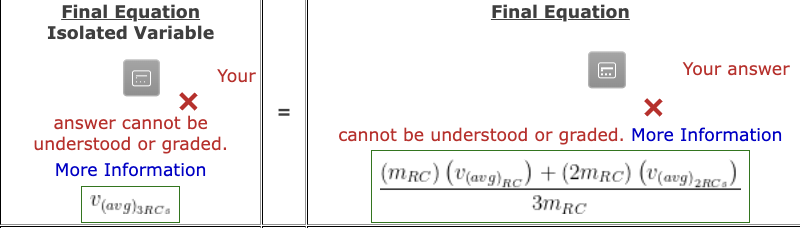
A railroad car with a mass [mRC] of 2.70 ✕ 104kg moving at a speed [vavgRC] of 3.15m/s collides and couples with two coupled railroad cars, each of the same mass as the single car and moving in the same direction at a speed [vavg2RCs] of 1.26m/s.
12.2 (b) {Standard Form} How much kinetic energy [KElost], in kilo Joules, is lost during the collision?
KE lost = kg times m²/s² times 1N/kg times m²/s² times 1J/1Nm times 1kJ/10³J = kJ
