ATI Teas 7: 20 Must know biology questions
 Call Kai
 Learn
 Practice Test
 Spaced Repetition
 Match
 Flashcards
 Knowt Play
1/24

There's no tags or description
Looks like no tags are added yet.
25 Terms
Interphase (Mitosis)
cell growth and DNA replication (loose and messy like worms)

Prophase (mitosis)
nuclear envelope begins to dissolve, Chromatin condense into a "x" shaped chromosomes (X's)

Metaphase (mitosis)
chromosomes line up on metaphase plate
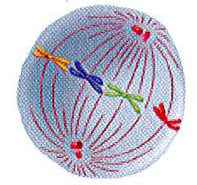
Anaphase (Mitosis)
cell elongates and sister chromatids are pulled apart toward the poles

Telophase (mitosis)
a cleavage furrow pinches the two daughter cells apart (cytokinesis). Each daughter cells left with 46 chromosomes

Which of the following describe a codon? (circle all that apply)
A. Codon is a sequence of three nucleotides that code for a specific amino acid.
B. A STOP codon signals to STOP protein synthesis
C. A START codon initiates protein synthesis and the nucleotide sequence for a start codon is AUG
D. A codon is a protein that codes for a gene.
Answers: A,B,C
Which of the following describes the independent variable in the experiment? (Use the following information given)
A group of people in an experiment test out the effects of a new drug, "X". Group 1 is given a placebo and reports having no side effects. (they are given none of the medication "X".)
Group 2 is given a full dose of the medication and reports having headaches.
Group 3 is given half the full dose of medication and reports having trouble sleeping.
A. Trouble sleeping is the independent variable.
B. "Trouble sleeping" and "headaches" is the independent variable
C. The amount of medication given is the independent variable; "placebo" "full dose" and "half dose" of medication are the independent variables.
D. The placebo medication is the only independent variable in the experiment
Answer: C
Dependent variable: The outcome of the independent variable( Example: if half dose is independent then dependent would be trouble sleeping
What illustaration represents the correct nucleotide base pairing in DNA?
A: Adenine, Uracil, Guanine, Thymine
B: Adenine, Thymine, Guanine, Cytosine
Answer: B (there is no thymine in RNA)
(adenine pairs with thymine, guanine pairs with cytosine in DNA....adenine pairs with uracil, guanine pairs with cytosine in RNA)
A phenotype is a characteristic trait that is observable. Phenotype is the expression of a genotype.
TRUE OR FALSE
TRUE
genotype is the letters
phenotype is what those letters represent
Match the correct macromolecules with the monomer they are made of
A. Carbohydrates
B. Lipids
C. Proteins
D. Nucleic Acids
Nucleotides, Amino Acids, Fatty Acids + Glycerol, Monosaccharides
A. Carbohydrates -> Monosaccharides
B. Lipids -> Fatty Acids+Glycerol
C. Proteins -> Amino Acids
D. Nucleic Acids -> Nucleotides
which part of the phospholipid bilayer is hydrophilic? Glycerol or fatty acids
Answer: Glycerol is hydrophilic, fatty acid is hydrophobic
Which of the following statements is true?
A. Humans have a total of 46 chromosomes. All chromosomes are either inherited from the mother or from the father.
B. Humans have 2 different copies of one gene. One from the mother and one from the father. Each variation of a gene is referred to as an ellele. Therefore, offspring will have 2 alleles for each gene.
C. In a homologous pair of chromosomes there are 4 sister chromatids identical to each other.
D. Humans have a total of 23 chromosome pairs, with a total of 46 chromosomes. 23 are inherited from the mom and 23 inherited from the dad.
B and D
Pea plant seeds are either yellow or green. Green seeds are dominant to yellow seeds. Two pea plants that are heterozygous for seed color are crossed. What percent of their offspring will have green seeds?
75% will be green seeds
Monomers are the building blocks of macromolecules
TRUE OR FALse
TRUE
Correct nucleotide base pairing in RNA
A. Adenine-Uracil, Guanine-Cytosine
B. Adenine- Thymine, Guanine- Cytosine
A
Thymine is not in RNA
Pair the RNA with the correct description
A. Decodes the nucleotide sequence and creates the correct amino acid from the code
B. Transports the DNA information form the nucleus to the ribosomes
C. Creates the structure of the ribosome
rRNA(ribosomal RNA), mRNA(messenger RNA), tRNA(transfer RNA)
tRNA -> A
mRNA -> B
rRNA -> C
Which of the following are true statements regarding protein synthesis?
Select all that apply
A. In transcription mRNA is made from a template strand of DNA
B. As the nucleotide bases are copied from DNA to RNA during transcription, Thymine is replaced with Uracil
C. The process of translation comes before transcription
D. Translation happens in the ribosomes
A,B,D
Transcription comes first, translation comes next
Which of the following are Eukaryotic?
Select all that apply
A. Plants
B. Fungi
C. Animals
D. Archaea
E. Bacteria
F. Cyanobacteria
A,B,C
D,E,F (prokaryotic)
Does a eukaryotic cell have a nucleus or does prokaryotic?
Eukaryotic cells have a nucleus while prokaryotic lack a nucleus
What is the correct amount of chromosomes found in a human cell?
46 chromosomes (23 pairs from each parent)
Which of the following is true regarding the properties of water?
A. Water is the universal solvent
B. Water is cohesive and adhesive
C. Water is polar
D. Water molecules form weak hydrogen bonds with other nearby water molecules
E. High boiling point
All are correct
At which phase in the cell cycle does the cell make copies of its DNA?
During the S phase (Synthesis phase) of the interphase
Which of the following is a true statement. Select all that apply
A. At the end of mitosis there are 4 haploid daughter cells
B. At the end of Telophase II in Meiosis, there are 4 haploid gamete cells
C. There are 2 rounds of mitosis in the process of making somatic cells
D. There are 2 rounds of meiosis in the process of making gamete/sex cells
B and D
The result of meiosis you end up with 4 gamete cells and there are 2 rounds
Which of the following statements are true. Select all that apply.
A. Mitosis results in 2 diploid daughter cells that are identical to the parent cell
B. Meiosis results in 4 haploid gamete cells that are different from the parent cell and different from each other
C. Both Meiosis and Mitosis produce 2 identical daughter cells that are identical to each other and the parent cell
D. Both Mitosis and Meiosis result in 4 haploid daughter cells that are identical to each other
A and B
Which of the following is true regarding crossing over/recombination?
A. Crossing over or recombination creates genetic diversity. Crossing over contributes to the fact that all four gametes (at the end of Meiosis II) will be different from each other and different from their parent cell
B. Crossing over creates alleles that are the same in both sister chromatids
C. Crossing over/ recombination creates diversity in somatic cells during the process of mitosis
D. Crossing over/recombination creates diversity in only male sperm cells
A. Crossing over or recombination creates genetic diversity. Crossing over contributes to the fact that all four gametes (at the end of Meiosis II) will be different from each other and different from their parent cell
What is genetic diversity and why is it important?
Genetic diversity is the outcome of making new different variation of alleles. This means there is a diverse amount of genes within one species. Genetic diversity is crucial and important because it increases the species ability to adapt and survive.