Cell Membranes
 Call Kai
 Learn
Learn Practice Test
 Spaced Repetition
 Match
Match Flashcards
 Knowt Play
1/12

There's no tags or description
Looks like no tags are added yet.
Name | Mastery | Learn | Test | Matching | Spaced | Call with Kai | Chat |
|---|
No analytics yet
Send a link to your students to track their progress
13 Terms
Cell Membranes (Overview)
All cells, including prokaryotic cells and eukaryotic cells, are surrounded by a membrane which is called a plasma membrane.
The plasma membrane forms a barrier which separates the cell from the environment.
Eukaryotic cells also have internal membranes that form compartments within the cell. These compartments include organelles.
prokaryotes vs eukaryotes
eukaryotic cells have a true nucleus and membrane-bound organelles, while prokaryotic cells do not have a nucleus or membrane-bound organelles.
Phospholipid Structure
Some membranes are composed of phospholipids.
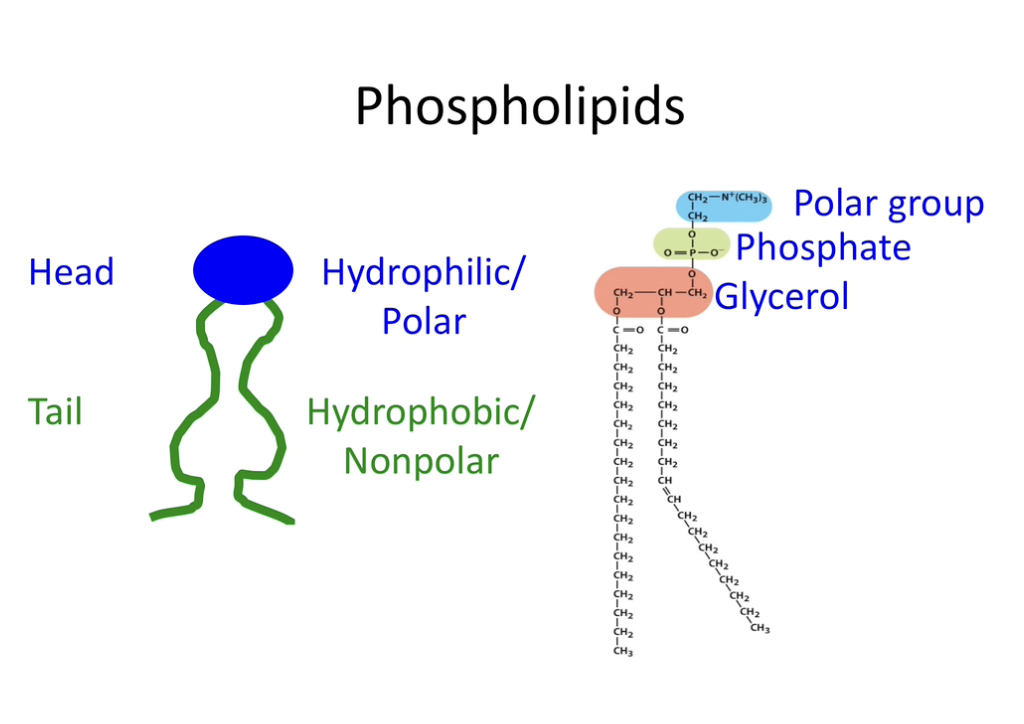
Phosholipids are biological molecules that contain a hydrophilic head group shown here in blue, and a hydrophobic tail shown here in green.
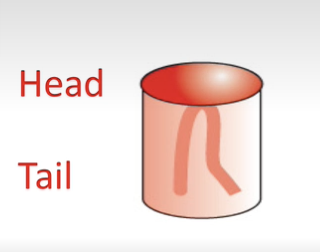
On the right you can see a more detailed structure of a specific phospholipid. The hydrophilic head group consists of a polar group, a negatively charged phosphate group, and a glycerol. Two fatty acid chains are connected to the glycerol backbone, creating the hydrophobic tail. Here's another representation of a phospholipid, showing the head group and the tail group.
Phospholipid Bilayer Formation
In an aqueous environment, fatty acid tails of phospholipid molecules can associate with each other due to the hydrophobic effect.
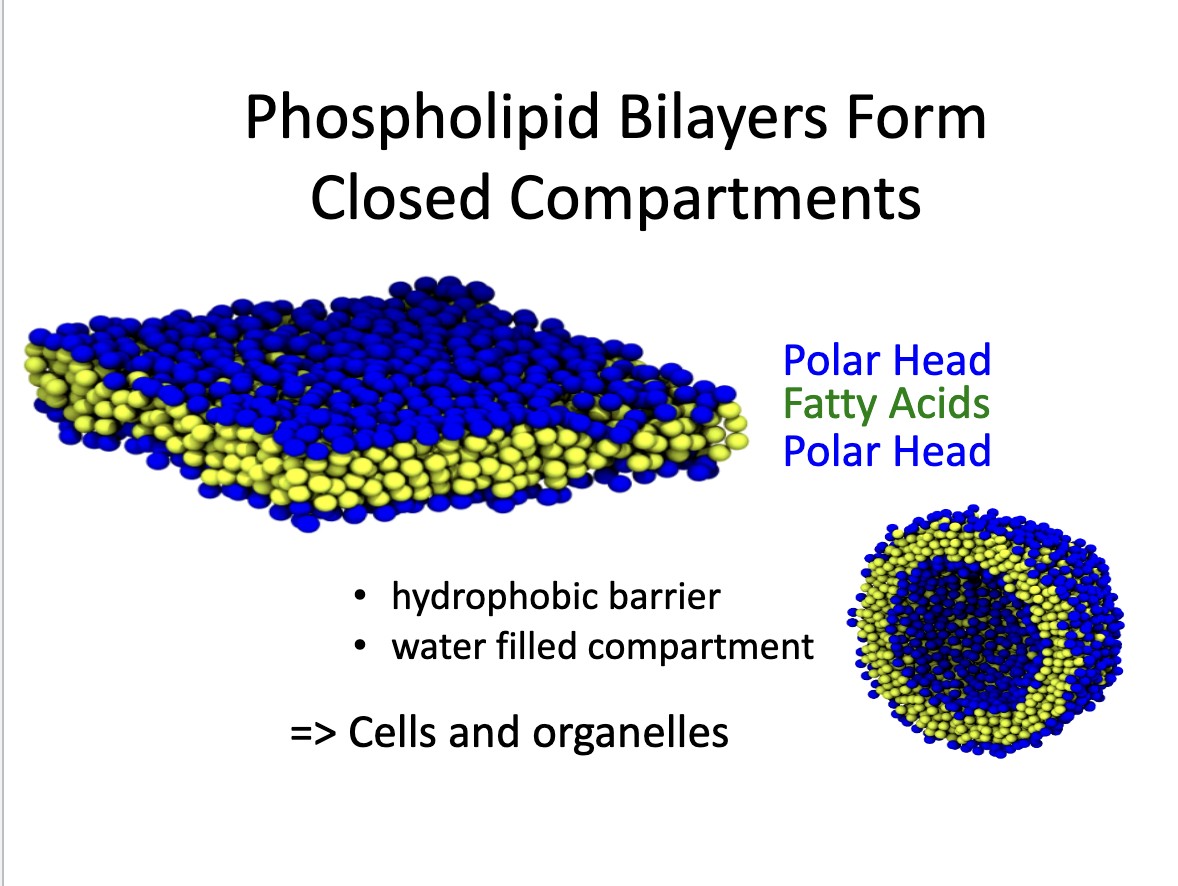
The shape of the phospholipids leads to the formation of a flat sheet consisting of two layers of phospholipids with the tail groups facing each other and separated from the surrounding water. This sheet of phospholipids is called a bilayer.
Here's a different representation of a phospholipid bilayer. The polar heads which are exposed to water are shown in blue and the fatty acid tails are shown in yellow or green. The flat bilayer can bend and fuse to form a hydrophobic barrier that creates a water-filled compartment. Cells and organelles are water-filled compartments created by phospholipid bilayers. Here's an animation that shows how a phospholipid bilayer can bend and fuse to form a closed compartment.

Permeability of Phospholipid Bilayers
Phospholipid bilayers are hydrophobic barriers. Small nonpolar molecules and small uncharged polar molecules can both pass through the phospholipid bilayer with some permeability.
However, large (uncharged) unpolar molecules and charged molecules have low permeability because it is unfavorable for these molecules to pass through the hydrophobic layer of the bilayer.
Summary of Cell Membranes
In summary, phospholipids are composed of two hydrophobic fatty acid tails, a hydrophilic head containing a glycerol, a phosphate, and a polar group.
Phospholipids form bilayers due to the hydrophobic effect.
Phospholipid bilayers can form closed compartments.
phospholipid bilayers are hydrophobic barriers
The Plasma Membrane
defines all cells

Eukaryotic Cells
Contain Intracellular Membranes

Phospholipids

Phospholipids Form

Bilayers
Phospholipid Bilayers Form
Closed Compartments

Phospholipid Bilayers are
Hydrophobic Barriers

Cell Membranes Summary
• Phospholipids are composed of:
Two hydrophobic fatty acid tails
A hydrophilic head containing a glycerol, a phosphate,
and a polar group
• Phospholipids form bilayers due to the hydrophobic effect
• Phospholipid bilayers can form closed compartments
• Phospholipid bilayers are hydrophobic barriers