CLASS 10 PCA + LECTURE NOTES
 Call Kai
 Learn
 Practice Test
 Spaced Repetition
 Match
 Flashcards
 Knowt Play
1/37

There's no tags or description
Looks like no tags are added yet.
38 Terms
what is the main energy source for muscles and how long does it last?
ATP
only stores limited reserves of ATP – can sustain 5-6 seconds of activity.
three main mechanisms of replenishing ATP
Phosphorylation by phosphocreatine
Anaerobic glycolysis and lactate formation
Oxidative phosphorylation
phosphocreatine
high energy molecule that acts as a rapid, anaerobic energy reserve in vertebrate tissues
how and when does phosphocreatine work
it is the first level of energy backup after the 5-6 seconds of ATP is used
muscles convert phosphocreatine into ATP
allows for 15 more seconds of sustained energy
when is glucose the main energy source
after atp and after phosphocreatine
glucose metabolic biochem path
glucose → glycolysis → pyruvate → anaerobic or aerobic pathways
aerobic pathway
oxidative pathway!
slow ATP but more of it
• Provides enough energy for hours
• Resource-intense
anaerobic pathway
glycolytic pathway!
Makes ATP more quickly, but less of it
• Provides enough energy for 30-40 secs
• Resource-light
energy source summary

skeletal muscle fiber classification
speed of contraction and main mechanism for ATP
features of fast contracting fibers
• myosin isoform that hydrolyzes ATP more quickly
• SERCA isoform that pumps Ca2+ more efficiently
• Fast-contracting fibers crossbridge and relax more quickly.
slow oxidative
low-intensity, sustained activity
fast glycolytic
high-intensity, short burst
fast oxidative-glycolytic
intermediate levels
fatigue
Inability to contract even when the muscle is receiving stimulation
→ low on ATP
slow oxidative features
Myosin ATPase + SERCA activity: slow
Primary pathway for ATP synthesis: oxidative phosphorylation
Diameter: small
Tendency to fatigue: low
Capillary density: high
Myoglobin content: high
Color: dark red
fast oxidative-glycolytic
Myosin ATPase + SERCA activity: fast
Primary pathway for ATP synthesis: Oxidative phosphorylation + anaerobic glycolysis
Diameter: medium
Tendency to fatigue: medium
Capillary density: medium
Myoglobin content: medium
Color: red
fast glycolytic
Myosin ATPase + SERCA activity: fast
Primary pathway for ATP synthesis: anaerobic glycolysis
Diameter: large
Tendency to fatigue: high
Capillary density: low
Myoglobin content: low
Color: pale
real world examples
Running a marathon: Primarily slow oxidative (aerobic)
Running a sprint: Primarily fast glycolytic (anaerobic)
how does endurance cause muscle fibers to adapt
• Increase the number of mitochondria
• Increased myoglobin
• Increased capillary density
• Increased reliance on oxidative pathways
motor unit
a single lower motor nueron and all the muscle fibers it innervates
features of motor units
can innervate up to hundreds of muscle fibers.
When one lower motor neuron fires, all the muscle fibers in a motor unit contract together
Each muscle fiber is only innervated by one motor neuron.
load
weight
tension
muscle force
isometric contraction BEFORE lifting
same length = no movement
tension < load
concentric contraction
muscle shortens
tension > load
eccentric contraction
muscle lengthens
tension < load
factors affecting muscle tension
1) # of motor units recruited
2) frequency of stimulation of each motor unity
3) resting sarcomere length before contraction
4) size of muscle fibers in motor units
1) Number of motor units recruited
more motor units → more tension (vice versa)
2) frequency of stimulation of each motor unit
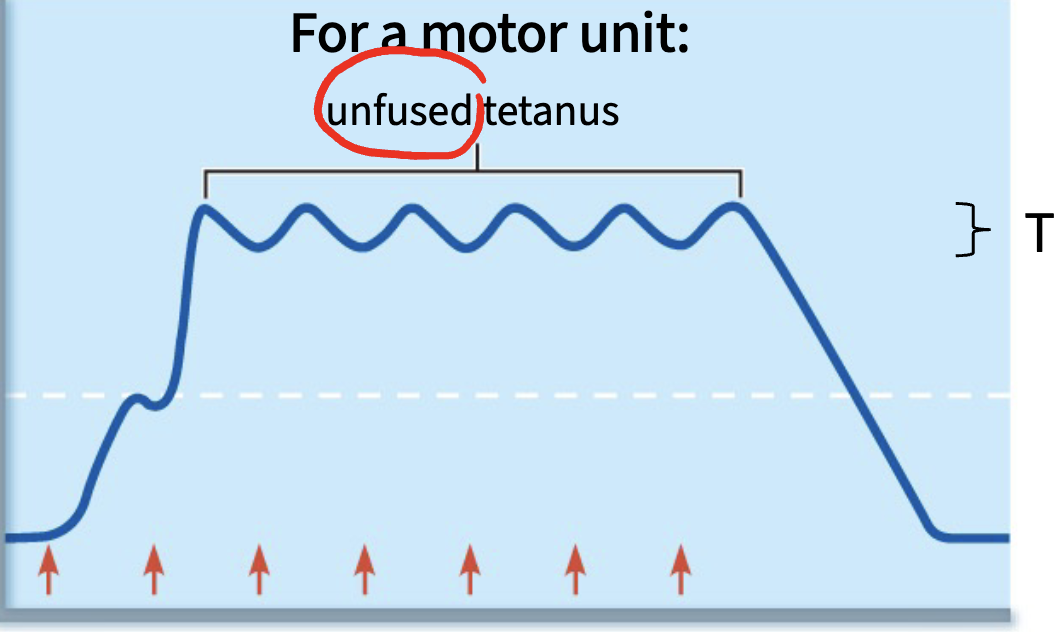
APs are far apart in time , we observe two distinct twitches
APs are closer, the second contraction begins before the first relaxation finishes
refractory period ( for motor units)
he refractory period of the muscle action potential is shorter than time it takes for muscle to fully relax
unfused tetanus
If the frequency is higher still, the muscle reaches a steady state and maintains constant tension
→ partial contraction/relaxation
fused tetanus
if the frequency is super high
→ no relaxation and rapid fatigue

muscle cramps/ spasms
sudden, involuntary contractions of a muscle due to hyperexcitability (excess firing) of lower motor neurons
3) resting sarcomere length

4) size of muscle fibers
The larger the muscle fibers within a motor unit, the more tension they produce
strength training
working out induces hypertrophy (cell enlargement) of muscle fibers
motor unit recruitment
the process of activating additional motor units to increase muscle tension (force).