Schizophrenia pharmacology + MED CHEM
 Call Kai
 Learn
 Practice Test
 Spaced Repetition
 Match
 Flashcards
 Knowt Play
1/25

There's no tags or description
Looks like no tags are added yet.
26 Terms
What are the classes of antipychotics?
- Typical (first generation)
- Atypical (second generation)
What are examples of a typical antipsychotic?
- Chlorpromazine
- Haloperidol
What are examples of atypical antipsychotics?
- Clozapine
- Risperidone
- Onlanzepine
- Quetiapine
Whats the difference between typical and atypical antipsychotics?
- Typical only block D2 whilst atypical block D2 and 5-HT2A (serotonin).
- Typical only treats +ve whilst atypical treats +ve and -ve
Describe the pharmacology of antipsychotics.
- Work by blocking D2 receptors in mesolimbic pathway.
- Clinical efficacy at 80% occupancy of D2 receptors.
- Can cause side effects by blocking dopamine receptors in other pathways e.g., nigrostriatal.
- Atypical (SGAs) also can block 5-HT2A receptors treating negative symptoms.
Describe the side effects caused by antipsychotics blocking the nigrostriatal pathway.
- Extrapyramidal (motor) side effects. (EPSE_
- Involuntary movement
- Repetitive movement
- Spasm in face and neck. (Dystonia)
Describe the side effects caused by antipsychotics blocking the tuberhypopheseal pathway.
- Increases prolactin secretion (hyperprolactinaemia).
- Cause breast development/enlargement/lactation/pain.
- Decreases fertility in women
- Loss of libido
Describe the side effects caused by antipsychotics blocking the mesocortical pathway.
- Can worsen negative and cognitive symptoms of SZ as dopamine activity is decreased in mesocortical pathway during SZ.
- Such as, reduced motivation, emotional blunting, and impaired attention etc.
Describe the side effects caused by antipsychotics blocking the mesolimbic pathway.
Leads to inhibition of reward pathways, which can cause:
- Anhedonia (inability to feel pleasure)
- Apathy or lack of motivation
- Emotional blunting
How do atypical antipsychotics treat negative symptoms of SZ?
- Block 5-HT₂A receptors in the cortex which increases dopamine in the mesocortical pathway.
- This reduces -ve symptoms caused by a decrease in dopamine in the mesocortical e.g., low motivation.
What other effects do atypical antipsychotics have as a result of 5-HT₂A receptor antagonism (reduced serotonin activity)?
- Increases dopamine in the striatum.
- Reduces prolactin secretion
- Enhances glutamate release in cortical pyramidal cells.
How do atypical antipsychotics differ from typicals in the way they target dopamine receptors?
- Atypical have improved selectivity for D2 over D1 receptors (e.g., risperidone)
- Atypical have rapid D2 dissociation, reducing extrapyramidal side effects.
What other receptor actions help atypical antipsychotics reduce side effects?
- Partial D₂ agonism (e.g., aripiprazole) helps balance dopamine activity in different pathways, reducing extrapyramidal side effects (EPS)
- 5-HT₂A antagonism increases dopamine release in the nigrostriatal pathway, which also helps reduce EPS
What side effects can atypical antipsychotics which act on muscarinic receptors cause?
- Dry mouth
- Dry eyes
- Drowsiness
- Constipation
- Tachycardia
Clozapine, onlanzapine, quetiapine
What side effects can atypical antipsychotics which act on alpha1 (a1)receptors cause?
- Postural hypotension
- Also hypotension if blocking DA receptors as well.
Clozapone, onlanzapine, quetiapine, risperidone, chlorpomazine
What are other side effects of typical antipsychotics?
- Neuroleptic malignant syndorme (reduced dopamine activity)
- Weight gain
- Insulin resistance
- Hyperlipidaemia
- Prolonged QT interval
- Loss of neutrophils (neutropenia) and loss of WBC (agranulocutosis) ∴ monitor clozapine
How might NMDA agonists work as new antipsychotics?
- Enhances glutamatergic activity at NMDA and AMPA receptor which can increase glutamate activity
- This decreases mesolimbic dopamine and increase mesocortical dopamine seen in schizophrenia.
- This can improve positive and negative symptoms.
What is the role of mGluR modulators in schizophrenia treatment?
mGluR5 agonists or positive allosteric modulators aim to fine-tune glutamate signalling, potentially restoring balance in disrupted neural circuits and improving cognition and emotional regulation in schizophrenia.
Why are mGluR/5HT2R heterodimers being explored for antipsychotic development?
These heterodimers link glutamatergic and serotonergic signalling, offering a novel way to rebalance neurotransmission and target both positive and negative symptoms with fewer side effects.
What are examples of phenothiazines?
- Fluphenazine
- Chlorpromazine
- Fluphenthixol
How does chlorpromazine block dopamine signalling?
Chlorpromazine structurally mimics dopamine, allowing it to bind to D2 receptors. However, instead of activating them, it acts as an antagonist, blocking dopamine's effect and reducing dopaminergic activity — useful in treating psychosis.

Describe the SAR of phenothiazines.
- Nitrogen-substituent is essential for activity.
- C1 or C4 substitution reduces activity.
- C2 requires an electron-withdrawing group (e.g. SO₂NR₂ > CF₃).
- Tertiary amine is preferred (better binding after BBB crossing).
- Optimal side chain length = 3 carbons.
Branched chains give anti-histamine activity.

What are examples of butyrophenones?
- Meperidine
- Haloperiodl
- Butyrophenone
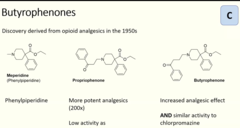
Describe the SAR of butyrophenones.
- Changing linker length abolishes activity.
- Branching at linker also reduces activity.
- Tertiary nitrogen is essential and higher activity if in a ring structure.
- Carbonyl is essential.
- Fluorine group at the bottom is essential to activity

How does potency relate to toxicity in butyrophenone antipsychotics?
As potency increases, toxicity also increases

Describe neurotoxicity from butyrophenones.
- Dehydration of haloperidol leads to form HPTP.
- Oxidation occurs twice to from HPP+ which mimics MPP+.
- This leads to Parkinson's like symptoms due to dopaminergic toxicity.