EFM II
 Call Kai
 Learn
 Practice Test
 Spaced Repetition
 Match
 Flashcards
 Knowt Play
1/18

Earn XP
Description and Tags
maternity exam 3
19 Terms
accelerations
abrupt temporary increase
32 wks: greater than or equal to 15 bpm increase over 15 or more seconds
below 32 wks: ≥ 10 bpm X 10 seconds
prolonged: 2-10 minutes
decelerations
nadir is lowest
duration: beginning to end
frequency:
recurrent - greater than or equal to 50% of contractions in 20 min
intermittent: less than 50% of contractions in 20 minutes

early decelerations
gradual decrease and return to baseline
associated with contractions
mirror contractions
nadir occurs with peak of contractions
caused by head compression
variable decelerations
abrupt decrease
decrease >15 bpm, lasting >15 seconds
Duration < 2 minutes
may be or not be associated with contraction
U, V, or W shape
caused by umbilical cord compression
nursing interventions for variable decels
try to change position to alleviate cord compression
intrauterine resuscitation
amnioinfusion - trying to expand uterus
tocolytics
prepare for delivery
late decels
gradual decrease and return to baseline FHR associated with contraction
delayed timing
nadir occurs after peak of contraction
caused by uteroplacental insufficiency - some sort of oxygen depletion
can be with hypo or hypertension, placental abruption
nursing interventions for late decelerations
intrauterine resuscitation - changing moms position, give oxygen if low
tocolytics
delivery
need to intervene bc showing oxygenation insufficiency
prolonged decels
decrease in FHR
decrease greater than or equal to 15 bpm
lasts longer than 2 minutes but less than 10
what causes prolonged decels
caused by significant change in O2
interrupted uteroplacental perfusion
interrupted umbilical blood flow - baby laying on cord
vagal stimulation - sometimes mom dilated super quick and baby drops fast causing significant head compression and this can happen
if dont fix late decels this will happen
nursing interventions for prolonged decels
treat underlying cause
prep for delivery
NST
non-stress test
reactive = 2 accelerations within 20 minutes = good!
nonreactive = insufficient accelerations or repetitive decelerations greater than 30 seconds
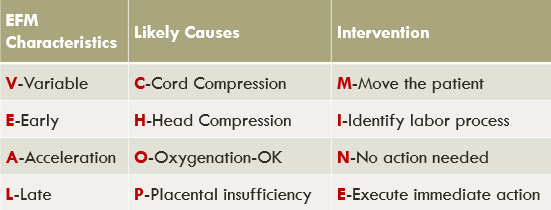
VEAL CHOP MINE
VAS
vibroacoustic stimulation
assess fetal well-being with non-reactive NST if FHR baseline is normal
activate near fetal head for 1 sec
may repeat q1min x 3
put next to babies head to try to wake them up
contraction stress test (CST)
simulates labor to see how the baby will react
term gestation, non-reactive NST
need 3 ctx/10-20 min
no variable or late decels = NEGATIVE/NORMAL
late decels with 50% of ctx = POSITIVE
intermittent late/variable decels = EQUIVOCAL
rarely done
NICHD three-tier FHR interpretation system
category 1 = normal
category 2 = indeterminate
category 3 = abnormal
category 1 FHR interpretation
FHR baseline 110-160
moderate baseline variability
no late or variable decels
accelerations or early decelerations present or absent
category 2
indeterminate
all FHR tracings not category 1-3
if doesnt fit in one category or the other then its this
category 3
abnormal
absent variability with recurrent late decels, recurrent variable decels or bradycardia
OR
sinusoidal pattern - symmetric up and down pattern, not like mod variability its completely perfect up and down, very very bad need emergent c section, indicates oxygenation is not happening or neurological concern
preterm fetus monitoring considerations
•FHR baseline higher
•Accelerations = 10 bpm X 10 sec
•Decreased variability
•Variable decelerations common
•Deteriorates more rapidly