Microbiology Test 2 Comprehension Check Questions
 Call Kai
 Learn
Learn Practice Test
 Spaced Repetition
 Match
Match Flashcards
 Knowt Play
1/117

There's no tags or description
Looks like no tags are added yet.
Name | Mastery | Learn | Test | Matching | Spaced | Call with Kai | Chat |
|---|
No analytics yet
Send a link to your students to track their progress
118 Terms
1. Describe the three phases of a bacterial cell cycle. The overlapping of cytokinesis and chromosome partitioning could potentially create problems for a cell during the cell cycle. What mechanisms does the cell use to prevent problem
Three Phases:
Post-birth growth period.
Chromosome replication and partitioning.
Cytokinesis (septum and daughter cell formation).
Prevention Mechanisms:
Min System: Oscillating proteins (MinCDE) prevent FtsZ polymerization at the cell poles, restricting Z-ring assembly to midcell.
Nucleoid Occlusion: The protein SlmA coats the chromosome and inhibits FtsZ polymerization, ensuring the Z-ring does not form until chromosomes have moved away from midcell.
Anchoring Proteins: ZapA and ZapB link the Z-ring to the chromosome terminus (ter), preventing constriction until replication and separation finish.
How does the bacterial cell cycle compare with the eukaryotic cell cycle? List two ways they are similar and two ways they differ.
Similarities:
Both feature a growth phase following cell birth.
Both involve replicating chromosomes and partitioning them into daughter cells, followed by cytokinesis.
Differences:
Timing of events: In bacteria, chromosome replication, partitioning, and the initial events of cytokinesis occur concurrently, whereas eukaryotes have distinct S, G2, and M phases separated in time.
Replication rounds: Some bacteria can initiate new rounds of DNA replication before the previous round and cytokinesis are even finished, which does not happen in eukaryotic cell cycles.
Do you think the Min system and nucleoid occlusion function in coccoid-shaped cells? Explain your answers
Yes, they function in coccoid cells: Even though coccoid cells (like spheres) lack the elongated geometry of rod-shaped bacteria, they still need to ensure that the Z-ring forms precisely at the center to divide symmetrically.
Explanation: The Min system and nucleoid occlusion mechanism ensure that the septum is positioned correctly between the newly separated chromosomes and that cell division does not prematurely pinch the chromosome during replication.
What elements of the Sulfolobus spp. cell cycle are similar to the bacterial cell cycle? What elements are similar to the eukaryotic cell cycle?
Bacterial-like elements: Uses a chromosome segregation system (SegA and SegB proteins) that functions similarly to the bacterial ParA/ParB partitioning system.
Eukaryotic-like elements: Features distinct growth (G1), DNA replication (S), and extended delay (G2) phases; uses eukaryotic-homologous replisome proteins, three origins of replication, and ESCRT-III/Vsp4 homologues (CdvB/CdvC) for cytokinesis.
Many archaeal genomes encode an FtsZ homologue. Describe how FtsZ might function in an archaeal cell cycle
Forms a contractile Z-ring at midcell to direct cytokinesis, similar to its role in bacteria. However, because archaea lack peptidoglycan, the archaeal Z-ring associates with newly synthesized S-layer proteins and alternative cell wall components to constrict the membrane.
Review figure 4.6 and the variety of cell wall types in archaea. How might these coordinate with the cytokinesis proteins to sculpt the cell wall during cell division?
Because archaea lack peptidoglycan and commonly rely on surface protein layers (S-layers) or pseudomurein, cytokinesis proteins (like Cdv proteins or FtsZ rings) must anchor to and recruit new S-layer subunits or alternative wall polymers, coordinating membrane scission with the targeted deposition or rearrangement of surface armor to seal each daughter cell.
Define microbial growth.
Microbial growth refers to an increase in cellular components and size that prepares a cell for division, or more broadly, to an increase in the number of cells within an expanding population (population growth).
Describe the phases of the growth curve and discuss the causes of each.
Lag Phase: Cells adjust to fresh medium, synthesize missing ATP, cofactors, ribosomes, or new enzymes; no immediate increase in cell number.
Exponential (Log) Phase: Microorganisms grow and divide at their maximal rate constant (k) given genetic and environmental conditions; population doubles at regular intervals.
Stationary Phase: Population growth ceases and the total number of viable cells remains constant; caused by nutrient limitation, oxygen depletion, toxic waste accumulation, or reaching a critical population density.
Death Phase: Viable cell numbers decline exponentially; caused by irreparable cellular harm from prolonged nutrient deprivation and toxic waste buildup.
Long-Term Stationary Phase: Population size remains relatively stable for months to years; sustained by successive waves of genetic variants that evolve to feed on nutrients released by dying cells.
Why must k and g be calculated from exponential phase measurements?
Because quantitative aspects of growth and binary fission equations are only valid when a culture is actively in the exponential phase, where the growth rate constant is constant and the population acts in synchrony.
Why would vigorously growing cells have a shorter lag phase than those that have been stored in a refrigerator when inoculated into fresh culture medium?
Vigorously growing cells already possess fully stocked levels of ribosomes, ATP, cofactors, and active metabolic enzymes, whereas refrigerated cells are depleted of these components and require time to synthesize them before division can begin.
How do microorganisms adapt to hypotonic and hypertonic environments?
In hypotonic environments, microbes use cell walls to prevent overexpansion and mechanosensitive (MS) channels as escape valves to let solutes leave (or contractile vacuoles to expel water). In hypertonic environments, osmotolerant and halophilic microbes maintain high internal solute concentrations either by accumulating compatible solutes (salt-out strategy) or by accumulating high concentrations of potassium and chloride ions (salt-in strategy).
Review transport mechanisms in section 3.2. Which type is used by mechanosensitive channels?
Mechanosensitive channels use passive transport (specifically facilitated diffusion/channel-mediated transport) to allow solutes to leave the cell in response to membrane stretch.
What are halophiles and why do they require sodium and potassium ions?
Halophiles are microorganisms adapted to extreme hypertonic, saline environments requiring NaCl concentrations above about 0.2 M (and up to saturation for extreme halophiles). They require ions because extreme halophiles using the salt-in strategy accumulate high intracellular potassium levels for enzyme and ribosome stability, and high sodium concentrations to stabilize their cell walls and plasma membranes.
Define water activity. Why is it difficult for microorganisms to grow at low a_w values?
Water activity (aw) is the ratio of a solution's vapor pressure to that of pure water (or 1/100 of its relative humidity). It is difficult for microorganisms to grow at low aw values because solutes "tie up" water, causing water to flow out of the cell via osmosis, which leads to cell dehydration, plasma membrane damage, and metabolic inactivity unless high internal solute concentrations are maintained.
When solutes (like salt or sugar) are added to pure water, they interact with water molecules and "tie them up." Because those water molecules are held more tightly by the solute, fewer of them can escape into the gas phase. This causes the solution's vapor pressure (Psoln) to decrease compared to pure water (Pwater).
Water activity (aw) uses this relationship as a ratio (Psoln/Pwater) to quantify how freely available the water molecules are for biological use.
Define pH, acidophile, neutrophile, and alkaliphile.
pH: A measure of relative acidity defined as the negative logarithm of the hydrogen ion concentration pH= -log[H+]
Acidophile: An organism with a growth optimum between pH 0 and 5.5.
Neutrophile: An organism with a growth optimum between pH 5.5 and 8.0.
Alkaliphile: An organism with a growth optimum between pH 8.0 and 11.5.
Describe the mechanisms microbes use to maintain an internal neutral pH. Explain how extreme pH values might harm microbes.
Mechanisms for Neutral pH:
Neutrophiles: Potassium-proton antiport systems and internal buffering.
Acidophiles: Transport cations in and use proton pumps to remove excess [H]+.
Alkaliphiles: Exchange internal sodium ions for external protons.
Harm from Extreme pH:
Inflows of excess {H}+ alter biomolecule ionization, disrupt amino acid side chains, impair enzyme active sites, and prevent protein folding.
What are cardinal temperatures?
The minimum, optimum, and maximum growth temperatures that define a microbe's temperature range.
Why does the growth rate rise with increasing temperature and then fall again at higher temperatures?
Enzyme catalysis and metabolic rates speed up as temperature rises, but past the optimum point, further heating denatures proteins, enzymes, and transport systems, and melts cell membranes.
Identify environments where you could find microbes considered psychrophilic, psychrotolerant, mesophilic, thermophilic, and hyperthermophilic.
Psychrophilic: Arctic/Antarctic habitats and cold ocean waters.
Psychrotolerant: Refrigerated foods and cold permafrost.
Mesophilic: The human body and moderate temperature environments.
Thermophilic: Composts, hot water lines, and hot springs.
Hyperthermophilic: Deep-sea hydrothermal vents.
Compare and contrast the metabolic and structural adaptations for extreme temperatures found in psychrophiles and thermophiles.
Psychrophiles: Have membranes with high levels of unsaturated fatty acids to remain fluid when cold, and accumulate compatible solutes and antifreeze proteins to prevent freezing.
Thermophiles: Have heat-stable enzymes with rigid, hydrophobic interiors, rich noncovalent/proline bonds, DNA-stabilizing nucleoid proteins (and reverse DNA gyrase in hyperthermophiles), and saturated, branched, or ether-linked lipid monolayers to prevent melting.
Describe the five types of O2 relationships seen in microorganisms.
Obligate aerobes: Dependent on atmospheric O2 for aerobic respiration.
Microaerophiles: Damaged by atmospheric O2 (20%) and require low O2 levels (2% to 10%).
Facultative anaerobes: Grow with or without O2, but grow faster in its presence using aerobic respiration.
Aerotolerant anaerobes: Tolerate O2 equally well whether present or not, but do not use it.
Obligate anaerobes: O2 is toxic, and they are usually killed by prolonged exposure
What are the toxic effects of O2? How do aerobes and other oxygen-tolerant microbes protect themselves from these effects?
Toxic effects: O2 forms reactive oxygen species (ROS) such as superoxide radicals, hydrogen peroxide, and hydroxyl radicals that severely damage cellular proteins, lipids, and nucleic acids.
Protection: Microbes neutralize ROS using protective enzymes like superoxide dismutase (SOD), catalase, and peroxidase.
Where would you expect to find barotolerant and piezophilic microbes? Explain your answer.
Barotolerant microbes: Found in environments with moderate to high pressure where increased pressure adversely affects them less than nontolerant microbes.
Piezophilic microbes: Found in the deep sea (ocean depths of 1,000 m or more, such as deep-sea trenches) where hydrostatic pressure reaches 600 to 1,100 atm, because they require high pressure for growth and have specialized short, unsaturated membrane lipids to resist it.
List the types of electromagnetic radiation in the order of decreasing energy or increasing wavelength.
Gamma rays -> X-rays -> Ultraviolet (UV) radiation -> Visible light -> Infrared rays -> Radio waves.
How do ionizing radiation, ultraviolet radiation, and visible light harm microorganisms? How do microorganisms protect themselves against damage from UV and visible light?
Harm mechanisms:
Ionizing radiation: Breaks hydrogen bonds, destroys ring structures, and causes severe protein oxidation.
UV radiation: Absorbed effectively by DNA (around 260 nm), causing lethal genetic damage.
Visible light: In the presence of photosensitizers and O2, it generates reactive singlet oxygen that destroys cells.
Protection mechanisms: Microbes repair UV-damaged DNA using DNA repair mechanisms, and use carotenoid pigments to quench singlet oxygen and protect against photooxidation.
As a cell adapts to starvation conditions during growth arrest, which cell division molecules are no longer needed?
Molecules involved in energy-intensive processes like cell division and protein synthesis machinery (such as ribosomes and membrane lipids that get recycled) are halted or reduced.
What is a biofilm? List two ways life in a biofilm is advantageous for microbes.
Definition: A complex, slime-encased community of microbes attached to a surface.
Advantages:
Provides a physical scaffold for stability and protection from harmful agents (like UV light and antibiotics).
Acts as a nutrient supply (matrix polymers serve as a carbon reservoir) and facilitates metabolic cooperation.
What medical challenges do biofilms present?
They form on medical devices (like catheters and hip implants) and wounds, causing device failures, delayed healing, and chronic infections that resist standard antibiotic treatments due to protection by the extracellular polymeric substance (EPS) and growth-arrested persister cells.
What is quorum sensing? Describe how it occurs, and briefly discuss its importance to microorganisms.
Definition: A system where microbes assess their population density using small signaling molecules (autoducers/AIPs).
How it occurs: At low cell densities, signaling molecules diffuse out into the environment. As population density increases, the concentration builds up, and when it reaches a threshold (a quorum), the molecules diffuse back into the cells to trigger the coordinated expression of specific genes.
Importance: Allows microbes to act as a multicellular unit to coordinate behaviors that only work effectively at large group sizes, such as bioluminescence, biofilm formation, and virulence factor expression.
Describe the following kinds of media and their uses: defined media, complex media, supportive (general purpose) media, enriched media, selective media, and differential media. Give an example of each.
Defined (synthetic) media: Each ingredient has an exact chemical formula; used in research when precise metabolism tracking is needed. Example: A medium with glucose and an ammonium salt.
Complex media: Contains at least one ingredient of nonspecific chemical composition (e.g., peptones, extracts); used when exact requirements are unknown or for fastidious microbes. Example: Nutrient broth or tryptic soy broth.
Supportive (general purpose) media: Sustains the growth of many types of microorganisms. Example: Tryptic soy agar (TSA).
Enriched media: Fortified with blood or other nutrients to encourage fastidious microbe growth. Example: Chocolate agar.
Selective media: Allows specific microorganisms to grow while inhibiting others. Example: Mannitol salt agar or media containing crystal violet.
Differential media: Distinguishes among different groups of microbes based on biological characteristics. Example: MacConkey agar or blood agar
What are peptones, yeast extract, beef extract, thioglycollate, and agar? In what kinds of media are they used?
Peptones: Partially digested protein sources providing carbon, energy, and nitrogen; used in complex media.
Yeast extract: Aqueous extract providing B vitamins, nitrogen, and carbon; used in complex media.
Beef extract: Aqueous extract providing amino acids, peptides, nucleotides, and vitamins; used in complex media.
Thioglycollate: A reducing agent that eliminates dissolved oxygen; used in anaerobic media.
Agar: A sulfated polymer extracted from red algae used as a solidifying agent; used in solid media.
List four ways in which anaerobes may be cultured.
Using anaerobic media containing reducing agents like thioglycollate or cysteine.
Using an anaerobic workstation or chamber with a nitrogen/hydrogen gas mix and palladium catalyst.
Using a tightly sealed hard container with a catalyst envelope to remove oxygen.
Using a candle jar where a lit candle consumes remaining oxygen before sealing.
What are pure cultures and why are they important? How are spread plates, streak plates, and pour plates inoculated?
Pure culture: A population of cells arising from a single cell (axenic culture); important because a single microorganism cannot be studied adequately in a mixed culture.
Streak-plate inoculation: Cells are transferred to the edge of an agar plate with a loop and streaked across sectors to dilute organisms and yield isolated single-cell colonies.
Spread-plate inoculation: A small volume of a serially diluted mixture is transferred to the center of an agar plate and spread evenly over the surface with a sterile bent rod.
Pour-plate inoculation: A serially diluted sample is mixed with cooled liquid agar and poured immediately into sterile Petri dishes so cells are embedded within the agar.
Briefly describe each technique by which microbial population numbers may be determined and give its advantages and disadvantages.
Counting Chambers (Direct Count): Uses a grid-etched slide (like a Petroff-Hausser chamber) to count cells under a microscope.
Advantages: Easy, inexpensive, quick, and provides cell size/morphology info.
Disadvantages: Requires a large, evenly dispersed population; cannot easily distinguish live from dead cells.
Membrane Filter Technique (Direct Count): Traps aquatic bacteria on a filter, stains them with fluorescent dyes, and counts them via epifluorescence microscopy.
Advantages: Highly sensitive for dilute aquatic samples.
Disadvantages: Counts both live and dead cells; labor-intensive.
Flow Cytometry: Forces cells in a narrow stream through a laser beam to detect light-scattering and fluorescence events independently.
Advantages: Rapid, highly automated, and can sort cells or analyze internal complexity and size.
Disadvantages: Expensive equipment required.
Electronic Counters (Coulter Counter): Measures electrical resistance changes as microbial cells pass through a small hole.
Advantages: Quick and automated.
Disadvantages: Can count debris or clumped cells incorrectly.
Viable Counting Methods (Plate Counts / Spread & Pour Plates): Dilutes samples and plates them on agar to count resulting colonies.
Advantages: Counts only live, culturable cells; highly sensitive.
Disadvantages: Subject to underestimation due to cell clumps, heat injury (pour plates), or unculturable media requirements (the great plate count anomaly).
Membrane Filtration (Viable): Traps microbes on a filter, places them on an agar/liquid pad, and counts colonies.
Advantages: Excellent for low-density samples like water purity checks.
Disadvantages: Only counts culturable organisms.
Dry Weight Measurement (Cell Mass): Collects cells by centrifugation, washes, dries, and weighs them.
Advantages: Useful for filamentous fungi.
Disadvantages: Time-consuming, insensitive, and requires large culture volumes.
Spectrophotometry (Turbidity / Cell Mass): Measures light scattering/absorption through a liquid culture.
Advantages: Rapid, sensitive, non-destructive, and allows real-time monitoring of growth.
Disadvantages: Requires high cell density (≈106 cells/mL) to detect turbidity; loses linearity above an absorbance of about 0.5.
Chemical Substance Estimation (Cell Mass): Measures constant cellular components like total protein, chlorophyll, or ATP.
Advantages: Correlates well with biomass.
Disadvantages: Cellular composition can vary under different growth conditions
When using direct cell counts to follow the growth of a culture, it may be difficult to tell when the culture enters the death phase. Why?
Direct cell counts typically count both live and dead cells (unless specialized live/dead fluorescent stains are used). Because dead cells often remain intact in the medium after dying, the total cell count remains steady or decreases very slowly during the death phase, masking the actual decline in live cells.
Why are plate count results expressed as colony forming units?
Because it is impossible to be certain that every single colony arose from a single isolated cell rather than a clump or chain of multiple cells.
For each of the following, which enumeration technique would you use? Explain your choice.
(a) A pure culture of Staphylococcus aureus
(b) A water sample that needs to be checked for E. coli contamination:
(c) A sample of yogurt:
(a) A pure culture of Staphylococcus aureus: Spectrophotometry or standard plate counts. Since it is a pure, high-density lab culture, spectrophotometry provides rapid real-time turbidity measurements, while plate counts can determine viable numbers.
(b) A water sample that needs to be checked for E. coli contamination: Membrane filtration (viable count) using selective media. Water samples usually have low bacterial densities, requiring concentration via a filter and selective growth to isolate and enumerate E. coli.
(c) A sample of yogurt: Viable plate count (spread plate or pour plate with serial dilutions). Yogurt is dense with active starter cultures and food particulates, making direct microscopic counts difficult and turbidity/mass measurements unreliable for distinguishing specific viable bacteria.
How does a continuous culture system differ from a closed culture system (i.e., a batch culture)?
A continuous culture system supplies fresh nutrients and removes wastes to maintain constant environmental conditions and exponential growth indefinitely. A closed batch culture has no nutrient renewal or waste removal, causing growth to stop and the culture to reach the stationary phase.
Describe how chemostats and turbidostats operate. How do they differ?
Chemostat: Feeds sterile medium at a constant rate with a limiting essential nutrient, maintaining a constant dilution rate and stable cell density.
Turbidostat: Uses a photocell to measure culture turbidity and automatically regulates media flow to maintain a predetermined cell density.
Differences: Chemostats operate with a limiting nutrient and constant dilution rate, whereas turbidostats have all nutrients in excess and a varying dilution rate. Turbidostats operate best at high dilution rates, while chemostats are most stable at lower rates.
What is the dilution rate? What is maintenance energy? How are they related?
Dilution rate (D): The rate at which medium flows through the culture vessel relative to the vessel volume (D = f/V).
Maintenance energy: The baseline energy a microorganism must use just to survive and maintain cellular integrity, rather than for growth and reproduction.
Relationship: When the dilution rate is very low, nutrients only supply enough energy for maintenance. As the dilution rate increases beyond the maintenance energy requirement, the excess energy allows the growth rate and cell density to increase (until a washout point is reached).
Define the following terms: sterilization, sterilant, disinfection, disinfectant, sanitization, antisepsis, antiseptic, chemotherapy, and biocide.
Sterilization: The process by which all living cells, spores, and acellular entities are destroyed or removed.
Sterilant: A chemical agent used to achieve sterilization.
Disinfection: The killing, inhibition, or removal of microorganisms that may cause disease (substantially reducing the total population and destroying potential pathogens).
Disinfectant: A chemical agent usually used on inanimate objects to carry out disinfection.
Sanitization: Reducing the microbial population to levels considered safe by public health standards while partially cleaning the object.
Antisepsis: The destruction or inhibition of microorganisms on living tissue to prevent infection.
Antiseptic: A chemical agent applied to living tissue to prevent infection by killing or inhibiting pathogens.
Chemotherapy: The generic term for applying chemicals to kill or inhibit the growth of microorganisms.
Biocide: A general term for all antimicrobial agents used to control microorganisms through mechanisms like cross-linking, oxidizing, or denaturing biomolecules.
What is the difference between bactericidal and bacteriostatic? To which category do you think most household cleaners belong? Why?
Based on what you learned in section 3.8, how would the D value differ between heat treatments to kill vegetative cells vs. endospores for a species of Bacillus?
Difference: Bactericidal agents kill bacteria, whereas bacteriostatic agents only inhibit their growth without necessarily killing them (if removed, growth resumes).
Household cleaners: Most household cleaners are likely bactericidal because consumers expect these products to actively kill germs and sanitize hard surfaces effectively rather than just temporarily pausing bacterial growth.
Based on what you learned in section 3.8, how would the D value differ between heat treatments to kill vegetative cells vs. endospores for a species of Bacillus?
Endospores are exceptionally recalcitrant, heat-resistant structures compared to vegetative cells. Therefore, the D value would be significantly higher for endospores, meaning it requires a much longer heat treatment time to reduce an endospore population by 90% than it would for vegetative cells of the same species.
Describe how an autoclave works. What conditions are required for sterilization by moist heat? What three things must one do when operating an autoclave to help ensure success?
Mechanism: Uses saturated steam under pressure to destroy cells/viruses by degrading nucleic acids, denaturing proteins, and disrupting cell membranes.
Conditions: Temperatures above 100°C (typically 121°C at 15 psi for 10 to 12+ minutes).
Three Success Factors: Flush out all air, avoid packing items too tightly to allow free steam circulation, and use extended times for larger liquid volumes (or verify with biological indicators).
In the past, spoiled milk was responsible for a significant proportion of infant deaths. Why is untreated milk easily spoiled?
It is a nutrient-rich medium that supports the rapid growth of nonpathogenic and pathogenic microorganisms.
List the advantages and disadvantages of ultraviolet light and ionizing radiation as sterilizing agents. Provide a few examples of how each is used for this purpose.
Ultraviolet (UV) Radiation:
Advantages: Effectively kills microbes (via thymine dimerization) without chemicals.
Disadvantages: Poor penetration (blocked by glass, dirt, water).
Examples: Sterilizing air/surfaces in labs, biological safety cabinets, and treating water.
Ionizing Radiation:
Advantages: Deep penetration, destroys endospores and all cells (cold sterilization).
Disadvantages: Not always effective against viruses.
Examples: Sterilizing medical supplies/plastics (syringes, sutures), pharmaceuticals, and treating foods (meat, fruits, spices).
Why are most antimicrobial chemical agents disinfectants rather than sterilants? What general characteristics should one look for in a disinfectant?
Why disinfectants: True sterilization is difficult and requires conditions too toxic for safe everyday use. Disinfectants effectively lower pathogen counts while remaining safe and practical.
Ideal characteristics: Broad antimicrobial spectrum, low toxicity, non-corrosive, stable, odorless/pleasant, water/lipid soluble, low surface tension, and inexpensive.
Construct a table that compares the chemical nature, mechanism of action, mode of application, common uses and effectiveness, and advantages and disadvantages between phenolics, alcohols, halogens, metals, quaternary ammonium compounds, aldehydes, and ethylene oxide.


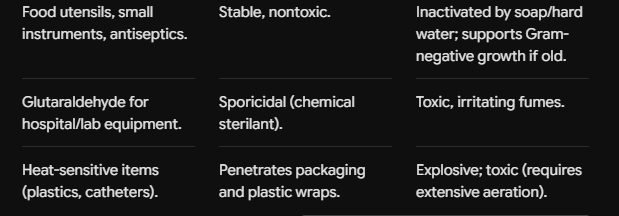
Which biocides would be used to treat the following: microbiology laboratory bench top, drinking water, skin before surgery, small medical instruments (probes, forceps, etc.)? Explain your choices
Microbiology lab bench top: Phenolics or dilute bleach, because they effectively decontaminate hard surfaces and tolerate minor organic residue.
Drinking water: Chlorine or chlorine dioxide (ClO2), because they rapidly oxidize vegetative pathogens cost-effectively on a large scale.
Skin before surgery: Iodophors, because they minimize skin irritation while reducing pathogens.
Small medical instruments (probes, forceps, etc.): Glutaraldehyde or alcohols, because they quickly disinfect equipment without thermal damage.
How do phenolic agents differ from the other chemical control agents described in this chapter?
Phenolics remain active on surfaces long after application and retain efficacy in the presence of organic material, unlike agents that degrade quickly or are inactivated by organic matter.
Which physical or chemical agent would be the best choice for sterilizing the following items: glass pipettes, tryptic soy broth tubes, nutrient agar, antibiotic solution, interior of a biological safety cabinet, wrapped package of plastic Petri plates? Explain your choices.
Glass pipettes, tryptic soy broth tubes, nutrient agar: Autoclaving (moist heat), as they withstand heat and pressure to kill endospores.
Antibiotic solution: Filtration, because heat or harsh chemicals would degrade the antibiotics.
Interior of a biological safety cabinet: Vaporized hydrogen peroxide (VHP) or UV radiation, for safe, residue-free large space decontamination.
Wrapped package of plastic Petri plates: Ethylene oxide (EO) gas or ionizing radiation, because plastic melts under autoclave heat and EO penetrates packaging.
Briefly explain how the effectiveness of antimicrobial agents varies with population size, population composition, concentration or intensity of the agent, contact time, temperature, and local environmental conditions.
Population size: Larger populations require longer exposure times because a fixed fraction is killed per interval.
Population composition: Susceptibility varies; endospores, younger cells, and species like Mycobacterium tuberculosis are more resistant.
Concentration/intensity: Higher concentrations generally increase the killing rate up to a point (though water enhances some agents like 70% ethanol).
Contact time: Longer exposure increases the number of organisms killed (requiring 6-log reduction for sterilization).
Temperature: Higher temperatures enhance activity, sometimes allowing lower agent concentrations.
Local environment: Acidic pH aids heat killing, while organic matter and biofilms can protect microorganisms.
How does being in a biofilm affect an organism’s susceptibility to antimicrobial agents?
Organic matter in biofilms protects microbes physically, and physiological alterations make resident bacteria significantly less susceptible to antimicrobial agents.
Suppose hospital custodians have been assigned the task of cleaning all showerheads in patient rooms to prevent the spread of infectious disease. What two factors would have the greatest impact on the effectiveness of the disinfectant the custodians use? Explain what that impact would be.
Biofilms / Organic matter (Local Environment): Showerheads commonly harbor biofilms and mineral/organic deposits that physically shield bacteria and reduce agent penetration.
Contact time: The disinfectant must remain wet and in contact with the surfaces long enough to achieve adequate microbial reduction.
Briefly describe the phenol coefficient test.
It is a screening test comparing a disinfectant's potency against phenol using standard cultures (Salmonella enterica serovar Typhi and Staphylococcus aureus), measuring the highest dilution that kills bacteria in 10 minutes but not 5 minutes.
Why might it be necessary to employ procedures such as in-use tests?
Because laboratory screening tests like the phenol coefficient use pure cultures under controlled conditions and do not account for real-world variables like organic matter, varying environmental conditions, or complex microbial populations.
How would you explain to a patient that a virus can be used to eliminate a bone infection caused by bacteria that do not respond to antibiotics?
Explain that a specific type of virus called a bacteriophage acts as a microscopic predator that targets and infects only the harmful bacteria causing the infection, leaving human cells and good bacteria unharmed. Once inside, the virus replicates and destroys the antibiotic-resistant bacteria by lysing (bursting) them.
Propose the use of specific bacterial, viral, or fungal products that might be used to kill other, more virulent bacteria, viruses, or fungi.
Enzybiotics: Purified bacteriophage endolysins that target and degrade peptidoglycan in bacterial cell walls to cause cell lysis.
Bacteriocins: Antimicrobial peptides or toxins produced by certain bacteria to inhibit or kill closely related competing strains.
Bacterial depolymerases: Enzymes that break down the protective extracellular matrix of pathogen biofilms, making them vulnerable to immune clearance or other treatments.
What is the evolutionary benefit to Penicillium chrysogenum for producing penicillin?
It suppresses competing bacterial populations in the mold's environment, reducing competition for vital resources and nutrients.
Louis Pasteur is often credited with saying, “Chance favors the prepared mind.” How does this apply to Alexander Fleming?
While mold contamination on a Petri dish was an accidental stroke of chance, Fleming’s expert microbiological background allowed him to recognize the significance of the clear inhibition zone surrounding the mold rather than simply discarding the ruined plate as a failed experiment.
Define the following:
Selective toxicity: The ability of a chemotherapeutic agent to kill or inhibit microbial pathogens while damaging the host as little as possible.
Therapeutic index: The ratio of the toxic dose (the level at which an agent becomes too toxic for the host) to the therapeutic dose (the drug level required for treatment).
Side effect: Unwanted or damaging adverse effects on host organ systems caused by a drug inhibiting host processes or damaging host tissue.
Narrow-spectrum drug: An antimicrobial agent effective only against a limited variety of pathogens.
Broad-spectrum drug: An antimicrobial agent that targets many different kinds of bacteria.
Synthetic antibiotics: Chemotherapeutic agents manufactured by abiotic, artificial chemical processes rather than produced naturally by bacteria or fungi.
Semisynthetic antibiotics: Natural antibiotics that have been structurally modified by adding chemical groups to make them less susceptible to stomach acids or pathogen inactivation.
Cidal agents: Antimicrobial agents that actively kill the target pathogen.
Static agents: Antimicrobial agents that reversibly inhibit microbial growth without necessarily killing them.
Minimal inhibitory concentration (MIC): The lowest concentration of a drug that prevents the growth of a particular pathogen.
Which drug would have more side effects: a drug with a high or low therapeutic index?
A drug with a low therapeutic index would have more side effects because the therapeutic dose is close to the toxic dose, meaning it is more likely to damage host cells and organ systems.
How can the MIC concept be applied to distinguish between cidal and static agents?
A cidal drug typically kills pathogens at concentrations only two to four times its minimal inhibitory concentration (MIC), whereas a static agent requires much higher concentrations to kill, if it kills them at all.
Describe the relationship between the diameter of growth inhibition and antibiotic susceptibility in the Kirby-Bauer test.
A wider zone of inhibition generally indicates greater susceptibility of the pathogen to the antibiotic, whereas a smaller or absent zone indicates resistance. (Note: Because zone width also depends on diffusion rate and drug concentration, specific standards from reference tables are used to classify results).
What would you surmise if you examined a Kirby-Bauer assay and found individual bacterial colonies growing within the zone of inhibition?
Those colonies are likely resistant mutants or persistent variants that arose within the larger, otherwise susceptible population
How is the Etest® carried out? When might it be used instead of the Kirby-Bauer test?
Procedure: An agar medium is inoculated with a bacterial isolate, and plastic strips containing a continuous concentration gradient of an antibiotic and an MIC scale are placed on the surface. After incubation, the Etest® yields an elliptical zone of inhibition where the intersection point gives the precise minimal inhibitory concentration (MIC).
When used: It is used when a clinician or researcher needs a precise numerical MIC value rather than a qualitative or categorical susceptibility classification (resistant/intermediate/susceptible).
Explain five mechanisms by which chemotherapeutic agents kill or damage bacteria.
Inhibition of cell wall synthesis: Blocks peptidoglycan cross-linking (e.g., Penicillins, Cephalosporins), causing osmotic lysis.
Inhibition of protein synthesis: Binds to bacterial 30S or 50S ribosomal subunits to disrupt translation or peptide elongation (e.g., Aminoglycosides, Tetracyclines, Macrolides).
Action as metabolic antagonists (antimetabolites): Competitively inhibits key metabolic enzymes, such as those required for folic acid synthesis (e.g., Sulfonamides, Trimethoprim).
Inhibition of nucleic acid synthesis: Disrupts DNA replication, repair, or chromosome separation via topoisomerases (e.g., Fluoroquinolones).
Inhibition of transcription: Blocks RNA polymerase from carrying out bacterial transcription (e.g., Rifamycins).
Why do penicillins and cephalosporins have a higher therapeutic index than most other antibiotics?
They target structures and functions—specifically peptidoglycan cell wall synthesis—that are unique to bacteria and not found in eukaryotic cells, minimizing toxicity to the host.
Why is linezolid not more commonly prescribed?
It is used primarily in hospitals to prevent overuse and the rapid development of resistance against critical drug-resistant threats like MRSA.
What are antimetabolites? Why are these effective against protozoan pathogens, but the other drugs presented here generally are not?
Antimetabolites: Drugs structurally similar to enzyme substrates that compete for binding sites to block key metabolic pathways.
Effectiveness: Like many bacteria, protozoa must synthesize their own folic acid internally and cannot absorb it from the host environment, making them vulnerable to metabolic antagonists that target folate synthesis (whereas other drug classes often target bacterial-specific ribosomal structures or cell walls that protozoa lack or process differently).
Why do drugs used to treat herpes target the virus and spare the host cell?
They exploit the fact that herpesviruses use their own viral enzymes (rather than host enzymes) to phosphorylate nucleoside analogues into active nucleotides, which are then preferentially incorporated by the virus to cause chain termination
Compare and contrast the activity of a nucleoside reverse transcriptase inhibitor and a nonnucleoside reverse transcriptase inhibitor.
NRTIs: Act as nucleoside analogues that incorporate into the viral DNA chain to cause chain termination.
NNRTIs: Bind directly to and allosterically inhibit the viral reverse transcriptase enzyme without incorporating into the DNA chain.
Why must individuals with HIV infections take antiretroviral drugs for the rest of their lives?
While antiretroviral therapy reduces active virus levels to undetectable limits, proviral HIV DNA remains dormant in host cells (such as memory T cells), meaning the virus will reactivate if medications are stopped.
Compare the older and newer drugs used to treat hepatitis C virus. Explain why the newer compounds are called direct-acting antiviral agents.
Comparison: Older treatments relied on the immune system mediator interferon-α and ribavirin, which had unpleasant side effects and lower efficacy. Newer direct-acting antiviral agents specifically target viral enzymes (like RNA polymerase) to cure the infection with higher efficacy.
Why called direct-acting: They target specific viral proteins and replication enzymes directly rather than stimulating the host's general immune response.
Compare and contrast the mechanism by which polyenes, azoles, and 5-flucytosine inhibit fungal growth.
Polyenes: Bind directly to ergosterol in the fungal cell membrane to disrupt membrane function.
Azoles: Block the final step of ergosterol biosynthesis, halting membrane biogenesis.
5-flucytosine: Converted inside fungal cells to 5-fluorouracil (5FU), which incorporates into RNA during transcription to disrupt RNA function.
Why are immunosuppressed individuals sometimes given antifungal agents in the absence of infection?
They are given prophylactically to prevent severe, life-threatening opportunistic fungal infections that their weakened immune systems cannot naturally fight off.
Why are drugs that inhibit bacterial protein synthesis also effective against some protists?
Because these protists (such as apicomplexans) possess an essential organelle derived from plastids called an apicoplast, which contains bacterial-like ribosomes targeted by these protein synthesis inhibitors.
Why is malaria, like tuberculosis and HIV, treated with several drugs simultaneously?
To prevent or delay the rapid development of drug resistance.
Synthesis of what metabolite is blocked by the drugs used to treat toxoplasmosis?
Folic acid (via inhibition of dihydrofolate reductase).
Compare and contrast the four mechanisms bacteria use to block antibiotic activity.
Modify drug target: Alters cellular targets (e.g., changing penicillin-binding proteins) so antibiotics can no longer bind.
Inactivate drug: Destroys or alters the drug chemically using enzymes (e.g., beta-lactamases cleaving the beta-lactam ring).
Prevent drug entry into cell: Restricts access by altering membrane/porin structures or actively extruding drugs via efflux pumps.
Render drug activity irrelevant: Bypasses the inhibited pathway entirely by using alternative metabolic routes or preformed metabolites.
Which of the resistance mechanisms described here could be used by viruses? Which cannot? Explain your answer.
Can be used: Target modification (altering viral enzymes/proteins) and drug inactivation (viral enzymes modifying antiviral drugs).
Cannot be used: Preventing entry via cellular porins, active extrusion via bacterial-style efflux pumps, or bypassing metabolic pathways (like folic acid synthesis), because viruses lack cellular structures, membranes, and metabolic machinery.
Why does the use of narrow-spectrum antibiotics help prevent the spread of drug resistance to a greater extent than broad-spectrum antibiotics?
Narrow-spectrum antibiotics target only specific pathogens, leaving the normal non-target microbial flora unharmed and reducing the selective pressure for resistance across a wide range of bystander bacteria
What are the primary medical practices that result in antimicrobial drug resistance?
Overuse, misuse, and abuse of antibiotics (including unnecessary prescriptions), failure by patients to complete a full course of therapy, and heavy agricultural use of antibiotics in animal feed.
Compare photolithoautotrophy with chemolithoautotrophy. Do you think it is possible for an ecosystem to exist solely on the organic carbon generated by chemolithotrophy (i.e., without any contribution by photosynthetic organisms)? Explain your reasoning.

What are the three major products generated by fueling reactions? Summarize how they are used in anabolic processes.
Products: ATP, reducing power (e.g., NADPH), and precursor metabolites.
Anabolic usage: Precursor metabolites supply the carbon skeletons for monomers, while ATP and reducing power provide the energy and electrons required to synthesize those monomers and assemble them into macromolecules and cellular structures.
Identify the energy, electron, and carbon sources for each of the following types of microbes: photolithoautotroph, photolithoheterotroph, chemoorganoheterotroph, chemolithoautroph, and chemolithoheterotroph.

Give examples of the types of electron acceptors used in fermentation and respiration. What is the difference between aerobic respiration and anaerobic respiration?

Why is it to a cell's advantage to catabolize diverse organic energy sources by funneling them into a few common pathways?
It greatly increases metabolic efficiency and flexibility by avoiding the need for a large, impractical number of specific individual pathways to break down every unique nutrient molecule.
Summarize the major features of the Embden-Meyerhof, Entner-Doudoroff, and pentose phosphate pathways. Include the starting points, the products of the pathways, the ATP yields, and the metabolic roles of each pathway.
Embden-Meyerhof Pathway (EMP):
Starting point: Glucose
Products: 2 pyruvates, 2 NADH, precursor metabolites
ATP yield: Net yield of 2 ATP (consumes 2, produces 4 via substrate-level phosphorylation)
Role: Most common route for glucose degradation, functioning in aerobic/anaerobic respiration and fermentation.
Entner-Doudoroff Pathway (EDP):
Starting point: Glucose
Products: 2 pyruvates, 1 NADH, 1 NADPH, precursor metabolites
ATP yield: Net yield of 1 ATP (when coupled with the 3-carbon phase of EMP)
Role: Used mainly by soil and Gram-negative bacteria as an alternative to the 6-carbon phase of EMP.
Pentose Phosphate Pathway (PPP):
Starting point: Glucose 6-phosphate (or 3 glucose 6-phosphates)
Products: 3 CO2, 6 or 12 NADPH (depending on cycle), ribose 5-phosphate, erythrose 4-phosphate, and other sugar phosphates
ATP yield: Variable (can feed intermediates into EMP to generate ATP)
Role: Major producer of reducing power (NADPH) for biosynthesis and 5-carbon precursors for nucleotide synthesis.
What is substrate-level phosphorylation? List an example reaction.
Definition: The synthesis of ATP (or GTP) by coupling ADP (or GDP) phosphorylation with the exergonic hydrolysis of a high-energy molecule that has a higher phosphate transfer potential.
Example reaction: The donation of a phosphate group from 1,3-bisphosphoglycerate or phosphoenolpyruvate to ADP during the 3-carbon phase of the Embden-Meyerhof pathway.
Why are the Embden-Meyerhof and pentose phosphate pathways considered amphibolic?
They can function in both catabolic (breakdown/oxidation for energy) and anabolic (biosynthetic/gluconeogenesis) directions.
Identify the substrate and products of the TCA cycle. Describe its organization in general terms. What are its major functions?
Substrate & Products: Acetyl-CoA (entering via condensation with oxaloacetate). Each turn produces 2 CO2, 3 NADH, 1 FADH2, and 1 GTP (or ATP).
Organization: Divided into three stages based on carbon number, separated by two oxidative decarboxylation reactions.
Major functions: Complete oxidation of carbon to CO2, generation of reducing power (NADH and FADH2) for the electron transport chain, and provision of vital precursor metabolites for biosynthesis.
What chemical intermediate links pyruvate to the TCA cycle?
Acetyl-coenzyme A (acetyl-CoA), formed via oxidative decarboxylation by the pyruvate dehydrogenase complex.
How many times must the TCA cycle be performed to oxidize one molecule of glucose completely to six molecules of CO2? Explain.
Twice, because a single molecule of glucose is split into two pyruvate molecules during glycolysis, each of which yields one acetyl-CoA that must run through the cycle independently.
In what eukaryotic organelle are the enzymes that catalyze the TCA cycle found? How does this compare to bacterial and archaeal cells?
Eukaryotes: In the mitochondrial matrix.
Bacteria and Archaea: Free in the cytosol (as they lack membrane-bound organelles)
Why is it desirable for a microbe with the Embden-Meyerhof pathway and the TCA cycle to also have the pentose phosphate pathway?
Because the Embden-Meyerhof pathway and TCA cycle are geared primarily toward energy generation and central catabolism, whereas the pentose phosphate pathway provides essential reducing power (NADPH) for anabolism and 5-carbon sugars (ribose 5-phosphate) for nucleotide synthesis.
Describe the components of an ETC and their relative standard reduction potentials.
Components: Membrane-embedded carriers (flavoproteins, quinones, iron-sulfur proteins, cytochromes) that pass electrons and/or protons.
Reduction potentials: Ordered sequentially from donors with negative reduction potentials to terminal acceptors with positive potentials.
Describe the current model of oxidative phosphorylation. Briefly describe the structure of ATP synthase and explain how it is thought to function.
Model: The chemiosmotic hypothesis states that proton pumping during electron transport generates a proton motive force (PMF) that drives ATP synthesis.
Structure: Composed of a membrane-embedded F0 rotor/channel and a cytoplasmic F1 catalytic head containing beta subunits and a central gamma stalk.
Function: Protons flowing through F0 spin the gamma subunit, inducing conformational changes in beta subunits to synthesize and release ATP.