Music theory week 5
 Call Kai
 Learn
 Practice Test
 Spaced Repetition
 Match
 Flashcards
 Knowt Play
1/15

Earn XP
Description and Tags
Chamber music
16 Terms
What are compositional features?
These are the building blocks composers use to create and develop music e.g a phrase, motif, melodic sequence, imitation and pedal note
What is a phrase?
A phrase is a musical sentence: a group of notes that feels like a complete musical thought. Phrases often end with a cadence.
What is a motif?
A motif is a short, recognisable musical idea that can be repeated and developed. Think of it as the musical “seed” of a piece.
What is a melodic sequence?
A musical idea repeated at a different pitch - usually higher or lower - while keeping a similar shape.
What is imitation?
One voice or instrument repeats a short musical idea immediately after another. It can be at the same pitch or transposed.
What is a pedal note?
A repeated or sustained note, usually tonic or dominant, that stays the same while the harmony changes above it.
How to spot phrases in a score?
Look for cadences – longer notes or pauses can help show phrase endings.
Look for repetitions or sequences.
Look for patterns in the melody and accompaniment.
A phrase often ends with a question-and-answer feeling, but not always.
What are ornaments?
Ornaments are extra notes added to decorate a melody. They make the music more expressive and elaborate.
What is a trill?
A rapid alternation between the written note and the note immediately above it. Extra accidentals can tell you whether that upper note is a tone or semitone away.

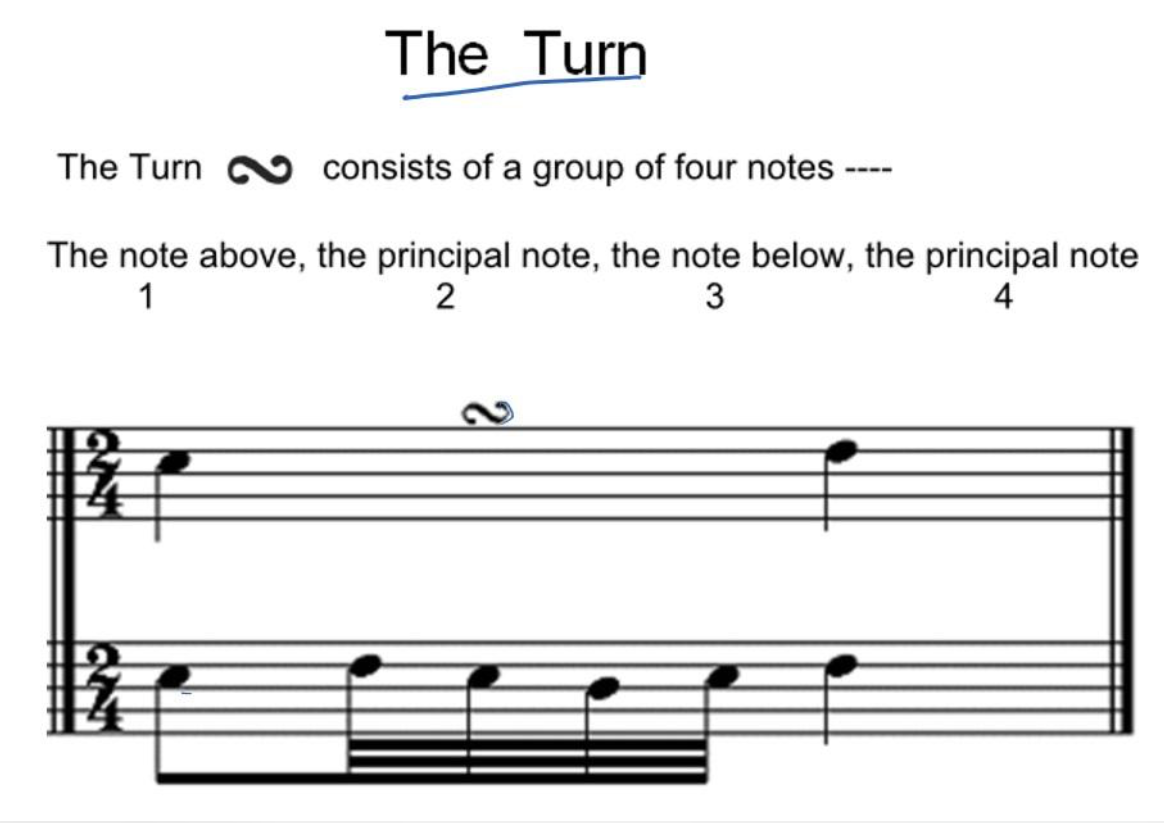
What is a turn?
A short pattern of notes that goes above the main note, returns to it, goes below it, then returns again. It can also appear inverted.
What is a mordent?
A rapid, single alternation with the note above or below the main note.

What is an appoggiatura?
An extra note that usually takes time from the main note. They can be described as usually leaning melodically on the note.
What is an acciaccatura?
Similar to an appoggiatura, but very quick and usually played just before the beat.
What is glissando and portamento?
Glissando: sliding between notes. Portamento: gently connecting two different notes on the same string by sliding a finger.
What’s the difference between an appoggiatura and an acciaccatura?
An appoggiatura usually takes time from the main note; an acciaccatura is much quicker.