unit 4 aos 2: theory
 Call Kai
 Learn
Learn Practice Test
 Spaced Repetition
 Match
Match Flashcards
 Knowt Play
1/40

There's no tags or description
Looks like no tags are added yet.
41 Terms
Mental Wellbeing includes:
Complex multifaceted phenomenon including,
· Levels of Functioning: the degree to which an individual can complete daily tasks in an independent and effective manner. Inability to meet demands of daily life, sign of experiencing low levels of mental wellbeing.
· Resilience: ability to cope with and manage change and uncertainty. Taught over time & can result from seeking appropriate social support. Being resilient does not mean that there is no difficulty/distress in life, however it means you are able to respond effectively to stressors and adapt.
· Social & Emotional Wellbeing: ability for an individual to form and maintain meaningful bonds with others and adapt to different social situations. Ability for an individual to appropriately control and express their own emotions in an adaptive way, also understand the emotions of others. displayed through empathy.
Considered to high or low levels of mental wellbeing depending on ability to function and cope with everyday demands.
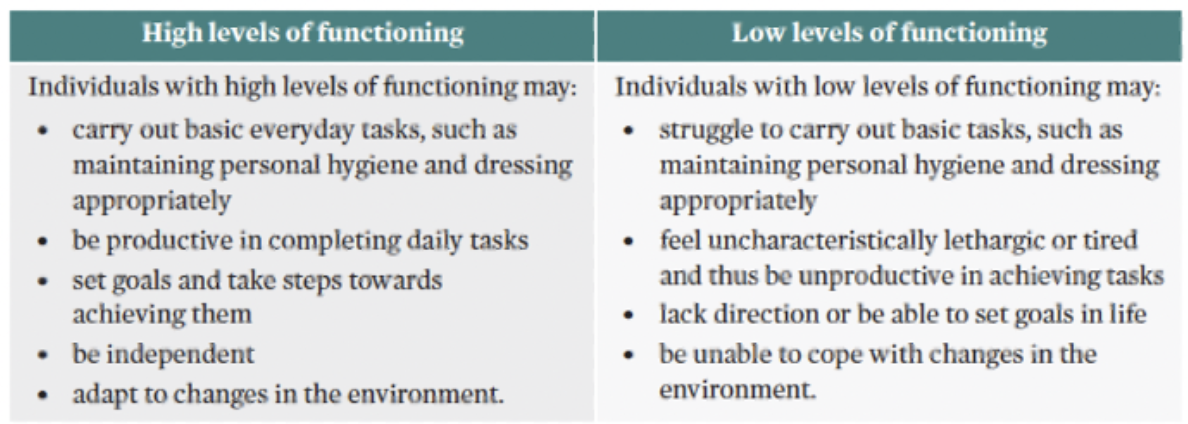


SEWB & Aboriginal and Torres Strait Islander communities:
Aboriginal peoples and communities teach importance of considering the whole person when conceptualising mental wellbeing.
Social & Emotional Wellbeing (SEWB) includes all elements of being, therefore wellbeing. The SEWB framework is: Multidimensional (made up of different components), Holistic (considers the whole person (mental, physical, spiritual and social needs).
Grounded in collectivist perspective- self is viewed as significantly linked to family and community. Culture and cultural identity are integral to achieving social and emotional wellbeing. Aboriginal and Torres Strait Islander peoples’ understanding of social and emotional wellbeing varies between different cultural groups and individuals.
Connection to: Body:
Connecting to the physical body in order to participate fully in all aspects of life (Maintaining healthy weight, access to good nutrition, and managing illness and disability).
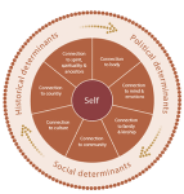
Connection to: Mind and Emotions:
Ability to effectively manage thoughts and feelings. (Maintaining self-esteem, connecting to values and motivation, high levels of confidence, and maintaining strong identity).

Connection to: Family and Kinship:
Connection to the immediate and wider family group and community. (Spending time within family groups promotes a feeling of connection and therefore wellbeing and caring for the ill is the responsibility of all, not simply one’s biological parents or children).
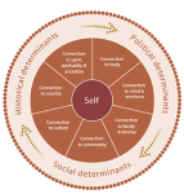
Connection to: Community:
Connection to wider social systems, providing individuals and families the ability to connect with and support each other. (Community services and support, and networks).
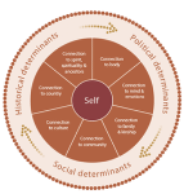
Connection to: Culture:
A strong sense of identity, values, tradition, and connection between the past, present, and future that drives behaviour and beliefs.
Being removed from families (stolen generation) means they will have reduced connection to culture, and therefore poor social and emotional wellbeing.
(Elders passing on information and tradition to future generations, speaking local languages, attending cultural events, and participating in traditional rites and rituals that enable children to learn about their culture’s value systems).

Connection to: Country:
The traditional lands of a particular language or cultural group, used by Aboriginal peoples to describe the lands, waterways and seas to which they are connected, and contains complex ideas about law, place, custom, language, spiritual belief, cultural practice, material sustenance, family and identity.
Establishing social and emotional wellbeing is a strongly embedded in connection to Country. (Beliefs are tied heavily to the land and how one lives on it, therefore one belongs to land rather than the other way around).
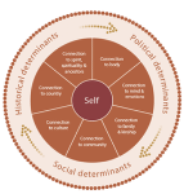
Connection to: Spirituality and Ancestors:
Spirituality: a concept that connects all things, and shapes beliefs, values, and behaviour. It guides knowledge systems, culture, and all that is life for Aboriginal people, including connections to ancestors, the past, the present, and the future.
Ancestors: a belief that a family’s and community’s ancestors are interconnected with Creation spirits and Country, and watch over, guide, and protect families and communities in the physical and spiritual world. (Ancestors watch over them for the entirety of their life, offering guidance creating sense of purpose and wellbeing).

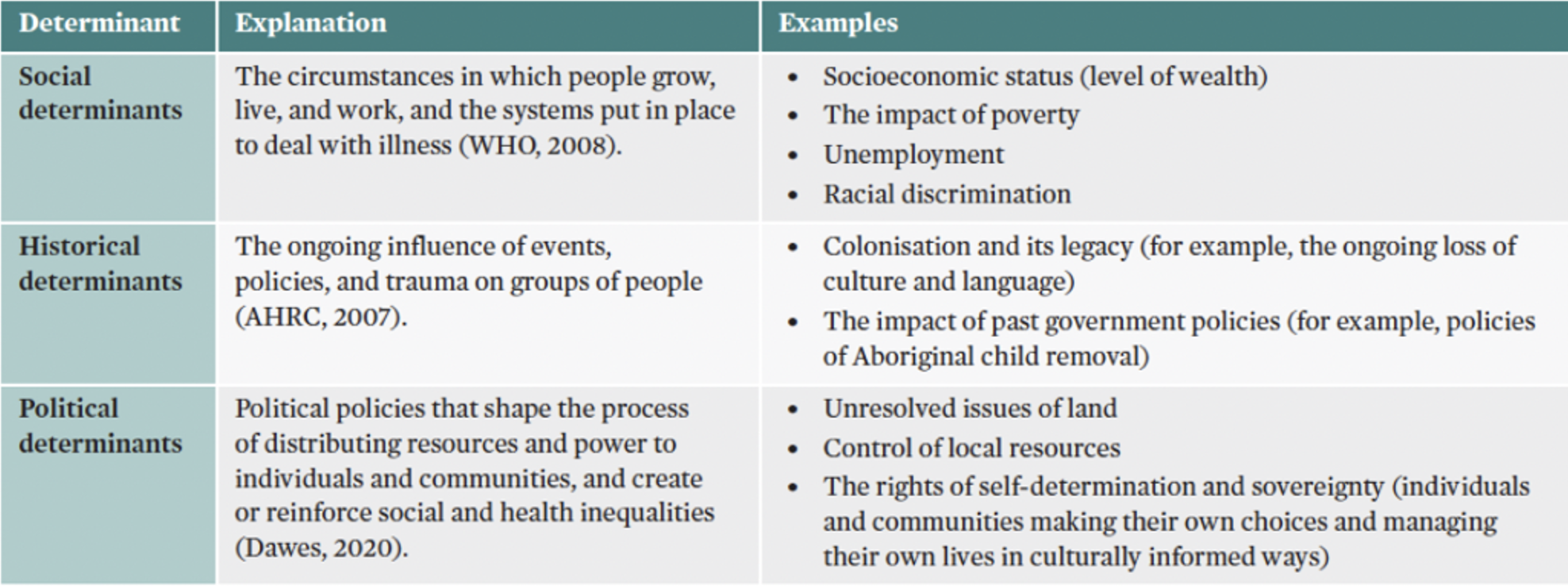
Determinants of Wellbeing on Framework:
Points on the continuum: high

Points on the continuum: middle

Points on the continuum: low

Factors influencing mental wellbeing:
Place on continuum is influenced by:
Internal factors (with in individual)
External factors (from environment)
These factors can be protective (preventing development low levels of wellbeing); or risk factors (contributing to development low levels of mental wellbeing).
Internal Factors:
Categorised as:
Biological factors = functioning of body
Psychological factors = influences that come from mental processes and may relate to prior learning experiences and memory.
Can be more vulnerable to a disorder at different times because of biological factors such as genetics, sex, neurotransmitter function, hormones, immune function, nervous system activity, and physical health.
Psychological factors = styles of thinking, beliefs and attitudes, emotions, learning and memory, and personality traits.
External Factors:
Categorised as:
Social factors =conditions in which people live.
Examples of social factors are: relationships, early life experience, education level, income, social support, stability of accommodation, experience of abuse, cultural values, employment, and discrimination.
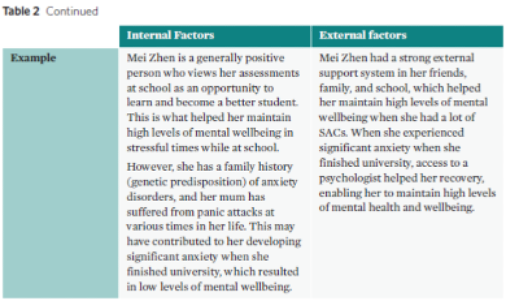
SKILLS Practice: Key points to remember:
· When identifying and applying internal and external factors that influence mental wellbeing, start by stating the category your factor belongs to (internal or external) and then list the examples you have chosen.
· Use quotation marks to clearly
provide examples from the scenario that back up your example.
· Make a link from your example to the impact.
(suggested answer: Internal factor – negative thinking: Sakura ‘always told herself that she wasn’t good at performing well under time pressure’, which is an example of negative thinking. This can lead to a cycle of worry in the lead-up to her VCE exams, causing stress and lowering Sakura’s mental wellbeing.
External factor – employment: Sakura has ‘preferred to work a couple of extra shifts on the weekend at her local café and earn some extra money for schoolies, instead of revising’. This has reduced the available time that Sakura has to prepare her exams, causing stress and lowering her mental wellbeing.).
Distinguishing between stress, anxiety and phobia:
Differences that result in different placements on the continuum.
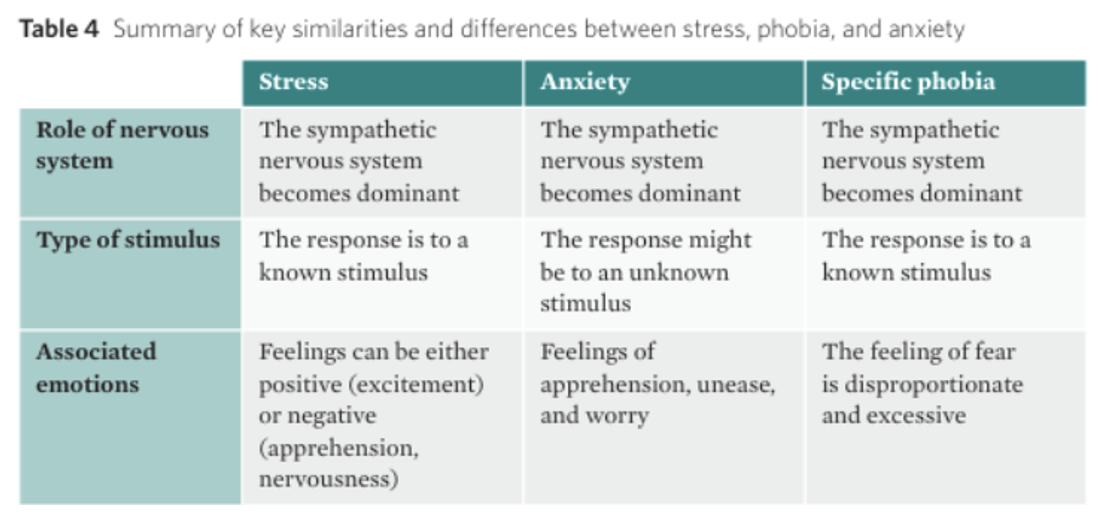
Stress and anxiety on the continuum:
Both stress and anxiety are on the moderate to high part of the mental wellbeing continuum because: expected part of daily life, usually don’t interrupt daily functioning, not always a sign of low mental wellbeing, some stress and anxiety can be adaptive for functioning.
When anxiety is excessive, persistent over a long period of time, and disrupts aspects of daily functioning, an individual may experience lower levels of mental wellbeing.
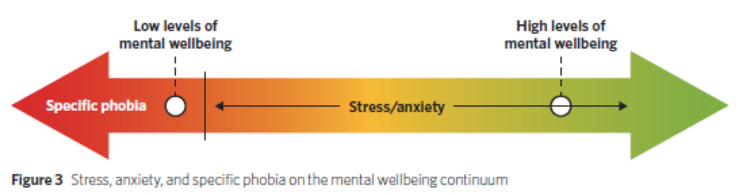
Phobia:
Specific phobias associated with:
• an individual going to great lengths to avoid their phobic stimulus.
• significant disruption to individual’s daily functioning
• low levels of mental wellbeing when encountering or attempting to avoid the phobic stimulus
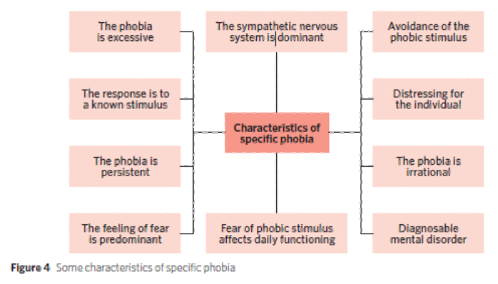
summary:

Factors contributing to the development of a specific phobia: Biological contributing factors:
Genetics: Member of family has a phobia, more likely to have one, more likely to have the same one. Not clear whether factors are genetic or due to something in the home environment. Evidence of genetic component (identical twins are more likely to share a specific phobia than other siblings raised in the same household).
GABA dysfunction: flight-or-fight-or-freeze response or anxiety response is more easily activated, may be very severe, persist for long periods. Maintain the feelings of anxiety in relation to the fear object, even though the perception of danger is imagined and not real. Recurrent stress response to specific stimulus can lead to development of a phobia, because they have a dysfunctional GABA system (predisposed with anxiety).
Excessive anxiety is due to an elevated stress response caused by the release of glutamate during a flight-or-fight-or-freeze response. If there is a failure to produce, release or receive the correct GABA signal, then there is an insufficient inhibitory signal to adequately regulate heightened arousal levels that are caused by excitatory neurons being too active.
Without the inhibitory effect of GABA, activation of postsynaptic neurons might get out of control, could spread throughout the brain, causing seizures like those of epilepsy.
Long-term potentiation: Development of phobias is substantially influenced by learning through experience (Little Albert). Neurologically strengthens the association between a phobic stimulus and a fear or anxiety response through its activity at the synapse (the more its activated the more its strengthened). The more that the connection is activated through each encounter with a phobic stimulus, connection is strengthened, more the relevant neural pathway is strengthened, increasing the efficiency in transferring fear info along pathway and decreasing the likelihood that what has been learnt will be forgotten.
Role of amygdala in conditioned fear responses: LTP is likely to occur within the amygdala.
strengthening through co-activtion either to perpetuate or develop.

BIOLOGICAL PROTECTIVE FACTORS: Adequate nutritional intake and hydration:
When the type and amount of food and drink that an individual consumes meet their physical needs, to maintain high levels of physical and mental wellbeing. Provides enough energy to do daily life, adapt, overcome stressors. Mental wellbeing impacted.
Research tells us to drink 2-3 litres of water, and mediterranean diet (unprocessed food) best for mental wellbeing. Western-style diet (processed foods and lacking vital nutrients): impair mental wellbeing by increasing risk of experiencing mental health disorders.
Biological protective factors: Sleep:
Adequate sleep is vital as a restorative process to prepare the body for daily life. Adequate sleep = less irritable, less likely to become ill. Poor sleep can contribute to issues with memory consolidation, inability to restore neurotransmitter levels and reduced resilience. Common in patients with anxiety, depression, bipolar disorder and attention deficit hyperactivity disorder (ADHD).
Adequate nutrition and hydration, sleep, have a bidirectional relationship with mental wellbeing. (adequate nutrition and hydration can be a protective factor for depression, however, depression can also impair an individual’s appetite, meaning it may be more challenging for a depressed individual to have adequate nutrition and hydration).
Psychological risk factors:
factors that relate to functioning of brain and mind (cognitive and affective processes such as thought patterns and memory).
Risk factors include:
· Rumination: repeating thinking about negative thoughts and
experiences. Can lead to distress and contribute to the development of a mental
disorder, or prolong existing ones.
· Stress: linked to both psychological and biological processes
that occur in the body when a person encounters a stimulus that challenges
their coping mechanisms. Appraisal of stimulus as challenging or exceeding
their coping ability can then lead to a stress response that contributes to the
development of a mental disorder.
· Self-efficacy: a person’s confidence that they can complete life tasks
and meet their goals. Poor self-efficacy may lead to negative thought patterns
about the ability to cope with the everyday demands of life, can contribute to
the development of a mental disorder.
Factors contributing to the development of a specific phobia: Psychological factors:
Phobias learned through experience and may be developed, sustained or modified by environmental consequences such as rewards or punishments.
Explanations of phobias proposes:
Phobia precipitation (initiation/development) by classical conditioning:
· Precipitation by classical conditioning: Classical conditioning has been used to explain the acquisition/initiation/development/precipitation of specific phobias. Psychologists have also found that fear conditioning can occur in people after only a single pairing if the UCS is sufficiently intense/traumatic (being viciously attacked by a dog). Process by which a stimulus with no particular significance (neutral or unconditioned stimulus) becomes, by association, a sign of impending danger (a conditioned stimulus). The innate, naturally occurring fear response (UCR) eventually becomes a conditioned fear response (CR). In addition, stimulus generalisation may occur to other similar situations.
Phobia perpetuation (maintenance) by operant conditioning:
· Perpetuation by operant conditioning: After acquisition, phobia can be maintained through operant conditioning. Any response that that reduces fear will be negatively reinforced. When a person is confronted by, or thinks they might be confronted by, a phobic stimulus, using avoidance behaviour reduces unpleasant feelings of fear associated with the stimulus. This makes the person more likely to avoid the phobic stimulus in future, effectively continuing the cycle of fear.
Question: Cooperm terrible phobia of cupcakes since he was a child. Cooper now has his own children and refuses to take them to parties because he fears encountering a cupcake. With reference to the three-stage model of operant conditioning, describe how Cooper’s avoidance behaviours could perpetuate his phobia of cupcakes. (4 marks)
Suggested answer for full marks:
· Antecedent: Cooper’s children are invited to a birthday party, and Cooper is afraid that he might see a cupcake.
· Behaviour: Cooper avoids going to the party (phobic stimulus).
· Consequence: Cooper’s anxiety about seeing a cupcake is reduced or avoided (negative reinforcement) and therefore he is more likely to avoid taking his children to parties (phobic stimulus) in future, increase likelihood of behaviour reoccurring.


PSYCHOLOGICAL PROTECTIVE FACTORS:
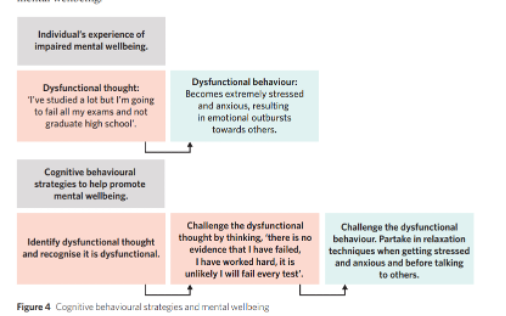
Cognitive behavioural strategies/therapy: Form of psychotherapy, encourages individuals to substitute dysfunctional cognitions and behaviours with more adaptive ones. Focus on the ways in which people think, which often then influences their behaviour. Involves a cognitive and a behavioural component
• The cognitive component involves: identifying negative/dysfunctional thoughts and feelings (cognitions) about the issue. Replacing these negative thoughts and feelings with more positive/functional ones.
• The behavioural component involves: identifying negative/dysfunctional behaviours relating to the issue. Developing and maintaining more positive/functional behaviours relating to the issue.
Mindfulness meditation= Type of meditation, individual focuses on their present experience to promote feelings of calm and peace, without judgement.
Mindfulness meditation can: improve emotional reactivity, reduce the likelihood of rumination (repeatedly considering negative thoughts), reduce stress, improve memory.
Factors contributing to the development of a specific phobia: Social Factors:
Stigma around seeking treatment:
Stigma= People with a specific phobia are vulnerable to stigmatisation because phobias are irrational fears and it is difficult for others to empathise with people who have them. Distress and symptoms may be worsened by a lack of understanding by family, friends and others, and may be a barrier to seeking treatment. In this way, stigma perpetuates a specific phobia.
SOCIAL PROTECTIVE FACTORS:
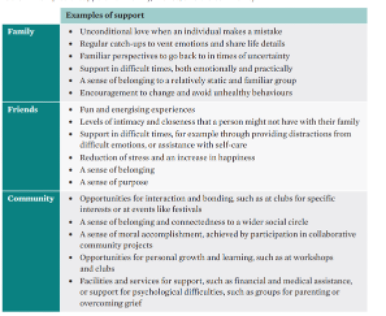
For support to be effective in promoting mental wellbeing, ensure that it is authentic and energising. This means ensuring that the support being provided:
• genuinely aims to promote mental wellbeing
• is focused on creating an environment that is likely to improve mental wellbeing
• uses legitimate and effective advice.
This key knowledge focuses on the positive attributes that should accompany social support – support that is authentic (genuine, down-to-earth, real) and energising (provides vitality, enthusiasm).
The community aspect of this key knowledge can come from community groups that a person engages with (sports club, music group or local community group or more formal support) that comes from the community settings (Headspace and Beyond Blue and other support organisations). Students should understand the reasons why this type of support can act as a social protective factor that can maintain mental wellbeing.
Cultural Determinants of wellbeing:
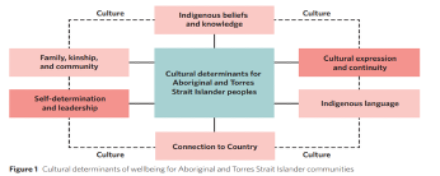
The cultural determinants of wellbeing originate from and promote a strength-based perspective, acknowledging that stronger connections to culture and Country build stronger individual and collective identities, a sense of self-esteem and resilience. Health incorporates individual and community, social, emotional, spiritual and cultural wellbeing.
2 cultural determinants: Cultural continuity and self-determination.
Many determinants of wellbeing, from influences in physical environment to economic factors. Culture is an important determinant of wellbeing. For Aboriginal and Torres Strait Islander peoples, culture can be understood as encompassing a strong sense of identity, values, tradition, and connection between the past, present, and future that drives behaviour and beliefs.
Cultural continuity:
Cultural continuity = the passing down and active practice of cultural knowledge, traditions, and values from generation to generation.
Strong cultural identity can improve wellbeing and protect against stress, trauma, self-harm and suicide.
Colonisation from 1788 caused violence, displacement, disease and loss of culture.
Assimilation and protection policies separated families and created the Stolen Generations.
These experiences caused intergenerational trauma that continues today.
Maintaining culture helps Aboriginal and Torres Strait Islander communities heal, strengthen identity and improve wellbeing.
Self Determination:
This is specified by the UN. Self-determination requires that First Nations people are involved in decision making including decisions that impact communities, states, and the country.
When Aboriginal and Torres Strait Islander peoples were subjected to colonisation and dispossession, cultural determinant was lost and contributed to significant disadvantage and low levels of wellbeing. A range of practices may be used by governments and organisations to demonstrate that they respect and are enabling Aboriginal and Torres Strait Islander peoples’ self-determination. These practices include:
· prioritising culture
· addressing trauma and supporting healing
· addressing racism and promoting cultural safety
· transferring power and resources to communities.
Does not mean separate from the wider Australian community. Aboriginal and Torres Strait Islander peoples assert their right to freely determine their own political, economic, social and cultural development. This contributes to the promotion and maintenance of wellbeing for Aboriginal and Torres Strait Islander peoples.
Self-determination can include endeavours such as:
• Aboriginal community-controlled organisations.
• established partnerships between communities, governments, and non-government organisations, which is any not-for-profit organisation that exists to address a political or social issue.
• constitutional recognition for Aboriginal and Torres Strait Islander peoples.
This will recognise Aboriginal and Torres Strait Islander peoples as the First Nations of Australia and empower Aboriginal and Torres Strait Islander peoples to determine their own futures. Self-determination is an integral factor for the maintenance of wellbeing in Aboriginal and Torres Strait Islander peoples as it enables communities to protect what is most important to them on a wider scale.
Operant condition can also contribute to acquisition:
Eight-year-old ‘Samir’ went camping went for a walk and came across a lake, ‘saw something moving’ in the lake and reacted with terror. He started crying, screaming and shaking all over. Samir’s parents promptly reassured, hugged and kissed him. In addition, to help him ‘feel better’, Samir’s father gave him a piggy-back all the way back to their camping ground and then drove him into town to buy Samir his favourite chocolate ice-cream. Although well-intentioned, Samir’s parents may have inadvertently provided positive reinforcement for his fear response in the form of reassurance, kisses, hugs, a piggy-back and a chocolate ice-cream. The positive reinforcement could therefore strengthen Samir’s fear response or increase the likelihood that he behaves fearfully the next time he encounters a lake or body of water.
Example: Hayley who has claustrophobia, starts job on fifth floor. Uses stairs to get to her office to avoid elevator. Using stairs reduces unpleasant feelings of fear (negative reinforcement) and increases the likelihood that her avoidance behaviour of using the stairs will occur again. Operant conditioning process of negative reinforcement is contributing to the persistence of her avoidance behaviour and therefore her phobic response.

APPLY: Classical conditioning and phobias: reminders
CLASSICAL CONDITIONING REMINDER: Use appropriate language at each stage. ‘During conditioning’ stage: must include ‘neutral stimulus is repeatedly presented before the unconditioned stimulus’.
OPERANT CONDITIONING REMINDER: When constructing a response for how a phobia is perpetuated through operant conditioning, you must continue to use a similar structure to when you discuss it about learning.
Evidence-based interventions in the treatment of specific phobia:
Treatments that have been found to be effective based on valid and reliable studies. Different treatment are appropriate for different people. Based on a thorough evaluation of evidence from published research studies that identifies interventions to maximise the chance of benefit, minimise the risk of harm and deliver treatment at an acceptable cost.

Biological intervention:
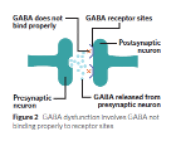
GABA Agonists: GABA dysfunction, biological factor, contribute to specific phobia. The lack of inhibitory neural transmission in the body leads to over-excitation at the synapses, and this decreased ability to regulate neural firing can lead to feelings of anxiety. - Benzodiazepine, reduces physiological arousal and promotes relaxation. Are agonists (mimic/enhance action of a neurotransmitter that binds to its receptor on the post-synaptic neuron). When a benzodiazepine binds to a GABA receptor site, increases inhibitory effects of GABA. This makes the post-synaptic neuron less likely to fire, which reduces the feelings of anxiety.
Breathing retraining: Helps maintain correct breathing or correct abnormal breathing patterns when anticipating or exposed to specific phobias. Goal is to slow the breathing (HR, BP and other bodily functions also affected) = promoting relaxation. Involves slow, regular breaths in through the nose and out the mouth at a controlled rate as opposed to fast and/or irregular, shallow ‘chest breathing’ or the rapid, deep breathing of hyperventilation. Maintain the correct balance of oxygen and carbon dioxide in the blood. Generally, a slow breathing and fight/flight response are mutually exclusive. Can be Used by itself or in combination with other treatments. (needs to be practiced as a skill).

Reasons for levels of GABA
Levels may be affected by: Genetic inheritance, Central nervous system damage, exposure to prolonged stress, Nutritional deficiencies in vitamin B6 and citric acid, high caffeine intake. Either inhibit GABA release, inhibit its ability to bind to GABA receptors on post-synaptic neurons, or to stimulate overproduction of glutamate in some way.
Psychological interventions:
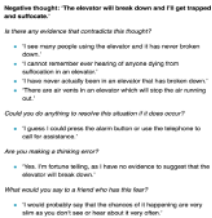
Cognitive behavioural therapy: Focuses on addressing pattern underlying a specific phobia. Aims to develop a new understanding that their feared stimuli are not dangerous, avoidance is unnecessary. Avoidance and safety behaviour used to help minimise or control their fear (targeted).
During CBT: Address cognitive and behavioural components of the therapy. Changes in feelings and behaviour, particularly a reduction in fear, anxiety and avoidance
Cognitive therapy: Identify negative thoughts (cognitive biases), challenge and feeling replace with more positive ones. Reduction in fear-related behaviours (avoidance of phobic stimulus).
Behaviour therapy: Identify and challenge negative behaviours (using relaxation techniques- breathing retraining, promoting exercise), develop and maintain more positive behaviours.
· Systematic desensitisation: Classical conditioning plays a role in the development of some specific phobias. Apply classical conditioning processes in developing therapies for treating phobias and aims to replace anxiety with a relaxation response.
Three step process:
Learning a relaxation technique: decrease physiological symptoms. (Breathing retraining, progressive muscle relaxation, visual imagery).
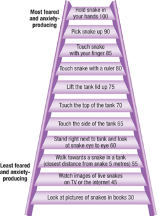
Forming a fear hierarchy: Breaking down the anxiety-arousing object into least to most anxiety-producing.
Gradual exposure to the fear stimulus in the hierarchy: least-frightening fear + using relaxation technique -> control fear response, repeated until the stimulus no longer produces a fear response (produces a relaxation response). No advancement is made to the next step until relaxation is achieved.
Social interventions:
Psychoeducation for families and supporters: Psychoeducation = process of providing information to people with a mental illness and their family/friends to increase understanding of disorder and treatment options (enhance therapy). (Increased understanding will be increasing coping). Social support network educated about two key strategies to help manage a phobia:
· challenging unrealistic or anxious thoughts: Social support to challenge unrealistic or anxious thoughts of the person. (encourage recognise and challenge unrealistic thoughts (calm, gentle manner), ‘How likely is it that you will get an infection?’). Replace with more rational evaluation of exposure to phobic stimulus.
· not encouraging avoidance behaviours: Understand what avoidance is and the role it plays in perpetuating a phobia and how it can impact on daily functioning. Support network might encourage person to slowly expose themselves to the fear stimulus, use praise and companionship while sufferer does this. (sit in a doctor’s office for a small amount of time and encourage him to remain). Important to continue to provide comfort/reassurance, positive reinforcement through praise and possibly even provide a reward.
How Benzodiazepine as a GABA Agonists works:
More receptive to the activity of the GABA and consequently more resistant to excitation. Reducing excitability of neurons reduces communication between neurons and has a calming effect. If there is no GABA at the receptor site, benzodiazepine has very little effect on the post-synaptic neuron. If GABA is present, then benzodiazepine will amplify the impact of GABA.

Breathing excessively:
Experiencing a phobic reaction may over breathe (hyperventilate). Breathing = rapid, small shallow breaths, resulting in oxygen and carbon dioxide imbalances in the blood, carbon dioxide levels can become low. Carbon dioxide helps regulate the body’s reaction to anxiety, and when levels are low this can cause reactions (dizziness, light-headedness, blurred vision and pins and needles), which in turn increases already heightened anxiety.
