VCE Chemistry Unit 4
 Call Kai
 Learn
 Practice Test
 Spaced Repetition
 Match
 Flashcards
 Knowt Play
1/105

106 Terms
Hydrocarbons
molecule consisting of C and H only
Isomer
molecules with the same molecular formula, but have a different arrangement of atoms
Alkanes
Contain singly C-C bonds, fully saturated
Alkenes
Contain at least one C=C bond, are unsaturated
Degree of unsaturation
number of C=C bonds in a molecule
Formula= no. H atoms missing/2
Arenes (benzenes)
Most common is C6H6 aka benzene
Contain a ring of delocalised e-

Haloalkane
Organic compound with a halogen atom
Halogens named in alphabetical order
Alcohol
Have a hydroxyl group attached
Primary: Group attached to C attached to only one other C
Secondary: Group attached to C attached to 2 other Cs
Tertiary: Group attached to C attached to 3 other Cs
Amines
-NH2
Name: amino
Suffix: -amine
Aldehydes
C=O
Name: carbonyl
Suffix: -al
Ketones
C=O (not primary)
-CO-
Carboxylic acids
-COOH
Name: carboxyl
Suffix: -oic acid
Primary amides
-CONH2
Naming not required for study design
Esters
-COO-
Name: ester
Suffix: -oate
Formed through condensation of primary alcohol and carboxylic acid
Bonding for Carboxylic acids
Can form 2 hydrogen bonds per molecule, resulting in the formation of a dimer. Much stronger bond than many other organic compounds with hydrogen bonds.
Viscosity
Measure of a liquid’s resistance to flow.
More viscous, less flow
Substitution reaction
An atom or group of atoms is replaced by another atom or group of atoms.
Must be in the presence of UV light
Addition reaction
An unsaturated bond is saturated through the addition of an atom or group of atoms.
e.g. HBr, Cl2 all react to saturate double bonds
Addition of halogens/hydrogen halides don’t require any catalysts
Addition of Hydrogen
Hydrogenation reaction, between an alkene and hydrogen
Requires a catalyst to react
e.g. Nickel, Platinum
Addition of Water
Hydration reaction (involves water/steam)
Requires presence of solid H3PO4 catalyst (phosphoric acid) and heat
Substitution of haloalkanes
-OH, NH3
Require no catalyst as bond is reactive enough
H2O
Produces alcohol, requires a catalyst (e.g. Iron oxide) and heat
Oxidation reaction
Alcohols can be oxidised depending on their structure
Distillation:
Primary, secondary alcohols → aldehyde, ketone
Reflux:
Primary → Carboxylic acid
*Tertiary alcohols can not be oxides
Oxidising agents: MnO4- or Cr2O7- (with H+)
Reactions of carboxylic acids
Act as weak acids, partially ionise in water
React fully with bases and carbonates/hydrogen carbonates
Esterification reaction
also condensation reaction, as water is produced
Carboxylic acid + alcohol with conc. H2SO4 and heat
Hydrolysis of an ester
Add water with acid catalyst
Transesterification reaction
Triglyceride converted to biodiesel
Reacts an alcohol + ester
Presence of catalyst e.g. KOH or NaOH
From 3 ester molecules + 1 glycerol molecule

Yield for multistage process
(decimal yield of all x each other) x 100
Proteins
Growth, repair of tissues
Meat, eggs, lentils
Carbohydrates
Dietary fibre
Starchy foods
Fats + oils (triglycerides)
Carrier for fatty acids
Butter, oils, fats
Amino acids
Carboxyl group
Amino group
R’ group → on second carbon
Formation of proteins
Condensation reaction, forms peptide/amide bond
[-OH from carboxyl, H for amino]→ combine
Carbohydrates
monosaccharide
disaccharide
polysaccharide
Made from C, H and O
Monosaccharides
Glucose (α and β)
Fructose, galactose
Disaccharides
Form glycosidic link/ether bond between monosaccharides
(C-O-C)
Condensation reaction
Polysaccharides
Very large, no taste, generally insoluble in water
e.g. starch, cellulose, glycogen
Starch
α-D-glucose
creates:
amylose (linear)
amylopectin (occasional branching)
Cellulose
β-D-glucose
Plant cell walls, rigid structure
Glycogen
α-D-glucose
Very, very branched
enables quick absorption for energy in muscles
Hydrolysis of carbohydrates
Starch, glycogen + enzymes, water → maltose → glucose
Cellulose + cellulase → usable fuel
Latent heat of fusion
Energy required to change a solid to a liquid
Volatility
Measure of how readily a substance will form a vapour
Primary standard
Must:
High state of purity
Accurately known formula
Be stable/uncreative with atmosphere
Cheap
High molar mass
Readily accessible
Melting point determination
Variations in mp can determine purity.
Impurity: interrupts regular lattice structure of compound, decreasing mp
Pure: 0.5 - 2 C range
Impure: 5+ C range
Thiele tube
Ensure sample is heated slowly to determine a more accurate mp range
1 C per min

Distillation
Functions based off different bp of compounds.
Most effective when compounds differ by at least 100 C
Distillation can be repeated multiple times to get a more pure distillate

Fractional distillation
Fractioning column - has beds/platforms in which vapour condenses, going back down the column. Separates compounds, making a more pure distillate and functioning the same as multiple boil-condense cycles
Starch indicator
Detects presence of Iodine.
brown → colourless/ox → reduced
In presence of iodine = dark blue
Methylene blue
Blue in presence of oxidising agent
Colourless in presence of reducing agent
Mass spectrometry
Splits particles to determine the molar mass of a compound, as well as information regarding arrangements of atoms within a molecule
Ionisation
Bombards a sample with high energy electrons, knocking some off, creating a positively charged ion
Only pos charged ions detected by mass spectrometer
Fragementation
Unstable molecular ion fragments, produces smaller ions
Base peak
Tallest peak in mass spectrometry
Molecular ion
Peak with largest mass-to-charge (m/z) value
Isotope effect
Smaller peak after molecular ion due to isotopes e.g 13C
Common Isotopes
79Br 81Br, in ~ 50 50 ratio to one other
35Cl 37Cl
Infrared spectroscopy
Identifies functional groups through measuring energy absorbed by covalent bonds when exposed to infrared radition
Covalent bond vibration
Covalent bonds are always vibrating
When exposed to infrared radiation, this vibration changes
Non-polar bonds and molecules of only 2 of the same element will not absorb infrared radiation
Fingerprint region
Region below 1500 cm-1 which is unique to each molecule. Not used in VCE study design
Factors affecting bond vibration energy
Strong bonds: more energy to change vibration, will vibrate at a higher frequency
Light atoms: more energy to change vibration, will vibrate at a higher frequency
NMR spectroscopy
Used to determine different “environments” surrounding each Carbon and Hydrogen in a molecule.
Basics of NMR
Nuclei have a “spin state”
Magnetic field applied aligns nuclei parallel/anti-parallel depending on their energy
As nucleus moves to low energy state, releases energy, which is then detected.
Shielding
Electrons/atoms surround nucleus will shield from magnetic field
Hence different chemical environments will release different energy levels
Chemical shift
Tetramethyl silane (TMS) taken as value 0
All other molecules measured in comparison to TMS

Pros of TMS
1 C and 1 H environment
Signal peak is well away from other peaks
Volatile, so can easily be separated
Inert compound
Low resolution H NMR
Number of peaks = number of unique hydrogen environments
Relative size of peak to one other determines ratio of hydrogens to each other
High-resolution H NMR
Peaks “split” according to number of hydrogens on adjacent carbons
Splitting pattern
0 H = 1 peak
1 H = 2 peaks
2 H = 3 peaks
3 H = 4 peaks
Surrounded by H attached to C in same environment, = multiplet, splitting up to 7 times
C NMR
Produces single peak, no splitting
Much larger chemical shift than H NMR
Stationary phase
Solid, liquid coating a solid, onto which components of a sample adsorb
Mobile phase
liquid, gas that flows through a chromatography system, moving materials along
Affinity
Attraction of a component to the stationary or mobile phase
Retention time
Time taken for component in a sample to elute
Resolution
Effective separation of components within a sample
Improved by increasing number of adsorb/desorb cycles
Chromatography
Technique used to separate components based on their polarity
Column chromatography
Chromatography done in a column, with components being collected from the bottom
Continuous mobile phase added throughout the process

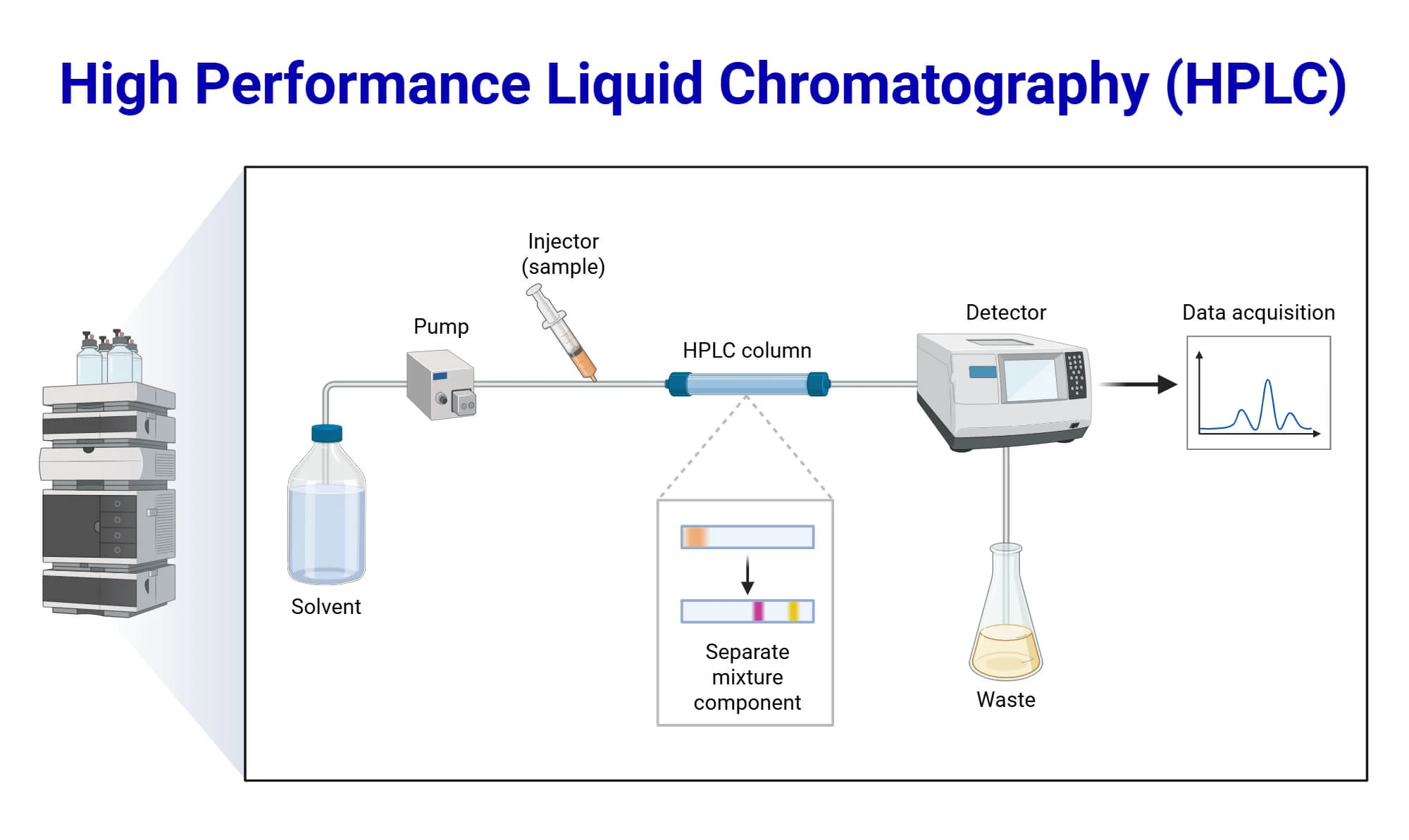
High-performance liquid chromatography
Sample injected onto start of column as liquid
Eluent pumped through the column
Components separated through adsorption/desorption
As components exit column, usually detected by measuring the absorbance of UV light
Chromatogram
Makes graph based on retention time
Peak height corresponds to concentration of the component in the sample
HPLC quantitative analysis
Conc. of component = area under corresponding peak
Create a calibration curve, assists in finding concentration of unknown substance

Increasing resolution
Lower temp, components less soluble in mobile phase
Packing resin in column more tightly, components move slower
LC - MS
Inject sample in HPLC
As separated components leave the column, they are analysed by MS
Mass spectra are matched to identify the component
Optical isomer
Non-superimposable mirror image known as enantiomers
Do not have a plane of symmetry
Extraction
Process of moving a substance from one phase to another, generally to isolate a specific component
2-amino acid
Amino + carboxylic acid group attached to same carbon
Type of amino acid found in the body
Zwitterion
Molecule that contains both positively and negatively charged groups, with a net charge of 0

Substrate
Reactants in an enzymatic reaction
Active site
Area where substrate binds to an enzyme for a reaction to occur
Denaturation
Enzyme/protein loses its 3D shape
Only primary structure, disulfide bridges remain
Competitive inhibitor
Inhibitor that binds to the active site of an enzyme in place of the substrate
Stereoisomer
Atoms are connected in the same order, but are oriented differently in space
Chiral
Asymmetrical molecule: chiral
Symmetrical molecule: achiral
Carbon bonded to 4 different atoms or groups of atoms
A molecule will form enantiomers if it has a chiral centre
Polarised light interactions
Enantiomers will rotate polarised light.
If light is rotated clockwise, it is the + enantiomer
If light is rotated anticlockwise, it is the - enantiomer
Synthetic formed stereoisomer
Optically active, produced 50:50 mixture of 2 enantiomers (aka racemic mixture)
Biological formed stereoisomer
1 stereoisomer formed
May function for a specific biological task where the other enantiomer is not useful, hence only one is produced
Solvent extraction
2 layers created through a suitable solvent + immiscible solvent e.g. opposite polarities
Funnel closed + shaken, allows two layers to mix
Mixture with varying polarities will be separated, allowing scientists to isolate certain components

Acid-base solvent extraction
e.g. with Salicylic acid
Non-polar organic solvent (hexane) added to dried plant to dissolve salicylic acid
NaOH (aq) is added, forming a salicylate salt
--—→ contains charged -COO- group, dissolving in polar layer
can then be extracted, HCL may be added to convert back to salicylic acid
Primary structure
Amino acids covalently bonded with peptide/amide links
Secondary structure
Folding of polypeptide chain due to hydrogen bonding
α-helix: hydrogen bonds between peptide bonds that are 4 amino acids apart
β-pleated sheets: two section of same peptide line up and held together in a sheet-like structure
Tertiary structure
3D structure of protein, referred to as its conformation.
Interactions between R-groups
e.g. ionic, disulfide bridges, hydrogen
Quaternary structure
Proteins with 2 or more folded peptide chains combined
Bonds: hydrogen bonding, disulfide links, ionic attractions