Neur305 Exam 1
 Call Kai
 Learn
Learn Practice Test
 Spaced Repetition
 Match
Match Flashcards
 Knowt Play
1/90

Earn XP
Description and Tags
anatomical terms n such
Name | Mastery | Learn | Test | Matching | Spaced | Call with Kai | Chat |
|---|
No analytics yet
Send a link to your students to track their progress
91 Terms

What part of the brain is circled?
Central Sulcus

What part of the brain is circled?
Parieto-occipital Sulcus

What part of the brain is circled?
Pre-Occipital Notch

What part of the brain is circled?
Lateral Sulcus/ Sylvian Fissure

What LOBE of the brain is circled?
Frontal Lobe

What LOBE of the brain is circled?
Parietal Lobe

What LOBE of the brain is circled?
Occipital Lobe

What LOBE of the brain is circled?
Temporal Lobe

What PART of the brain is circled?
Cerebellum
what is important/significant about “Sulci”
Increase surface area of the brain and are important landmarks

What plane of view for the brain is this?
Coronal Plane

what plane of view for the brain is this?
Horizontal Plane
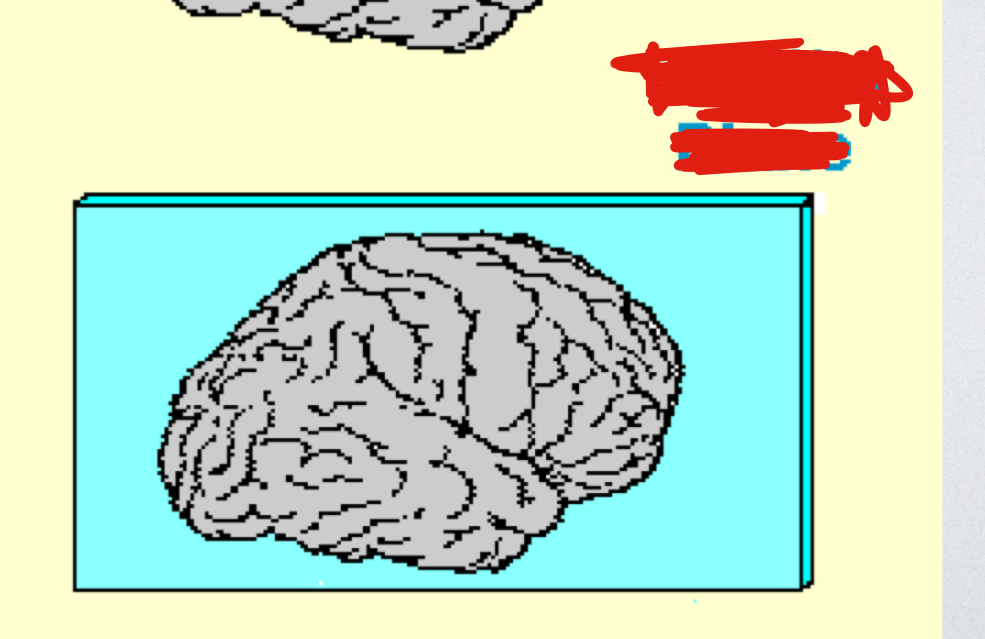
what plane of view for the brain is this?
Saggital Plane

What plane/view of the brain is this?
Lateral

What plane/view of the brain is this?
Superior
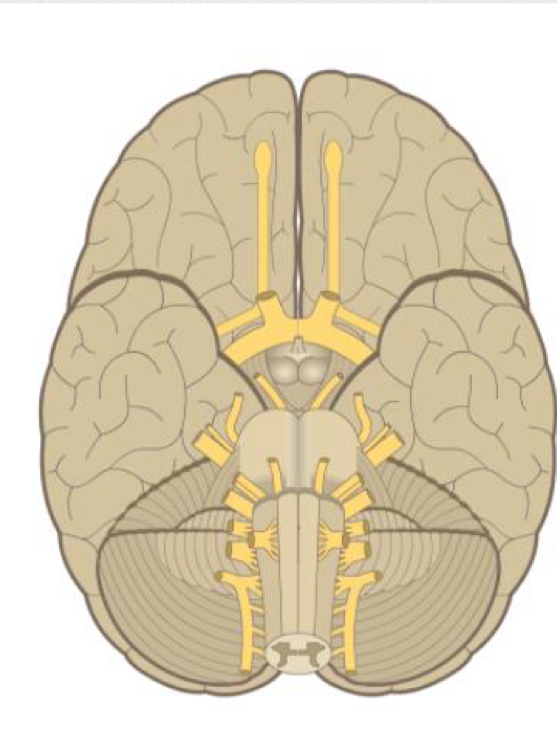
What plane/view of the brain is this?
Inferior

What plane/view of the brain is this?
Saggital

what plane/view of the brain is this?
Coronal

what plane/view of the brain is this?
Horizontal/transverse
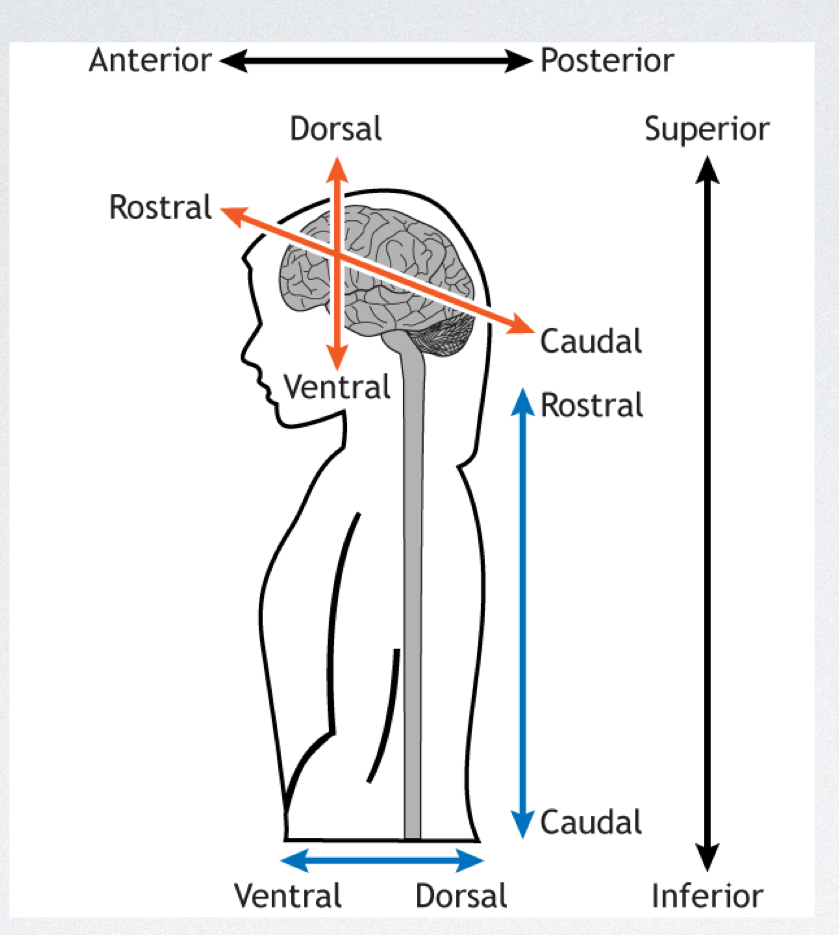
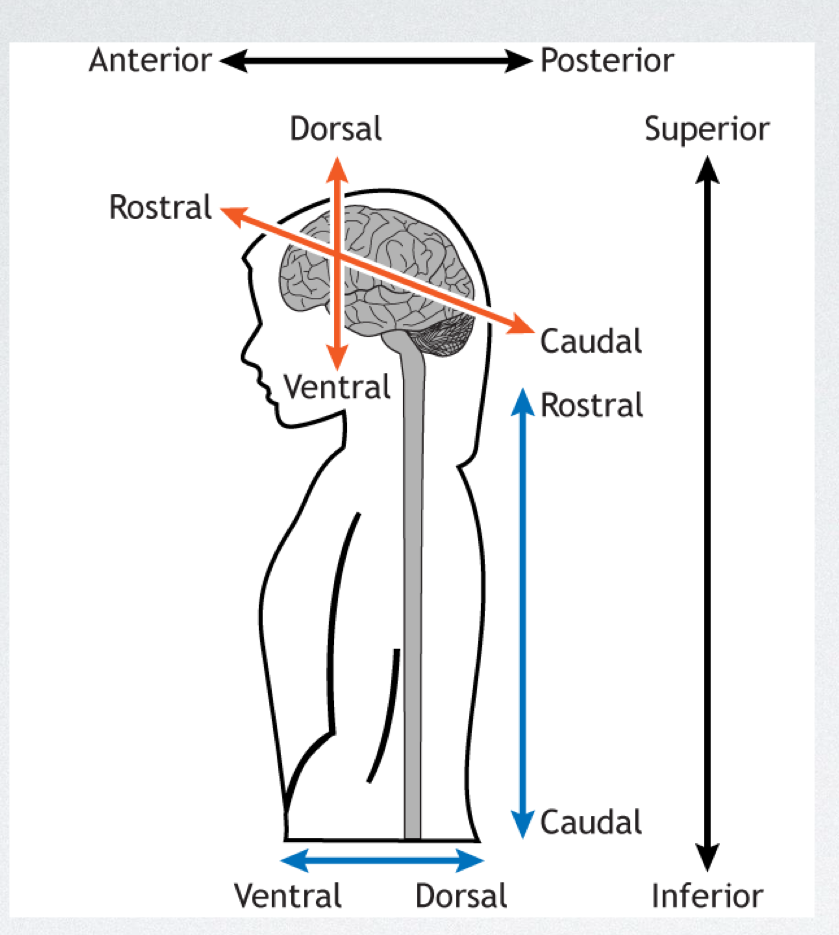
In terms of directional terminology, where/what is ROSTRAL?
towards the front of the brain/face(nose)

In terms of directional terminology, where/what is Caudal?
away from the head or towards tail
In terms of directional terminology, where/what is Medial?
meaning closer to the midline of the body
In terms of directional terminology, where/what is Contralateral?
Meaning opposite side of the body

In terms of directional terminology, where/what is Ipsilateral?
Means on the same side of the body

In directional Terminology, what/where is anterior?
In front of or frontal

In directional Terminology, what/where is Posterior?
behind of or behind

In directional Terminology, what/where is Ventral?
Towards the front of body, bottom of brain/spinal cord

In directional Terminology, what/where is Dorsal?
Towards the back of the body
What is the resting membrane potential, and what maintains this potential
-70mV, maintained by Ion pumps Na+/K+
Where is the action potential generated?
Generated at axon hillock
In action potential propagation, what can speed up signal transmission
Both wider axon diameter, but MOSTLY MYELIN
What is responsible for signal regeneration in myelinated axons?
Nodes of ranvier
Do signals only move in one direction?
Yes, saltatory conduction, (however backpropagation does exist)
What are action potentials usually described as
all or nothing events
Action potentials occur after the membrane potential crosses a
threshold that is more ___ than the resting membrane potential
Positive
Post-synaptic potentials can be excitatory or
inhibitory
True
Glutamate significance
released by pyramidal cells, most abundant neurotransmitter, found in most fast,
excitatory synapses
GABA significance
second most prevalent, synthesized from glutamate found in most fast, inhibitory
synapses
Neuromodulators
substances that work with neurotransmitters to enhance or modify the
response of the receptor (for example neuropeptides)
What is neural coding?
The study of how neurons process information, and perform some computation to achieve an end goal: produce some behavior
What is the relationship between stimulus and response?
Stimulus→Encoding→Neural Response→Decoding→stimulus…..
What is the “Language” of neurons?
Spikes
as an example of neural coding, what is sparse coding?
small number of active neurons used to represent data, which can be more efficient than using all neurons (olfaction, vision)
Rate Coding?
the rate or frequency of action potentials represents data
Temporal Coding?
the timing of and between spikes represents data
On the scale of connection, what is MICROSCOPIC describing?
Single neurons and their synaptic connections.
On the scale of connection, what is MESOSCOPIC describing?
Connections within and between columns or other types of local cell assemblies
On the scale of connection, what is MACROSCOPIC describing?
Anatomically segregated brain regions and inter-regional pathways.
Regarding structural, functional, and effective connectivity, what is STRUCTURAL describing?
Pattern of structural connections between
neurons, neuronal populations, or brain regions.
Regarding structural, functional, and effective connectivity, what is FUNCTIONAL describing?
Pattern of statistical dependencies (e.g. temporal correlations) between distinct (often remote) neuronal elements.
Regarding structural, functional, and effective connectivity, what is EFFECTIVE describing?
Network of causal effects, combination of functional connectivity and structural model.
Brain lesions tend to be have effects on what scale?
Macroscopic
Compare MRI to CT ("CAT scans"). Which is
true?
A. Both methods use X-rays, but
exposure is higher with CT.
B. CT reveals soft structures,
while MRI is better at dense
material, such as bone.
C. Both methods produce cross-
sectional images at a
specified plane through the
body.
C. Both methods produce cross-
sectional images at a
specified plane through the
body.
What is an advantage of using animal models of brain injury?
allow researchers to experimentally control brain injuries and study their effects on behavior and brain function.
What is MRI, advantages and disadvantages in terms of spatial and temporal resolution
Magnetic Resonance Imaging, High spatial resolution(1-3 voxels/mm²), but poor temporal resolution(seconds)
What is fMRI, advantages and disadvantages in terms of spatial and temporal resolution
Functional MRI, detects changes in magnetic field as result of changes in blood o2 levels, signals activity in that region,
good spatial resolution(voxels)
Poor temporal resolution (seconds)
What is EEG, advantages and disadvantages in terms of spatial and temporal resolution
Electroencephalography, measures electrical activity over time
Poor spatial resolution, covers large area per sensor
Very good temporal resolution (ms)
What is MEG, advantages and disadvantages in terms of spatial and temporal resolution
Magnetoencephalography, measure tiny magnetic fields produced by electrical currents in the brain using sensitive sensors,
Good (or at least better than eeg) spatial resolution, less distortion of active brain areas
Good temporal resolution (ms)
What is Optogenetics, advantages and disadvantages in terms of spatial and temporal resolution
Monitor activity of specific neurons in living tissues; genetic engineering introduces light sensitive proteins (opsins) to target specific cells
Very good spatial resolution(single neuron)
Very good temporal resolution (ms)
What is Calcium Imaging, advantages and disadvantages in terms of spatial and temporal resolution
Measure concentration and flow of intracellular calcium ions within living tissue, Electrical activity within cells used as visual flashes of light, calcium concentration in resting cells is low but when AP occurs, influx of Ca2+; calcium indicatiors simply change color or brightness when bound to Ca2+
Very good spatial resolution (single neuron)
Very good temporal resolution(ms)
Isoptrophic
having a physical property that has the same value when measured
in different directions
Anisotropic
having a physical property that has a different value when
measured in different directions
Neuronal axons would be considered: Anisotropic or Isotropic
Anisotropic
What is DTI, advantages and disadvantages as a imaging technique
Diffusion Tensor Imaging: MRI technique that measures the directional diffusion of water to map white-matter axons.
non-invasive, good spatial resolution (~1–2 mm), maps white-matter pathways.
poor temporal resolution (seconds), doesn't directly measure neural activity, and has difficulty resolving crossing fibers.
tells where and how axons are organized, but not when neurons fire
Positron Emission Tomography (PET)
Uses radioactive tracers to visualize changes in
metabolism, and blood oxygen levels.
Mainly used in clinical settings for cancer and
Alzheimer’s disease detection.
Functional Near-Infrared Spectroscopy (fNIRS)
non-invasive, portable method employing near-
infrared light propagating diffusely through the scalp
and brain
functional monitoring and imaging of human brain
hemodynamics.
Similar to EEG in that is is non-invasive and portable.
Can only measure near the surface of the brain.
significance of pharmacology in imaging?
Agonist drugs – similar structure to neurotransmitter & mimic action
Antagonist drugs – bind to receptors and block function
Transcranial stimulation
Human participants possible
Poor spatial resolution
Inconsistent results
Deep brain stimulation
Implantable electrode deep in the brain
For treatment of Parkinson’s implanted in subthalamic nucleus
Neurostimulator in chest sends continuous pulses to disrupt neural function at site of electrode
What are morals?
an individual's own principles regarding right and wrong
What are ethics?
rules or codes provided by an external source. Usually founded on moral principles
What is Legal/Law?
legal standards that allow for enforcement. Often based on ethics but not everything legal is ethical and vice versa
Regarding the Belmont Report, what are the 3 BASIC ETHICAL PRINCIPLES
Respect for persons, Beneficience, and Justice
Why are non human animals often used in research?
Known behavioral history. Can control prior experience.
Often know full genetic sequence
Animals will not try to guess the goals of the experiment
Can control confounding variables such as inherent traits
can carry out some experiments not “possible” with humans; gene editing
What are the 3 “R”s in animal research?
Replacement
Reduction
Refinement
What is the role/significance of both the IRB and IACUC in research?
Insitutional Review Board: Reviews human experimental research
International Animal Care and Use Commitees: review research with non human subjects
What are the seven criteria for IRB?
Minimization of risk to participants
Reasonable risk in relation to benefits
Equitable selection
Informed consent
Documentation of informed consent
Data monitoring
Privacy and confidentiality
The two hemispheres of the brain are more alike than they are different? True or false
True
What is a commisure?
generally, the location where two things are joined. In our neuroscience, white matter axon bundles connecting the hemispheres of the brain
What is the largest commissure in the brain?
Corpus Callosum
What does Homotopic mean in terms of hemispheric spatialization?
going to the same area on opposite side of brain
What does Heterotopic mean in terms of hemispheric spatialization?
goes to different area opposite side of brain
What are 3 anatomical and functional differences between the left and right hemisphere of the brain
Right half has more frontal volume
Sylvian fissure more prominent on the right hemisphere
language is usually more left-lateralized, while right is facial and spatial attention/processing are more right-lateralized
Why do split brain patients largely feel normal following surgery?
Because the 2 hemispheres are largely similar and each of the hemispheres can perform the same functions independently
Information from the left visual field goes to?
RIGHT hemisphere
You show the word ‘key’ to the LEFT visual field and the word “ring” to the RIGHT
visual field, then and ask the patient what word they saw. What will they say?
Ring- Right visual fied→ left hemisphere associated with speech/language

F is a local or global stimuli?
Local

What would be GLOBAL stimuli in this image?
the overall letter H
Regarding the Habenula (Hb) what are some differences/asymmetries
Right Hb is much larger
Different neuronal types and numbers present in
left versus right
The LHb receives projections from the parapineal
(light), whereas the RHb receives olfactory
projections
What are the Left (LHb) and Right (RHb) habenula connected by?
anterior commisure
What did the wada test show about how hemispheres work together?
They have some specialized function, but can work together and partially compensate for the other