acid base imbalances
 Call Kai
 Learn
Learn Practice Test
 Spaced Repetition
 Match
Match Flashcards
 Knowt Play
1/26

There's no tags or description
Looks like no tags are added yet.
Name | Mastery | Learn | Test | Matching | Spaced | Call with Kai | Chat |
|---|
No analytics yet
Send a link to your students to track their progress
27 Terms
normal pH
7.35 - 7.45
normal pCO2
35 - 45 mmHg
normal [HCO3]
24 - 28 mEq/L
acidosis
low ph symptoms due to Na+ channels clocking —> signals cannot be started or propagated (nerve firing)

decreased in nerve firing causes
vasodilation (headache, warmed flushed skin), decreased HR and BP, weakness, tremors, stupor, confusion, hallucinations
acidosis complications
increased cerebral pressure, paralysis —> respiratory insufficiency, cardiac arrythias, coma
alkalosis
high pH, Na channels too open (not enough h+ to close door)—> signals excessivelt started or propagated
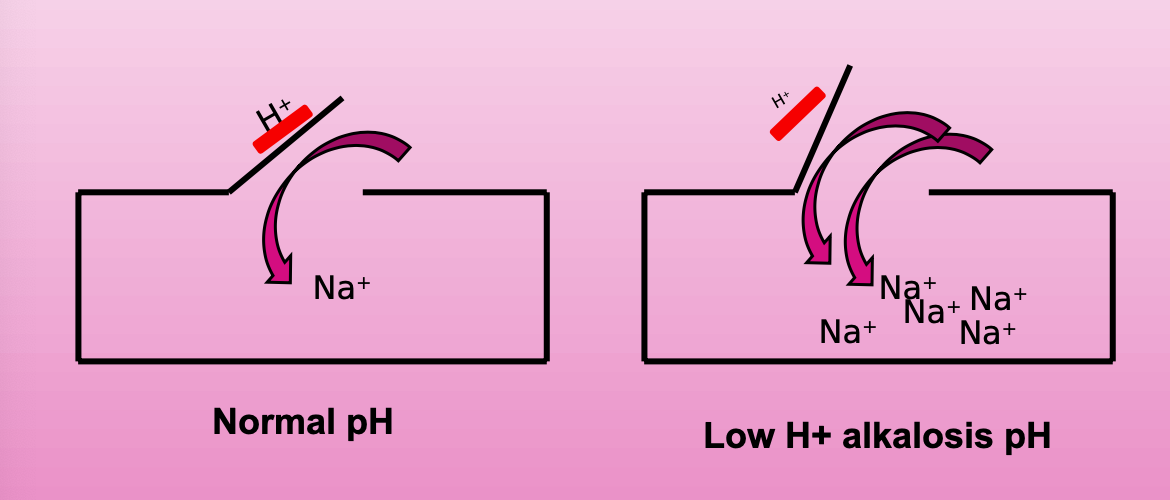
symptoms of alkalosis
vasoconstriction (high BP), increased nerve firing, overactive GI, paresthesias (tingling), tetany &/or seizures, cardiac dyshrythmia & increased HR, dizziness & syncope
metabolics
changes in acid of base concentration (has proportionate relationship with CO2)
respiratiry
CO2 changes (has an inverse relationship with CO2)
respiratory acidosis
pCO2 increases and forms h2co3 carbonic acid, bicarb buffer is normal or elevated
why would HCO3 be normal or elevated in respiratory acidosis
to compensate by kidney retention pancrease bicarb and diet. large source of bicarb. carbonic acid turns to carbonate when neutralized then to bicarb
CO2 is elevated in respiratory acidosis because of
pt cannot get rid of CO2/ increase production (fever, sepsis, burns, exercise), ventilation disorders.
metabolic acidosis
release H+ into blood, H+ interacts with bicarb to become carbonic acid to become CO2 and H2O. more of this less bicarb in blood, decreased pH and HCO3, CO2 normal
examples of nonvitile or metabolic
lactic acid, amino acids (from proteins), free fatty acids (from fats), hydrochloric acid (from GI), ketones (ketoacidosis)
lactic acid
fermentaiton due to hypoxia or figorous exercise
ketones/ ketoacidosis
alternatice energy source common in diabetes of keto diet or starvation
Kidney failure and metabolic acidosis
distrupts excretion of H- and retention of HCO3, excess acid production
respiratory alkalosis
increase pH, decreased CO2 loss of carbonic acid, hyperventilation, anxiety, pain, fever, sepsis, aspirin posioning
metabolic alkalosis
elevated HCO3, elevate pH, CO2 normal, loss of acid (vomiting, suction, diuretics, hyperaldosteronism), excess HCO3 (antacids, IV, calcium carbonate)
compensation for respiratoy imbalance
kidneys retain or excrete HCO3 and retain or excrete H+ to bring pH back to normal. use cells H+/K+ exchange to bring pH back to normal
respiratory acidosis compensation
kidneys maintain bicarb raising its levels, kidney excrete H+ in urine —> acidic urine, cells in body take in H+ in exchange for K+ (put out potassium, hyperkalemia)
respiratory alkalosis compensation
kidney excrete bicarb to lower bicarb levels, kidneys retain H+ in the blood —> alkaline urine, cells put out H+ in exchange for K+ (take in K, hypokalemia)
compensation for metabolic imbalance
respiratory system changes pCO2 and bring pH back to normal, kidney retain or excrete HCO3 and H to bring pH back to normal, cell H/K exchange to bring pH back to normal
metabolic acidosis compensation
lungs breath faster lowers CO2 (hypocapnia) —> lower carbonic acid —> bring pH up, kidney retain bicarb —> bicarb is used up, kidney excretes H in urine —> acidic urine, cells in body take in H in exchange for k —> hyperkalemia
metabolic alkalosis compensation
lungs breathe slower to raise CO2 —> raise carbonic acid —> pH down, kidney excrete bicarb —> lower bicarb in blood, kidneys retain H in blood —> alkaline urine, cells in body put out H in exchange for K —> hypokalemia