Cognitive Psychology Exam 2
 Call Kai
 Learn
Learn Practice Test
 Spaced Repetition
 Match
Match Flashcards
 Knowt Play
1/79

There's no tags or description
Looks like no tags are added yet.
Name | Mastery | Learn | Test | Matching | Spaced | Call with Kai | Chat |
|---|
No analytics yet
Send a link to your students to track their progress
80 Terms
Memory
Processes involved in encoding, retaining, retrieving, & using info about stimuli, images, events, ideas, & skills
after original info is no longer present
Active any time some past experience has an impact on how you think or behave now or in the future
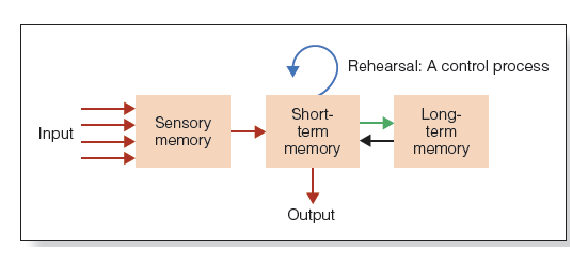
Modal of Memory
Memory Types:
Sensory Memory: initial stage that holds all incoming info for secs or fractions of a sec
Short-Term Memory: holds 5 to 7 items for about 15 to 20 secs
Long-Term Memory: can hold a large amount of info for years or even decades
Control Processes: active processes that can be controlled by the person
rehearsal (telephone number)
strategies used to make a stimulus more memorable
Is wrong
but has been useful in stimulating research
Control Processes
active processes that can be controlled by the person
rehearsal (telephone number)
strategies used to make a stimulus more memorable
Storage and Retrieval
Modal of Memory is Wrong

Short Term Memory
umbrella term; includes both of these types of memory:
Sensory memory: initial stage that holds all incoming info for secs or fractions of a sec
Working memory: limited-capcity system for temporary storage and manipulation of info
Sensory Memory
retention, for brief periods of time, of the effects of sensory stimulation
info decays very quickly
iconic memory
echoic memory
persistence of vision
Iconic Memory
brief sensory memory of things that we see
responsible for persistence of vision:
retention of the perception of light
trail of light from a moving sparkler
frames in film
Echoic Memory
brief sensory memory of things that we hear
responsible for persistence of sound
Persistence of Vision
retention of the perception of light
trail of light from a moving sparkler
frames in film
Sensory Memory Research
Sperling (1960) conducted some of earliest research in attempt to measuring the capacity & duration of sensory memory
array of letters flashed quickly on screen
participants asked to report as many as possible
Whole report method: participants asked to report as many as could be seen
avg of 4.5 out of 12 letters (37.5%)
Partial report method: participants heard tone that told them which row of letters to report (immediate tone)
avg of 3.3 out of 4 letters (82%)
participants could report any of th
Delayed partial report method: presentation of tone delayed for a fraction of a sec after letters were extinguished (delayed tone)
performance decreases rapidly
performance decrease is due to the rapid decay of iconic memory (sensory memory)
But Sperling’s experiment confounds sensory memory w/other types of memory (e.g., working memory)
To determine duration & capacity of sensory memory, need paradigms that isolate sensory memory
Whole Report Method
Partial Report Method
Delayed Partial Report Method
Sensory Memory Duration
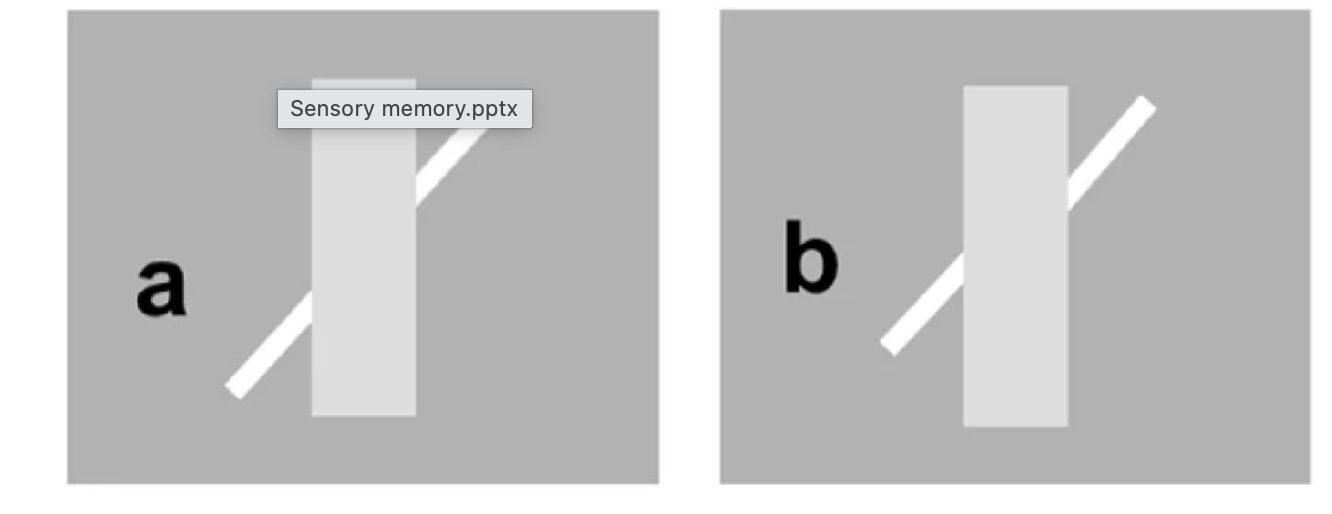
Sugita & colleagues studied sensory memory duration using perceptual illusions
In the following stimuli, most people perceive (a) w/the white lines separate, & (b) as a single white line behind a block
In fact, in (a) the white lines would connect to each other, but in (b) they wouldn’t
& the discontinuity of the lines in (b) is seen clearly when the block is absent
Working Memory
limited-capacity system for temporary storage & manipulation of info
important in language comprehension, learning, & reasoning
can include new sensory info as well as info recalled from long term memory
Working Memory Duration
Storage duration: 15-20 sec (w/ot rehersal or other controlled processes)
Working Memory Capacity
can be assessed in many ways
digit span: how many digits a person can remember
chunking: small units can be combined into larger meaningful units
Chunking
small units can be combined into larger meaningful units
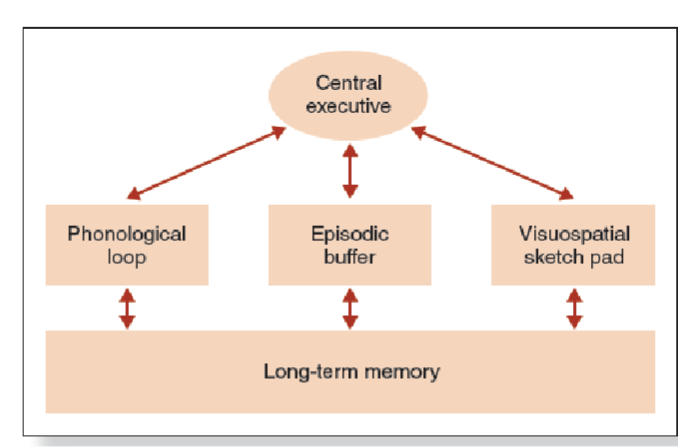
Phnonological Loop
verbal & auditory info
whnonological similarity effect
word length effect
articulatory suppression
Phnonological Similarity Effect
letters or words that sound similar are confused

Word Length Effect
memory for lists of words is better for short words than for long words
takes longer to rehearse long works & to produce them during recall
Articulatory Suppression
speaking prevents one from rehearsing items to be remembered
Visuospatial Sketch Pad
storage of visual images in the mind in the absence of a physical stimuli
can be studied w/a mental rotation task
trials that require greater rotations took longer
The Central Executive
acts as the attention controller (traffic cop)
focus, divide, switch attention
controls suppression of irrelevant info perseveration

Perseveration
repeatedly performing the same action or thought even if it’s not achieving the desired goal
The Episodic Buffer
backup store that communicates w/LTM & WM components
holds info longer & has greater capacity than phonological loop or visuospatial sketch pad
Baddelely’s Model in the Brain

Prefrontal Cortex
responsible for processing & controlling incoming info
damage to frontal lobe causes:
probs in controlling attention
difficulty w/working memory
Long Term Memory
archive of info about past events & knowledge learned
works closely with/working memory
storage stretches from a few moments to as far back as one can remember
more recent memories = more detailed
varies a lot in how detailed it is, in how much info you can retain over time

Primacy Effect
memory is better for stimuli presented at beginning of a list
more likely to remember 1st word, had more time to reherse it
why?
more time to rehearse info, more likely to enter long-term memory (LTM); tap into LTM
Recency Effect
memory is better for stimuli presented at end of a list
sometimes more likely to remember very last thing on list; not as strong; still active in STM
stimuli still in short-term memory (STM)
Serial Position Curve
primacy effect
recency effect

Coding in Long Term Memory
a mental approach to coding:
how is a stimulud or experience represented in the mind?
visual encoding
auditory encoding
semantic coding
Visual Encoding
visualizing a person or a place from the past
take info that we’ve gathered & generate mental images from it
ex: visualizing what the Lincoln Memorial in Washington D.C. looked like when you saw it last summer
Auditory Encoding
representing a sound (e.g., a song) you heard a long time ago
repeating a song you’ve heard many times before, over & over in your mind
Semantic Coding
the specific wording is forgotten (might not remember explicit details)
general meaning can be remembered for a long time
ex: recalling the general plot of a novel you read last week (Sachs)
Locating Memory in the Brain
Henry Molaison (HM) (bike accident, damaged something in head, after injury developed epilepsy)
Surgery removed bilateral MTL (both sides) (hippocampus; parahippocampal gyrus, perirhinal cortex)
Retained short-term memory & other cognitive abilities
No longer able to form long-term memories
EP
Virus damaged bilateral MTL (hippocampus; parahippocampal gyrus, perirhinal cortex)
Retained short-term memory & other cognitive abilities
No longer able to form long-term memories
KF
An accident damaged his parietal lobe (supramarginal & angular gyri)
Impaired STM (reduced digit span)
Functional LTM
Able to form & hold new memories

Hippocampus
doesn’t just support long-term memory
activity is greater when holding new info in working
memory
supports short & long term memory in the same way
how? binding of high-resolution, complex info
can be items & contexts, or high-resolution features within items
not just storing memory, maybe also relevant for supporting memory
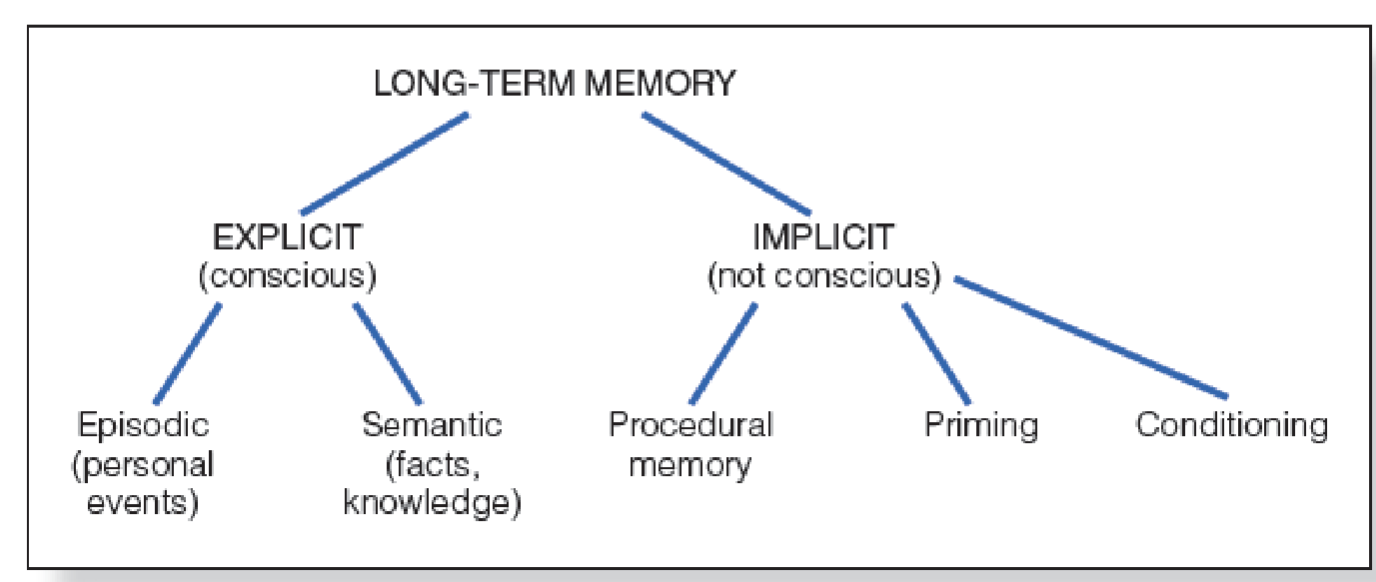
Types of Long Term Memory
typical conceptual divisions; Larry Squire’s model
Explicit (conscious) (consiously aware of) (have to think of but always there):
episodic (personal events)
semantic (facts, knowledge)
Implicit (not conscious) (don’t have to recall as use info):
procedural memory
priming
conditioning
Episodic Memory
involves mental time travel (episodes of your life)
tied to personal experience; remembering is reliving
“self-knowing”
memory for specific personal experiences, involving mental time travel back in time to achieve a feeling of reliving the experience
ex: I remember going to get coffee at Le Buzz yesterday morning & talking w/Gil & Mary about their bike trip
Semantic Memory
doesn’t involve mental time travel
general knowledge, facts
“knowing”
memory for facts
ex: there is a Starbucks down the road from Le Buzz
Separation of Episodic and Semantic Memories
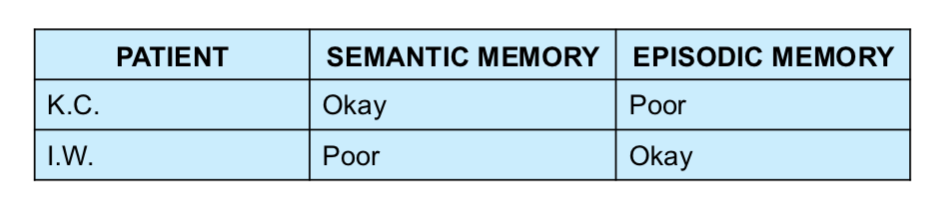
KC - damaged hippocampus
no episodic memory, can’t relive past events
semantic memory intact, can remember general info about the past
I.W (encephalitis)
impaired semantic memory
episodic memory intact, can remember past events & create new event memories
retrieving episodic & semantic memories activate diff areas of brain
Episodic and Semantic Memory Interaction
episodic can be lost, leaving only semantic
acquiring knowledge may start as episodic, but then “fade” to semantic
consolidated, rely less on hippocampus
alternatively, newer works suggest that multiple memory traces may be made at once (episodic = hippocampus; semantic = cortex)
semantic memories can be enhanced if associated w/episodic
autobiographical memory
personal semantic memory
Autobiographical Memory
specific experiences
includes semantic & episodic
ppls memories for experiences from their own life
memories have both episodic components (relived specific events) & semantic components (facts related to these events)
semantic components of it are personal semantic memories
ex: I met Gil & Mary at Le Buss yesterday morning; we sat at our favorite table near the window, which is often difficult to get in the morning when coffee shop is busy
Personal Semantic Memory
semantic memories that have personal significance
Types of Explicit Long-Term Memory
Episodic
Semantic
Autobiographical
How Time Affects Memories
Forgetting increases w/longer intervals after encoding
Forgetting is not an “all-or-nothing” process
familiarity: sense of knowing (“know”)
recollection: contextual details (“remember”)
Remember/Know procedure
contextual details get lost for memoties of long-ago events
Memory and the Future
Similar brain structures are involved in remembering the past & imagining the future!
constructive episodic simulation hypothesis
Constructive Episodic Simulation Hypothesis
episodic memories are extracted & recombined to create simulations of future events
helps us to anticipate future needs & guide future behaviors
Implicit Memory
occurs when learning from experience isn’t accompanied by conscious remembering
procedural memories
priming
conditioning
Procedural Memory
skill memory: memory for actions
no memory of where or when learned
perform procedures w/out being consciously aware of how to do them
ppl who can’t form new LTMs can still learn new skills
e.g. KC - stacking books at library
expert-induced amnesia
being “in the sone”
doesn’t require attention
Priming in Everyday Experience
Presentation of priming stimulus changes person’s response to a test stimulus
Propaganda effect
Involves implicit memory because it can occur when people aren’t aware of previously seeing or hearing statement
Implications for advertisement
Propaganda Effect
more likely to rate statements read or heard before as being true
Long-Term Memory Stages
Encoding:
acquiring info & transforming it into memory
where sensory memory is living
Retention:
period of time between encoding & retrieval
storing in the mind
where memory lives most of its life
Retrieval:
recalling or recognizing retained info encoded previously
when need info
act goes back into working memory

Getting Information into Long Term Memory
Various strategies can enhance memory encoding, which provide clues as to how memory encoding happens
Maintenance rehearsal
Repetition of stimuli that maintains info
But results in poor memory (low transfer to LTM)
Not necessarily gonna keep info in your mind
Elaborative rehearsal
Using meanings & connections to help transfer info to LTM
Encoding info that we tie to other things, link to other pieces of info
Levels of Processing Theory
Memory depends on how info is encoded
Depth of processing
Shallow processing
little attention to meaning
focus on physical features
poor memory
Deep processing
close attention to meaning; attach meaning
better memory, stronger capacity to remember
Other Factors That Aid Encoding
Visual imagery
paired-associates learning
tie 2 things together, force a mental image into someone’s head
Self-reference effect
Self > Common'
think about if word describes you
when think about self, more likely to think words were common
Generation effect
Read group: give bunch of words, pairings, remember overtime
Generate group: fill in blank w/word that is related to 1st word
spend extra time, more likely to recall words
more effort into forming associations = stronger gonna stick
Organizing to-be-remembered info
Words within categories can serve as retrieval cues
Retrieval practice
Testing memory can result in better memory!
Presented difficult-to-comprehend info
Having a mental framework of comprehension aided memory encoding & retrieval
Intentional Encoding
Trying to remember something
Trying to store all of the info
Incidental Encoding
Not trying to remember something
Capture info we don’t care to remember
Does Trying to Remember Something Help You Remember It?
Yes & no
You’ll generally remember things better if you try to remember them than if you don’t (intentional encoding)
But this is due to differences in levels of processing
If make semantic judgments about incidentally encoded info (processing it on the level of meaning)
then remember that info just as well as (& sometimes even better than) info intentionally encoded
accidentally taps into deeper level of processing
Effective Studying
Strategies that help w/transferring info into long-term memory:
Elaborate
Relating to other things that you know
Think through meaning of it
Generate & Test
Make up questions yourself
Generate more meaning
Organize
Create a framework, make the material meaningful
Take Breaks
Don’t cram!
Avoid “illusion of learning”
Fluency doesn’t = learning
Be an “active” note-taker!
Computer note-taking results in more shallow processing & poorer performance on exams
More likely to simply transcribe
Consolidation
Transforms new memories from fragile state to more permanent state
Synaptic consolidation
rapid (minutes to hours)
structural changes of the synapses
Systems consolidation
gradual (months to years)
reorganization of neural circuits
Synaptic Consolidation
Learning & memory represented in the brain by physiological changes at the synapse
Neural record of experience
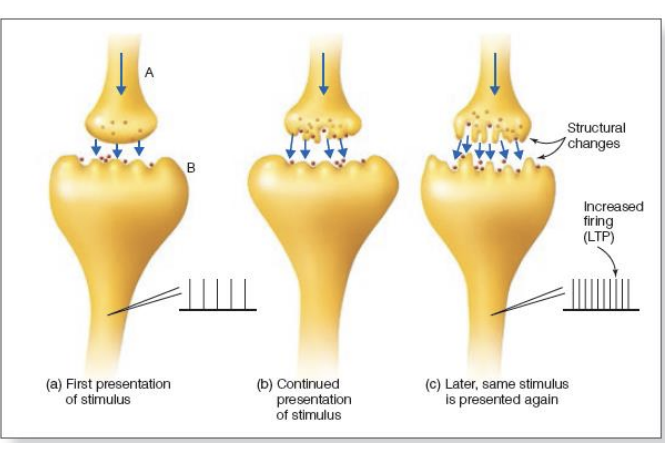
Long-term potentiation (LTP)
Enhanced firing of neurons after repeated stimulation
Structural changes & enhanced responding
At synapse:
(a) stimulus is presented for the 1st time
(b) stimulus is presented repeatedly
(c) structural changes occurred (learning) → increase in firing rate
more you activate certain brain cells overtime, the more likely they are to strengthen their ability to communicate
Glucocorticoids (e.g., cortisol) & norepinephrine enhance this
under stress more likely to remember neg images
under stress diff things are getting consolidated
things that are threatening/unhappy, more likely to be stored
Reconsolidation
When the memory is retrieved, it becomes fragile
Remember differently overtime
Similar to when it was originally formed
It needs to be this
Reactivating a memory can open it to being changed!
Can damage memory integrity
Consolidation and Sleep
Memory consolidation appears to be enhanced during sleep
Especially shortly after
Strongest reconsolidation effects
1 reason: sleeping stops interference from environmental stimuli
Some memories are consolidated more than others
Memory for a task in 1 study was stronger when participants expected to be tested after awaking
Systems Consolidation
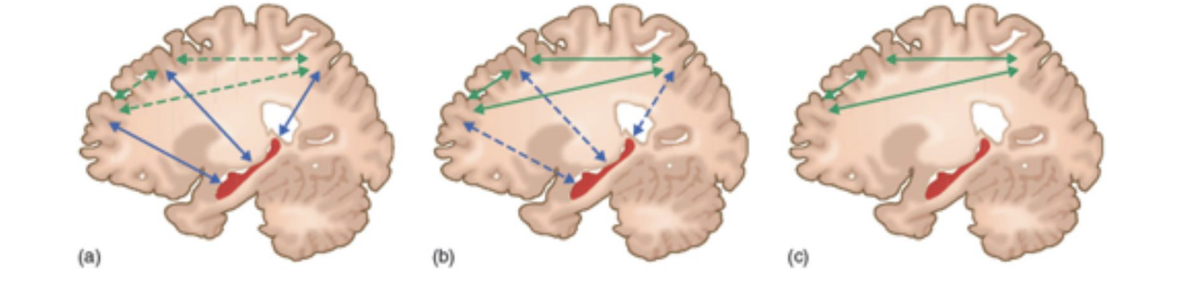
Standard model:
(a) Connections between the cortex & the hippocampus (blue) are initially strong & connections between cortical areas are weak (dashed green)
(b) As time passes, connections between the hippocampus & cortex weaken (dashed blue) & connections between cortical areas become stronger (green)
(c) Eventually, only intercortical connections remain
Systems Consolidation & Amnesia
Systems consolidation is the typical explanation for patterns of amnesia
Patients whose hippocampi are removed or damaged are famously able to remember remote memories better than recent memories
Systems consolidation argues that this is bc the hippocampus is heavily involved in recent memory, but, over time, memories are moved from the hippocampus to the cortex
Memories are the largest thing in our brain
no 1 brain region can be responsible for holding all of it, consolidate across regions
Does Systems Consolidation Occur?
Graded retrograde amnesia damage is less common in hippocampus damage than thought
In fact, it almost never occurs for memories dependent upon the hippocampus
Instead, it usually occurs for semantic (non-hippocampus) memories in cases of hippocampus damage
Studies w/healthy participants rarely find that the hippocampus is more active for recent than remote memories, though this is a crucial prediction of systems consolidation
79% of studies do not find the pattern that systems consolidation predicts!
Contextual Binding Theory
New theory that explains memory data well
Posits that the hippocampus and cortex support different types of memory rather than the same memories at different times
Explains all memory data that systems consolidation explains & more
Systems Consolidation & Contextual Binding
Support for systems consolidation is weaker than often assumed
Contextual binding theory of memory can account for data that are usually taken to support systems consolidation, as well as data that systems consolidation can’t explain
Memories formed by the hippocampus appear to stay in the hippocampus, & memories formed by the cortex (e.g., semantic memories) appear to stay in the cortex
Retrieval Long Term Memory
(Consciously) remembering information stored in long-term memory
Types:
Recognition
Recall
Recognition
Retrieval in the presence of the stimulus to be remembered
directly have thing infront of you that youre try to remember
No search; memory is supported by pattern separation & pattern completion processes
2 Processes:
Familiarity: confidence-based sense of knowing (can be 100% confident)
Recollection: threshold process w/contextual details
pulling actual details together
Recall
Retrieval in the absence of the stimulus to be remembered
don’t have thing trying to remember infront of you
Involves a search process for info, followed by pattern separation & pattern completion processes
pattern completion: think through what’s missing
Types
Cued: Presence of a retrieval cue
“remember name of your first grade teacher”
give exact thing to pull from; looking for specific thing
Free: Absence of a retrieval cue
“tell me about your first day of college”
generate a lot of info; bigger & broader
Retrieval Cue
Any stimuli that helps access info stored in long-term memory
Aid in recall
Most effective when created by the person who uses them
Generate own info to remember things
Encoding Specificity Principle
We learn info together w/its context
“Diving experiment”
Given list of words to remember; either learned while sitting in lab or while scuba diving
Best recall occurred when encoding & retrieval occurred in the same location
“Studying experiment”
Study in room thats very loud vs very quiet
Best recall occurred when encoding & retrieval occurred under the same conditions
Memory performance seems to depend at least slightly on location
State-Dependent Learning
Learning is associated w/a particular internal state
Happy or sad
Better memory if person’s mood at encoding matches mood during retrieval
Better memory for things learned while drunk if drunk!
Stress and Memory Retrieval
Stress impairs memory retrieval
Made recall worse; harder to remember things when stressed out
This effect is stronger for pos & neg info than neutral info
Suggests that memory retrieval of emotional info operates through at least partly different mechanisms from retrieval of neutral info!
Timing of stress really matters (make a diff in what find)